
What is a binary option?
A binary option is a financial instrument that allows an investor to make a prediction about two possible outcomes for a particular asset (cryptocurrency, fiat currency stock or commodity) in a given period of time. The outcomes can be of two types: "payout" or "loss." If the investor or trader correctly predicts the direction of the asset's price movement, he or she receives a fixed payout, otherwise he or she loses his or her entire investment.
For example, suppose an investor bets in a binary option on a rise in the price of gold from $1,840 to $1,850 within the next hour. Assuming at the end of the hour the price of gold does indeed rise to $1,850, the investor receives a payout, which is predetermined. However, if the price of gold remains at the same level or declines, the investor loses all of the money invested in the option.
The main advantage (and disadvantage) of binary options is their simplicity and clarity. An investor does not need to predict the exact price of an asset, only its direction (up or down). This makes binary options clear and accessible even for beginners - that is a plus. But guessing the direction of price movement in the short term is quite difficult - that's a minus.
A Note on Regulatory Context
Binary options trading is currently restricted or prohibited for retail traders in the United States (CFTC), European Union (ESMA), and United Kingdom (FCA). This article addresses software development for licensed brokers operating in permitted jurisdictions — Southeast Asia, Latin America, parts of the Middle East and Africa, where binary options platforms operate legally under local financial regulation.
If you are evaluating binary options software for your brokerage, understanding your target jurisdiction's regulatory framework is step one, before any development decision. We cover this in the Legal & Licensing section below.
How a binary options platform works?
A binary options platform is a website or mobile application that allows traders to trade binary options. Typically, traders register on the platform, select assets and option types, set trading parameters and place trades. The platform tracks asset prices, determines trade results and pays out profits or deducts losses. Binary options platforms may have some features, both at the frontend and backend level. Moreover, these features may vary depending on the specific binary options business model, market and target audience.
- Marketplace. Developers need to be careful about the specifics of each market in which binary options are traded. For example, there are forex markets, commodity markets, stock markets, index markets, etc. Each market has its own characteristics such as liquidity, volatility, trends, news, etc. Developers must ensure proper data acquisition and processing and adapt algorithms to market specifics.
- Option type. Developers must also know the basic logic and mathematical model of each option type, as well as its features. For example, there are options up/down, touch/no-touch, in/out, ladder/ladder, etc. Each option type has its own characteristics, such as closing time, strike price, payout. Developers must ensure that these parameters are correctly calculated and validated for each option type.
- Platform specifics. Different trading platforms may have different interfaces, features, analysis tools, option types, regulation, and more. For example, Nadex is a fully regulated trading exchange. Raceoption offers access to over 100 stocks, commodities, currencies and cryptocurrencies. Binary.com makes trading simple for beginners, but also offers more sophisticated platforms for experienced traders.
- Target audience. Developers must also consider the needs and interests of their target audience, as well as their level of knowledge and experience in binary options trading. For example, beginners may need more educational materials, tips, signals, simple interfaces, etc. Meanwhile, experienced traders may need more functionality, flexibility, sophistication, tools, etc.
How to develop software for binary options trading?
Binary options trading software development is a complex and multifaceted process that requires attention to detail and specialized knowledge. In this section, we will cover the key steps and tips on how to develop binary options trading software - from requirements analysis and functionality design to programming, testing and optimization. And each step plays an important role in creating a reliable and high-performance system for successful binary options trading.
Market research on binary options
Market research is an important step in the development of binary options trading software. It makes it possible to determine the target audience or market segment on which to focus their efforts. In addition, market analysis will help developers gain an understanding of the peculiarities and requirements of this specific market, which will allow them to create more effective and customized software.
Here are some important aspects to consider:
- Needs and requirements analysis. Market research allows you to identify the needs and requirements of traders and investors who would like to use binary options trading software. It is important to understand what functionality and tools are most in demand, what types of options are popular and what limitations current software solutions on the market may have.
- Competitive Advantage Identification. Market analysis also allows developers to study existing software solutions for binary options trading and identify their advantages and disadvantages. This will allow them to identify their competitive advantages and find their unique opportunities to attract users. For example, unmet traders' needs and gaps in functionality can be found which can be filled with a new software product.
Defining platform requirements and functionality
In this step, binary options developers go through the stage of defining functional requirements, such as option types, trading strategies and analysis tools, as well as establishing non-functional requirements related to performance, security, interface and other aspects of the program. This helps developers create a binary options platform that better meets the needs of users and ensures a successful implementation in the binary options market.
Here is a list of the main features of a binary options platform:
- Registration. Provides traders and investors with the ability to create an account and access the functionality of the platform. When developing this feature, it is important to consider the convenience and simplicity of the registration process, which includes entering the necessary personal data and setting a secure password. It is important to include verification and confirmation of email or phone number to confirm the user's identity. If you are creating a non-custodial platform for trading cryptocurrency binary options, the registration process should take place through the connection of a cryptocurrency wallet.

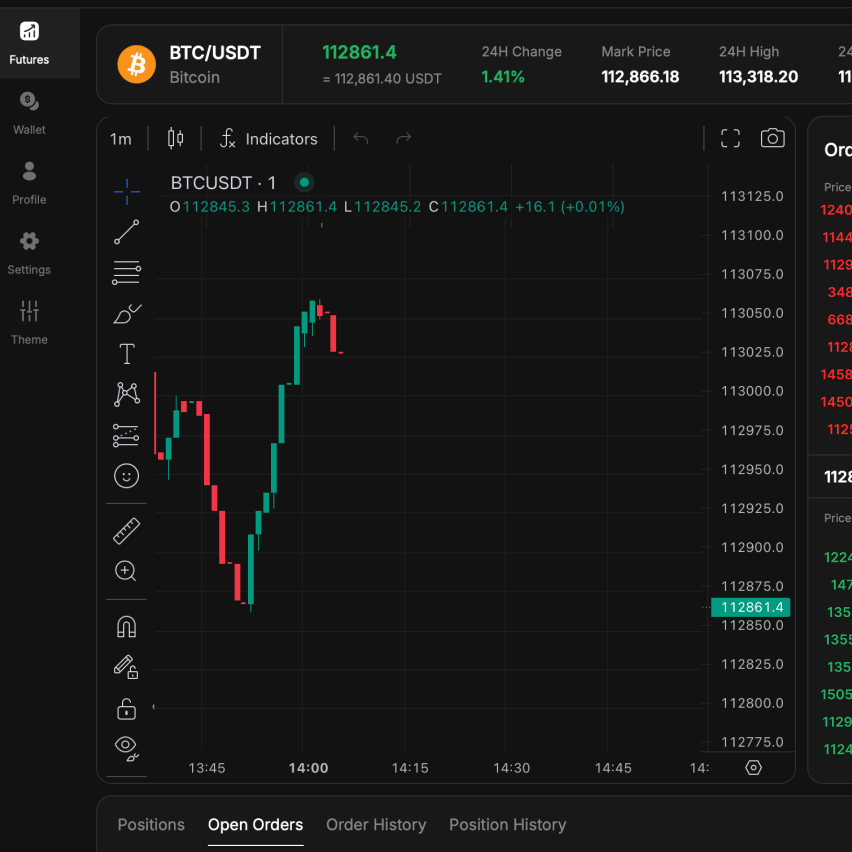
Charts and analytics. Provide users with important tools to analyze the market and make informed decisions. When developing this feature, traders should be provided with access to different types of charts that include price data and trading volumes as well as a wide range of technical indicators and analytical tools for in-depth and thorough study of market dynamics. Particular attention should be paid to the usability and visual appeal of the charts to provide traders with an intuitive and efficient user interface for market analysis.

From our professional trading platform work. Standard TradingView integration — the free embed available to anyone — gives you basic candlestick charts, common timeframes (1m, 5m, 15m, 1h, 1d), and limited indicators. That's sufficient for a beginner-oriented platform.
Trading Tools. This feature provides traders and investors with a wide range of tools and options for successful binary options trading. When designing trading tools, you need to provide different types of options (up/down, touch/no-touch, in/out, ladder/ladder) as well as a variety of expiration types that allow traders the flexibility to adapt their strategies. In addition, it is important to provide additional features such as a sell before expiry or an early close feature to complement the trader's toolbox. Quality trading tools provide simplicity, flexibility, convenience and the ability to apply different strategies on a binary options platform.

Supported markets. The support of various financial markets on a trading platform empowers investors and allows them to diversify their portfolios. Therefore, when developing binary options trading software, it is necessary to provide users with access to a variety of financial instruments, such as fiat pairs, cryptocurrencies, stocks, indices, commodities on a forex trading software. In addition, it is important to ensure that data about prices, volatility and other things related to each market is up-to-date and reliable.

Educational Resources. It is necessary to provide a variety of materials when developing this feature, including video lessons, articles, tutorials, interactive courses and instructions that will help users understand the basics of binary options trading and familiarize them with the most popular strategies and market analysis tools. In addition, it is important to provide traders with access to demo accounts where they can practice without the risk of losing real money. Quality educational resources help traders to develop their skills, expand their knowledge and increase their success in the market.

Mobile App. Many trading platforms offer a mobile app that allows you to trading platform software on smartphones or tablets, providing accessibility to the market anytime, anywhere. When developing this feature, you need to create an intuitive interface that allows traders to view market data, place trades, manage open positions and receive real-time alerts on important market events. In addition, the mobile app needs to keep traders' data safe and secure, as well as keep information synchronized between the app and the web version of the platform.

Risk management. Your platform should also provide risk management tools to enable traders to control their investments. You should provide tools to help traders identify and limit their losses, set stop-losses and take-profits, and apply other risk management strategies. It is also important to provide access to up-to-date information about market volatility, statistical indicators and other factors that may affect trading risks.
Payment Gateway. You must provide users with a variety of options for deposits and withdrawals. Thus it is necessary to provide reliability and protection of financial operations, using modern technologies of encryption and safety protocols. You must also provide investors with convenient tools to track and control their financial transactions, including transaction history and the ability to manage their account.
Demo account. To launch this feature, it is necessary to create a virtual environment that reflects real market conditions and allows traders to try out different strategies and trading methods. A demo account can be integrated with educational resources to provide traders with additional support and guidance as they learn to trade options.
Affiliate Program. Most binary options development vendors describe the affiliate program as a single line item. In practice, a serious affiliate system is a separate product — and the quality of that product directly determines your ability to acquire professional affiliate traffic.
This matters for one business reason: professional affiliates who drive real trading volume choose platforms based on the quality of their tracking and reporting. If your affiliate dashboard can't tell them their FTD conversion rate by traffic source, they'll use a competitor that can.
Software architecture development
There are a number of key aspects to consider when developing a software architecture for binary options trading. First, the architecture should be modular and extensible to allow the easy addition of new features and the integration of third-party services and applications. Secondly, it should be flexible in order to take into account different types of options, trading strategies and the requirements of different markets. In addition, an important aspect of the architecture is to ensure high performance and security of the system.
It includes optimization of work with data, providing the lowest possible latency when executing trading operations, using the most advanced encryption methods, authentication and access control mechanisms.
- Client interface. This is the user interface through which traders will interact with the platform. It should be intuitive, functional and have all the features for easy management of trading operations, opening and closing positions, viewing charts and analytics, as well as access to a demo account and other resources.
- Platform Trading Engine. This is the central component of your platform, responsible for processing and executing trading operations. It must support different types of binary options white label, provide real-time access to key market data and ensure reliable order execution and position management.
- Backend Server. This is the server part of the system, which is responsible for handling customer requests, interacting with the database, authorizing and authenticating users, as well as processing payments and managing traders' accounts. The backend server must be scalable, secure and provide the high performance of the platform.
- API. Your binary options trading platform should be able to integrate with various third-party services such as payment gateways, liquidity providers, analytical tools, etc. This will expand the functionality of the white label trading platform and provide traders with a wider range of options.
| Layer | Component | Technology |
| Frontend | Trading interface, charts | React.js / Vue.js + TradingView widget |
| Mobile | iOS + Android apps | React Native or native Swift/Kotlin |
| Backend | API, business logic | Node.js / Python (microservices) |
| Database | User data, transaction history | MySQL / PostgreSQL |
| Cache / Queue | Real-time rate feeds, session state | Redis |
| Message bus | Service-to-service events | Kafka / RabbitMQ |
| Trading engine | Option pricing, expiry, settlement | Custom Go / C++ service |
| Market maker | Synthetic price generation | Custom service, per-pair configuration |
| Payment | Deposits / withdrawals | Perfect Money, NowPayments + crypto nodes |
| Crypto nodes | BTC, ETH, TRX, BSC, USDT | Self-hosted full nodes |
| KYC | Identity verification | SumSub / manual document upload |
| 2FA / Auth | Google Authenticator, SMS | TOTP + Twilio / SMTP |
| Monitoring | Operational alerts | Telegram / Slack bot integration |
| Infrastructure | Deployment, scaling | Docker + dedicated server or cloud VPS |
In our binary options platform deployments, we use microservices architecture throughout. The trading engine, market maker, payment processor, and affiliate system run as separate services — a failure in one doesn't cascade to others. This also enables independent scaling: if trading volume spikes, you scale the trading engine pods without touching the affiliate system. The admin panel, user interface, and trading logic are physically separated at the service level, which also simplifies compliance audits.
Development of binary options trading algorithms
The next step is to build the binary options trading protocols, which define the rules of interaction between traders and the stock trading software, as well as ensure the speed, security and reliability of the trades. Various aspects must be taken into consideration, such as the communication between the client applications and the servers, the handling of requests to buy and sell options, user authentication, account (wallet) and transaction management, as well as the processing and transmission of market data.
Developing binary options trading protocols requires a deep understanding of networking technologies, data transmission protocols and security systems. Additionally, testing and verification must also be considered. Binary options trading protocols need to be tested for functionality, stability, scalability, and resilience to various types of stress. Also, different usage scenarios and possible errors or anomalies in the operation of the protocols should be taken into account.
User interface development
The user interface plays a key role in attracting and retaining users by providing a user-friendly and intuitive trading experience. It includes graphical elements such as buttons, input fields, selection lists, and charts that show current prices, trends, and more. In addition, it is also important to consider the effective use of color schemes and typography to highlight important design elements and make information easier to understand.
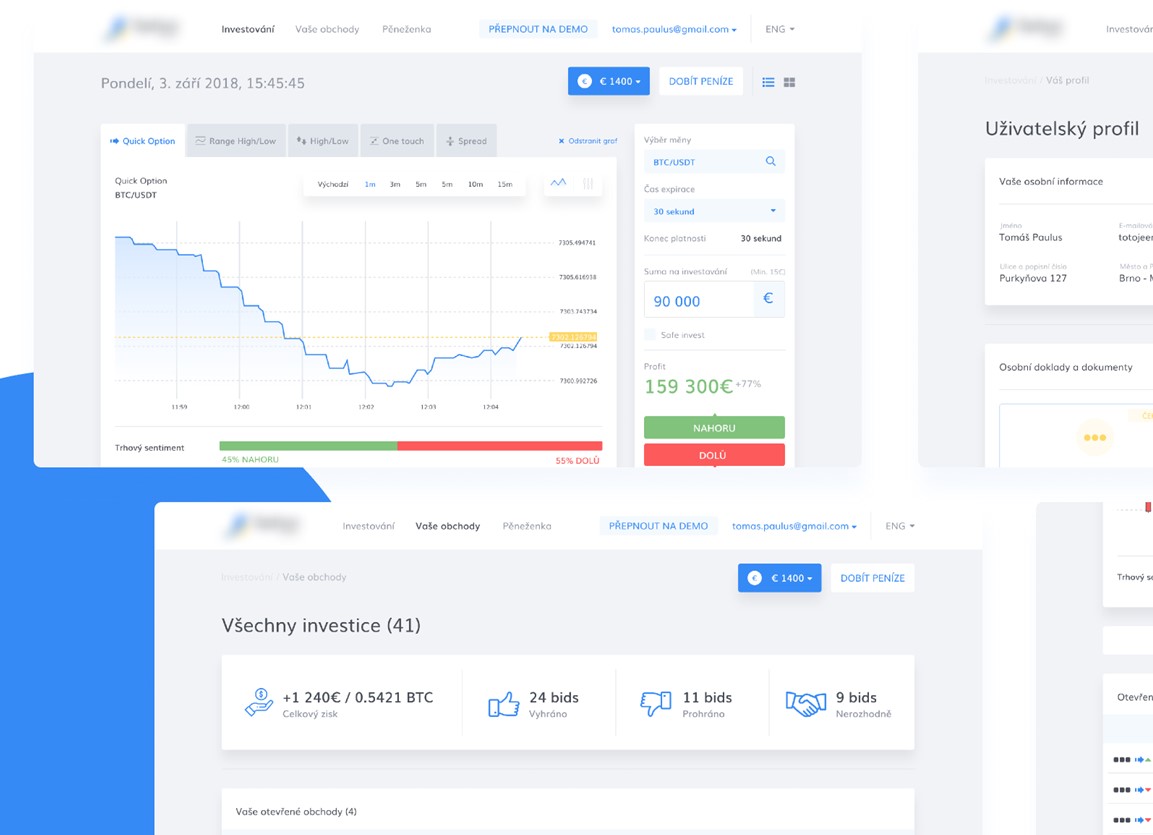
Interface design development takes place in several stages:
- Creation of the concept. Based on an analysis of the market and the target audience is developed interface concept, which includes the overall structure, the arrangement of elements, color palette and typography.
- Prototyping the design. Next, we create a prototype of the interface, which is an animated layout with the main elements and functionality. It allows you to test the interface and get feedback from users or stakeholders. Based on this feedback, further improvements and adjustments occur.
- Graphic design development. The next step is the development of the visual style of the interface, which includes design elements such as buttons, icons, graphics, and backgrounds. A single visually appealing design is created that matches the Tone of voice.
Frontend, backend and API implementation
The next stage of binary options trading software development involves implementing the frontend, backend and API in the code. Frontend development includes interface creation, visualization, interaction with the user through interactive elements and user actions processing. Various languages and technologies such as HTML, CSS, JavaScript and frameworks or libraries are used here to create dynamic and responsive user interfaces.
Backend programming involves creating the server side of the platform, which is responsible for processing user requests, executing business logic and interacting with the database. Languages used here include Python, Java, or C#, as well as frameworks and tools for developing server-side logic.
An API (Application Programming Interface) implementation defines available methods, parameters and data formats for exchanging information with other applications or services. Developers create and document the API to ensure that it is functional, secure, and compliant with communication standards.
All of these components - frontend, backend, and API - are closely linked to ensure the functionality and performance of the platform.
Here is a sample technology stack for developing a binary options platform.

Testing and debugging of the product
At the final stage of binary options trading software development, the created product is tested. Functionality, performance and security of the system are tested. This helps to detect and correct errors in the system as well as check compliance with the requirements and expectations of the users. Testing and debugging results play an important role in ensuring the quality and reliability of the platform, which is a key factor for the success of a trading platform and meeting the demands and needs of users.
Market Maker Engine: Why Your Platform Needs One
Most binary options platforms support forex pairs — EURUSD, GBPUSD, USDJPY, and others. These pairs have one problem: they don't trade on weekends. Real markets are closed Saturday and Sunday.
For a binary options platform targeting high engagement, this means your most active users hit a dead stop for 48 hours every week. A market maker engine solves this.
From our development experience
We've built market maker modules that generate synthetic price movement for forex pairs during non-trading hours. The admin panel configures the parameters per pair: movement frequency, volatility amplitude, direction bias. The system generates price data that follows realistic statistical distributions — not obviously artificial movement that experienced traders would immediately identify as fake.
The result: the platform remains fully tradable 24/7. Users on Saturday afternoon can still trade EURUSD. Crypto pairs, which trade continuously anyway, don't need this — but for a platform with serious forex coverage, a market maker engine is the difference between 5-day and 7-day revenue.
The admin can switch any pair between live market data and market maker mode independently. If markets are open but you want to test configurations, you can switch to market maker without affecting other pairs.
White Label vs Custom: Which Binary Options Software Model Is Right for You?
| White Label (Rebranding) | White Label (Extended) | Custom Build | |
| Timeline | 1–2 weeks | 1–2 months | 3–5 months |
| Cost | From $15,000 | $25,000–$60,000 | $80,000–$200,000 |
| Customization | Logo, colors, domain | + features, payment gateways | Full architecture control |
| Risk | Near zero | Low | Medium (testing critical) |
| Markets | Forex + Crypto (pre-set) | Forex + Crypto + configurable | Any market, custom assets |
| Proven base | Yes (production-tested) | Yes | Requires full QA |
| Best for | Fast market entry | Balanced speed + control | Unique product vision |
From our deployment experience
Cost of launching a binary option platform
The cost of developing binary options largely depends on the need to implement key functions and elements. For example, the chart is the most complex and very important component. Many companies keep a staff of front-end developers to draw unique bars and lines. But on the other hand, you can use ready-made solutions with a huge range of functions, such as Tradingview. The minimum cost of developing binary options will be about $40,000. More complex solutions with a demo account, a well-thought-out referral program, a robot for trading on weekends, will be about $60,000 - $80,000.
Legal features of launching a binary options platform
Following legal regulations is extremely important for the long-term and safe operation of a binary trading platform. It is important to consider such key points while launching the application:
- obtain a binary option broker license - this is a complex procedure that includes assessing regulations in the financial markets of the US, EU, UK and Asian region, submitting applications to regional regulatory organizations, passing inspection and compliance with the requirements of controlling bodies, exercising rights and obligations to clients;
- comply with the limits and thresholds of financial indicators, ensure regular verification of biometric data of top managers and founders;
- comply with the regulations of the main regulatory bodies, namely CySec, FCA, ASIC, DFS, FSC;
- engage experts to analyze the broker's activities in the context of market dynamics and constant legal updates.
Conclusion
In order to launch a platform for binary trading, it is important not only to take care of the software development, but also to plan carefully the organization of the entire work of the product, complying with the norms of international law. Based on the specifics of the industry and the client's personal needs, our company offers turnkey development of binary options trading applications.