×
Services
Exchange & Trading Infrastructure
DeFi & Web3 Core
NFT Ecosystem & Multi-Chain
Tokenization & Fundraising
Crypto Banking & Fintech
AI Development
Custom Development
Exchange & Trading Infrastructure
Create a centralized crypto exchange (spot, margin and futures trading)
Decentralized Exchange
Development of decentralized exchanges based on smart contracts
Stock Trading App
Build Secure, Compliant Stock Trading Apps for Real-World Brokerage Operations
Custom Trading Software
We build proprietary trading systems from the order management layer to the signal engine
P2P Crypto Exchange
Build a P2P crypto exchange based on a flexible escrow system
Centralized Exchange
Build Secure, High-Performance Centralized Crypto Exchanges
Crypto Trading Bot
Build Reliable Crypto Trading Bots with Real Risk Controls
Crypto Launchpad Development
Build crypto launchpad platforms that handle the full token launch lifecycle
DeFi & Web3 Core
Web3 Development
Build Production-Ready Web3 Products with Secure Architecture
Web3 App Development
Build Web3 Mobile and Web Apps with Embedded Wallets and Token Mechanics
DeFi Wallet Development
Scale with DeFi Wallet Development: from DEX and lending to staking systems
DeFi Lending and Borrowing Platform
Build DeFi Lending Protocols — Overcollateralized Pools, Flash Loans, and Credit Delegation
DeFi Platform Development
Build DeFi projects from DEX and lending platforms to staking solutions
DeFi Exchange Development
Build DeFi Exchanges — AMM, Order Book, Aggregator, and Hybrid Protocols
DeFi Lottery Platform
Build DeFi Lottery Platforms — Provably Fair Jackpots, No-Loss Savings, and NFT Raffle Protocols
DeFi Yield Farming
Build DeFi yield farming platforms with sustainable emission models and multi-protocol yield aggregation
NFT Ecosystem & Multi-Chain
NFT Marketplace Development
Build NFT marketplaces from minting and listing to auctions and launchpads
NFT Music Marketplace
Build NFT music marketplaces where artists mint, sell, and license music as tokens
NFT Wallet Development
Build non-custodial NFT wallets with multi-chain asset support, smart contract integration
NFT Launchpad Development
Build NFT launchpads where projects raise capital, mint tokens, and onboard communities
Tokenization & Fundraising
Real Estate Tokenization
Real estate tokenization for private investors or automated property tokenization marketplaces
Crypto Banking & Fintech
Build crypto banking platforms with wallets, compliance, fiat rails, and payment services
Build Secure Crypto Wallet Apps with a Production-Ready Custody Model
Crypto Payment Gateway
Create a crypto payment gateway with the installation of your nodes
Mobile Banking App
We build secure, regulation-ready mobile banking applications for fintech startups and financial institutions
AI Development
AI Development
We build production-ready AI systems that automate workflows, improve decisions, and scale
LLM Development Company
We design and build production-grade large language model solutions
Enterprise AI Development
We build enterprise AI systems - agents, LLM integration, and predictive analytics
AI Chatbot Development
We build AI chatbots powered by LLM agents, RAG pipelines, and multi-agent orchestration
Custom Development
CRM Software Development
We build custom CRM systems from scratch — multi-role architecture, automated workflows
Marketplace Development
We build two-sided marketplaces from scratch — with multi-role architecture and payment escrow

  AMM-Based Trading

Decentralized Exchange Development Company

Merehead is a decentralized exchange development company building non-custodial trading protocols end-to-end: architecture, smart contracts, Web3 frontend, liquidity integrations, security testing and mainnet launch. Our decentralized exchange development services cover AMM protocols, order book venues, cross-chain routing and perpetual futures modules.


130+ projects
Experience
since 2015
Experience
blockchain expert
image

  Services

Decentralized Exchange Development Services

Six delivery areas that cover a decentralized exchange from on-chain core to production launch. Each one reflects work we have shipped, not a catalogue of everything the category contains.

01

Custom Decentralized Exchange Development

End-to-end development of a decentralized exchange built around your business model, target chains and protocol strategy. We start from the trading model rather than the interface: how price is formed, where liquidity comes from, and what has to be enforced on-chain versus what can live off-chain. That decision shapes contract design, gas profile and the operational cost of running the venue, so it is made before any code is written.
02

AMM Protocol Development

Automated market maker protocols with pool mechanics, LP token accounting, fee distribution and slippage control encoded in smart contracts. We have integrated Uniswap V2 and V3 as the liquidity layer, implementing swap flows with configurable slippage tolerance and minimum-received calculation, plus a complete pool lifecycle: create, add liquidity, remove by percentage, share-of-pool display and top pools ranked by trading volume.
03

Perpetual Futures DEX Development

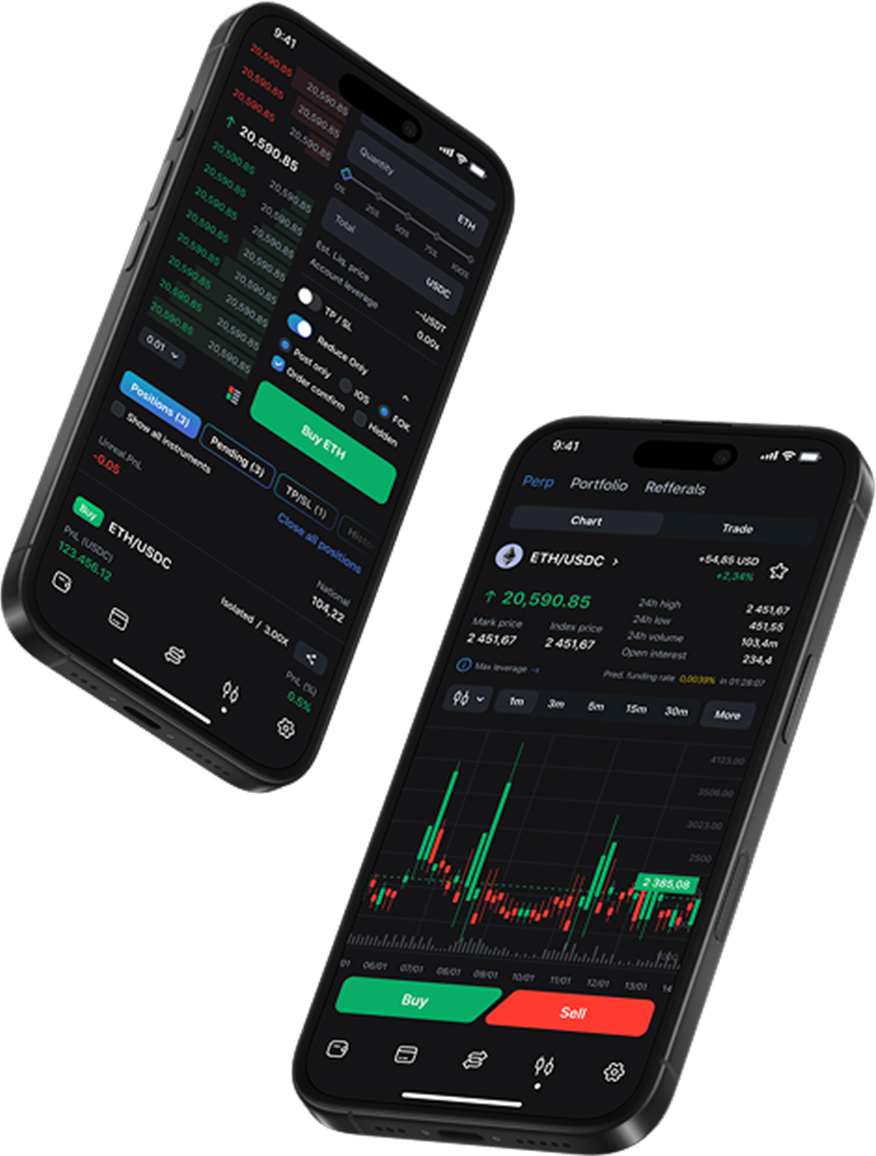
Perpetual trading modules built on purpose-built perp infrastructure. We have delivered order placement, position management and funding rate handling through HyperLiquid's API, with TradingView charting, a full order book, limit, market and stop-limit order types, take-profit and stop-loss orders, cross and isolated margin modes and leverage selection — packaged as a module inside an existing non-custodial application.
04

Cross-Chain DEX Development

Cross-chain swap routing that moves value between networks without wrapping assets. On THORChain-based builds we work with the protocol's AMM pools through XChainJS, tuning gas, slippage and pool depth, and we have combined arbitrage and AMM logic where the economics of a single approach were not sufficient. Multi-network monitoring and unified liquidity views are part of the delivery.
05

Hybrid DEX with Aggregated Liquidity

A non-custodial trading experience backed by external liquidity, for teams launching without market makers or an order book of their own. We have built venues where users authenticate through MetaMask and deposit to generated buffer wallets, while execution routes through exchange APIs with a switchable source — reducing time-to-market and allowing a gradual migration to proprietary liquidity later.
06

Smart Contract Development and Security Testing
Solidity and Rust contracts for swaps, pools, fee logic, staking and governance, written to be readable and audit-ready. Testing combines Slither, Mythril and Echidna automated analysis with manual line-by-line review, targeting reentrancy, price manipulation, oracle failure and logic flaws. We support third-party audit preparation; we do not issue formal audit certifications ourselves.
07

  About

What Is a Decentralized Exchange?

A decentralized exchange is a peer-to-peer venue where users trade directly from their own wallets through smart contracts, without transferring custody to an operator. Every trade settles on-chain and is independently verifiable, which removes the counterparty risk that comes with centralized fund management.
Modern platforms have moved well beyond simple swaps. Automated market maker algorithms and on-chain order books provide continuous liquidity without a traditional market maker, while concentrated liquidity, cross-chain routing and perpetual derivatives have made decentralized venues competitive with centralized ones on both depth and execution speed.
For a business, the practical question is not what a decentralized exchange is but which model to build. That decision — AMM, order book, cross-chain, hybrid or perpetuals — determines your liquidity strategy, your regulatory exposure and your cost structure, and it is difficult to change after launch. The sections below cover the models we build and how we select between them.
1/3

  Our Process

Decentralized Exchange Development Process

Our workflow for building secure, scalable, non-custodial decentralized exchanges

Step 01
Business Analysis and Model Selection
We define the trading model, revenue mechanics and regulatory position before touching architecture. Which of the five models fits your market, what liquidity you can realistically access, and what has to run on-chain — these answers constrain everything downstream. next step
Step 02
Infrastructure Benchmarking and Chain Selection
We benchmark the base infrastructure against your requirements. On perpetual DEX projects we compared dYdX v4's sovereign AppChain, GMX's EVM contracts and HyperLiquid's API — selecting on liquidity depth, latency and the operational independence the client actually needed. Node provisioning starts here, in week one. next step
Step 03
Architecture and UI/UX Design
We design the system and the interface together, because trading UX is a function of execution mechanics. Slippage display, confirmation flows and pool previews are architectural decisions, not screens drawn afterwards. next step
Step 04
Smart Contract Development
We build the on-chain core: AMM pricing curves, pool mechanics, fee distribution and governance rules encoded in Solidity or Rust. Every swap and payout rule lives on-chain — transparent, auditable and impossible for any operator to alter off-chain. next step
Step 05
Platform and Trade Execution Development
We build execution as deployed contracts running atomic swaps. For perpetual modules we add limit, market and stop-limit orders, TP/SL and cross/isolated margin — complete trading logic with no manual operator in the loop. next step
Step 06
Liquidity and Web3 Integrations
We wire the liquidity layer: pools, LP tokens and continuous fee accrual. On THORChain builds we manage AMM pools and tune gas, slippage and depth; for perpetuals we source institutional liquidity through HyperLiquid's book on BTC, ETH and SOL. Wallet connectivity covers MetaMask, WalletConnect and mobile wallets on TrustWalletCore. next step
Step 07
Testing and Security Validation
We analyse contracts with Slither, Mythril and Echidna alongside manual line-by-line review, then test deposit and withdrawal flows with real mainnet assets — not testnet. Fee estimation, confirmation timing and network-enforced minimums only behave truthfully with real money. next step
Start your story
Book a meeting with our expert to discuss the key features of the project, their strengths and weaknesses, and options for rapid implementation.
Book a 30-minute call  
The smart contract layer replaces the matching engine. In an AMM-based venue, liquidity providers deposit token pairs into pools and price follows a constant product formula; when a trader executes a swap, the contract calculates price, adjusts pool reserves and moves assets between wallet and pool in a single atomic transaction. We have implemented Uniswap V3 mechanics in production and published a comprehensive guide on DEX creation.

  Features

Core Features of a Decentralized Exchange Platform

Intro
Capabilities grouped as they are delivered: trading, liquidity, Web3 connectivity and administration. Full on-chain execution is the constant — assets stay under user control and trading runs without permission or a centralized intermediary.
Advanced Capabilities
Cross-chain swaps without asset wrapping, liquidity aggregation across multiple sources with switchable routing, on-chain governance with proposal voting, and perpetual derivatives modules.
Trading
Permissionless token swaps with configurable slippage tolerance and minimum-received calculation. For perpetual modules: limit, market and stop-limit orders, take-profit and stop-loss, cross and isolated margin, leverage selection and position management, with order book and TradingView charting.
Liquidity
Pool creation, add and remove liquidity with price and share-of-pool preview, LP token accounting and continuous fee accrual. Incentive design covers liquidity mining, staking rewards and yield mechanisms, plus pool analytics and top pools ranked by trading volume.
Web3 and Wallets
MetaMask, WalletConnect, Trust Wallet, Math Wallet and Coinbase Wallet connectivity, with network detection and install prompts where no supported wallet is present. Trading embedded directly inside non-custodial mobile wallets where the product calls for it.
Administration
Operator dashboard with token and listing management, fee configuration, trading analytics and user management. Role-based access control separates operational actions from protocol-level parameters.

  Architecture

Decentralized Exchange Architecture We Build

Modular architecture with full on-chain execution, designed so that scaling the platform does not require re-architecting it. Every decentralized exchange we build is customised to the operator's model, but the layer structure below is consistent across projects.


01
Smart Contracts Layer
Swaps execute and pools are managed at the contract level. Protocol rules are applied directly on the blockchain, so no operator can alter trade or payout logic off-chain.
02
AMM and Liquidity Logic
Automated market maker algorithms form price from pool balances and predefined curves. Curve selection and parameter tuning determine capital efficiency and the slippage traders experience.
03
Web3 Frontend
Users interact directly from their wallets through a non-custodial interface. In mobile builds on TrustWalletCore, trading lives inside the wallet with TradingView charts and a full order book — users sign from their own keys and never leave the app.
04
Indexing and Analytics
Continuous on-chain data aggregation feeding trading activity, pool depth and volume reporting in real time, for both the operator dashboard and public-facing pool statistics.
Governance and upgrade modules. Protocol evolution runs through governance actions and upgrade paths that preserve core exchange functionality during updates and scaling.

  Cost

How Much Does Decentralized Exchange Development Cost?

The cost of decentralized exchange development is driven by the trading model, the chain, and how much has to run on-chain. A standard AMM swap platform needs a contract core, a secure Web3 frontend and wallet integrations. Adding cross-chain bridges, perpetual modules, advanced analytics or limit order functionality extends both roadmap and budget.

The factors that move the estimate most: DEX type and trading model; target blockchain and number of networks; smart contract complexity; number of trading pairs; liquidity architecture and whether external sources are aggregated; wallet integrations; cross-chain functionality; security requirements; and admin or governance features. Our breakdown of DEX development costs in 2026 covers MVP versus enterprise scope in detail.
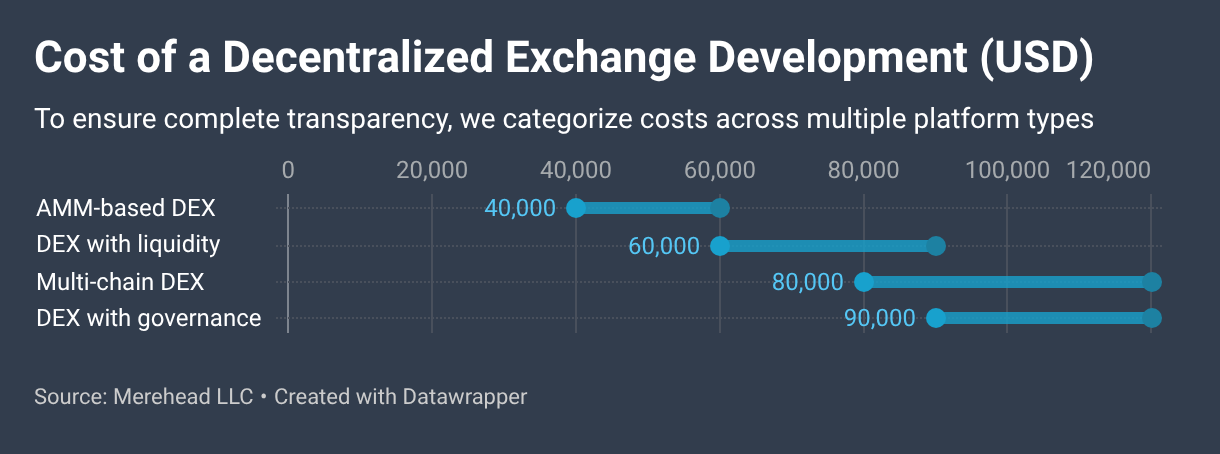
Cost Estimates
AMM-based DEX: $40,000 - $60,000
DEX with liquidity: $60,000 - $90,000
Multi-chain DEX: $80,000 - $120,000
DEX with governance: $90,000 - $120,000
Security testing is not an optional line item when contracts hold real TVL. Budget for automated analysis, manual review and third-party audit. For the US market we also recommend budgeting for a compliant interface that can support geo-fencing or optional KYC layers as regulatory frameworks evolve.

Maintenance affects long-term cost. As volume grows the platform needs gas optimisation, support for new token standards and periodic contract upgrades. A production-ready decentralized exchange typically costs between $60,000 and $90,000 with a 2 to 4 month timeline; multi-chain and governance-enabled builds run to $120,000.

If you are planning to launch a decentralized exchange, we can help you scope the work and prepare a transparent estimate against your goals.
Get a Custom DEX Development Estimate  

Who Should Launch a Decentralized Exchange

top crypto fintech startups
crypto entrepreneurs and investors
crypto on/off-ramp businesses
local payment aggregators

  Reason

Why Choose Merehead as Your Decentralized Exchange Development Company

Merehead has been building blockchain products since 2015, and decentralized exchange development is one of our core practices. We have shipped AMM protocols on Uniswap infrastructure, perpetual futures modules on HyperLiquid, cross-chain swap engines on THORChain, and hybrid venues that route order flow across several liquidity sources. That range matters: a DEX is not one product, and the right model for a token-launch platform is not the right model for a perpetuals venue serving the decentralized finance (DeFi) ecosystem.
10+ years on the market
130++ completed projects
Our approach is architecture first, code second. Before writing contracts we benchmark the infrastructure options against your liquidity requirements, latency targets and the degree of operational independence you actually need — because that decision is expensive to reverse after launch. Security is designed in rather than audited on: we build against MEV extraction and front-running, run automated analysis alongside manual review, and validate deposit and withdrawal flows with real mainnet assets before go-live.

We work as a full-cycle partner. Our team helps businesses understand the key differences between CEX and DEX and choose the model that fits their market. From AMM modelling and infrastructure selection through to liquidity bootstrapping and governance handover, we deliver the technical documentation your team needs to run the protocol independently.
Write to an expert  
Blockchain Development Since 2015
Merehead has built crypto and fintech products for a decade, with decentralized exchange development as a dedicated practice. Our engineers work in Solidity and Rust and have shipped protocols across 10 mainnets.
Five DEX Models in Production
We have delivered AMM protocols, perpetual futures venues, cross-chain swap engines, hybrid exchanges with aggregated liquidity, and Solana-native trading tools. Model selection is a decision we have made repeatedly, not theory.
Infrastructure Benchmarking Before Build
We evaluate dYdX v4, GMX and HyperLiquid against your liquidity depth, latency and independence requirements before architecture is fixed. Choosing wrong here is the most expensive mistake in perpetual DEX projects.
Security Designed In, Not Bolted On
Slither, Mythril and Echidna analysis plus manual line-by-line review, circuit breaker patterns for emergency pauses, and final validation with real mainnet assets rather than testnet tokens.

Merehead has delivered 8 decentralized trading platforms with a combined TVL of over $10 million. Our blockchain practice includes senior Solidity and Rust engineers, with protocols deployed across 10 mainnets.

  FAQ

Have questions in mind?

Answers to the most frequently asked questions from our clients

An AMM-based decentralized exchange starts at around $40,000. Adding liquidity programmes and staking modules brings it to $60,000-$90,000, while multi-chain routing or on-chain governance takes projects to $120,000. The variables that move the number most are the trading model, the number of chains, contract complexity and whether external liquidity has to be aggregated. We scope each project individually and provide a fixed estimate after discovery.

A production-ready decentralized exchange typically takes 3 to 6 months depending on AMM complexity, chain selection and security requirements. A focused module can be faster: we delivered a complete perpetual futures trading module — order book, TP/SL, cross and isolated margin — inside an existing non-custodial wallet in three months. Node synchronisation is scheduled in week one, since a Bitcoin full node alone takes five to ten days.

The decision comes down to three constraints: where your liquidity already exists, what gas cost your unit economics can absorb, and what latency your trading model requires. Ethereum offers the deepest DeFi liquidity at the highest cost; BNB Chain and Polygon suit high-frequency, lower-value trading; Solana fits products where per-transaction cost is the binding constraint; Arbitrum and Avalanche give access to established perpetuals liquidity. We benchmark these against your specific case during discovery.

Yes. We have built AMM platforms on Uniswap V2 and V3 infrastructure with a complete pool lifecycle: pool creation, add and remove liquidity, share-of-pool display, top pools by trading volume, and swap flows with configurable slippage tolerance and minimum-received calculation. We adapt the model to your token economics and liquidity strategy rather than forking a codebase unchanged.

Yes. We have built cross-chain swap engines on THORChain, working with its AMM pools through XChainJS to move value between networks without wrapping assets. The work includes tuning gas, slippage and pool depth, unified liquidity views across networks, and multi-network monitoring. On projects where a single mechanism did not produce workable economics we have combined arbitrage logic with AMM participation.

Yes. We benchmark the underlying infrastructure first — dYdX v4's sovereign AppChain, GMX's EVM contracts and HyperLiquid's API each carry different trade-offs in liquidity depth, latency and operational independence. We have delivered a perpetuals module on HyperLiquid with order book, TradingView charting, limit, market and stop-limit orders, TP/SL, cross and isolated margin and leverage selection.

Yes. We write swap, pool, fee, staking and governance contracts in Solidity and Rust, and test with Slither, Mythril and Echidna alongside manual line-by-line review, targeting reentrancy, price manipulation, oracle failure and logic flaws. We implement circuit breaker patterns for emergency pauses and validate flows with real mainnet assets. We prepare contracts for third-party audit; we do not issue formal audit certifications ourselves.

We do not act as a liquidity provider. What we build is the liquidity architecture: pool structures, LP incentive and reward mechanisms, AMM curve optimisation, and integration with external liquidity sources. On hybrid venues we have implemented routing across multiple external sources with a switchable provider, which lets an exchange launch without market makers and migrate to proprietary liquidity later.

We do not currently market a white-label decentralized exchange product. Where time-to-market is the priority, we recommend the hybrid model: a non-custodial trading interface with execution routed through external liquidity sources. In our practice this has produced the shortest path to launch without requiring market makers or a proprietary order book on day one.

Yes. Post-launch work covers gas optimisation as volume grows, support for new token standards and networks, contract upgrades that preserve core functionality, and monitoring. We hand over technical documentation and governance modules so your team can operate the protocol independently rather than depending on us for routine changes.
Talk to an expert
We are ready to answer all your questions
Top expert
Blockchain development since 2015

  Security

Security in Decentralized Exchange Development

Secure Smart Contract Design
Contracts for swaps, pools and fees are written to be readable and constrained, with a deliberately small attack surface. Clear structure reduces the number of paths an exploit can take and makes external audit and future upgrades substantially cheaper.
Exploit Prevention and Testing
Testing targets reentrancy, price manipulation, oracle failure and logic flaws before deployment. Automated analysis with Slither, Mythril and Echidna runs alongside manual line-by-line review, because tooling catches known patterns and reviewers catch intent.
Transaction Screening and Compliance
Where a venue handles deposits, we screen at transaction level before crediting a balance. In one hybrid build we integrated a KYT provider returning roughly 50 risk flags per transaction and wired the aggregate score into the decision engine — automatic approval below the threshold, a compliance review task above it. This is different from checking identity once at registration and trusting everything afterwards.
We do not consider a decentralized exchange ready for launch until deposit and withdrawal flows have been tested with actual mainnet assets — real USDT, real BTC, real ETH. Testnet behaviour differs from mainnet in ways that matter for real money: confirmation times vary with network congestion, fee estimation behaves differently under real mempool conditions, and network-enforced minimum withdrawal amounts only surface with real assets. Our final testing phase funds test wallets with small amounts of real cryptocurrency and runs full deposit, trade and withdrawal cycles on every supported network. It adds time and a small cost, and it is non-negotiable. We also implement circuit breaker patterns so operations can be paused if anomalies are detected.

  Liquidity

Liquidity Strategy for Decentralized Exchanges

Aggregated External Liquidity
For venues launching without liquidity of their own, we route execution through external sources with a switchable provider. We have built platforms where the backend routes between two external exchange APIs and an internal pool, letting the operator diversify counterparty risk and migrate toward proprietary liquidity as volume develops.
Order Book Depth From Day One
Cold-start liquidity is what kills most new exchanges. We have implemented models where the venue sources depth from an established external order book, so the book looks populated from launch. The trade-off is operational: it requires real-time monitoring of utilisation, borrow limits and collateral positions, with alerting on every critical threshold.
Liquidity Pool Modelling and LP Incentives
We simulate pool behaviour before fixing the architecture, to select viable asset pairs and their balance. Incentive design — liquidity mining, staking rewards, yield mechanisms — is calibrated so providers commit capital over long horizons rather than farming and exiting.
Why liquidity architecture is decided first
A decentralized exchange is only as strong as its liquidity, and the liquidity model is not a feature you add later — it determines contract design, custody model and operational cost. Three approaches have worked in our practice: aggregating external sources with switchable routing for fast launch; mirroring an established order book to solve cold start; and building proprietary pools with incentive programmes for protocols that can bootstrap their own depth. Most projects begin with the first and migrate to the third. Deciding which path you are on before writing contracts avoids an expensive rebuild in month six.

  Management

Governance and Protocol Management

For EVM-based platforms we build on OpenZeppelin's Governor contracts — an audited, widely reviewed framework — rather than writing voting logic from scratch, because governance bugs are among the most damaging in DeFi. The implementation covers proposal creation, voting periods, quorum thresholds, timelocks on execution and treasury parameter control. Where a protocol runs on a non-EVM chain, we adapt to the native governance primitives of that ecosystem. The goal is a structure where your community can vote on upgrades, fee structures and listings, and where the operator cannot bypass the process.
Write to an expert  
Governance Tokens
Governance tokens give stakeholders a formal role in protocol decisions. We build the issuance and voting-weight mechanics that make long-term self-governance workable for users, liquidity providers and the protocol itself.
Voting and Proposals
Transparent proposal and voting flows are how protocol changes get made without unilateral operator control. This is the mechanism that makes decentralisation verifiable rather than claimed.
On-Chain Parameter Control
Fees, rewards and pool settings adjust through governance actions rather than operator intervention. The protocol adapts to market conditions while the change history stays on-chain and auditable.
Do you have a project idea?
Send
Yuri Musienko
Business Development Manager
Yuri Musienko specializes in the development and optimization of crypto exchanges, trading platforms, P2P solutions, crypto payment gateways, and asset tokenization systems. Since 2018, he has been consulting companies on strategic planning, entering international markets, and scaling technology businesses. More details