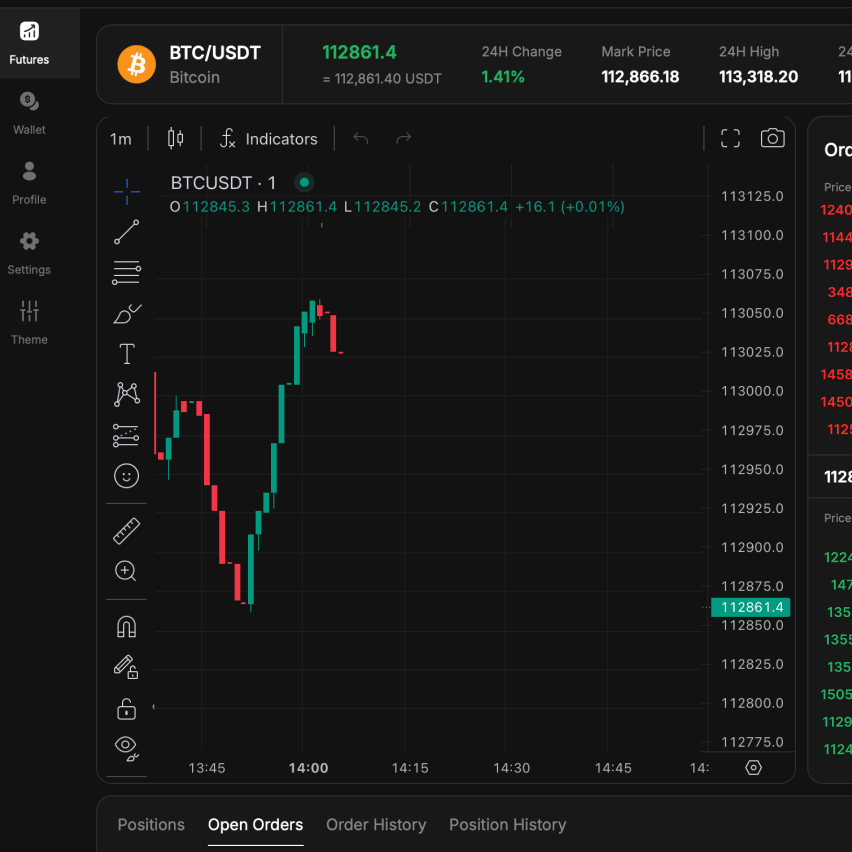
A binary options trading platform script is a pre-built software package — trading engine, payout/settlement logic, KYC/AML, payment rails, trader cabinet and admin panel — that lets a broker launch a working binary options platform without writing the core from scratch. Instead of 12–18 months of ground-up development, you customize a proven codebase and own it outright.
A production-grade binary options script is built in eight stages:
- Requirements & SRS — software spec, user flow, risk-book model (A-Book vs B-Book).
- Architecture & database design — microservices, isolated trading DB, settlement engine.
- Server infrastructure — AWS/dedicated, Docker, Kubernetes, autoscaling.
- UI/UX design — trader cabinet, charts, admin and back-office.
- Front-end & back-end coding — trade engine, payout logic, WebSocket price feed.
- Integrations — payment gateways, crypto nodes, KYC/AML providers, liquidity (optional).
- QA & security hardening — load testing, fills accuracy, DDoS/XSS/SQLi protection.
- Release & 60-day warranty — deploy, monitoring, observability.
What a Binary Options Trading Platform Script Actually Includes
A binary options trading platform script gives brokers, fintech founders, and investment firms a tested foundation: a High/Low trade engine, asset integration, payment gateways, a trader cabinet, and a back-office. You go live with a known-good codebase instead of debugging a green-field system for a year — and because you own the source, you control the design, the trading features, and the markets you enter.
Two architectures dominate the market, and they solve different problems:
- CEX-based scripts — centralized platforms on a classic microservice backend, suited to mass-market brokers who need speed and a low entry barrier for traders.
- DEX-based scripts — decentralized platforms where smart contracts settle trades and oracles like Chainlink feed prices. They offer transparency and self-custody but demand a thorough audit before launch.
We build both models. In practice, most binary options brokers ship a centralized core first — it matches how the business actually makes money — and add on-chain settlement later if their audience demands it.
Script vs White Label vs Build from Scratch
Before you pick a vendor, settle the ownership question. These three paths look similar on a landing page and behave very differently in production.
| Criterion | Script (you own it) | White Label (you rent it) | Build from Scratch |
| Source code ownership | Full | None — provider keeps it | Full |
| Customization | Unlimited | Branding + limited config | Unlimited |
| Time to launch | 1.5–3 months | ~2 weeks | 12–18 months |
| Ongoing fees | One-time + support | Monthly / revenue share | One-time + support |
| Best for | Serious long-term brokerage | Fast market test | Unique, novel product |
A white-label binary options platform is the fastest way to validate demand, but you don't control the core and you pay rent indefinitely. A script is the middle path most of our clients choose: you own the code, customize freely, and skip the year-long build. Custom-from-scratch only earns its cost when your product is genuinely novel.
Architecture: A Real Engine vs an API Wrapper
Here's the distinction that separates a real platform from a reskinned one — and the first thing a competent CTO checks.
Many "scripts" on the market are UI wrappers over a third-party exchange API: the server forwards orders to Binance and relays the response back. It looks like a platform, but the trading logic, the liquidity, and the margin all live somewhere else — and so does the commission.
If you don't run your own matching engine, you don't own a brokerage — you own a front-end to someone else's business. The economics never work for a wrapper.
 Yuri MusienkoBusiness developer, Merehead
Challenge. A founder wants a binary options platform but inherits a wrapper that leaks fees to an external exchange and offers no control over execution or settlement.
Solution. We build a microservice core with its own order and settlement engine. For the MVP we run an internal book (B-Book matching), isolate the trading database on a dedicated server, and cache frequently requested data to keep latency flat under load.
Result. The broker owns the full trade flow and payout logic. Database isolation let one of our trading platforms sustain high order volume without transaction loss — the kind of throughput problem we unpack in our matching engine deep-dive.
Database isolation isn't an optimization for a high-load trading system — it's a baseline requirement. A desynced ledger in a financial product is always a red flag, even when you recover the data.
Yuri MusienkoBusiness developer, MereheadThe Risk Book and the CRM: Where Brokers Actually Make Money
Founders fixate on the trading screen. Operators know the revenue lives in two places traders never see: the risk-book model and the CRM.
On the risk book, you choose between two models. A-Book routes trades to external crypto liquidity providers via API, duplicating positions to the market. B-Book keeps trades inside the system — the broker's internal "kitchen." Roughly 95% of brokers run B-Book because they don't need external counterparties, and starting there slashes both infrastructure complexity and time-to-market. You can layer A-Book on top later through liquidity provider APIs once volume justifies it.
Challenge. A trading business treats the platform as the product and underinvests in sales tooling — then can't convert or retain the traders it acquires.
Solution. We start brokers on B-Book to avoid external counterparties, run a transit (stateless) payment model so funds pass through rather than pool on-platform, and build a CRM with native lead tagging, inter-department handoff, and call-center analytics — instead of bolting on a generic Zoho or HubSpot.
Result. The CRM becomes the revenue engine — by our experience it drives up to 70% of brokerage efficiency — and the transit model removes the manual-withdrawal bottleneck and its DevOps dependency. We documented this in our CRM build for a trading platform.
Real-Time Integrity and Observability
Binary options live and die on the price feed. A late tick or a desynced calculation isn't a cosmetic bug — it's a financial incident.
Challenge. Front-end price calculation drifts out of sync with the backend, partial fills stay invisible to the trader, and a broken WebSocket silently stops updating charts — "blind flight" for a real-time product.
Solution. We centralize financial calculation (or hard-sync front-end and backend), expose a per-order fills breakdown — price, amount, timestamp — in the UI, and stand up observability with database- and application-level logging plus Grafana dashboards and socket health monitoring.
Result. Traders see exactly how each position executed (the industry standard for any serious platform), the team gets real root-cause analysis, and transaction integrity holds under load.
Compliance: AML, KYC, and Jurisdiction
Technology is half the launch. Regulation is the other half, and it dictates where your traders can come from.
| Jurisdiction | Status for binary options | Typical timeline |
| St. Vincent / Belize | Light offshore licensing | Months — fast market entry |
| United States (CFTC) | Regulated exchange model (e.g. Nadex) | Long, costly, high credibility |
| European Union | High-risk product, strict KYC/AML | Long, registration required |
| France / Belgium / Israel | Retail binary options banned | N/A — avoid |
On the technical side, AML is where most launches quietly fail. A single provider is a single point of failure, and a partial response with no risk categories is effectively no check at all.
Challenge. AML providers time out (we've seen ~1-hour stalls) or return incomplete payloads, blocking trader onboarding.
Solution. We orchestrate multiple AML providers behind a risk-segmentation engine with dynamic thresholds and ~70 normalized risk categories, run KYT scoring on every inbound deposit (not a one-time KYC), and add graceful fallback when one provider degrades.
Result. Regulatory coverage holds without freezing onboarding, and the same multi-provider discipline carries into deposits and withdrawals. Decide your jurisdiction before you build, because it changes the compliance modules you'll need.
Technology Stack Behind the Script
The stack defines how stable, fast, and scalable your platform stays as volume grows. This is the layered setup we ship binary options platforms on:
| Layer | Technologies |
| Back-end | Laravel, Express.js, MySQL/PostgreSQL, Redis/Kafka, MongoDB, WebSockets (Socket.io, Pusher) |
| Front-end | React, Redux Saga, Next.js, TypeScript; standalone TradingView advanced charts |
| Mobile | Kotlin / Java (Android), Swift (iOS) |
| Blockchain | BTC, ETH, TRX, LTC, USDT nodes; Solidity/Chainlink for the DEX model |
| DevOps | AWS / dedicated, Docker, Kubernetes, Jenkins, Cloudflare, SSL |
For a DEX-based binary options product, contracts settle trades on-chain and oracles supply real-time prices — strong on transparency, but plan for an audit before you go live.
How Much Does a Binary Options Trading Platform Script Cost in 2026?
Straight answer, from our own estimates rather than a marketing range: a real binary options platform starts around $52,000 for a web-only basic build and climbs past $100,000 for a full feature set with native mobile apps. Anyone quoting $15k is selling you a wrapper, not a brokerage.
| Tier | Web app | + 2 native mobile apps | Assets (crypto/fiat) | Highlights |
| Basic | $52,000–60,000 | +$35,000–40,000 | 10 / 10 | KYC, 1 PSP, demo + real, TradingView charts |
| Standard | $78,000–84,000 | +$53,000–58,000 | 20 / 20 | + affiliate program, OTC, 3 PSP, admin roles, trading academy |
| Maximum | $102,000–108,000 | +$72,000–78,000 | 30 / 30 | + tournaments, leaderboard + bots, bonus engine, 5 PSP |
Timeline runs 1.5–3 months plus a 2–4 week prep stage, on a microservice architecture. Payment is staged: 15% upfront for docs, architecture, and design, then 30/30/25 across delivery milestones. The cost drivers are predictable — feature scope, number of assets and payment gateways, depth of customization, and the compliance modules your target jurisdiction forces.
Optional: An AI Signal Layer
If you want to differentiate beyond payouts and UX, an AI signal module is a credible upsell. We build these as a multi-agent LLM system (CrewAI/LangGraph), where each agent owns a slice of the trading logic and the system explains the data behind every signal instead of emitting a black-box prediction. The stack splits Node.js for business logic and Python for the AI layer, with a vector database (pgvector/Supabase) for retrieval so the model analyzes market history rather than hallucinating it. We treat this as a proof-of-concept first (~$40k) — if the signals don't hold up on a POC, scaling makes no sense. You can see the pattern in our AI crypto trading bot case study.
Where to Start
The market rewards speed, but it punishes a thin foundation. A binary options script gets you past the year-long build and into a brokerage you actually own — provided the script runs a real engine, a deliberate risk-book model, and compliance that holds under regulatory pressure.
We've built binary options and trading platforms for brokers and fintech founders across several markets, including a binary options platform with futures trading. If you're weighing a build, tell us the scope and target jurisdiction, and we'll come back with a per-module hour breakdown rather than a flat number.
FAQ — Binary Options Trading Platform Script
A web-only basic build starts at $52,000–60,000. A full platform with native mobile apps and the complete feature set reaches $100,000+. The final figure depends on asset count, payment gateways, customization, and compliance scope.
A real script runs its own matching and settlement engine, so you own the trade flow and the commission. A wrapper forwards orders to an external exchange — you control the UI but not the economics, and the fees leak to the third party.
Most brokers start with B-Book — internal matching, no external counterparties, faster launch. Roughly 95% run this model. You can add A-Book via liquidity provider APIs once trade volume justifies routing flow to the market.
Yes. The standard build connects BTC, ETH, TRX, LTC, and USDT nodes, and you can add coins or tokens for your target market. Crypto and fiat asset pairs sit side by side in the trading table.
No. Some regions license it under financial regulators, the US treats it as a regulated exchange product (CFTC), and countries like France, Belgium, and Israel ban it for retail investors. Choose your jurisdiction before you build.
A custom script runs 1.5–3 months plus a 2–4 week prep stage. A white-label platform can go live in about two weeks, but you rent it instead of owning the code.