×
Services
Exchange & Trading Infrastructure
DeFi & Web3 Core
NFT Ecosystem & Multi-Chain
Tokenization & Fundraising
Crypto Banking & Fintech
AI Development
Exchange & Trading Infrastructure
Create a centralized crypto exchange (spot, margin and futures trading)
Decentralized Exchange
Development of decentralized exchanges based on smart contracts
Stock Trading App
Build Secure, Compliant Stock Trading Apps for Real-World Brokerage Operations
P2P Crypto Exchange
Build a P2P crypto exchange based on a flexible escrow system
Centralized Exchange
Build Secure, High-Performance Centralized Crypto Exchanges
Crypto Trading Bot
Build Reliable Crypto Trading Bots with Real Risk Controls
DeFi & Web3 Core
Web3 Development
Build Production-Ready Web3 Products with Secure Architecture
Web3 App Development
Build Web3 Mobile and Web Apps with Embedded Wallets and Token Mechanics
DeFi Platform
Build DeFi projects from DEX and lending platforms to staking solutions
DeFi Exchange
Build DeFi Exchanges — AMM, Order Book, Aggregator, and Hybrid Protocols
NFT Ecosystem & Multi-Chain
NFT Marketplace
Build NFT marketplaces from minting and listing to auctions and launchpads
Tokenization & Fundraising
Real Estate Tokenization
Real estate tokenization for private investors or automated property tokenization marketplaces
Crypto Banking & Fintech
Build crypto banking platforms with wallets, compliance, fiat rails, and payment services
Build Secure Crypto Wallet Apps with a Production-Ready Custody Model
Crypto Payment Gateway
Create a crypto payment gateway with the installation of your nodes
AI Development
AI Development
We build production-ready AI systems that automate workflows, improve decisions, and scale

  AMM & Concentrated Liquidity DEX

DeFi Exchange Development Company

We build decentralized exchange platforms — AMM DEXs, order book exchanges, aggregators, and hybrid protocols — with production-grade smart contracts, liquidity architecture, and frontend delivery. Merehead's DeFi exchange development services cover the full lifecycle from protocol design to mainnet launch.


130+ projects
Experience
since 2015
Experience
blockchain expert
image

  Services

DeFi Exchange Development Services

Our DeFi exchange development services cover every exchange architecture in production use in 2026. We select the right model for your use case and build it to production standard — not as a proof of concept.

01

AMM DEX Development

We build AMM DEXs using constant product (V2), concentrated liquidity (V3), and programmable hooks (V4) architectures — with Factory/Pool/Router contracts, fee tier configuration, and LP position management.
02

Order Book DEX Development

We build on-chain order book exchanges on L2 networks (Arbitrum, Base, StarkNet) for professional trading, perp futures, and limit order markets. Includes order matching logic, margin engine, and trading interface.
03

DEX Aggregator Development

We build aggregators that route trades across Uniswap, Curve, Balancer, and custom pools for best execution — with smart order routing, split-route execution, and MEV-protected submission.
04

Hybrid DEX Development

We build hybrid DEX protocols combining off-chain order matching with on-chain settlement — the standard architecture for perpetual DEXs in 2026 (dYdX, Hyperliquid). Includes matching engine, settlement contracts, and sync infrastructure.
05

Smart Contract Development & Audit Prep

We develop exchange contracts in Solidity with OpenZeppelin, Hardhat or Foundry, and unit/integration/fuzz test coverage. Delivered with natspec documentation and an audit preparation package.
06

Liquidity Pool & Tokenomics Design

We design fee distribution, LP incentive structure, and liquidity mining programs as part of the protocol spec. Tokenomics set at design phase are 10x cheaper than post-launch governance changes.
07

DeFi Exchange Frontend Development

React/Next.js DEX interfaces with wagmi, Viem, RainbowKit, and The Graph — including price impact display, slippage controls, transaction state handling, and LP position dashboard.

  About

DeFi Exchange Development: AMM vs Order Book vs Aggregator

The most important decision in DeFi exchange development is choosing the trading model — and this decision is driven by your target users and liquidity strategy, not by technical preference. Here is how we scope this in every engagement:

AMM DEX is right when: you're launching a governance token and want permissionless LP participation; your target market includes long-tail assets with lower liquidity; or you want a model where early community members can become LPs and earn fees. Revenue comes from LP fee sharing (typically 0.05%–0.3% per swap).
Order Book DEX is right when: your target users are professional traders who need limit orders, stop-losses, and precise execution; you're building a perp futures or margin trading platform; or you're launching on an L2 where gas costs are low enough to support active order placement and cancellation. Revenue comes from taker fees (typically 0.02%–0.05%).

DEX Aggregator is right when: you want to launch without a liquidity bootstrapping phase; your value proposition is best execution across sources rather than owning the liquidity; or you're building a wallet or portfolio product where trading is a feature, not the core product.
Hybrid is right when: you need CEX-level execution speed with non-custodial settlement guarantees — the standard for institutional-grade perp DEXs in 2026.

We make this recommendation explicitly in the first week of every engagement, with a written rationale tied to your specific use case. We have declined projects where the requested model was wrong for the stated business goal — and in every case, the revised model shipped faster and performed better in production.
1/3

  Step-by-Step

How DeFi Exchange Development Works

DeFi exchange development requires decisions in the first phase — exchange model, fee architecture, liquidity design — that are expensive to reverse later. Our process resolves them before development begins.

Exchange Model & Architecture Decision
We define the exchange model (AMM, order book, aggregator, hybrid), target blockchain(s), fee tier structure, and the on-chain/off-chain boundary. We produce a written recommendation with rationale, not just a spec sheet.
Smart Contract Interface Design
We define the contract interface — all public functions, events, state variables, access controls — before writing implementation code. The interface spec is the integration contract between smart contract developers and frontend developers, enabling parallel development.
Smart Contract Development & Testing
We develop contracts in Solidity using OpenZeppelin base contracts, test with Hardhat or Foundry (unit, integration, fuzz testing), and structure for external audit. Fuzz testing the price formula and fee calculation is mandatory — these functions contain the highest-value exploit surfaces.
Tokenomics & Liquidity Design
We design fee distribution (to LPs, protocol treasury, governance stakers), LP incentive structure, initial liquidity bootstrapping mechanism, and governance token utility if applicable. These decisions are made before smart contract development, not during it.
UI/UX Design
We design the swap interface, LP management dashboard, liquidity depth visualization, transaction confirmation UX, and all error states. DEX UX has failure modes Web2 design doesn't cover — we prototype wallet flows and transaction signing before development begins.
Frontend, Subgraph & Audit
We build the exchange frontend, deploy The Graph subgraph for indexed pool and trade data, and coordinate the external security audit. Engage the audit firm before development completes — major firms are booked 6-8 weeks in advance. Post-audit: remediate findings, re-test, verify on testnet.
Gas cost modeling is a required step in our discovery process that most DeFi exchange development companies skip. For AMM DEXs, every LP interaction — add liquidity, remove liquidity, collect fees — is a gas transaction. On Ethereum mainnet, issuing 1,000 LP positions costs $5,000–$50,000 in gas at current prices. On Base or Arbitrum, the same operations cost $5–$50. This calculation determines blockchain selection for every exchange we build — not network reputation or ecosystem size.

  Stack

Tech Stack & Ecosystems

Intro
We select blockchain networks and development tools based on your exchange's gas economics, user geography, and long-term liquidity strategy — not on network popularity at the time of the engagement.
MEV Protection
Flashbots Protect and MEV Blocker for private mempool routing. CoW Protocol integration for exchange-via-intent execution. TWAP oracle implementation for manipulation-resistant on-chain pricing. Slippage protection and deadline enforcement at the router contract level.
EVM L2s (Base, Arbitrum, Optimism)
Default recommendation for most new DeFi exchanges in 2026. Gas costs 100-1000x lower than Ethereum mainnet, inherited Ethereum security, and well-supported by wagmi/RainbowKit tooling. Arbitrum has the deepest existing DeFi liquidity.
Ethereum Mainnet
Right for protocols where maximum security credibility and institutional trust outweigh gas friction — large DeFi treasuries, stablecoin infrastructure, and protocols targeting institutional LPs who require Ethereum's settlement finality guarantees.
Solana (Rust / Anchor)
Right for high-frequency trading applications where sub-second finality and sub-cent fees are requirements. Solana DEXs (Raydium, Orca, Jupiter) dominate the high-throughput segment. We build Solana DEX programs using Anchor framework with Rust smart contracts.
Development Tooling
Hardhat and Foundry for smart contract testing and deployment. OpenZeppelin for audited base contracts. The Graph for event indexing. Chainlink for price oracle feeds. Alchemy or Infura for RPC infrastructure. Tenderly for transaction simulation and post-launch monitoring.

  Architecture

DeFi Exchange Architecture We Build

Our DeFi exchange architectures are modular — each protocol layer can be upgraded, audited, and scaled independently. The architecture boundary between on-chain and off-chain is documented and enforced from the first sprint.


01
Core Protocol Layer (Smart Contracts)
Factory contract (deploys new trading pair pools), Pool/Pair contracts (hold liquidity, execute price calculations, distribute fees), Router contract (handles multi-hop routes, slippage protection, deadline enforcement), and Governance contract (fee parameter control, protocol upgrades). Built in Solidity with OpenZeppelin patterns and upgradeable proxy architecture where protocol evolution requires it.
02
Liquidity & Incentives Layer
LP position management (ERC-721 NFT positions for V3-style concentrated liquidity), fee accrual and collection logic, liquidity mining contract (emission distribution to targeted LP positions), and staking contract (governance token staking for fee-sharing). Emission rate control is configurable by governance without contract redeployment.
03
Data & Indexing Layer
The Graph subgraph indexes all swap events, liquidity events, and fee collection events into a queryable GraphQL API. This powers real-time price charts, pool TVL displays, LP position P&L, and trading history without querying the chain directly — reducing frontend latency from seconds to milliseconds for data-heavy views.
04
Frontend & Wallet Layer
React/Next.js trading interface with wagmi and Viem for type-safe contract interaction. RainbowKit or Web3Modal for multi-wallet support. Transaction simulation before signing (shows exact output, price impact, and gas cost). Real-time price feed via The Graph and RPC provider fallback. Mobile-responsive for the significant portion of DeFi volume that originates from mobile wallets.
MEV (Maximal Extractable Value) protection is implemented at the routing layer — transactions are structured to minimize frontrunning and sandwich attack exposure. For high-volume DEXs, we integrate with private mempool solutions (Flashbots Protect, MEV Blocker) that route transactions to avoid public mempool exposure entirely.

  Cost

Cost of DeFi Exchange Development
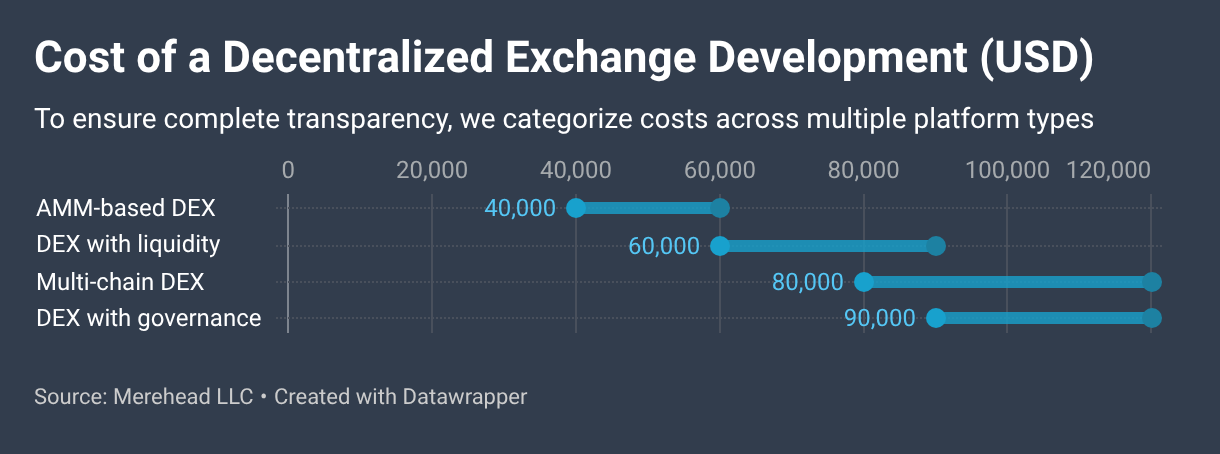
The cost of DeFi exchange development is driven by exchange model complexity, number of supported chains, and the depth of the liquidity and governance infrastructure. A basic AMM DEX starts at $40,000; a full-featured concentrated liquidity exchange with governance token, multi-chain deployment, and mobile interface runs $150,000–$300,000.
Cost Estimates
AMM DEX (Uniswap V2-style): $40,000 - $60,000
AMM DEX with Concentrated Liquidity: $70,000 - $120,000
Order Book DEX or Hybrid: $120,000 - $200,000
DEX Aggregator: $50,000 - $120,000
The security audit is the most consistently underestimated cost in every DeFi exchange build. For a standard AMM DEX, audit costs run $20,000–$60,000. For a complex concentrated liquidity protocol or hybrid DEX with novel price curve mechanics, audit costs reach $80,000–$150,000. Engage your audit firm before development completes — firms like Trail of Bits, OpenZeppelin, and Certik are typically booked 6-8 weeks out. In our experience, protocols that engage audit firms early (sharing contract specs before code is final) complete audit cycles 30-40% faster.

Liquidity bootstrapping is the budget line that founders consistently omit from financial models. A working DEX with empty pools attracts no traders. Budget $50,000–$500,000 for seed liquidity and market maker incentives depending on the number of trading pairs at launch. This is an operational cost — it should appear in your funding model before development begins, not be discovered after launch.

Merehead has built DeFi exchange protocols since 2018 - AMM DEXs, order book systems, aggregators, and hybrid architectures. Share your exchange idea and we'll scope it with a model recommendation and delivery estimate.
Contact Expert  

Who Should Build a DeFi Exchange

Native DEX Protocols
Token Ecosystem Projects
Compliant Fintech Companies
DAO Treasuries

  Reason

Why Choose Merehead as Your DeFi Exchange Development Company

Merehead has been building DeFi protocols since 2018 — before AMMs were the industry standard and when most of the patterns that define DeFi exchange architecture today were still being invented. Our DeFi exchange development team has delivered AMM DEXs, concentrated liquidity implementations, order book exchange frontends, and DEX aggregator routing engines in production. We don't customize templates — we design exchange architecture from first principles based on your target market, asset mix, and liquidity strategy.
0+ years on the market
0+ completed projects
The most expensive mistake in DeFi exchange development is treating the exchange model as a technical decision rather than a business one. An AMM DEX and an order book DEX serve different users, require different liquidity strategies, and have fundamentally different smart contract architectures. We resolve this in the discovery phase — before any code is written. The result is a protocol designed for the trading behavior of your actual users, not a generic fork with your logo on it.
Write to an expert  
Protocol-Level Exchange Architecture
We design DEX architecture at the protocol level — fee tiers, price curve selection, liquidity range logic, and router design — not at the UI level. The architectural decisions made in week one determine whether your exchange is capital-efficient and competitive 18 months after launch.
Audit-Ready Contract Engineering
We structure DeFi exchange contracts with clear separation of concerns, natspec documentation, and test coverage that audit firms expect. Protocols structured for audit from day one complete audit cycles 30-50% faster than those that add documentation after the fact.
Liquidity Strategy from Day One
A technically perfect DEX with empty pools attracts no traders. We design liquidity bootstrapping mechanisms, LP incentive structures, and market maker engagement strategies as part of the protocol spec — not as an afterthought on launch week.
Full Source Code, No Lock-In
Every DeFi exchange we build is delivered with complete source code — smart contracts, frontend, subgraph, and deployment scripts. No licensing dependency, no restriction on modifying the protocol, and no ongoing fees to us for running your exchange.

We deliver with full source code ownership, no vendor lock-in, and audit-ready contract structure. Post-launch support covers monitoring, incident response, and protocol upgrades through governance.

  FAQ

Have questions in mind?

Answers to the most frequently asked questions about DeFi exchange development

A DeFi exchange development company designs and builds the full technical stack of a decentralized exchange: smart contracts (AMM, order book, or aggregator architecture), tokenomics and liquidity design, trading interface frontend, data indexing infrastructure, and security audit preparation. Merehead's DeFi exchange development services cover all of this under one engagement — you receive a complete, deployable exchange with full source code and no vendor dependency.

DeFi exchange development costs range from $30,000 for a basic AMM DEX to $300,000+ for a full-featured concentrated liquidity exchange with governance, multi-chain deployment, and mobile apps. The security audit ($20,000–$150,000 depending on contract complexity) and liquidity bootstrapping ($50,000–$500,000) are separate budget items that should be planned from the start. Total realistic budget for a competitive production AMM DEX including audit and seed liquidity: $100,000–$250,000.

A basic AMM DEX (Uniswap V2-style) takes 2–4 months for development plus 4–8 weeks for security audit — total 4–6 months to mainnet. A concentrated liquidity exchange (V3-style) takes 4–6 months for development. An order book or hybrid DEX takes 6–10 months. The audit timeline is the most commonly underestimated factor — engage your audit firm before development completes to avoid adding 6-8 weeks of queue time after your contracts are ready.

An AMM DEX uses liquidity pools — users deposit token pairs, and a mathematical formula prices trades automatically. Anyone can provide liquidity; no market makers required at launch. An order book DEX matches limit and market orders between specific buyers and sellers, enabling precise execution at defined prices. AMM DEXs are better for long-tail markets and permissionless LP participation. Order book DEXs are better for professional trading, derivatives, and markets where price discovery via limit orders matters more than LP simplicity.

Yes. Our DeFi exchange development services cover EVM chains (Ethereum, Arbitrum, Base, Polygon, BNB Chain) and Solana. Solana DEX development uses Rust and the Anchor framework. We recommend Solana for high-frequency trading applications where sub-second finality and sub-cent transaction fees are requirements — for most other use cases, EVM L2s (Base, Arbitrum) are the more practical starting point due to tooling maturity and existing DeFi ecosystem depth.
Talk to an expert
We are ready to answer all your questions
Top expert
10 years of experience

  Security

Security in DeFi Exchange Development

Audit-Ready Contract Architecture
We structure DeFi exchange contracts from day one for audit efficiency: clear function separation between core logic and peripheral contracts, explicit state variable documentation, and natspec comments on all public functions. Protocols structured for audit complete review cycles 30-50% faster than those that add documentation retroactively.
Fuzz Testing for Price Math
The AMM price formula and fee calculation functions are the highest-value attack surfaces in any DeFi exchange. We run fuzz tests with Foundry's fuzzer against all price math functions — random input generation consistently finds edge cases in boundary conditions that unit tests miss. This is non-optional for any exchange handling real liquidity.
MEV & Oracle Attack Mitigation
We implement TWAP (time-weighted average price) oracles for manipulation-resistant on-chain pricing, slippage and deadline parameters at the router level, and MEV-protected transaction routing via Flashbots Protect or MEV Blocker for production deployments. Flash loan attack vectors are explicitly reviewed in the contract architecture before development.
DeFi exchanges lost over $1.2 billion to smart contract exploits in 2024. The majority of those exploits targeted contracts that either had no external audit or were deployed before audit findings were fully remediated. We treat the audit as a required line item in every DeFi exchange development engagement — not an optional add-on — and structure contracts from day one to minimize the audit scope and cost.

  Liquidity

Liquidity Strategy for DeFi Exchanges

Liquidity Bootstrapping Design
The most common DEX launch failure is an empty pool, not a smart contract bug. We design seed LP positions, liquidity mining programs, and market maker incentive structures as part of the protocol spec. A DEX with $500K in seed liquidity retains users 3-5x better in the first 30 days than one with $50K.
LP Incentive Architecture
We design LP reward programs that concentrate liquidity in the price ranges where trading actually happens — not uniform distribution that benefits inactive LPs. Targeted liquidity mining reduces incentive spend by 40-60% for the same active liquidity depth.
Fee Tier & Revenue Design
Fee tier selection (0.01%, 0.05%, 0.3%, 1%) determines which liquidity profile your exchange attracts. We model expected LP fee revenue against required seed liquidity for each tier before launch — so the fee structure supports sustainable LP economics, not marketing optics.
The liquidity bootstrapping problem
Every new DeFi exchange faces a cold start problem: LPs don't provide liquidity until there are traders, and traders don't come until there's liquidity. We solve this by designing the liquidity bootstrapping mechanism before the exchange launches — not as a marketing campaign after.

In our DeFi exchange builds, protocols that launch with a structured bootstrapping mechanism retain 70-80% of seed liquidity after 90 days; those that launch without one retain 20-30%.

  Governance

Governance & Protocol Management for DeFi Exchanges

Early DeFi exchange governance is always more centralized than it appears — token distribution concentrates voting power with the team and early investors. We design governance with explicit progressive decentralization: admin keys with time locks in year one, governance token distribution schedules that broaden voting power over 2-3 years, and quorum thresholds that prevent low-participation governance attacks on critical protocol parameters.
Write to an expert  
Fee Parameter Governance
The most actively governed parameters on a live DeFi exchange are fee tiers and protocol fee splits — changes that directly affect LP economics and treasury revenue. We implement governance-controlled fee parameters with time locks and quorum requirements that prevent adversarial fee changes while enabling the protocol to adapt to market conditions.
Upgradeable Protocol Architecture
We implement upgradeable proxy patterns (UUPS or TransparentProxy) for peripheral contracts where protocol evolution requires it, while keeping core price logic immutable for security. This allows adding new fee tiers, integrating new oracle types, and patching peripheral contracts through governance — without requiring a full protocol migration.
Emergency Response Mechanisms
We implement pause mechanisms with multi-sig time locks for emergency response to discovered vulnerabilities. The pause function can halt new deposits while existing positions remain withdrawable — the standard pattern that lets protocols respond to active exploits without trapping user funds.
Do you have a project idea?
Send
Yuri Musienko
Business Development Manager
Yuri Musienko specializes in the development and optimization of crypto exchanges, binary options platforms, P2P solutions, crypto payment gateways, and asset tokenization systems. Since 2018, he has been consulting companies on strategic planning, entering international markets, and scaling technology businesses. More details