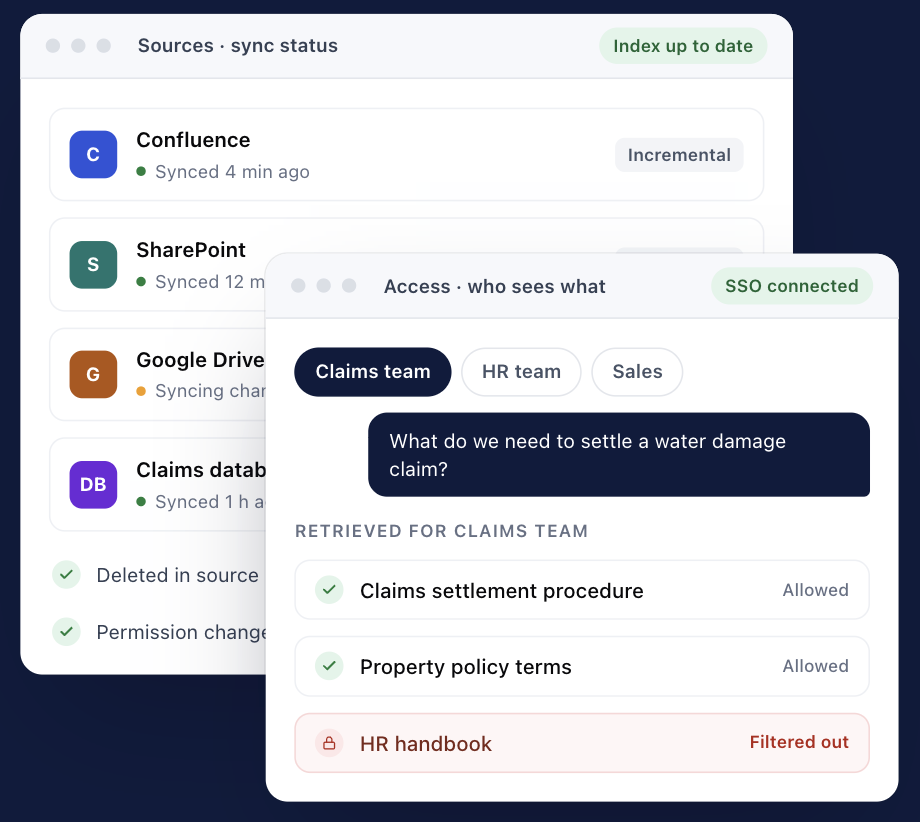
Discovery and data audit
What we need from you
Access to sample sources, an owner for each source, a security contact
Decision pointPilot scope: which use case, which sources, which users
Services
Our company has been building blockchain-based financial projects for over 10 years. Our scope of activity includes the development of centralized and decentralized crypto exchanges, crypto bots, payment gateways, real estate tokenization, DeFi and NFT projects.
AI & ML
Since 2023 we have been building AI for business: custom AI and LLM development, AI agents, chatbots and enterprise AI that connect to your data, products and processes.

RAG Development For Your Company
Merehead builds retrieval-augmented generation systems for your employees and customers: internal knowledge search, customer support assistants and AI features inside an existing product.
Most engagements start with a scoped pilot or a review of a system you already have. Answer quality is tested on your real questions before anything goes to production.
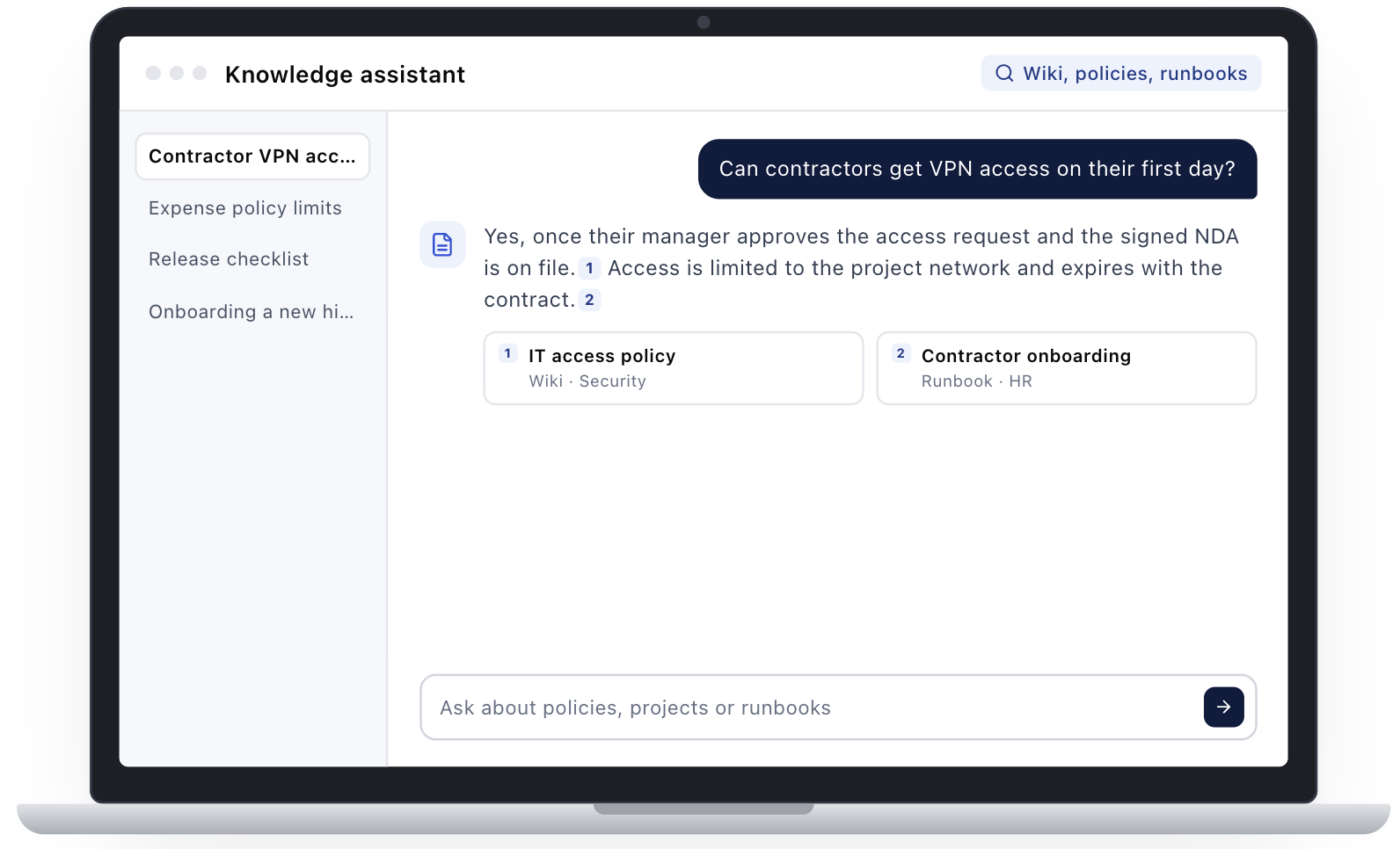
Start with one stage, such as a data readiness check, or hand us the full build through launch and support.
Discuss your RAG project“Now the RAG assistant handles most of these questions. After the pilot, the team itself asked to add materials from our other products.”
Will our documents support reliable answers?
We need retrieval over our sources, kept in sync.
Answers must show up in Slack, our CRM or our product.
Nobody can say how often our prototype is right.
It has to run in our environment, on data that changes weekly.
Policy terms, instructions and claims procedures, across departments that may not see each other’s files.
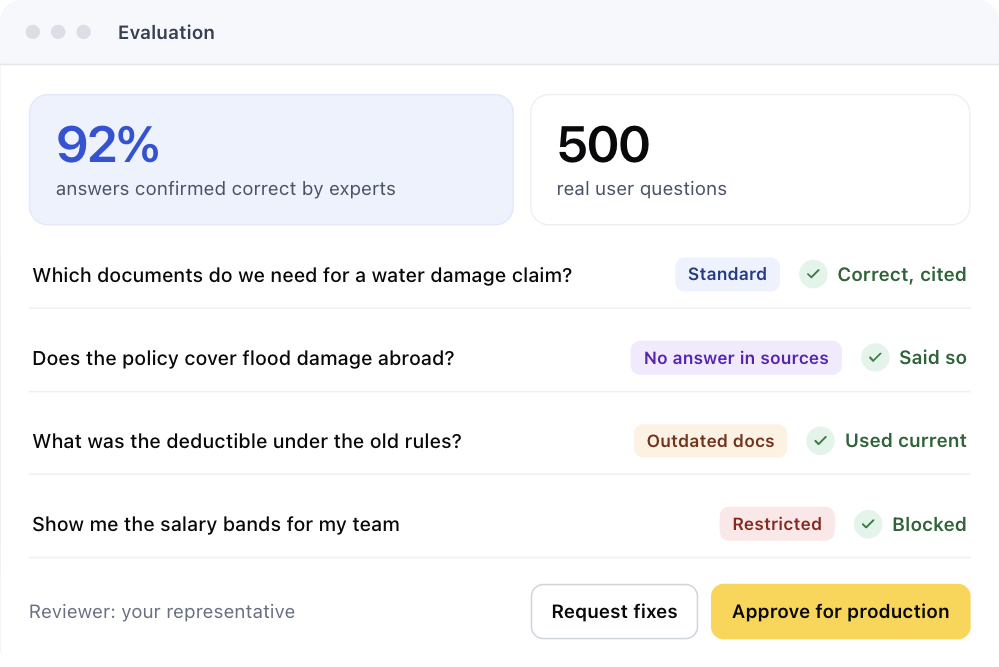
of answers confirmed correctExperts reviewed 500 test questions
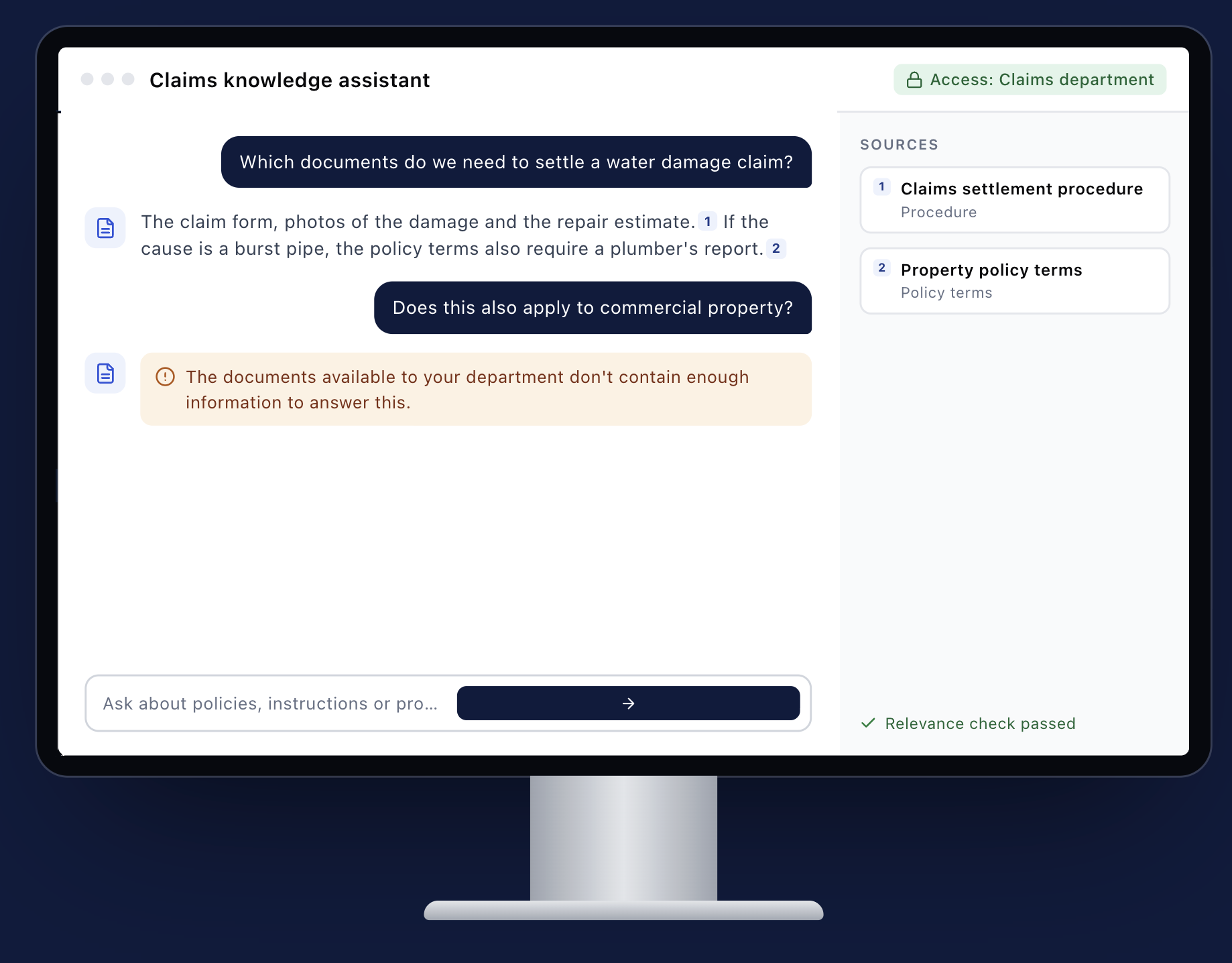
12,000 documents · 4 people · 10 weeks
Discuss your RAG projectEvery stage ends with something you can open, test and sign off.
Your data owners confirm sources, gaps and access rules
Your users test it hands-on with real questions
Your reviewer approves it against agreed criteria
Your engineers review it; ownership is set in the contract
Your team reviews it and takes over agreed tasks
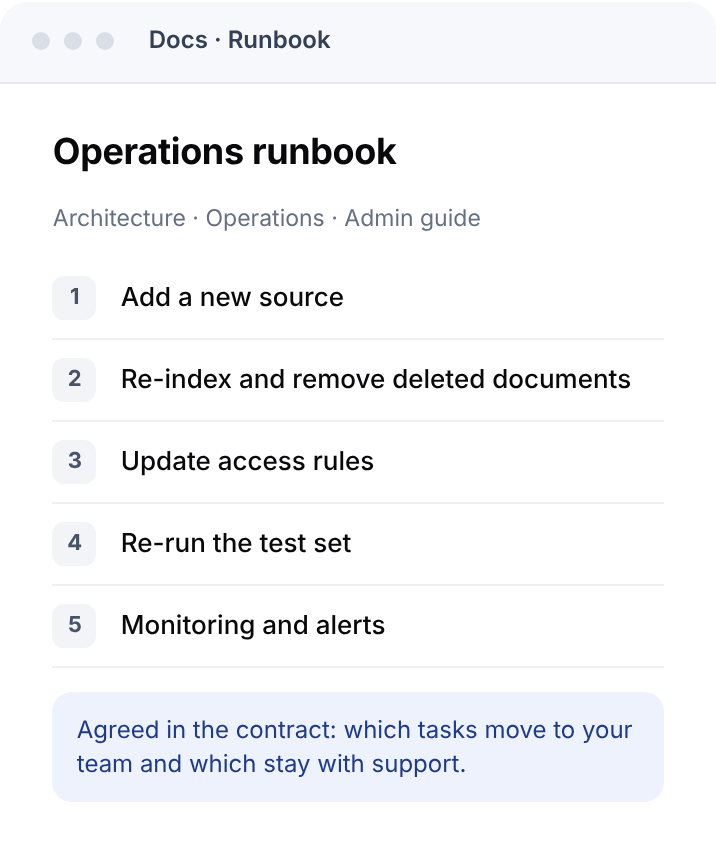
“The quality of the handover stood out. We received the tests, the documentation and a clear process for updating the knowledge base. Our engineers got to grips with the system and took over its support without needing the contractor for long.”
Two RAG systems with the same feature list can need very different amounts of work, because most of the effort sits in the data behind them. So we estimate each project from its inputs rather than from a price list.
Which sources, how many users, access rules, where it runs, which tools and what a wrong answer costs you.
Once you share these requirements, our Solutions Architect sends back a per-module hour breakdown.
After the data audit, the estimate is updated with what the audit found in your sources.
Clean text in one wiki is simple to index. Scanned PDFs, spreadsheets and complex tables need extra parsing and checking.
Duplicates, outdated versions and contradicting documents have to be cleaned up or ranked, or the system will answer from the wrong one.
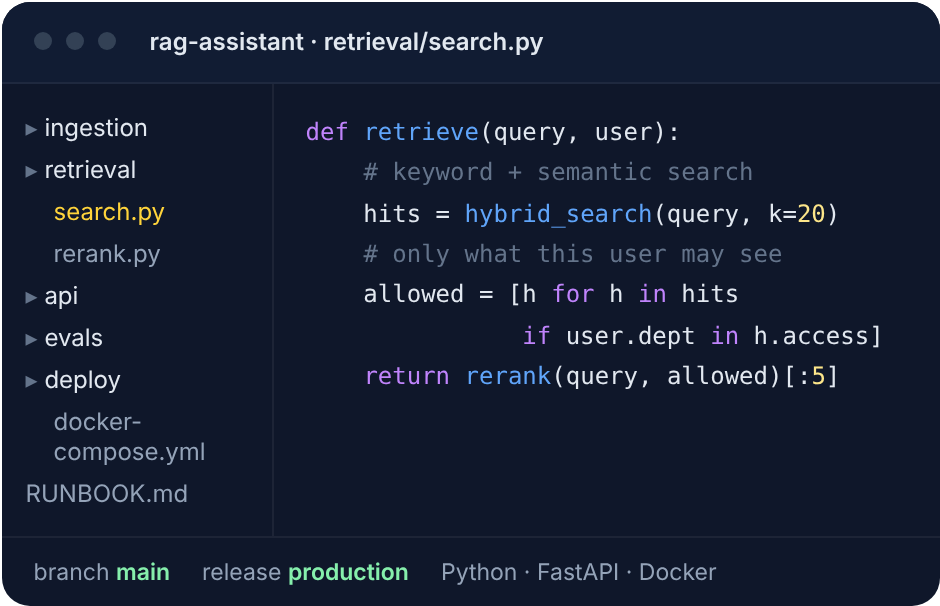
Carrying permissions from SharePoint or a CRM into retrieval is separate engineering work.
A support assistant for public docs needs less expert review than a tool your legal team relies on.
Every target system adds authentication, interface and maintenance work.
A managed cloud setup is usually faster to stand up than a private cloud or on-premises deployment with a self-hosted model.
It affects infrastructure sizing and model usage costs more than build effort.
The insurance assistant covered 12,000 documents with department-level access and took a team of four 10 weeks.
Query volume and model choice move this number the most, so we model it from your expected usage as part of the estimate.
Once the system is live, you pay for LLM usage (per token through an API, or GPU hosting if the model runs in your environment), vector database hosting, compute for ingestion and sync jobs, and monitoring and logs. Add support time for fixing retrieval issues and re-running tests when content changes.
For a wider view of AI budgets, see our breakdown of AI app development cost.
New builds usually move in four phases. Each one ends with a decision on your side before the next one starts. If you already have a RAG system, the work starts with a review of it instead, and the phases are adjusted to what needs fixing.
Access to sample sources, an owner for each source, a security contact
Subject-matter experts who write test questions and judge answers
Security and infrastructure requirements, access to the systems we integrate with
An owner for each source and a channel for user feedback
Your experts define what a correct answer is. Nothing goes to production until your representative approves the results.
Real questions from tickets, chats and search logs, with expected answers approved by your experts.
Including the cases where RAG breaks: no answer in sources, outdated documents, restricted files.
Go to production, or fix, narrow the scope, or stop. Far cheaper after a pilot than after a full build.
“The pilot exposed the gaps, so we put the documents in order and refined the search. Now new employees find what they need faster, and managers spend less time explaining the same things again.”
Custom development makes sense when your sources are complex or sensitive, when users need different access rights, or when the system must run in your environment or inside your product. For simpler cases, a managed RAG platform gets you to a working result faster.
A custom system often uses managed components, such as a hosted vector database or a commercial LLM API; the insurance assistant above runs on the OpenAI API and AWS.
It changes how a model behaves, such as its tone, output format or handling of domain terms, but it does not give the model access to your current documents. You can combine it with RAG when you need both up-to-date knowledge and a specific answer style.
If your project goes beyond retrieval, for example model selection or fine-tuning, see our LLM development services.
Ownership, data readiness, integration, stack choice and support after launch.
Your data stays yours, and ownership of the code, configuration and index is set in the contract before work starts.
No. Most teams start with messy sources. What matters at the start is knowing which documents are authoritative and who owns them. The data audit shows what needs cleaning, and the cleanup that affects answer quality becomes part of the project scope.
Yes. Retrieval and answer generation can be exposed as an API that your product calls. The main design questions are how your app passes the user's identity, so permissions apply, and how answers show their sources in your interface.
We choose after the data audit, based on where your data may be processed, expected query volume and results on your test set. The insurance assistant described above used Python, FastAPI, LangChain, PostgreSQL with pgvector and the OpenAI API on AWS. If data cannot leave your environment, an open-source model hosted on your infrastructure replaces the external API.
Support covers monitoring, fixing sync and retrieval issues, and re-running the test set after source or model changes. Adding new sources or use cases is development work and is scoped separately. The scope and response times of support are set in a separate agreement.
To get an estimate, send us the list of sources you want the system to use, the expected number of users and any security or deployment requirements.