×
Services
Exchange & Trading Infrastructure
DeFi & Web3 Core
NFT Ecosystem & Multi-Chain
Tokenization & Fundraising
Crypto Banking & Fintech
AI Development
Exchange & Trading Infrastructure
Create a centralized crypto exchange (spot, margin and futures trading)
Decentralized Exchange
Development of decentralized exchanges based on smart contracts
Stock Trading App
Build Secure, Compliant Stock Trading Apps for Real-World Brokerage Operations
P2P Crypto Exchange
Build a P2P crypto exchange based on a flexible escrow system
Centralized Exchange
Build Secure, High-Performance Centralized Crypto Exchanges
Crypto Trading Bot
Build Reliable Crypto Trading Bots with Real Risk Controls
DeFi & Web3 Core
DeFi Platform
Build DeFi projects from DEX and lending platforms to staking solutions
Web3 Development
Build Production-Ready Web3 Products with Secure Architecture
NFT Ecosystem & Multi-Chain
NFT Marketplace
Build NFT marketplaces from minting and listing to auctions and launchpads
Tokenization & Fundraising
Real Estate Tokenization
Real estate tokenization for private investors or automated property tokenization marketplaces
Crypto Banking & Fintech
Build crypto banking platforms with wallets, compliance, fiat rails, and payment services
Build Secure Crypto Wallet Apps with a Production-Ready Custody Model
Crypto Payment Gateway
Create a crypto payment gateway with the installation of your nodes
AI Development
AI Development
We build production-ready AI systems that automate workflows, improve decisions, and scale

  RFQ & Quote Management

OTC Crypto Exchange Development Services

We build OTC crypto trading platforms for institutions, brokers, and high-net-worth desks — designed for high-volume, off-book execution with full audit trails, compliance controls, and settlement rails that hold up under real operational pressure.


130+ projects
Experience
since 2015
Experience
blockchain expert
image

  Services

OTC Crypto Exchange Development Services

Our OTC crypto exchange development services cover the full platform lifecycle: product scope, RFQ engine, custody and settlement infrastructure, compliance integration, and operational tooling. Each build is tailored to your counterparty model, asset mix, and regulatory environment.

01

Custom OTC Trading Platform Development

We build bespoke OTC platforms from scratch — RFQ flow, dealer pricing tools, counterparty management, settlement, and reporting. Custom builds support unique approval hierarchies, deal structures, and compliance requirements that white-label products cannot accommodate.
02

RFQ Engine & Quote Management

The RFQ system is the operational core of any OTC desk. We build quote request flows with configurable TTL windows, pricing logic, spread controls, inventory constraints, and acceptance limits. Quote history and dealer notes are logged for audit and dispute resolution.
03

Institutional OTC Desk Software

We develop dealer-facing tooling for institutional desks: live inventory dashboards, multi-asset pricing feeds, one-click settlement initiation, and integrated compliance monitoring. Designed for high-value trades where execution quality and audit readiness are non-negotiable.
04

Broker-Dealer Portal Development

We build client-facing portals where verified counterparties request quotes, review deal terms, confirm trades, and access transaction history. Portals integrate with your KYC/KYB pipeline and include role-based access for multi-entity organizations.
05

Settlement & Custody Infrastructure

We implement settlement workflows for both crypto and fiat legs of OTC trades — hot/cold wallet custody, SWIFT/ACH/SEPA integration, reconciliation automation, and operational controls that prevent settlement errors on large transactions.
06

White-Label OTC Platform

We deliver pre-built, configurable OTC exchange software that can be branded and launched faster than a ground-up build. White-label includes core RFQ, wallet, compliance, and reporting modules. Customization is available for deal flow, UI, and specific integration requirements.
07

OTC Platform Integration & Upgrade

We integrate new modules — liquidity providers, compliance vendors, analytics dashboards, or fiat rails — into existing OTC platforms. We also harden legacy systems with modern security architecture and audit tooling without requiring full rebuilds.

  About

About Merehead as an OTC Crypto Exchange Development Company

Merehead is a blockchain engineering firm with over 10 years of experience building crypto exchange platforms across CEX, DEX, P2P, and OTC models. Our OTC crypto exchange development practice specializes in institutional-grade infrastructure: RFQ engines, settlement systems, custody flows, and compliance-integrated platforms for desks handling large-volume off-book trades.
We deliver custom OTC trading platforms and white-label OTC exchange software for institutional brokers, crypto funds, and enterprise desks. Our builds include full-stack delivery: backend RFQ and pricing logic, dealer and client portals, wallet and fiat settlement infrastructure, KYC/KYB and AML integration, and operational tooling that supports ongoing compliance reporting.
In 2026, OTC crypto desks are migrating from chat-based workflows to structured platforms because reporting expectations are tighter and liquidity is more fragmented. Merehead builds for this operational reality — platforms that work under real trading conditions, not just in demos.
1/3

  Step-by-Step

OTC Crypto Exchange Development Process

OTC platforms have more operational dependencies than retail exchanges — approval workflows, counterparty management, fiat rails, and compliance reporting all require design decisions that affect every module. We use a structured delivery process to resolve these early and keep builds predictable.

Discovery & Requirements
We define your OTC model, counterparty types, deal flow, compliance constraints, and operational requirements. Output: functional specification, integration map, compliance requirements document, and delivery roadmap with milestones.
UI/UX Design
We design dealer-facing and client-facing interfaces for the OTC workflow: quote request forms, pricing dashboards, trade confirmation screens, settlement status views, and admin panels. OTC UX must balance speed for dealers with clarity for compliance teams reviewing historical activity.
Integrations
We connect KYC/KYB providers, AML screening tools, blockchain nodes and custody infrastructure, liquidity provider APIs, fiat payment rails (SWIFT, ACH, SEPA), and market data feeds. Each integration includes error handling, reconciliation logic, and monitoring.
Architecture & Compliance Design
We design the platform architecture with the RFQ engine, custody model, settlement flows, and compliance infrastructure as first-class components — not additions. This phase determines how quotes are priced and TTL'd, how approvals and limits work, and how audit trails are structured.
Core Platform Development
We build the RFQ engine, counterparty management, pricing logic, order acceptance, and settlement initiation layer. Development proceeds in two-week sprints with working demos and acceptance criteria.
Security Audit, Testing & Launch
We run functional QA, load testing under peak volume scenarios, and a security audit covering the RFQ engine, custody flows, and admin access controls. Launch follows a guarded go-live: limited counterparty access for initial trades, monitoring, and escalation procedures before full rollout.
Security and compliance are integrated into every development phase, not added before launch. We conduct security reviews at each milestone and design audit trail infrastructure from the first sprint — because retrofitting compliance into an OTC platform after launch is consistently painful and expensive.

  Integrations

Integrations & Tech Stack

Intro
OTC platform integrations are more operationally complex than retail exchange integrations because settlement errors on large trades are expensive to unwind. We design every integration with reconciliation logic, error states, and operational tooling that supports your finance and compliance teams.
Reporting & Regulatory Exports
We build reporting modules that export trade tickets, counterparty activity, AML alerts, and settlement records in formats compatible with regulatory submission requirements in major jurisdictions.
KYC/KYB & AML Providers
We integrate identity verification (Sumsub, Jumio, Onfido), KYB for corporate counterparties, AML screening (Chainalysis, Elliptic), and sanctions list checking. OTC platforms require deeper counterparty profiling than retail exchanges — we design tiered verification flows for institutional clients.
Fiat Payment Rails
We integrate SWIFT, ACH, SEPA, and local payment networks for fiat settlement. Fiat integrations include funding confirmation flows, reconciliation with the trade ledger, and operational controls around settlement windows and cutoff times.
Liquidity Providers & Market Data
We connect LP APIs for reference pricing, integrate real-time market data feeds for spread calculation, and build smart order routing logic for cases where your desk hedges positions across multiple venues.
Blockchain Nodes & Custody
We connect to blockchain infrastructure for deposit monitoring, withdrawal signing, and multi-sig custody. Node integrations include confirmation handling, chain reorg detection, and fallback providers for high-availability settlement.

  Architecture

OTC Exchange Architecture We Build

OTC platforms require a different architecture from retail exchanges. There is no central order book — instead, the platform manages bilateral quote flows, approval state machines, and settlement coordination across two legs of every trade. We build in modular layers so each component can be maintained and scaled independently.


01
RFQ Engine & Pricing Core
The RFQ engine manages quote lifecycle: request intake, pricing logic with spread and inventory controls, TTL enforcement, acceptance, and rejection. State consistency is critical — every quote must have a single authoritative state at any point. We implement event-sourced architecture for full auditability.
02
Custody & Settlement Layer
This layer handles crypto address management, wallet signing policies, hot/cold separation, and fiat settlement coordination. For each settled trade, the layer produces a settlement record linking both crypto and fiat legs with timestamps and counterparty identifiers.
03
Compliance & Reporting Layer
KYC/KYB, AML transaction monitoring, sanctions screening, and Travel Rule compliance are implemented as first-class platform components — not third-party add-ons bolted onto a trading system. Reporting outputs are designed for regulatory submission and internal audit teams.
04
Dealer & Client Portal Layer
The dealer interface provides live pricing tools, inventory visibility, and one-click trade execution. The client portal provides quote request flows, trade history, and settlement status. Both surfaces share an access control model with role-based permissions and session audit logging.
This architecture reflects what we've learned across 20+ exchange builds: the components that change most often, compliance rules, fee logic, LP connections - must be isolated from the components that cannot fail.

  Cost

Cost of OTC Crypto Exchange Development

OTC development cost is driven by four variables: fiat settlement complexity, counterparty compliance depth, liquidity provider integration count, and approval workflow requirements. Each adds engineering scope that compounds — a desk needing SWIFT, institutional KYB, and multi-entity access controls costs materially more than a crypto-only OTC portal.

In our experience, the two most consistently underestimated cost items are fiat rail integration (banking approvals add 4–8 weeks regardless of development progress) and post-launch compliance tooling. We surface these early so budgets reflect the full operational picture before contracts are signed.
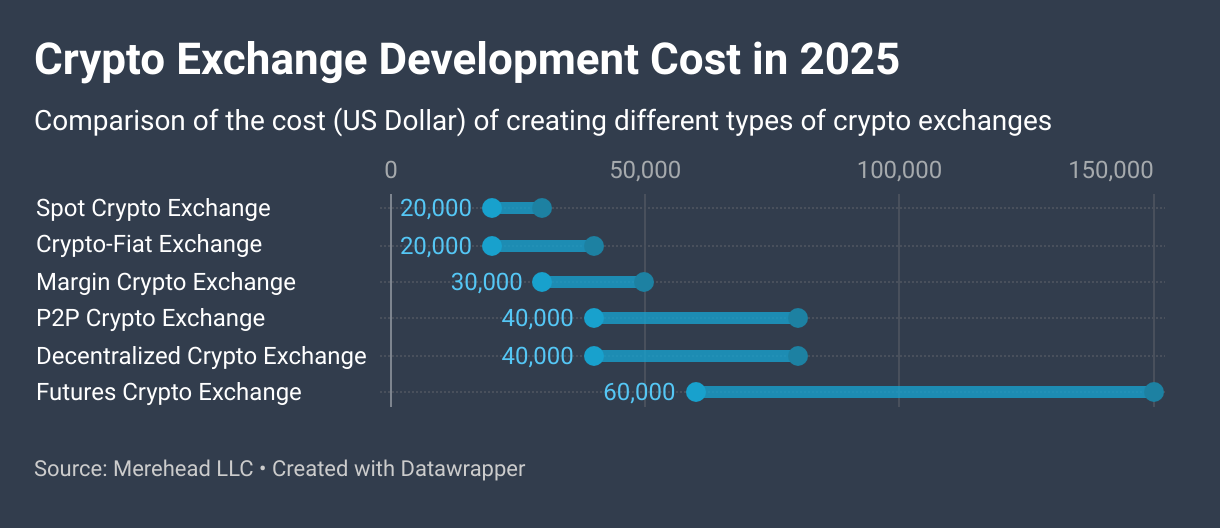
Cost Estimates
White-Label OTC Platform: $40,000 – $80,000
Custom OTC Trading Platform: $80,000 – $120,000
OTC Platform with Fiat Rails: $120,000 - $200,000
OTC development cost depends on deal flow complexity, fiat integration requirements, counterparty model, and compliance scope. Budgets above $200,000 apply to multi-entity desks with deep liquidity integration and multi-jurisdictional compliance requirements. Fiat rails and institutional KYC/KYB are the most significant budget drivers beyond the core RFQ platform.

Merehead maintains a production-tested codebase for RFQ engines, custody flows, and KYC/AML integrations built across 20+ exchange projects. We reuse audited components rather than rebuilding from scratch — reducing OTC platform delivery time by 6–10 weeks and eliminating entire categories of integration risk.

Share your OTC desk requirements and we'll return a scoped estimate — with line-item breakdown and timeline - within 1 business days.
Contact Expert  

Who Should Build an OTC Crypto Exchange

Institutional Crypto Brokers
Crypto Funds & Family Offices
Banks & Fintech Companies
Exchanges with OTC Desks

  Reason

Why Choose Merehead as Your OTC Crypto Exchange Development Company

OTC crypto exchange development is fundamentally different from building a retail exchange. The flow — request, quote, acceptance, settlement, reconciliation — looks simple until you add real constraints: TTL windows on quotes, inventory limits, approval hierarchies for large trades, fiat settlement across SWIFT and SEPA, and audit logs that satisfy a compliance team's questions months later.

Merehead has built this infrastructure in production, not in demos. We understand the difference between a platform that processes test trades and one that handles $10M settlements reliably.
0+ years on the market
0+ completed projects
We build crypto exchange platforms across all models — CEX, DEX, P2P, and OTC. This cross-model experience means our OTC builds benefit from proven matching engine patterns, custody architectures, and compliance workflows. You get a team that has seen what breaks at scale, not one learning on your project.
Write to an expert  
Production OTC Delivery Experience
We have built RFQ engines, settlement workflows, and custody integrations for live OTC desks. This experience prevents the failure modes that appear after go-live — approval bottlenecks, reconciliation gaps, and audit trail inconsistencies.
Compliance-First Architecture
OTC platforms face tighter scrutiny than retail exchanges because of trade size and counterparty profiles. We design KYC/KYB, AML screening, transaction monitoring, and sanctions checks into the platform architecture from day one — not retrofitted after the fact.
Fiat & Custody Infrastructure Expertise
Settlement in OTC is the hard part. We build fiat rails (SWIFT, ACH, SEPA), crypto custody flows, and reconciliation tooling that keep financial operations running without manual intervention at every step.
Transparent Milestones & Source Code Ownership
We deliver in clear milestones with demos and acceptance criteria. You receive full source code with no vendor lock-in and documentation sufficient for your own engineering team to maintain and extend.

We deliver with full source code ownership, technical documentation, and staff handoff. Our SLA-based support plans cover post-launch stability during high-volume periods and regulatory inquiries.

  FAQ

Have questions in mind?

Answers to the most frequently asked questions about OTC crypto exchange development

An OTC (over-the-counter) crypto exchange is a platform where trades are executed directly between two parties — outside a public order book. Instead of posting bids and asks that anyone can see and match, OTC trades follow a request-for-quote (RFQ) flow: the buyer or seller requests a price, the dealer quotes, and both parties agree before settlement is initiated. OTC is preferred for large trades because it avoids market impact — a $5M Bitcoin buy on a public exchange moves the price; the same trade through an OTC desk executes at a negotiated price without touching the public market.

OTC crypto exchange development costs range from $40,000 for a white-label solution to $200,000+ for a fully custom institutional platform with fiat rails, advanced compliance, and multi-entity access controls. The primary cost drivers are fiat settlement integration (SWIFT, ACH, SEPA), institutional KYC/KYB depth, liquidity provider connections, and compliance reporting requirements. A standard custom OTC platform without fiat integration typically runs $60,000–$100,000. Budget separately for security audit ($15,000–$40,000) and ongoing infrastructure costs ($1,000–$5,000/month).

A white-label OTC platform with standard customization can be deployed in 6–10 weeks. A custom OTC build takes 3–5 months depending on fiat integration complexity, compliance scope, and the number of counterparty types supported. The most common timeline driver is fiat settlement integration — banking connections, reconciliation logic, and compliance sign-offs add 4–8 weeks beyond core platform development. Starting the banking relationship in parallel with development is the single most effective way to reduce total time to launch.

OTC platforms handle large transactions between known counterparties, which creates a higher compliance obligation than retail exchanges in most jurisdictions. Required components include: KYC/KYB identity verification for all counterparties (including corporate entity verification for institutional clients), AML transaction monitoring and suspicious activity reporting, sanctions screening against OFAC, UN, and EU lists, Travel Rule compliance for transfers above $1,000, and trade ticket logging that supports regulatory inquiry responses. In the US, OTC desks operating above certain volume thresholds may require MSB registration with FinCEN and state-level money transmitter licenses.

Yes. We integrate SWIFT, ACH, SEPA, and local payment networks for fiat settlement in OTC trades. Fiat integration is the most operationally complex component of an OTC build — it requires banking partnerships, reconciliation automation for fiat and crypto legs, and operational controls around settlement windows and cutoff times. We have experience integrating fiat rails for OTC platforms serving European, US, and Middle Eastern institutional clients. Banking partnerships for a new OTC desk typically take 3–6 months to establish — we recommend starting this process before development completes.

A white-label OTC platform is pre-built software that can be configured and branded for your desk. It covers standard RFQ flow, counterparty management, basic compliance, and crypto custody. Suitable for desks with requirements close to the standard model and where speed to launch is the priority. A custom OTC crypto exchange is built to your exact specifications — unique approval hierarchies, specific deal structures, multi-entity support, proprietary pricing logic, or deep integration with your existing infrastructure. Custom builds take longer and cost more, but avoid the painful retrofits that happen when a white-label product can't accommodate your real operational requirements.
Talk to an expert
We are ready to answer all your questions
Top expert
10 years of experience

  Security

Security & Compliance for OTC Platforms

Custody & Key Management
We implement MPC (multi-party computation) or multi-sig custody architectures that require multiple approvals for large withdrawals. Hot wallet exposure is minimized through automatic sweep policies and cold storage thresholds configured for your operational risk tolerance.
Access Control & Session Management
Role-based access controls separate dealer, compliance, finance, and admin permissions at the platform level. Session logging records all access and actions for audit purposes. 2FA and hardware key support are standard for privileged roles.
Audit Trail & Immutable Logging
Every quote, acceptance, settlement, and admin action is logged with timestamps, user identifiers, and IP records in an immutable audit log. This infrastructure supports regulatory inquiries, internal security reviews, and dispute resolution.
An OTC platform that loses a large trade to a security incident — or fails a compliance audit because its logs are inconsistent — loses institutional clients that took years to acquire. We build security and compliance infrastructure as first-class platform components for exactly this reason. For US-facing platforms with SEC or FINRA requirements, we integrate advanced market surveillance and transaction monitoring tools aligned with regulatory expectations.

  Case study

Proof of Experience

Delivery Metrics
We structure proof using delivery timeline, feature scope, integration count, and post-launch performance metrics. Our OTC platforms have processed combined settlement volumes exceeding $200M across client deployments, with settlement error rates below 0.01%.
Compliance Outcomes
Platforms we have built have passed external security audits and regulatory compliance reviews in multiple jurisdictions. We can provide anonymized reference accounts with our clients' permission.
Deep experience
Merehead has delivered OTC crypto exchange platforms for institutional brokers, crypto funds, and exchange operators across US, EU, and UAE markets since 2015.
Why is this important?
Our OTC builds share a common operational foundation: RFQ engines that have processed high-value trades without settlement errors, custody flows that have passed external security audits, and compliance integrations that have satisfied regulatory review in multiple jurisdictions.

The codebases we maintain reflect real operational feedback — from dealers who needed faster quote tooling, compliance officers who needed cleaner audit exports, and finance teams who needed reconciliation that didn't require manual intervention at month-end.

  Liquidity

Liquidity Strategy for OTC Platforms

Liquidity strategy for OTC is not the same as for a retail exchange. An OTC desk's pricing depends on its own inventory position, LP quotes, and the relationship with the specific counterparty — not on a public order book. We design liquidity infrastructure for this bilateral model, with the monitoring and controls that prevent a mispriced quote from becoming an expensive operational error.
Write to an expert  
Liquidity Provider Integration
We integrate LP APIs for reference pricing and hedging support. OTC desks that internalize positions need LP connectivity to offset risk on large trades. We build routing logic that connects to multiple providers with automatic fallback.
Inventory & Risk Controls
We build inventory position tracking, exposure limits by asset and counterparty, and automated alerts when thresholds approach. Dealers need real-time visibility into their net position to price quotes accurately without accumulating unintended exposure.
Spread Management & Fee Configuration
We implement configurable spread logic — fixed spreads, dynamic spreads based on market volatility, and tiered pricing by counterparty volume or relationship. Fee structures are configurable without code changes for operational flexibility.
Do you have a project idea?
Send
Yuri Musienko
Business Development Manager
Yuri Musienko specializes in the development and optimization of crypto exchanges, binary options platforms, P2P solutions, crypto payment gateways, and asset tokenization systems. Since 2018, he has been consulting companies on strategic planning, entering international markets, and scaling technology businesses. More details