×
Services
Exchange & Trading Infrastructure
DeFi & Web3 Core
NFT Ecosystem & Multi-Chain
Tokenization & Fundraising
Crypto Banking & Fintech
AI Development
Exchange & Trading Infrastructure
Create a centralized crypto exchange (spot, margin and futures trading)
Decentralized Exchange
Development of decentralized exchanges based on smart contracts
Stock Trading App
Build Secure, Compliant Stock Trading Apps for Real-World Brokerage Operations
P2P Crypto Exchange
Build a P2P crypto exchange based on a flexible escrow system
Centralized Exchange
Build Secure, High-Performance Centralized Crypto Exchanges
Crypto Trading Bot
Build Reliable Crypto Trading Bots with Real Risk Controls
DeFi & Web3 Core
Web3 Development
Build Production-Ready Web3 Products with Secure Architecture
Web3 App Development
Build Web3 Mobile and Web Apps with Embedded Wallets and Token Mechanics
DeFi Platform
Build DeFi projects from DEX and lending platforms to staking solutions
NFT Ecosystem & Multi-Chain
NFT Marketplace
Build NFT marketplaces from minting and listing to auctions and launchpads
Tokenization & Fundraising
Real Estate Tokenization
Real estate tokenization for private investors or automated property tokenization marketplaces
Crypto Banking & Fintech
Build crypto banking platforms with wallets, compliance, fiat rails, and payment services
Build Secure Crypto Wallet Apps with a Production-Ready Custody Model
Crypto Payment Gateway
Create a crypto payment gateway with the installation of your nodes
AI Development
AI Development
We build production-ready AI systems that automate workflows, improve decisions, and scale

  Mobile Web3 Apps (iOS & Android)

Web3 App Development Company

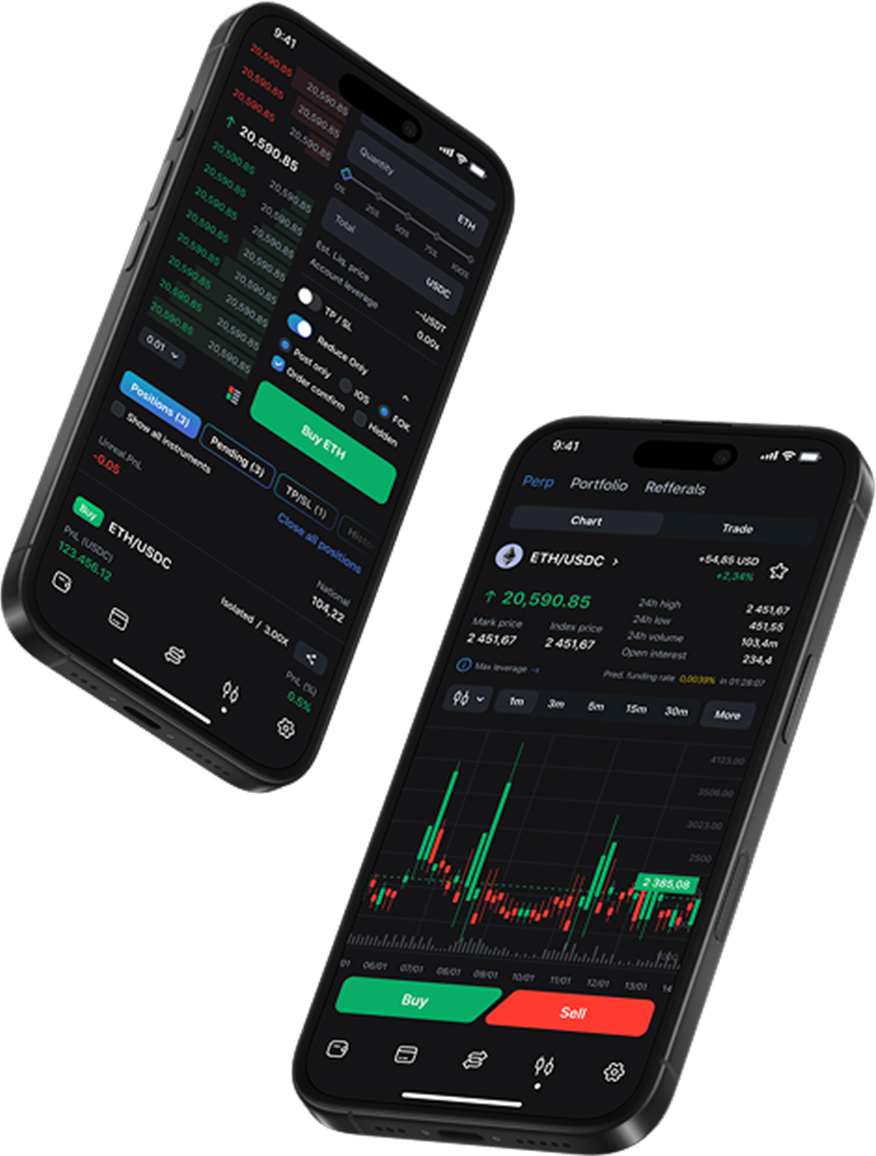
We build Web3 applications — mobile (iOS/Android) and web — that combine smart contracts, wallet-based UX, token mechanics, and NFT features into production-ready products. Merehead delivers with full source code ownership, security-first engineering, and clear milestones.

130+ projects
Experience
since 2015
Experience
blockchain expert
image

  Services

Web3 App Development Services

Our Web3 app development services cover the full product lifecycle — from architecture and smart contract design to mobile delivery, wallet integration, and post-launch support. We build Web3 applications that work for users who have never touched crypto alongside users who have been in the space for years.

01

Web3 Mobile App Development

We build iOS and Android Web3 apps with embedded wallet onboarding, transaction signing flows, token balance displays, and NFT management. React Native is our primary mobile stack, with biometric authentication and app store-compliant token mechanics built in.
02

dApp Development (Web3 Frontend + Backend)

We build dApps with wallet-based authentication, safe transaction signing UX, and clear pending/confirmed/failed states. Off-chain backends handle search, notifications, and data that doesn't need to live on-chain — reducing gas costs without sacrificing decentralization where it matters.
03

Smart Contract Development & Integration

We develop smart contracts for tokens (ERC-20, ERC-721, ERC-1155, SBT), marketplace logic, DeFi primitives, and application-specific protocol rules. Contracts are tested with Hardhat or Foundry and structured for external audit readiness.
04

Wallet Integration & Embedded Wallet UX

We integrate MetaMask, WalletConnect, RainbowKit, and embedded wallet providers (Privy, Magic.link) based on your target audience. For consumer Web3 apps, we recommend embedded wallets by default — external wallet requirements consistently reduce conversion by 3-5x for non-crypto-native users.
05

NFT & Token Application Development

We build NFT minting interfaces, token-gated access systems, credential issuance platforms, and learn-to-earn mechanics. Applications include marketplace features, on-chain reputation systems, and Soulbound Token (SBT) implementations for non-transferable credentials.
06

DeFi App Development

We build DeFi interfaces for DEX trading, lending and borrowing, staking, and yield distribution. Frontend design prioritizes transaction clarity — users understand exactly what they're signing before they sign it. Backend indexing via The Graph provides real-time portfolio and position data without direct chain scanning.
07

Web3 eLearning & EdTech App Development
We build Web3 eLearning applications with NFT certificate issuance, learn-to-earn token mechanics, and on-chain credential verification. Credential contracts use SBTs for non-transferable diplomas and NFTs for transferable course completions — designed for L2 deployment to keep per-credential gas costs under $0.01.

  Products

Web3 Applications We Build

We build Web3 applications across consumer, enterprise, and protocol categories. Each product is designed for the users who will actually use it — with wallet UX calibrated to their crypto literacy level and on-chain logic scoped to what genuinely requires decentralization.

Web3 Mobile Apps
iOS and Android applications with embedded wallet onboarding, token management, NFT galleries, and in-app transaction flows. Built with React Native for cross-platform delivery and Privy or Magic.link for mainstream-accessible wallet creation.
Web3 Consumer Applications
Dating apps with on-chain reputation and token-gated matching. eLearning platforms with NFT credentials and learn-to-earn mechanics. Social apps with decentralized identity and portable follower graphs. Healthcare apps with patient-controlled medical records on IPFS.

Web3 Enterprise Applications
Corporate credential verification systems that replace PDF certificates with on-chain SBTs. Supply chain traceability platforms. Real estate tokenization interfaces. Treasury management dashboards for DAOs and token-holding companies.
DeFi Applications
DeFi development for trading interfaces, lending dashboards, staking portals, and yield farming UIs. Built with wagmi and Viem for type-safe contract interactions and The Graph for indexed data.

Every Web3 app we build includes a documented on-chain/off-chain boundary — a technical specification of which application state lives on blockchain and which lives in a conventional database. This boundary document is the architectural foundation that prevents the most common Web3 app development mistake: putting everything on-chain and discovering the gas costs make the product economically unviable at scale.
1/3

  Step-by-Step

Web3 App Development Process

Web3 app development requires decisions early in the process — blockchain choice, wallet model, on-chain/off-chain boundary — that are expensive to reverse later. Our process resolves these in the first phase so development proceeds without architectural pivots.

Discovery & Architecture
We define your Web3 app's on-chain/off-chain boundary, blockchain selection, wallet model (external vs embedded), and token architecture if applicable. Output: product specification, architecture diagram, and delivery roadmap.
UI/UX Design
We design wallet connection flows, transaction confirmation UX, loading states (pending/confirmed/failed), and error recovery paths. Web3 UX has failure modes that Web2 design patterns don't cover — we prototype these explicitly before development.
Testing & Security Review
Smart contract testing (unit, integration, fuzz), mobile app QA (device compatibility, wallet flows, transaction edge cases), and security review of custody flows and admin controls. External audit engagement coordinated if required.
Smart Contract Design
We design the smart contract interface — functions, events, state variables, access controls — before writing implementation code. This contract interface becomes the integration specification that frontend and backend developers work against in parallel.
Development (Parallel Tracks)
Smart contract development (Hardhat/Foundry) and frontend/mobile development (React/React Native + wagmi) run in parallel against the agreed contract interface. Two-week sprints with working demos.
Deployment & Launch
Mainnet contract deployment with verified source code on block explorers. App store submission (iOS App Store, Google Play) with compliance review for token mechanics. Guarded launch with monitoring active from day one.
Security is designed in from the first sprint, not added before launch. Smart contracts are tested with unit tests, integration tests, and fuzz testing before any external audit engagement. The mobile app undergoes penetration testing and wallet flow review as part of QA — not as a separate security phase.

  Stack

Tech Stack & Ecosystems

Intro
We select blockchain networks, frameworks, and infrastructure tools based on your app's performance requirements, gas economics, target user geography, and long-term maintainability — not on what's currently trending.
The Graph (Indexing)
We use The Graph to build subgraphs that index contract events into queryable GraphQL APIs — portfolio balances, transaction history, leaderboards, credential registries. Querying indexed data is 10-100x more performant than reading directly from the chain.
EVM Chains (Ethereum, Arbitrum etc)
We build on EVM chains when ecosystem depth, tooling maturity, and broad adoption are priorities. For consumer apps with frequent micro-transactions, we recommend L2 deployment — Base or Polygon reduce gas costs by 100-1000x vs Ethereum mainnet.
Solana (Rust / Anchor)
We build on Solana for high-throughput applications — gaming, social, high-frequency trading interfaces — where sub-second finality and sub-cent transaction fees are requirements, not nice-to-haves. Anchor framework for program development.
Wallets & Account Abstraction
We implement ERC-4337 account abstraction for gas sponsorship (users don't pay gas), session keys (approve once, sign many), and social recovery (no lost seed phrase). These patterns remove the primary friction points in Web3 consumer app onboarding.
IPFS & Decentralized Storage
We use IPFS via Pinata for NFT metadata, course content, and user-generated files that should persist independently of platform infrastructure. Content-addressable storage ensures files remain accessible even if the platform is discontinued.

  Architecture

Web3 App Architecture We Deliver

We design Web3 app architecture in clearly separated layers — smart contracts, wallet/identity, frontend, backend, and storage — so each can scale and be maintained independently. The layer boundaries are documented and enforced, not assumed.

01
Smart Contract Layer (Solidity / Rust)
ERC-20, ERC-721, ERC-1155, and ERC-5114 SBT contracts for token and credential use cases. DeFi primitives (AMM, lending, staking) for financial applications. OpenZeppelin patterns for security and upgradeability. Hardhat or Foundry for testing and deployment.
02
Wallet & Identity Layer
MetaMask and WalletConnect for crypto-native users. Privy and Magic.link for embedded wallet creation via email or social login — the recommended approach for consumer Web3 apps targeting mainstream audiences. ENS and Lens Protocol for portable Web3 identity.
03
Frontend & Mobile Layer
React and Next.js for web applications; React Native for iOS and Android. wagmi and Viem for type-safe smart contract interaction. RainbowKit or Web3Modal for multi-wallet connection UI. XMTP for decentralized messaging where required.
04
Data & Storage Layer
The Graph for indexed blockchain data (transaction history, event logs, portfolio positions) via GraphQL. IPFS via Pinata or Web3.Storage for decentralized file storage (NFT metadata, course content, profile data). PostgreSQL for off-chain application data that doesn't require decentralization.
The on-chain/off-chain boundary document is delivered at the end of the discovery phase and governs every subsequent architectural decision. It specifies exactly which application state lives on blockchain and which lives in conventional infrastructure — preventing the gas cost surprises that appear when too much logic is pushed on-chain without cost modeling.

  Cost

Cost of Web3 App Development

The cost of Web3 app development is driven by three variables: smart contract complexity, wallet onboarding model, and whether mobile apps are required. A simple dApp with a single contract and basic wallet connection starts around $15,000. A full-featured Web3 mobile application for iOS and Android — with embedded wallet onboarding, token mechanics, NFT features, and smart contract integration — typically runs $60,000–$120,000.
Cost Estimates
Simple Web3 dApp: $15,000 - $40,000
Web3 Mobile App (iOS + Android): $80,000 - $150,000
Web3 eLearning or Social App: $60,000 - $120,000
The most consistently underestimated cost item in Web3 app development is wallet UX. Consumer applications that require MetaMask installation before registration lose the majority of mainstream users. Our Web3 development team implements embedded wallet solutions (Privy, Magic.link) that add $8,000–$15,000 to the budget but are non-negotiable for any app targeting users who don't already have a crypto wallet.

Gas cost modeling is a second often-missed budget item — particularly for apps that mint credentials, issue tokens, or record events on-chain at scale. Issuing 10,000 NFT certificates on Ethereum mainnet costs $8,000–$15,000 in gas; the same operation on Polygon or Base costs $8–$15. We run this calculation during discovery for every project with significant on-chain write volume.

Merehead's pricing reflects 10 years of Web3 and mobile delivery. We reuse audited contract components, tested wallet integrations, and proven architecture patterns across projects — reducing build time without reducing quality. You pay for your product, not for solving problems we've already solved.

Share your Web3 app requirements and we'll return a scoped estimate with component breakdown and timeline within 1 business day.
Contact Expert  

Who Should Build a Web3 App

Web3 Consumer Startups
EdTech & eLearning Companies
Enterprise Credential Platforms
DeFi Protocol Teams

  Reason

Why Choose Merehead as Your Web3 App Development Company

Merehead has been building Web3 applications since 2018 across mobile, web, and protocol layers. As a web3 development company, we have delivered exchanges, wallets, DeFi protocols, NFT marketplaces, and consumer Web3 apps — which means the architectural decisions we make for your project are grounded in what works in production, not in whitepapers.
0+ years on the market
0+ completed projects
The biggest failure mode in Web3 app development is treating the blockchain as the primary system and the app as an afterthought. We invert this: we design the user experience and app architecture first, then implement the on-chain layer to serve it. The result is a Web3 application that real users can actually use — not one that requires a crypto-native background just to get started.
Write to an expert  
Mobile-First Web3 Delivery
We build Web3 apps for iOS and Android with embedded wallet support, biometric signing, and app store-compliant token mechanics. Most Web3 agencies build web-only — we deliver the full mobile product.
Embedded Wallet Expertise
Consumer Web3 apps that require MetaMask installation before first use lose 70-80% of mainstream users. We implement embedded wallet solutions (Privy, Magic.link) that create wallets behind email or social login — Web3 benefits without Web3 friction.
On-Chain / Off-Chain Architecture Split
Not everything belongs on a blockchain. We design the boundary explicitly: on-chain for trust-critical state (balances, ownership, credentials), off-chain for everything else. This keeps gas costs manageable and app performance predictable.
Source Code Ownership, No Lock-In
Every Web3 app we build is delivered with full source code — smart contracts, frontend, backend, and deployment scripts. No SaaS dependency, no ongoing licensing, no constraint on modifying or redeploying after handoff.

We deliver with full source code ownership, no vendor lock-in, and technical documentation sufficient for your own team to maintain. Post-launch SLA-based support is available for production stability during high-traffic periods.

  FAQ

Have questions in mind?

Answers to the most frequently asked questions about Web3 app development

A Web3 app development company builds applications that combine standard app interfaces (mobile or web) with blockchain functionality — smart contracts, wallet authentication, token mechanics, NFT features, and on-chain data. Merehead builds the full product: smart contracts in Solidity or Rust, mobile apps in React Native, web frontends in React/Next.js, wallet integration, backend services, and IPFS storage. You receive a complete, deployable application — not just a smart contract.

Web3 app development services start at $15,000 for a simple dApp (single contract, basic wallet connection, limited frontend). A production-ready Web3 mobile app for iOS and Android runs $60,000–$120,000. Full-featured platforms with DAO governance, DeFi features, and institutional compliance start at $150,000. The security audit ($5,000–$30,000) and embedded wallet implementation ($8,000–$15,000) are the most commonly underestimated line items — budget for both from the start.

A simple Web3 dApp takes 4–8 weeks. A Web3 mobile app for iOS and Android takes 4–8 months depending on feature scope. The security audit adds 4–6 weeks to any timeline involving mainnet deployment. App store submission (iOS App Store, Google Play) adds 1–3 weeks for review, with potential additional time if the token mechanics require policy clarification. Start the app store compliance review in parallel with development — not after QA completes.

For most Web3 consumer apps in 2026, Base or Polygon are the right starting point — EVM-compatible, low gas fees, and well-supported by wagmi and RainbowKit. Ethereum mainnet adds credibility for high-value financial applications but increases user gas costs significantly. Solana is the right choice for high-throughput applications (gaming, social) where sub-second finality and sub-cent fees are requirements. We recommend the network based on your app's specific transaction volume and user geography — not general reputation.

Not if you implement embedded wallets. Solutions like Privy and Magic.link create a blockchain wallet using email or social login — users never see a seed phrase or install a browser extension. We recommend this approach for any Web3 app targeting users who are not already crypto-native. Embedded wallets can always be upgraded to external wallets (MetaMask, Ledger) by advanced users. The conversion difference between embedded and external wallet onboarding is 3-5x in favor of embedded — we've measured this across multiple consumer Web3 app deployments.

A regular app stores all state on your servers and controls user data centrally. A Web3 app stores trust-critical state on a blockchain — balances, ownership, credentials, governance votes — where it's transparent and tamper-proof. Users authenticate with their wallet (a cryptographic key pair) rather than a username/password. The practical differences: users own their data and assets independent of the platform, credentials are verifiable by anyone without contacting the issuing platform, and transactions are irreversible once confirmed. Not every app benefits from these properties — we help clients identify exactly where Web3 adds genuine value vs. where it adds complexity without benefit.
Talk to an expert
We are ready to answer all your questions
Top expert
10 years of experience

  Security

Security & Compliance for Web3 Apps

Smart Contract Testing & Audit Preparation
We test smart contracts with unit tests, integration tests, and fuzz testing before any external audit. Contracts are structured with clear natspec documentation, internal/external function separation, and access control patterns that auditors expect — reducing audit time and cost.
Mobile Wallet Security
We implement secure key storage (iOS Secure Enclave, Android Keystore), biometric transaction signing, session management for wallet connections, and transaction simulation before submission. Users see exactly what a transaction will do before they sign — not after.
App Store Compliance for Token Apps
Apple App Store and Google Play have specific policies for apps with cryptocurrency and token features. We review token mechanics against Apple Section 3.1.1 and Google Play Financial Services policy before development to prevent post-submission rejections — a common and expensive problem for Web3 mobile apps.
In a Web2 app, a compromised account means a password reset. In a Web3 app, a compromised wallet means permanent loss of assets — there is no recovery without a backup. This changes the security model fundamentally: wallet key storage, transaction signing flows, and session management must be treated as critical security surfaces from the first sprint, not hardened before launch.

  Use Cases

Web3 App Use Cases & Industries

eLearning & EdTech
NFT certificate issuance, Soulbound Token (SBT) credentials, learn-to-earn token mechanics, and on-chain academic transcripts. Credential verification time reduced from days to seconds for employers. L2 deployment keeps per-certificate gas costs under $0.01.
Social & Dating Apps
Token-gated matching, on-chain reputation systems, decentralized identity (DID) integration, and anti-catfishing via wallet-based verification. Portable reputation follows the user's wallet — not locked to one platform's database.
Gaming & NFT Applications
In-game asset ownership via NFTs, cross-game item portability, play-to-earn mechanics, and tournament prize distribution via smart contracts. Players own their assets — the game studio cannot remove or alter them unilaterally.
How we scope Web3 features for each vertical
For every Web3 app project, we produce an on-chain/off-chain boundary document that specifies exactly which features require blockchain and which don't. This prevents over-engineering (putting everything on-chain) and under-engineering (missing the features that genuinely benefit from decentralization). The boundary document is delivered in week one — before any code is written.

  Experience

Proof of Experience

Merehead has been building Web3 applications since 2018 — exchanges, wallets, DeFi protocols, NFT marketplaces, and consumer Web3 apps across EVM chains and Solana. Our team includes engineers with backgrounds in both traditional mobile development (iOS, Android, React Native) and blockchain engineering (Solidity, Rust, smart contract auditing) — the combination that Web3 mobile app development requires.
Write to an expert  
Web3 Delivery Track Record
We can provide anonymized delivery metrics from relevant Web3 app projects — scope, timeline, supported chains, and operational outcomes — on request. Our delivered projects span DeFi interfaces, NFT marketplaces, crypto wallet apps, tokenization platforms, and consumer Web3 applications.
Mobile + Web3 Engineering Team
Our team covers smart contract development (Solidity, Rust), mobile development (React Native, iOS, Android), Web3 frontend (React, Next.js, wagmi), backend (Node.js, PostgreSQL), and DevOps — the full stack required for production Web3 app delivery without subcontracting.
Deep Web3 Experience
The projects that achieve adoption are the ones that treat wallet UX as the primary design constraint, not as a feature added after the smart contracts are written. We build mobile-first by default and design the on-chain/off-chain boundary before the first sprint — the two practices that most distinguish production-ready Web3 apps from technically correct but unusable ones.
Do you have a project idea?
Send
Yuri Musienko
Business Development Manager
Yuri Musienko specializes in the development and optimization of crypto exchanges, binary options platforms, P2P solutions, crypto payment gateways, and asset tokenization systems. Since 2018, he has been consulting companies on strategic planning, entering international markets, and scaling technology businesses. More details