
AI cybersecurity in 2027 means one thing for engineering teams: AI stops being a detection feature bolted onto your platform and becomes a component with permissions, a failure mode, and an audit obligation.
Three forces drive the shift — AI agents that execute actions instead of raising alerts, attackers who now generate deepfakes and exploits at industrial scale, and regulators who require you to explain every automated decision after the fact.
A production-ready AI security architecture for a fintech or crypto platform contains six layers:
- Risk scoring layer — threshold-driven transaction segmentation with configurable auto-approve, enhanced-check, and manual-review tiers.
- Agent permission layer — separate read and act rights, whitelist-constrained destinations, and mandatory human approval for irreversible operations.
- Identity layer — verification tiers that map directly to operation limits, continuous authentication, and hardened secondary operations.
- Secrets and key layer — Vault-managed credentials, JWT key pairs deployed through the pipeline, private keys outside developer reach.
- Observability layer — centralized logs, anomaly alerting, and a full decision chain you can reconstruct months later.
- Audit layer — old-value/new-value records on every configuration change and every approve/reject decision.
Over the past two years AI swapped sides with itself. The same voice and video generation models that teams embed into biometric verification now let fraudsters walk straight through that verification. In 2025 the FBI started counting AI-assisted fraud as its own category and logged $893 million in confirmed U.S. losses — counting only cases where investigators proved the AI link.
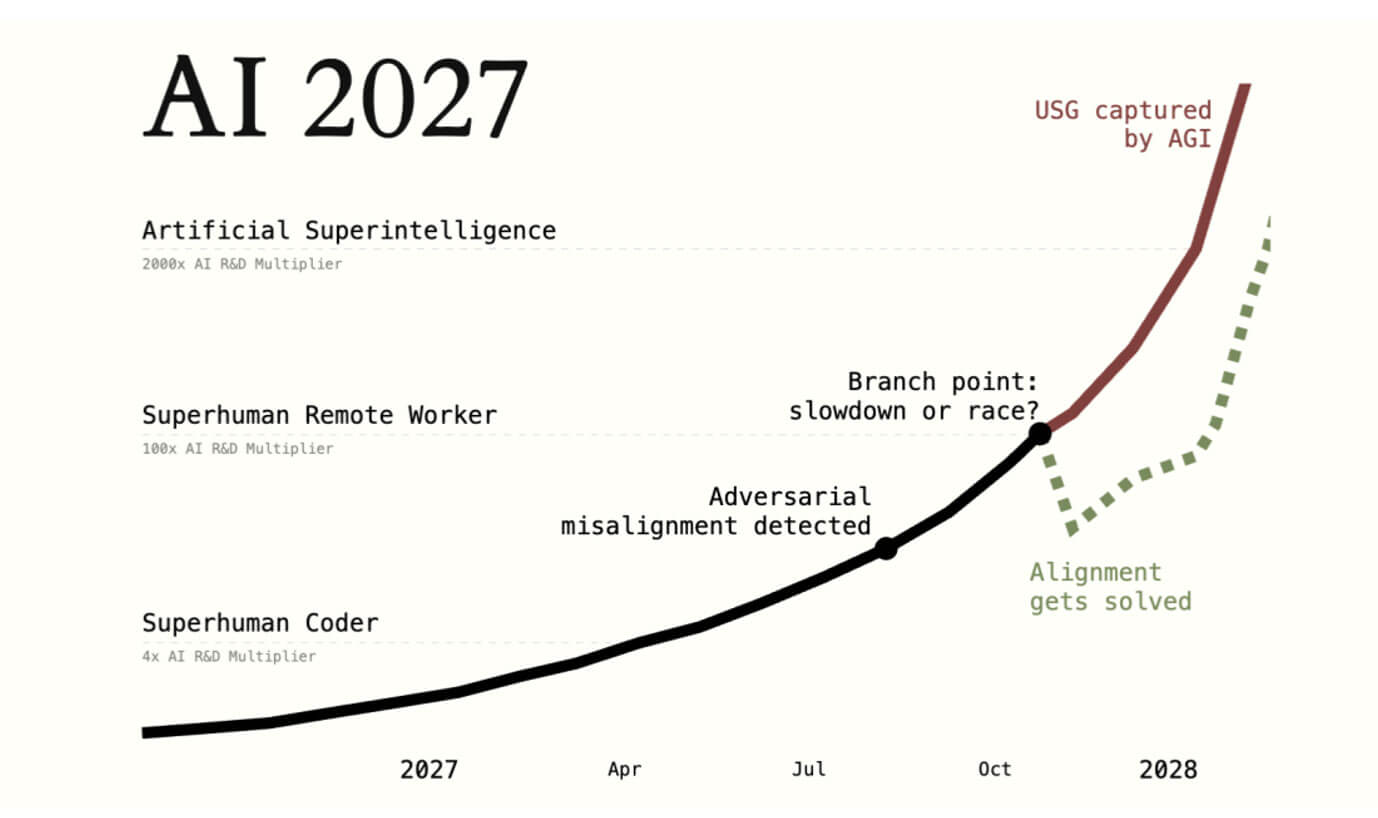
Deloitte projects generative AI will push total U.S. financial-sector fraud losses to $40 billion by 2027, up from $12.3 billion in 2023, with crypto platforms leading every financial vertical in the growth rate of fraudulent attempts. Set against the broader ai market growth statistics 2026, the attack side is scaling faster than the defense budget behind it.
Below we cover six trends that will genuinely change security architecture requirements by 2027, what each one costs to implement, and a readiness checklist you can hand to your team as a working document.
Key Takeaways
- Agentic AI moves from advisor to executor. SOC systems now block transactions and accounts on their own — which creates a new class of operational risk, not a new class of protection.
- Deepfakes and voice cloning dropped the cost of a convincing social engineering attack by an order of magnitude. Selfie-plus-document KYC no longer holds as a standalone barrier.
- The AI stack itself — models, agents, MCP integrations — became an attack surface. Prompt injection has held the top spot in the OWASP Top 10 for LLM Applications two years running.
- LLM-assisted smart contract review accelerates the first pass but creates a false sense of coverage. It does not replace formal verification or manual audit of critical modules.
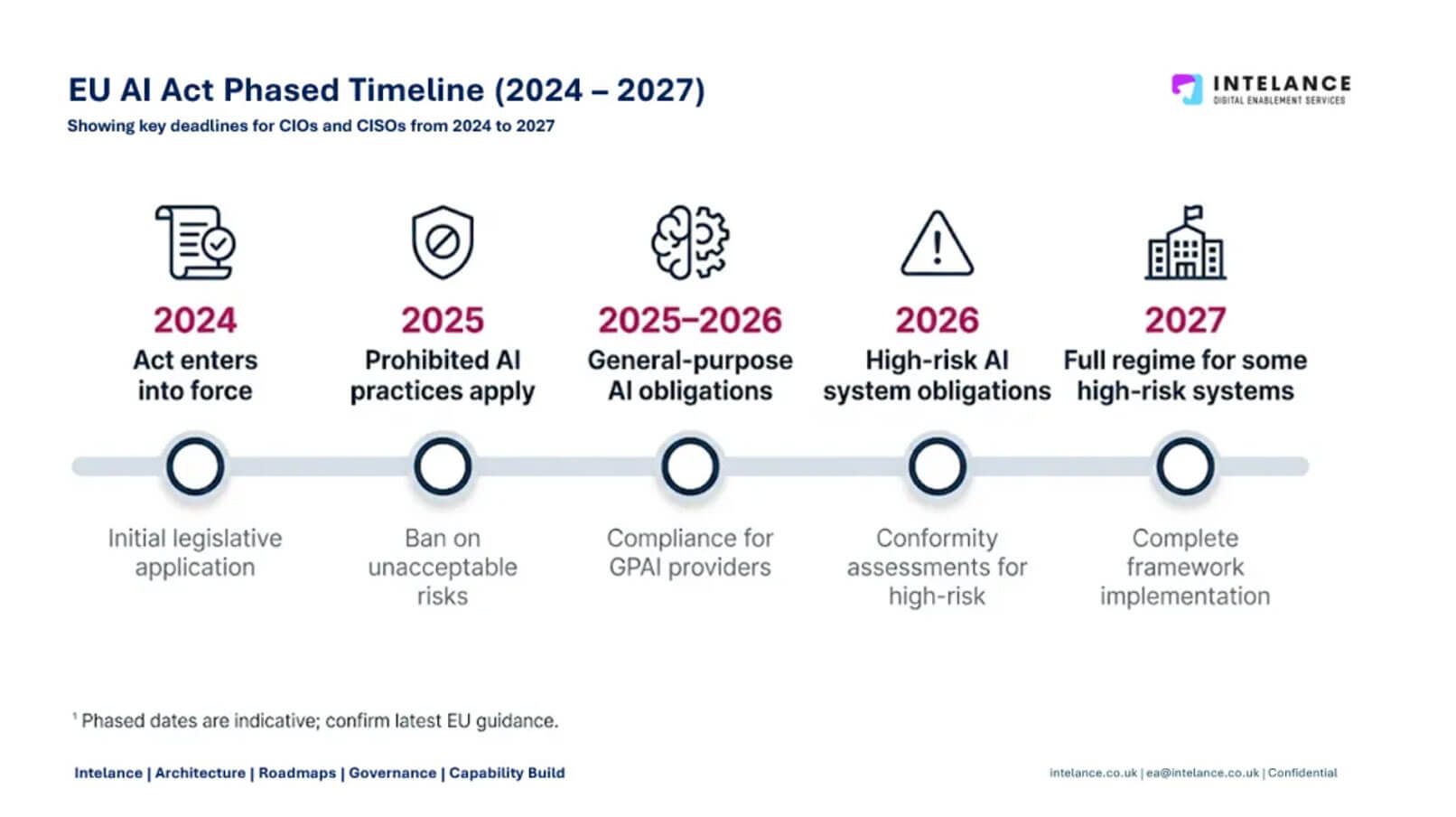
- Regulators are catching up on a delayed schedule. The EU AI Act's high-risk obligations moved to 2 December 2027 for standalone systems and 2 August 2028 for embedded ones, while DORA already requires ICT risk management from MiCA-authorized CASPs today.
- Readiness is an operating model, not a one-time audit: continuous authentication, agent permission boundaries, quarterly adversarial testing of liveness checks, and legally defensible documentation of AI decisions.
Where AI Cybersecurity Actually Stands in 2026
Before we talk about 2027, we need an honest baseline. Otherwise the predictions float free of what teams actually run in production.
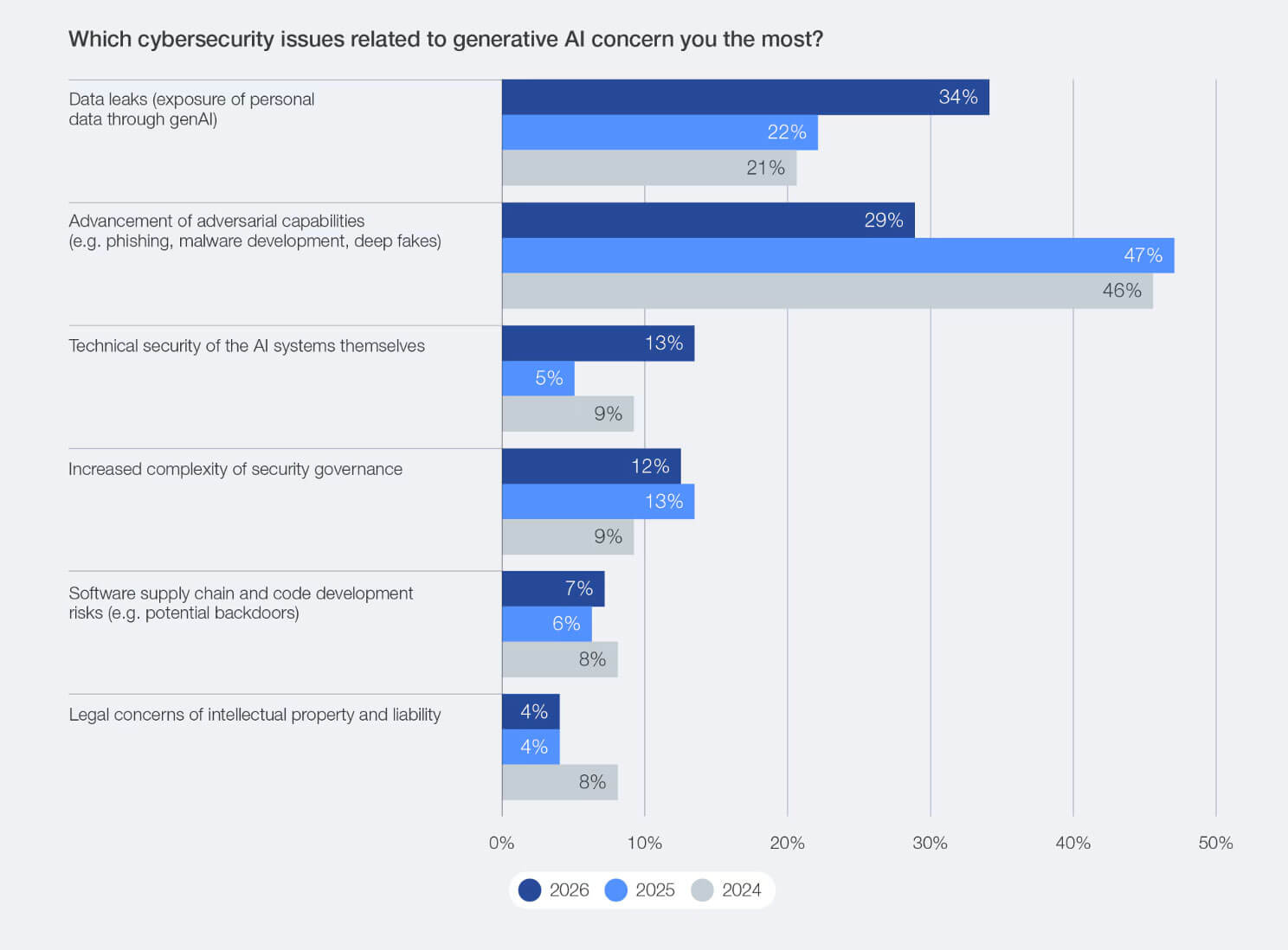
What genuinely works in production today: anomaly detection models on transaction flows, behavioral biometrics at onboarding, and automated alert triage that takes load off Tier-1 analysts. These are mature technologies. Most large exchanges and neobanks have run them for years.
What remains mostly marketing: fully autonomous agents that freeze funds without human involvement, "universal" deepfake detectors with guaranteed accuracy, and LLM smart contract audits that replace an audit team. All three directions move fast, but production maturity sits well behind the vendor decks. Gartner expects more than 40% of agentic AI projects to be cancelled by the end of 2027 — a number worth keeping next to every autonomy pitch you evaluate.
| Technology | Status in 2026 | What to expect by 2027 |
| ML detection of transaction anomalies | Production, widely deployed | Graph models and cross-platform signal sharing |
| Behavioral biometrics | Production at large players | Mid-market standard, merged with continuous authentication |
| Automated alert triage | Production | Partial autonomy on low-risk incidents |
| Autonomous AI agents with act permissions | Early production, pilots | Cautious scaling with mandatory human-in-the-loop |
| Universal deepfake detection | Marketing with production elements | Specialized solutions per attack vector, not universal ones |
| LLM smart contract audit | Supporting tool | First filter inside the pipeline, never the audit itself |
Trend 1 — Agentic AI Moves Into the SOC
The defining shift of 2026–2027 runs from "AI highlights a suspicious alert" to "the agent investigates the incident and executes actions". That difference matters. In the first model a human always makes the final call. In the second, the system acts autonomously inside whatever authority you granted it.
In practice this splits into autonomy levels. At the bottom level the agent gathers context and proposes a decision to the analyst. At the middle level it performs reversible actions — a temporary session block, an additional verification request — and notifies afterward. At the top level it performs irreversible actions such as freezing a withdrawal or locking an account, with no prior human approval, relying entirely on risk thresholds.
That top level carries the real operational risk for fintech and crypto platforms. A false positive with act permissions is not a missed signal — it is active interference in a legitimate customer operation. A blocked withdrawal during a volatility spike. A frozen trader account mid-position. That creates legal exposure, not just reputational damage, the moment you cannot explain and justify the agent's decision after the fact.
The permission matrix we use
| Action class | Example | Required control | Reversible? |
| Read-only | Pull balance, transaction history, risk score | Scoped API token, full request logging | N/A |
| Reversible action | Session lock, step-up verification request, temporary hold | Threshold-driven, post-hoc notification, audit record | Yes |
| Irreversible action | Withdrawal execution, account termination, fund release | Whitelist-constrained destination + manual back-office approval | No |
Case study: building the escalation contour
Challenge. A client's transaction monitoring blocked too much and explained too little. Every moderate risk flag froze a deposit, support drowned in tickets, and nobody could reconstruct why a specific transaction went on hold three weeks earlier. The compliance team wanted more automation. The product team wanted less friction. Both were right.
Solution. We separated the decision into a pipeline rather than a single check: AML (KYT) screening first, then restriction checks against KYC rules, then manual review where enabled. We normalized every provider's risk taxonomy down to roughly 70 unified categories, even though some vendors return 150 or more — that normalization is what lets us swap an AML provider without rewriting decision logic. Enhanced Check calls all active providers in parallel.
Some of them take up to an hour to respond, so we added a timeout with fallback to whatever data arrived in time, rather than holding the user hostage to the slowest vendor. Every threshold change, profile activation, and approve/reject decision writes an audit record with both old and new values.
Result. The transaction state machine now runs pending → on_hold → manual_review → completed / cancelled with a distinct refund path per rejection type: KYT rejection archives the address and refunds through Spot, while manual rejection never credits the funds and returns them separately. Compliance reviews now reconstruct any decision from the audit trail alone. The engineering effort came to 240 hours across backend and frontend.
A risk engine that cannot explain a three-week-old decision is not a control — it is a liability with a dashboard. Audit trail granularity is what survives a compliance review, not the number of checks you run.
 Yuri MusienkoBusiness developer, Merehead
What this layer costs
Concrete numbers from our own estimates, at our standard rates — $40/hour DevOps, $30 backend, $25 frontend, $20 QA, $25 PM:
| Module | Effort | Cost |
| AML / security module: configurable thresholds, behavioral scenarios, withdrawal from new device or geolocation, automatic CRM ticket and block | 120h BE + 120h FE | $6,600 |
| RBAC — admin roles and permission editing | 32h BE + 24h FE + QA/PM | $1,740 |
| Audit logging, client and admin side | 24h BE + 16h FE + QA/PM | $1,300 |
| Deposit and withdrawal limits tied to verification status | 40h BE + 40h FE | $2,200 |
| Full automated-decision + human-control contour | ~420 hours | ~$11,800, 3–4 weeks |
That total sits below one annual license for a mid-tier vendor fraud suite. The difference: your thresholds stay in your admin panel instead of someone else's SaaS, and your audit trail belongs to you. Teams comparing this against a full build should also weigh the ai agent development cost for the orchestration layer, since compute and API calls scale with the number of specialized agents you deploy.
Trend 2 — AI-Powered Attacks Against Financial Platforms
Defense moves cautiously. Offense moves without constraints. Anyone hardening a platform against this shift should start from the baseline controls we cover in our guide to crypto exchange security, because AI-era attacks still enter through the same unpatched surfaces. The cost of preparing a convincing attack collapsed over the past two to three years, and that changes the threat model itself, not just the toolset.
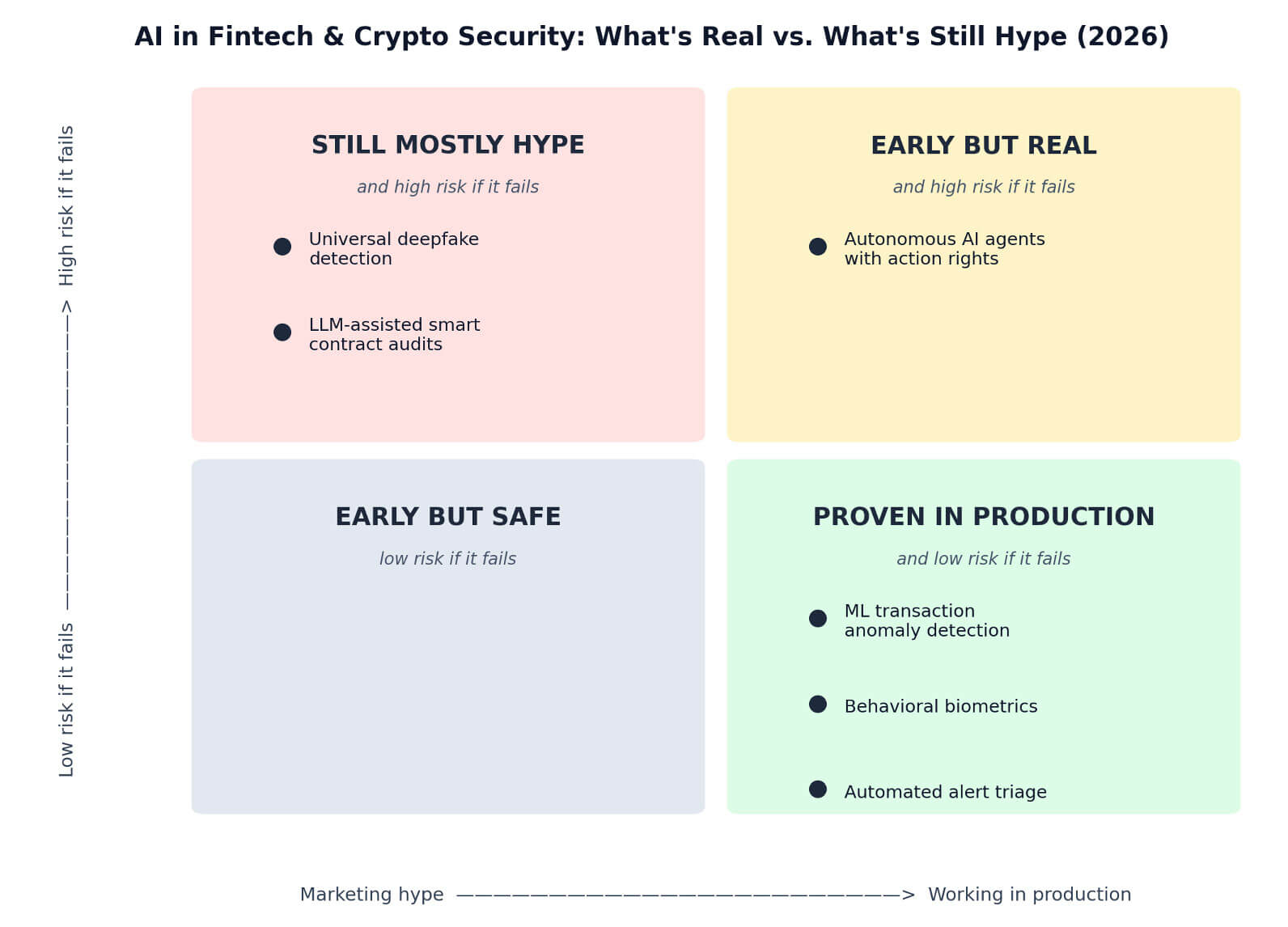
The first vector is KYC and liveness bypass through deepfakes. Current models generate a convincing video stream or clone a voice from under thirty seconds of audio, against the several hours of source material the same job required in 2020. Entrust reports that roughly one in five biometric fraud attempts in 2025–2026 already involves a deepfake. Gartner predicted back in 2024 that up to 30% of organizations would stop treating biometric identification as reliable on its own by 2026 — and that threshold arrived on schedule.
The second vector is voice and video cloning for social engineering against support desks and finance departments. The Arup case remains the reference point: a finance employee transferred $25.6 million after a video call in which every other participant, including the supposed CFO, was synthetic. Mandiant's M-Trends report ranked voice phishing as the second most common initial intrusion vector across organizations in 2025, and the single most common one for cloud incidents.
The third vector is LLM phishing and scalable BEC campaigns. Generative models removed the last bottleneck of older phishing operations — writing convincing, personalized messages by hand across multiple languages. That work now takes seconds and runs at industrial volume.
Where the money actually goes on the defense side
Teams consistently underbudget identity. A full KYC module — verification tiers, integration with a provider like SumSub, bank-partner verification, self-service document checks, and dynamic limits that shift with identification status — runs 240 hours on web ($6,600) or 440 hours with mobile clients ($13,600).
The cost does not sit in the verification call. It sits in the logic that maps verification level to available operations and limits. Vendor products never ship that logic; you always write it on the platform side. Engineering teams that rethink how to use kyc data as an authorization input rather than a compliance checkbox end up with a materially stronger secondary-operation posture.
Trend 3 — Securing the AI Stack Itself
While the industry argues about AI defending platforms and AI attacking platforms, a third and less obvious front opened: the AI stack became the attack surface.
Several vulnerability classes matter here. Prompt injection — an attacker embeds instructions into input the model processes as a legitimate command, either directly through user input or indirectly through a document, email, or web page the model reads during normal work. Context leakage — confidential information that reaches the prompt or system instructions surfaces through a well-crafted query.
Data and model poisoning — manipulation of training or retrieval data to skew system behavior. And the fastest-growing category: tool-calling and MCP abuse, where an over-permissioned agent executes a malicious action through an entirely legitimate tool.
None of this is hypothetical. The OWASP Top 10 for LLM Applications, effectively the industry classification standard, has placed prompt injection first two years running, with excessive agency and system prompt leakage sitting in the top ten as separate critical categories.
Architecture choices at the retrieval layer matter more than most teams expect here — the tradeoffs between rag vs mcp determine how much untrusted content ever reaches your model's context in the first place.
Case study: an AI agent with access to real financial operations
Challenge. We received a specification for an AI agent on a crypto exchange where a single feature list contained both "show transaction history" and "send X amount". Those are fundamentally different operation classes — one idempotent and read-only, the other irreversible and financial. Once an LLM layer holds both through one interface, deterministic authorization disappears: a probabilistic model decides which call to make.
In parallel we already ran a multi-agent LLM system in production — six specialized agents whose Synthesizer produces the final output from the other five plus context retrieved from pgvector. That means the agent's input context is not just the prompt. It is persistent state in a vector store fed by external sources: news, social signals, on-chain data.
Solution. We did not try to make the model more obedient. We moved control outside the model. Withdrawals target whitelist recipients only — the agent never composes a destination address, it selects from a pre-approved list.
On top of that we route every irreversible operation through manual back-office approval, so a human gate applies regardless of model confidence. Key management sits outside developer reach entirely: private keys use AES-256-CBC encryption validated against a 32-byte encryption key, generated on the secp256k1 curve, accessible only to DevOps through VPN plus 2FA, never stored in plaintext anywhere. For the vector layer we deduplicate and cluster incoming news through embeddings before anything enters scoring.
We built that originally so a single event would not count three times in sentiment — in practice it works as a context-poisoning filter. Every agent output writes to PostgreSQL with the full reasoning chain, ML predictions, and retrieved historical precedents. Teams weighing the same architecture decisions from scratch will find the layer-by-layer breakdown in our guide on how to create an ai app maps closely onto this permission model.
Result. The irreversible-action perimeter became deterministic and stopped depending on model behavior. We reconstruct any decision completely: which agent said what, which historical analogues the system retrieved, and what actually happened 24, 48, and 72 hours later. The evaluator checks every signal against reality daily and recalculates agent weights weekly. We know, for example, that a given agent hits 67% accuracy in trending markets and 41% in ranging ones, and the system reduces its influence automatically. Recurring infrastructure for the whole AI layer runs $270–400 per month.
If your agent can move funds to an address it generated itself, you do not have an AI security problem — you have an authorization architecture problem. Containment belongs outside the model, never inside the prompt.
Yuri MusienkoBusiness developer, MereheadTeams designing this layer from scratch should map their model selection and prompt pipeline decisions early — our llm development practice covers the production deployment patterns that keep agent permissions auditable, and the broader question of how to integrate ai into an app without handing it more authority than the business case requires.
The permission contour around an agent costs far less than teams assume: RBAC with separate read and act rights at $1,740, whitelist withdrawals with manual approval inside the limits module at $2,200, and full decision audit trail at $1,300. Roughly $5,200 and two weeks of work. Compare that against the price of one erroneous automated withdrawal to an uncontrolled address.
Yuri MusienkoBusiness developer, MereheadTrend 4 — AI Meets On-Chain Security
A separate layer of 2027 trends plays out directly in blockchain infrastructure.
LLM-assisted smart contract review genuinely accelerates the first pass: fast pattern matching against known vulnerability classes, highlighting suspicious constructs, generating test scenarios. The danger sits in the same place.
The model creates a false sense of coverage. It finds what it already saw in training data and systematically misses the novel, non-trivial attack vectors — precisely the ones behind major exploits. Anyone evaluating smart contract development partners should ask what portion of their review runs on formal methods versus model output.
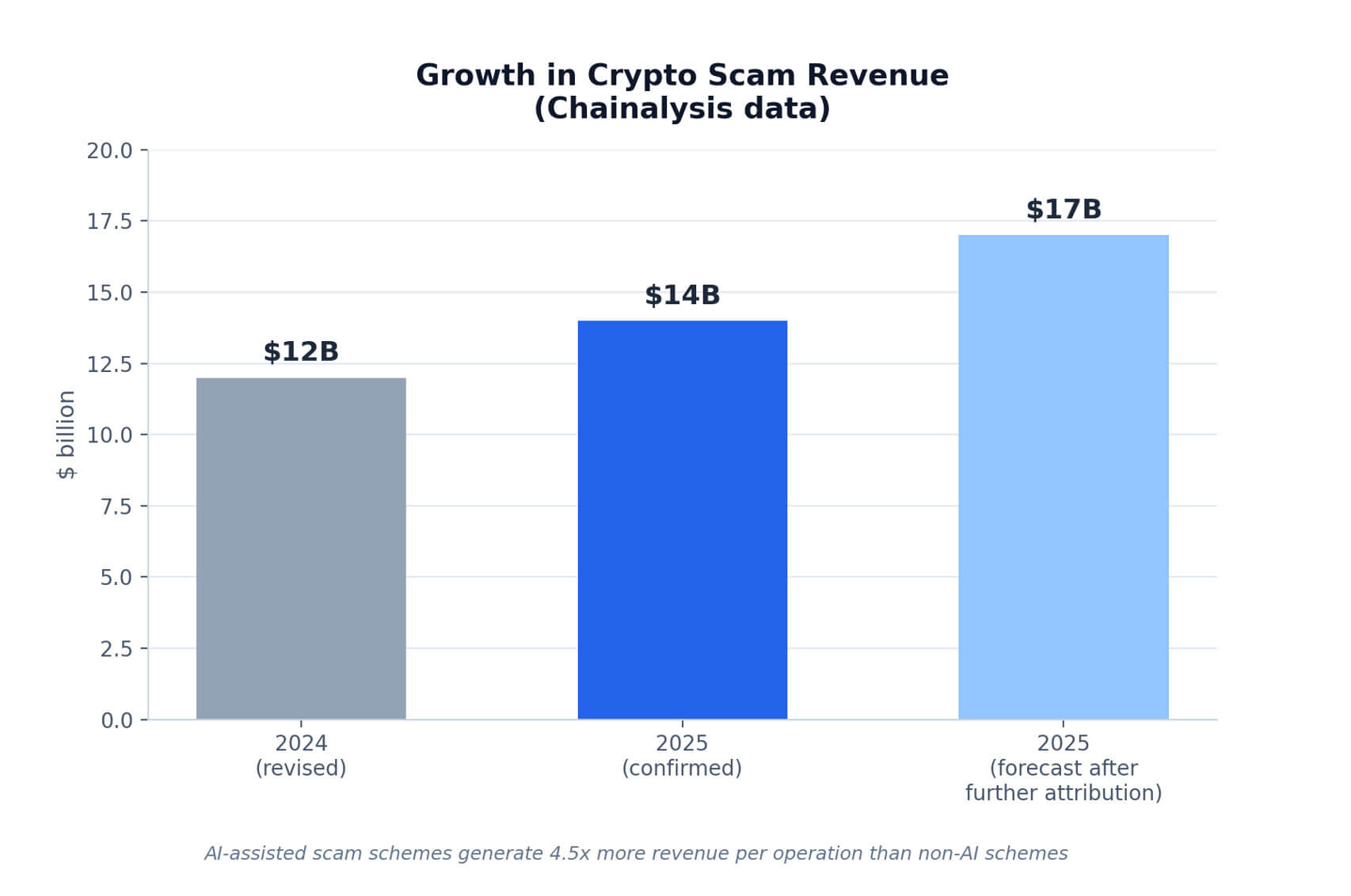
The more mature direction is real-time on-chain analytics: identifying wallet drainer addresses, and behavioral models that surface laundering patterns or rug-pull preparation before the damage lands. Chainalysis reported at least $14 billion flowing to identified crypto scam addresses in 2025, with operations showing visible on-chain links to AI tooling generating roughly 4.5 times more revenue per operation than those without. Attackers already use AI systematically in the on-chain environment.
Real on-chain monitoring also carries a line-item cost teams discover after launch. Each network requires its own integration: $500 per first-tier network (BTC, ETH, TRON, Solana, BNB Chain, XRP, Cardano) and $250 per token standard such as USDT or USDC on ERC-20.
A platform supporting 60–70 assets across four chains is not an API hookup — it is a budgeted engineering layer. The same applies to the wallet contour itself: multisig transactions with an escrow confirmation system run 200 hours ($5,600), and automated hot-to-cold balance rebalancing another 140 hours ($3,900). The custody side deserves its own architectural review — web3 crypto wallet development carries key-management tradeoffs that no monitoring layer compensates for.
None of that removes the need to understand the underlying security of blockchain technology at the protocol level before you design custody flows on top of it.
The honest position, stated plainly rather than buried under marketing: AI does not replace manual audit or formal verification of critical smart contracts. It accelerates the process and widens coverage. Final responsibility for a contract managing meaningful value stays with an expert team working with formal methods.
Trend 5 — Identity in the Post-Deepfake Era
The selfie-plus-document model that anchored fintech and crypto onboarding for a decade no longer works as a standalone barrier. Generating a convincing video or voice clone became accessible, fast, and cheap.
Several connected technologies replace it. Next-generation liveness detection analyzes multiple simultaneous signals resistant to synthetic substitution, rather than asking whether a live human sits in front of the camera. Device-bound credentials and passkeys anchor identity to a specific secured device instead of a static biometric sample.
Continuous authentication re-evaluates session trust throughout the session on behavioral signals, rather than granting it once at login. Proof-of-personhood adds cryptographic confirmation that a unique real human stands behind an account.
The weakest points in that chain are not primary onboarding. They are secondary operations: raising withdrawal limits, recovering account access after device loss, changing withdrawal details. Attackers concentrate there because those operations usually carry weaker protection than initial verification, while a successful attack yields direct access to funds.
Trend 6 — Regulation Catches Up: What Changes by 2027
The 2027 regulatory base is forming right now. For a platform serving customers across jurisdictions, the gap between "already required" and "required soon" drives planning.
| Regulation | What it requires | Timing | Who it covers |
| EU AI Act | High-risk AI system requirements: documentation, conformity assessment, human oversight | Originally 2 Aug 2026; Digital Omnibus moved standalone systems to 2 Dec 2027 and embedded systems to 2 Aug 2028 | AI providers and deployers serving EU customers, regardless of where they incorporate |
| DORA | ICT risk management, resilience testing, third-party oversight, incident reporting | In force since 17 Jan 2025; supervisory phase intensifying through 2026 | All EU financial entities, including MiCA-authorized CASPs |
| MiCA | Crypto service provider authorization, operational security and custody requirements | In force since Dec 2024; transition windows for unauthorized providers closed mid-2026 | Exchanges, custodians, brokers, token issuers in the EU |
| NIST AI RMF | Voluntary AI risk framework: map, measure, manage, govern | Active reference standard, increasingly required contractually | Companies working with U.S. partners and regulators |
| PCI DSS 4.0 | Updated payment data protection requirements, including stricter authentication | Full mandatory application since end of March 2025 | Any organization processing card payments |
Case study: compliance you cannot retrofit
Challenge. We implemented 2FA confirmation on every configuration change inside the AML risk profile. Formally impeccable: each threshold modification became a separately confirmed cryptographic act.
In practice a profile holds roughly 70 normalized risk categories with moderate and high thresholds on each. Configuring a single provider turned into hundreds of consecutive 2FA entries. We produced the classic outcome — a control so expensive to operate that the team starts looking for ways around it, which is worse than no control at all, because auditors still see it as working.
Solution. We moved the 2FA check from the individual field to the profile level — save_profile and create_profile — implemented behind a backend feature flag so compliance can reverse the decision without a release. Control granularity dropped, but it never provided real protection: an attacker holding an admin session changes 70 fields as easily as one.
Actual protection lives in the audit trail, and ours writes old and new values on every threshold change, profile activation, and approve/reject decision. We export JSON as the source of truth for systems and PDF as the presentation layer for regulators and banking partners.
Result. AML profile configuration stopped being an operational bottleneck while audit traceability held, because it never depended on 2FA in the first place. That audit layer costs $1,300 to build during development. Adding it to a system already running in production, where the decision history simply was not stored, costs tens of thousands and cannot recover what you never captured.
EU AI Act and DORA requirements for documentation, explainability of AI decisions, and audit trail cannot be bolted on after the fact without refactoring. Build the decision log before you build the decision engine. The order matters more than the budget.
Yuri MusienkoBusiness developer, MereheadHow We Approach AI Security in Crypto and Fintech Builds
Three inputs shape every security architecture we ship: environment parity, deterministic perimeters around non-deterministic components, and audit trails written before anyone needs them.
Case study: environment parity as a security control
Challenge. Login broke for a subset of users and services in a pre-production environment. It looked like an authorization logic defect. The actual cause: a JWT key mismatch — the token carried a signature from one private key while verification used a public key from a different pair. Not a code error. Configuration drift between environments.
In the same release cycle we caught a second symptom of the same root: a single-use verification code bug that would not reproduce on one developer's machine because his local environment ran different settings. And a third: we expected five GitLab runners at instance level and saw four in the group, probably because someone registered the new one against a single repository.
Solution. We fixed the principle first: cryptographic configuration goes through the same controlled deployment procedure as application code. Secrets management runs on HashiCorp Vault with authentication through GitLab JWT tokens. CI/CD runs on GitLab with one Helm chart across all services, and production images live in a Harbor registry instead of local builds. Production sits on a Kubernetes cluster over Proxmox with control plane and worker nodes separated.
We moved dev and stage into the same Kubernetes specifically to kill environment drift — as long as pre-prod runs Docker Compose with its own configuration, the divergence reproduces forever. We also added a definition-of-done rule: infrastructure changes get committed to the repository. A commit completes the deployment; it is not administrative paperwork.
Result. All three incidents surfaced in pre-production, before release. A JWT mismatch reaching production would have taken down the login flow platform-wide immediately after a fiat module release. On the base platform we hold the numbers written into our SLA: initial incident response within 15 minutes, analysis within one hour, RTO of two hours, RPO of 30 minutes, daily backups across multiple Hetzner zones, quarterly recovery testing, and 12-plus months of log retention accessible only with 2FA. Our DevOps response window on runtime requests runs 30–60 minutes so it never blocks dev or QA.
What the full security contour costs
| Component | Cost |
| KYC with verification tiers and dynamic limits (web) | $6,600 |
| AML / risk scoring with configurable thresholds | $6,600 |
| RBAC — admin roles and permissions | $1,740 |
| Audit trail, client and admin | $1,300 |
| Monitoring and system log analysis for microservices (Prometheus) | $6,120 |
| Server hardening and network architecture | $2,880 |
| 2FA, Google Authenticator, Captcha (web) | $1,080 |
| Total | ≈ $26,300, 6–8 weeks, 3–4 engineers |
For scale: a mid-tier exchange backend plus admin panel starts at $37,000, and a full platform with derivatives, a private blockchain, trading bots, and an analytics module came to 11,567 hours and $344,010 in one of our estimates. The security contour therefore represents 7–8% of a full platform budget when you design it in — and a multiple of that when you add it retroactively.
Anyone benchmarking these figures against their own scope will find the component-level breakdown in our crypto exchange development cost analysis useful, alongside the broader crypto exchange architecture patterns that determine where these controls sit.
Engineering leaders sizing an internal build against these numbers usually start by scoping ai app development cost for the model layer, then add the permission and audit contour on top.
Security is an operating model, not a delivery milestone. Our support packages with DevOps coverage start at $3,000 per month (one business day response, 20 development hours) and run to $12,000 per month for 24/7/365 with 150 hours. For a platform where an AI agent holds act permissions, the one-hour response tier at $6,500 per month is a floor, not an upgrade.
Where a security contour touches model training, retraining cadence, and drift detection, the engineering discipline shifts again — our breakdown of how to develop ai software covers the evaluation layer that makes drift measurable rather than assumed.
A 2027 Readiness Checklist for Fintech and Crypto CTOs
By 2027 the gap between "we know about these risks" and "we run a working process" becomes what auditors, partners, and regulators check simultaneously.
Identity and KYC
- Run adversarial testing of liveness verification against current deepfake tooling at least quarterly.
- Deploy continuous authentication for sessions with withdrawal access, not just a one-time login check.
- Protect secondary operations — detail changes, limit increases, access recovery — with a verification contour independent of primary onboarding.
AI stack
- Log and preserve provenance for every AI agent decision touching financial operations.
- Constrain each agent and tool to least privilege, with separate read and act rights.
- Red-team agent chains and LLM integrations against OWASP Top 10 for LLM Applications scenarios at least twice a year.
Detection and response
- Set an explicit amount or risk threshold above which an agent decision requires human confirmation.
- Guarantee post-hoc explanation of any automated action — who, why, on what data, with which model version.
- Monitor on-chain activity for drainer address behavior and suspicious withdrawal patterns in real time.
Compliance
- Classify your AI systems against EU AI Act risk categories before the applicable deadlines arrive.
- Document DORA ICT risk management compliance for every critical technology supplier, cloud providers included.
- Reconcile your authentication architecture against PCI DSS 4.0 if the platform processes card payments.
People
- Train support and finance teams to recognize voice and video cloning in live social engineering scenarios.
- Fix a mandatory identity verification procedure for any large transfer request arriving through a non-standard channel.
What We Do Not Promise
FAQ
Three vectors dominate: deepfake attacks against identity verification, excessive autonomy in AI agents holding act permissions on financial operations, and vulnerabilities in the AI stack itself, prompt injection first among them. Attackers exploit all three today, not in theoretical scenarios. The compounding risk sits where they overlap — an agent with financial permissions that accepts untrusted context.
No. AI absorbs routine triage and first-pass investigation of low-risk incidents, while decisions on critical incidents and security policy configuration stay with people — particularly where the cost of an error runs high. The analyst role shifts toward supervising agent output and tuning guardrails rather than reading dashboards.
Move control outside the model. Constrain withdrawal destinations to a whitelist so the agent selects rather than composes an address. Route every irreversible operation through manual back-office approval regardless of model confidence. Separate read rights from act rights in RBAC. Keep private keys outside developer and application reach. Log the full reasoning chain for every decision. In our estimates that contour costs roughly $5,200 and two weeks.
Partially. Next-generation liveness detection improves accuracy, but no solution guarantees results against continuously improving generative models. Treat deepfake detection as one layer among several rather than the barrier itself, and concentrate hardening on secondary operations — limit increases, access recovery, withdrawal detail changes — where attackers actually focus.
A configurable AML and risk-scoring module with behavioral scenarios and new-device detection runs 240 hours, or $6,600 at our rates. Adding RBAC ($1,740) and full audit logging ($1,300) closes the automated-decision-plus-human-control contour at roughly $9,600 in three to four weeks. A complete security contour including KYC tiers, monitoring, and server hardening reaches about $26,300 over 6–8 weeks.
Yes, extraterritorially. Serving European users brings you in scope regardless of where you incorporate, and MiCA plus DORA apply on top if you handle crypto assets. High-risk obligations land 2 December 2027 for standalone systems and 2 August 2028 for systems embedded in regulated products. Build the documentation and explainability layer into the architecture now — you cannot reconstruct decision history you never stored.
Buy the detection models, build the decision logic. Vendor products handle risk scoring and identity verification well. They never ship the logic mapping verification level to available operations and limits, or the threshold configuration your compliance team needs to change without a release. We normalize every AML provider's taxonomy to about 70 unified categories precisely so we can swap vendors without touching decision logic. Organizations running this at scale across multiple products usually formalize it as an enterprise ai development program rather than a per-platform integration.