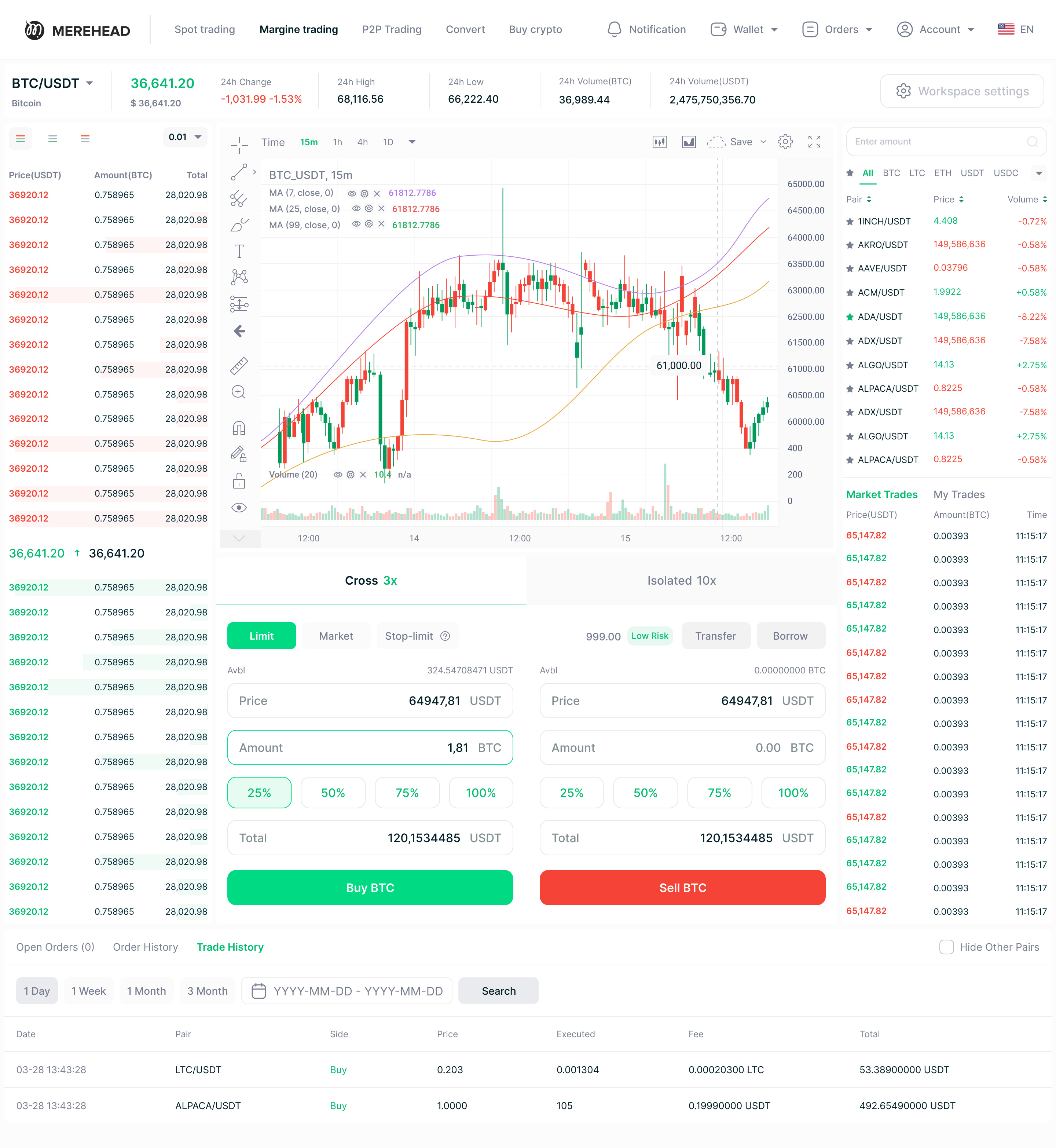
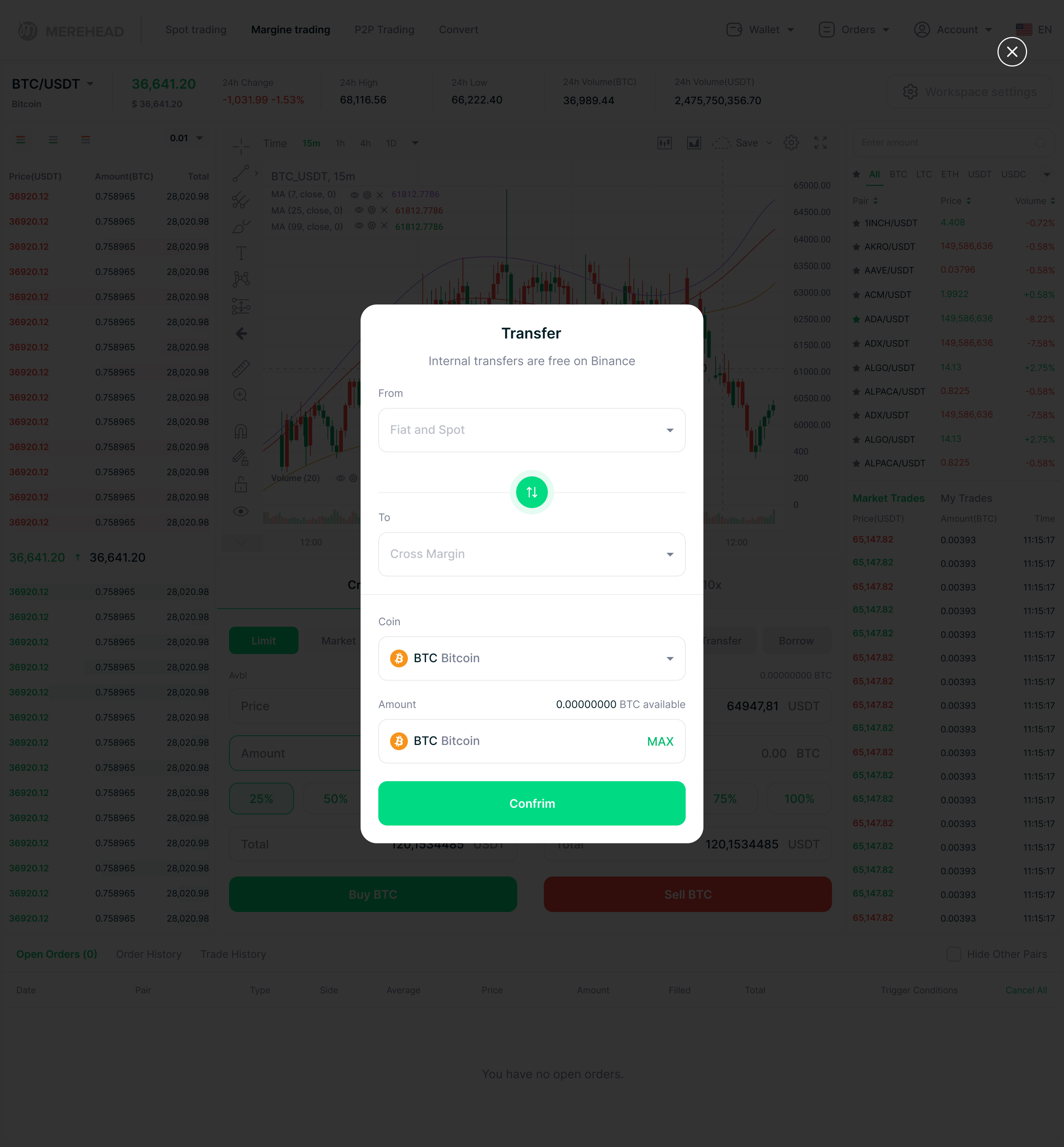
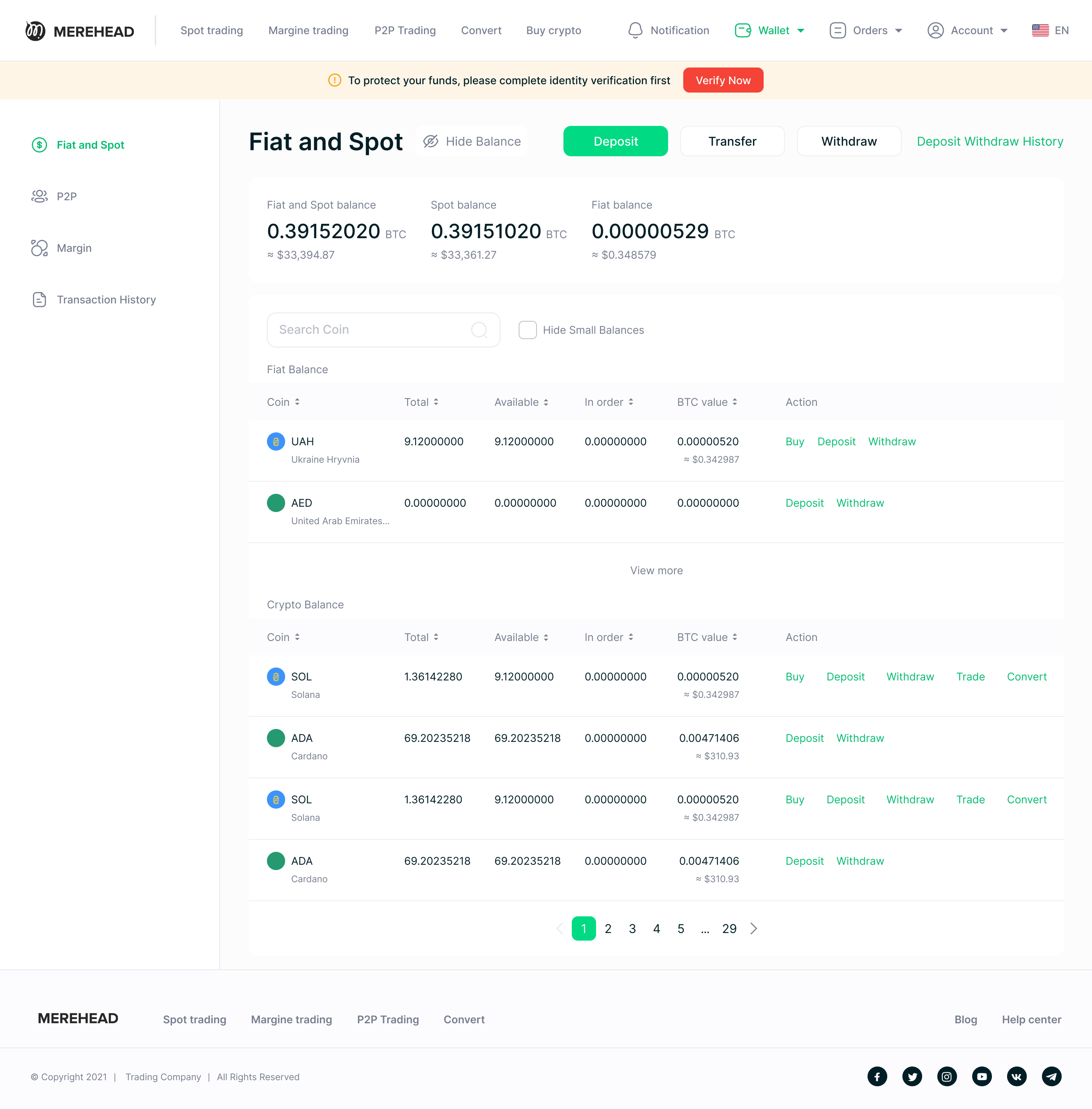
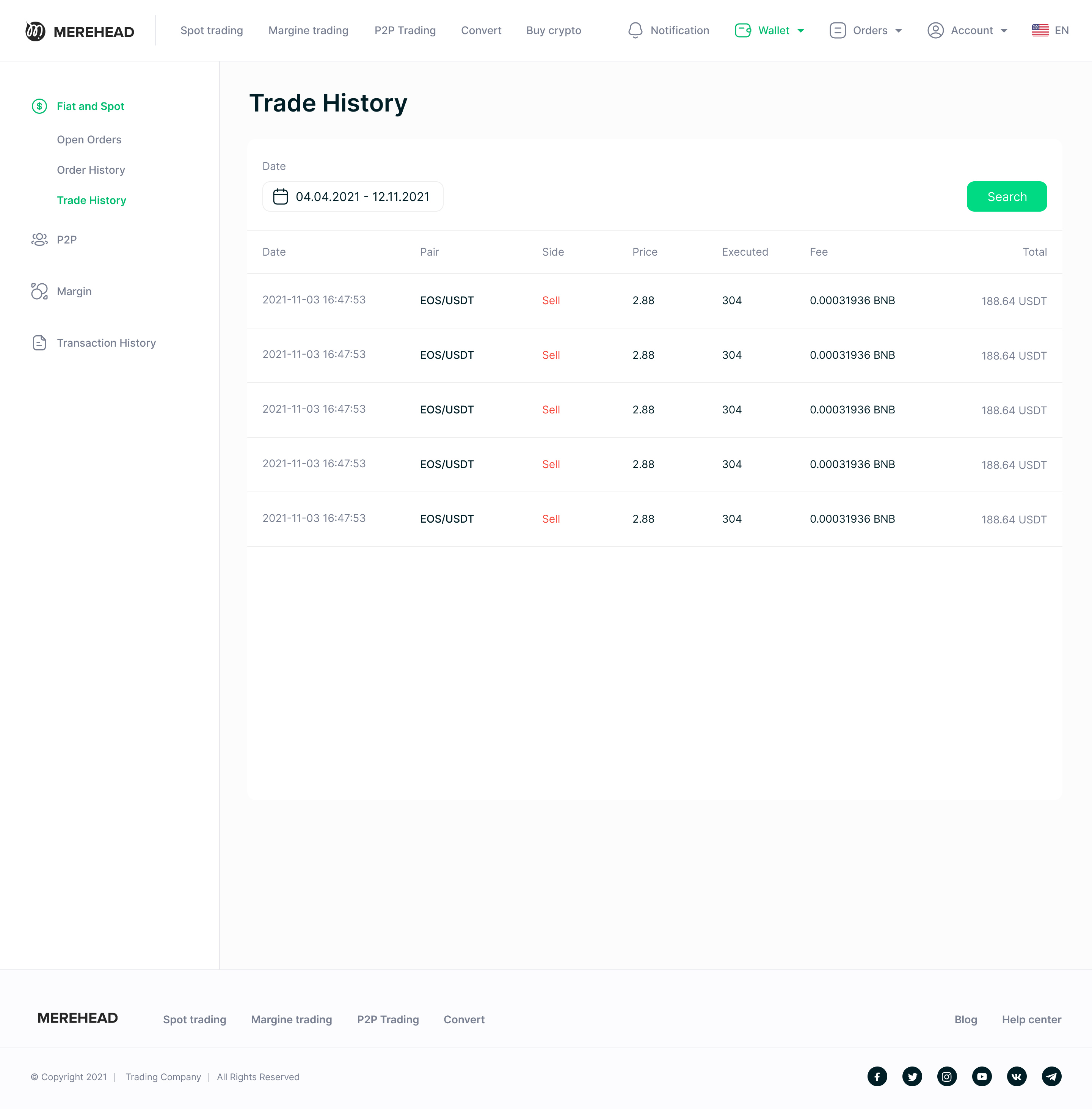
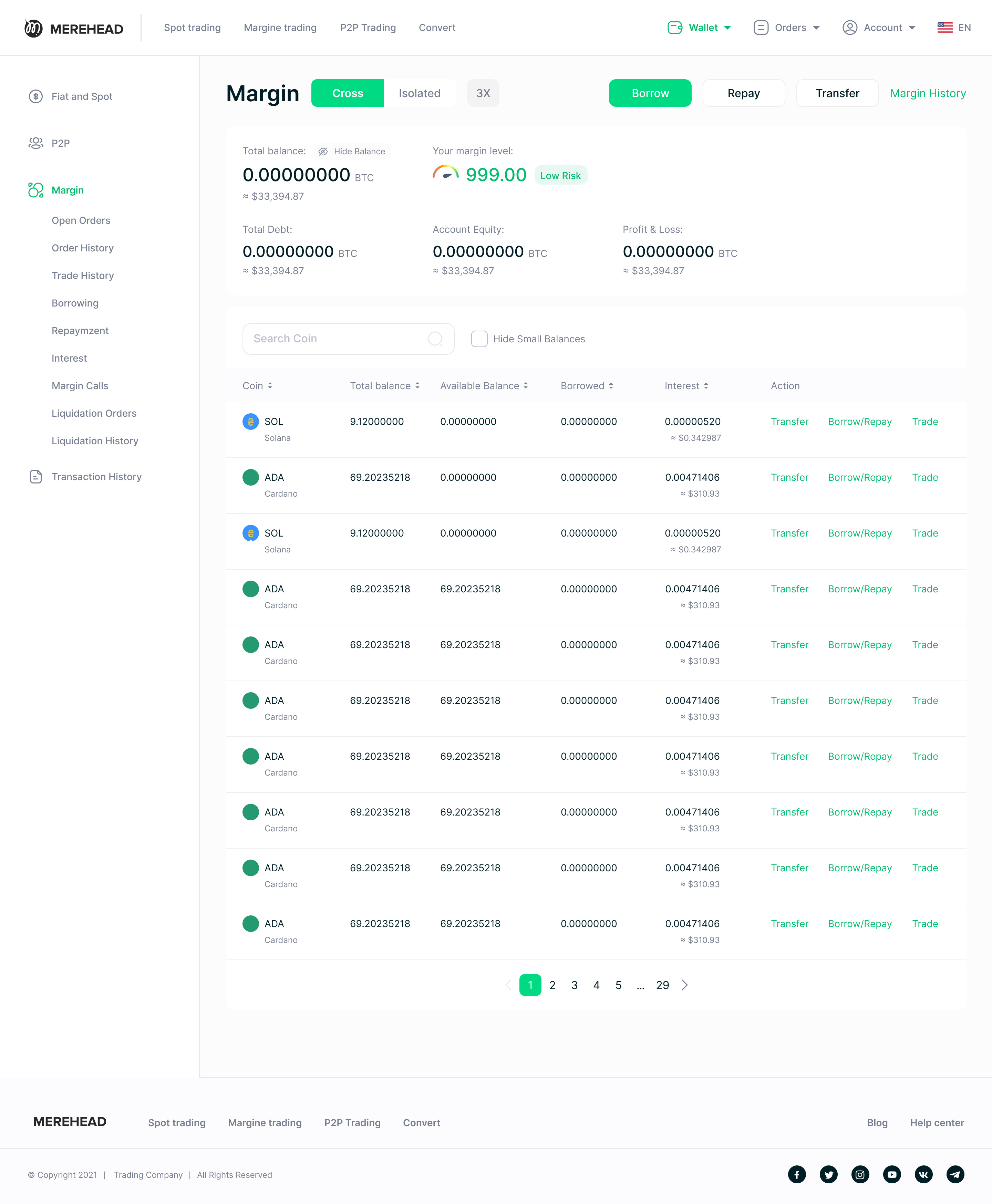
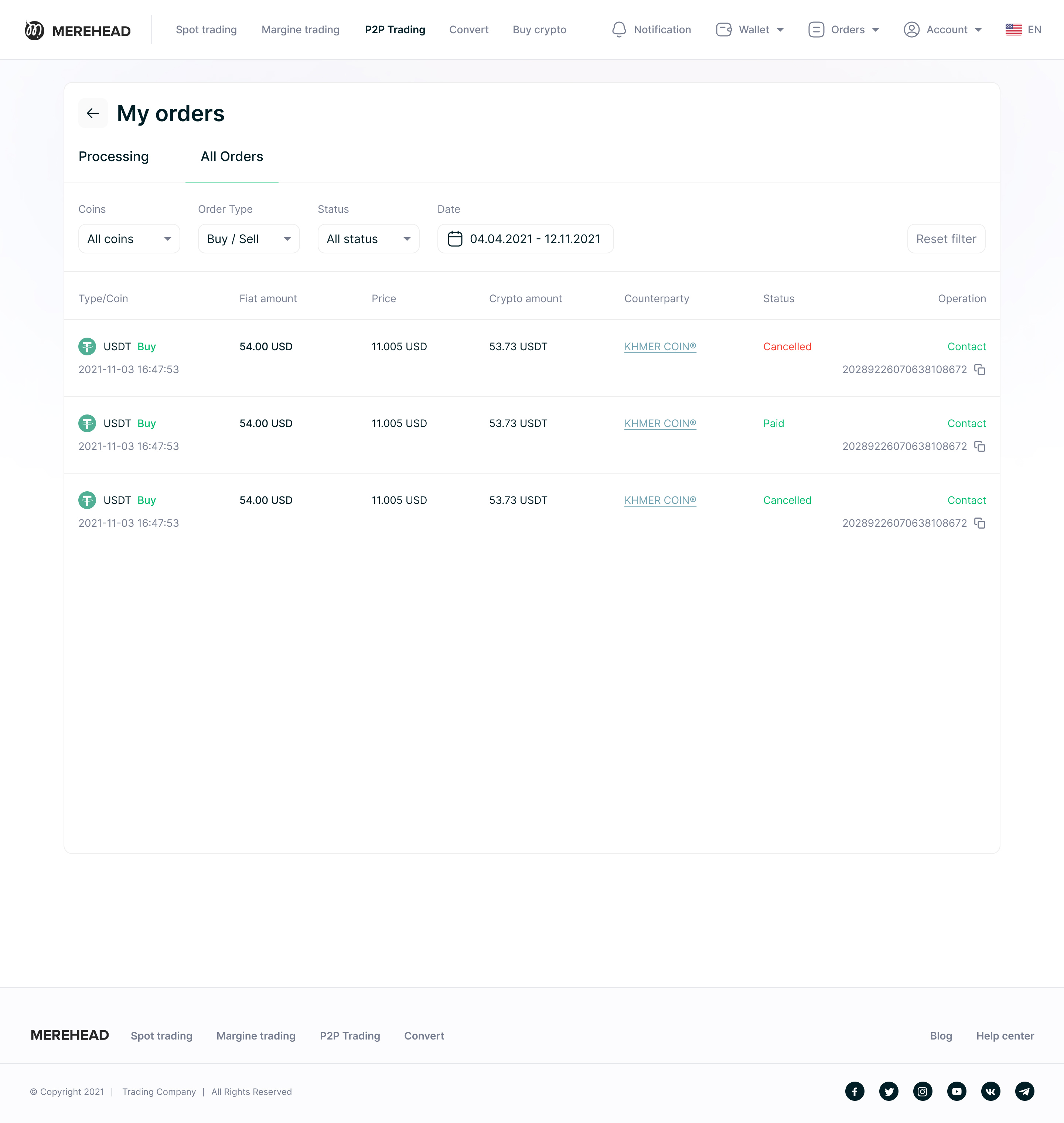
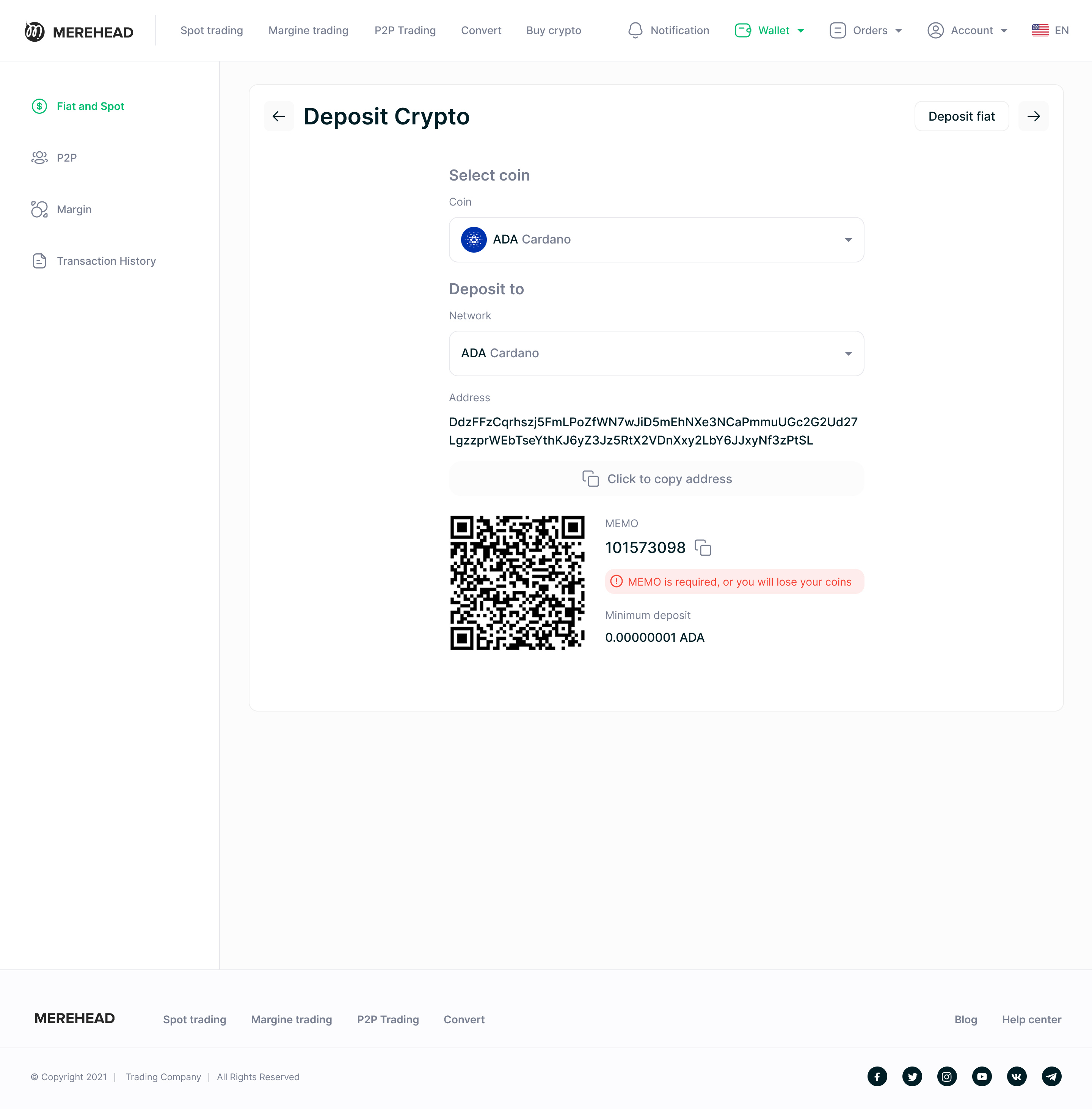
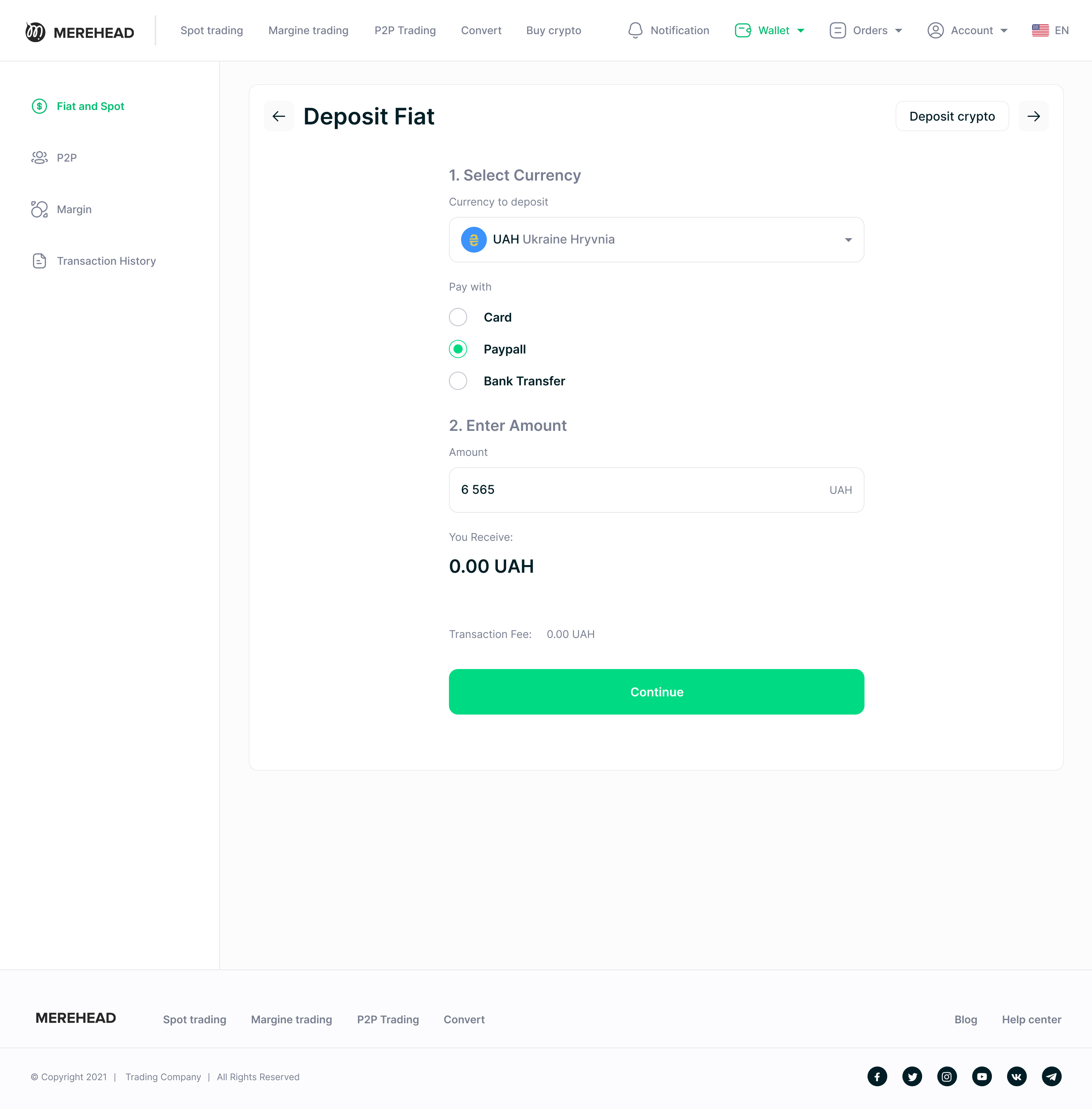
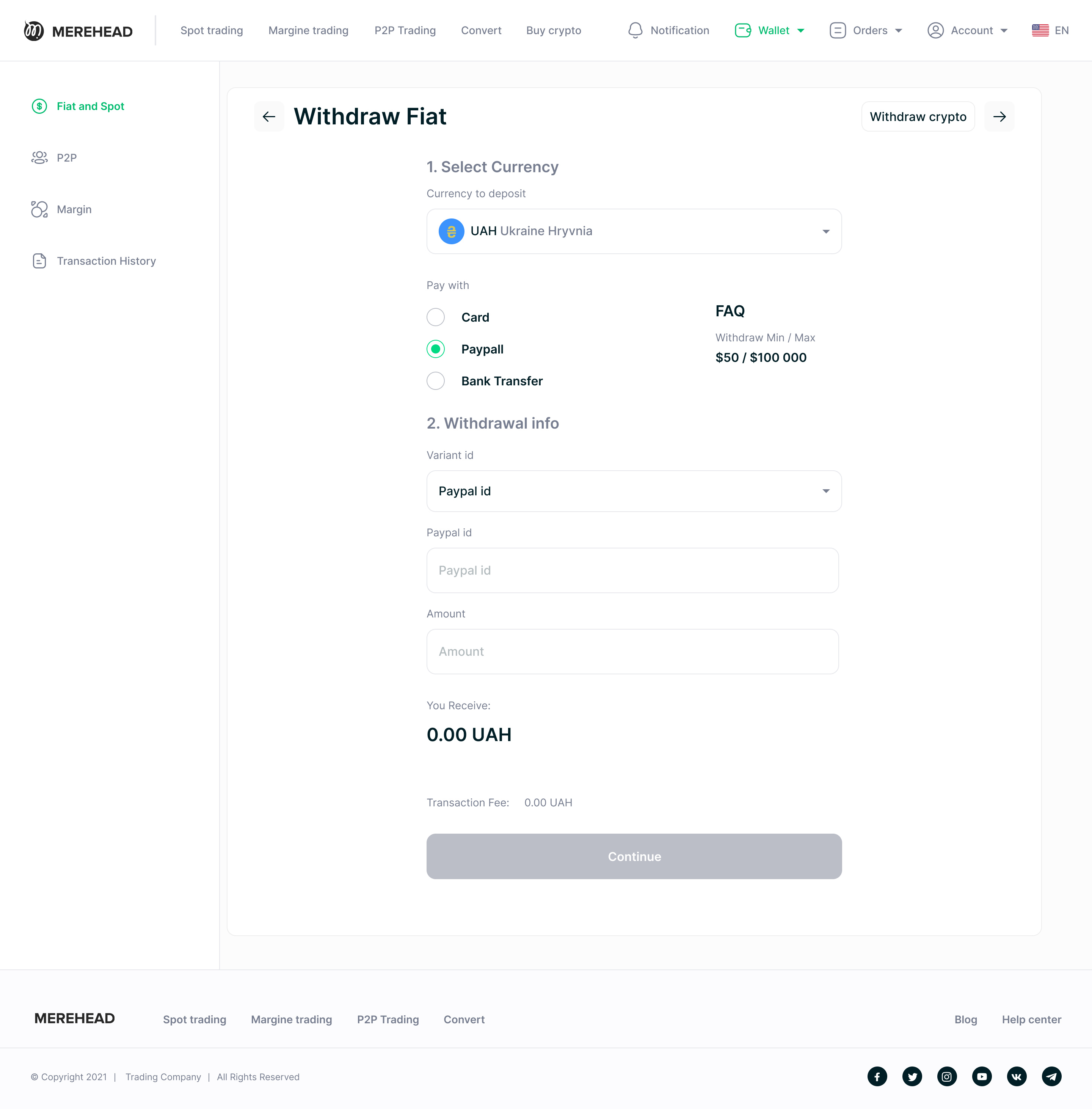
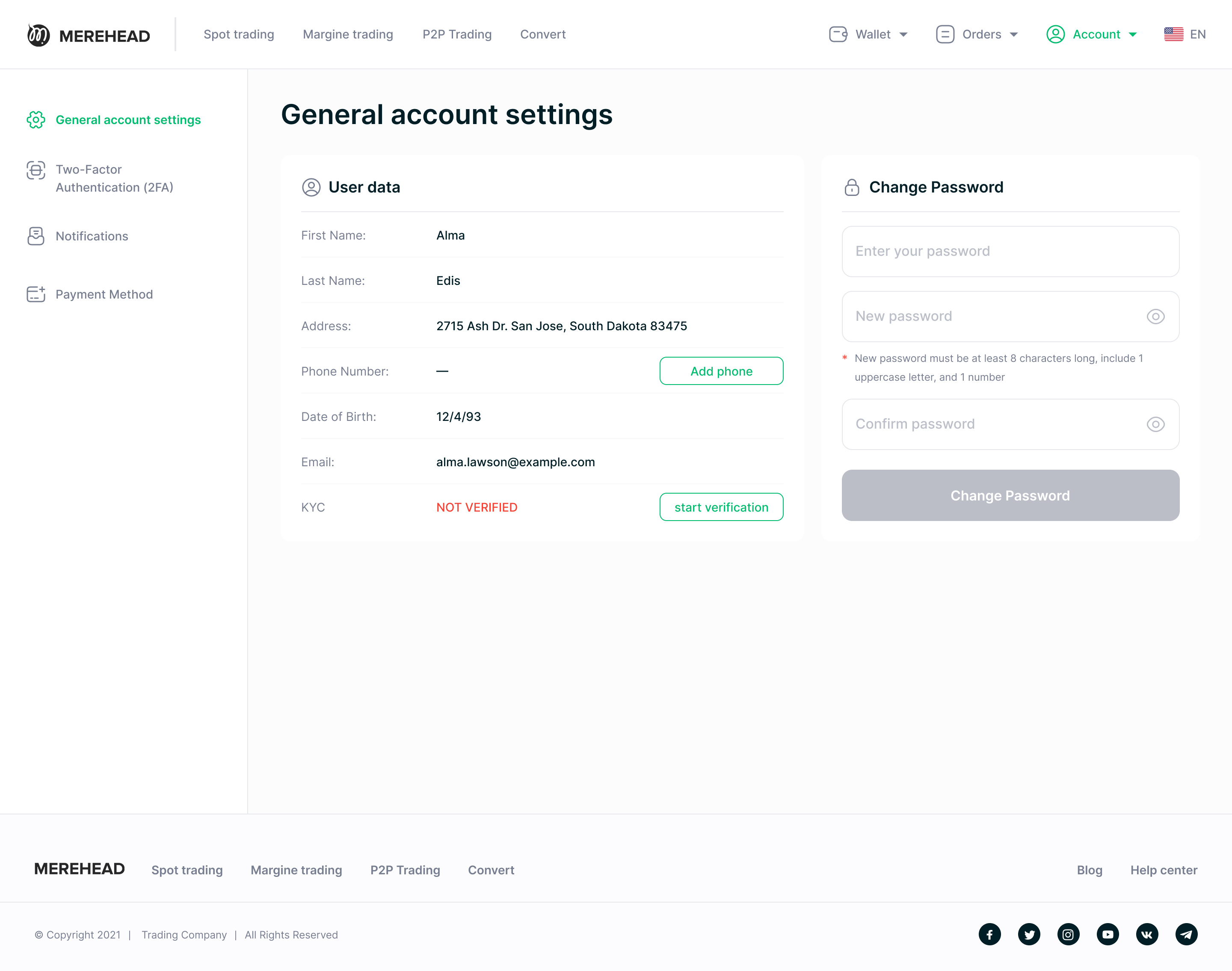
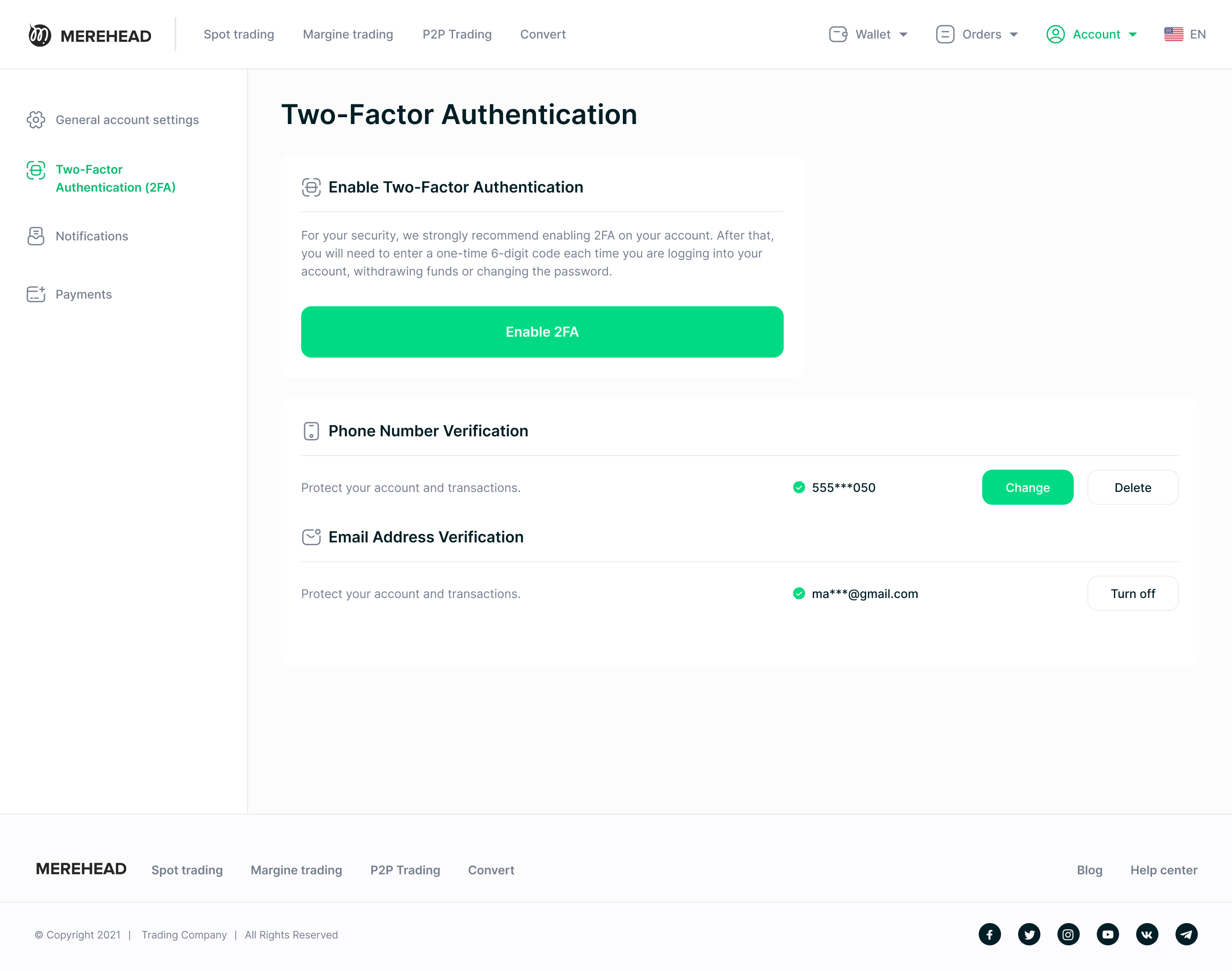
A production-grade cryptocurrency exchange architecture typically includes:
- Trading engine and matching engine — accepts orders, applies price-time priority, executes trades in milliseconds.
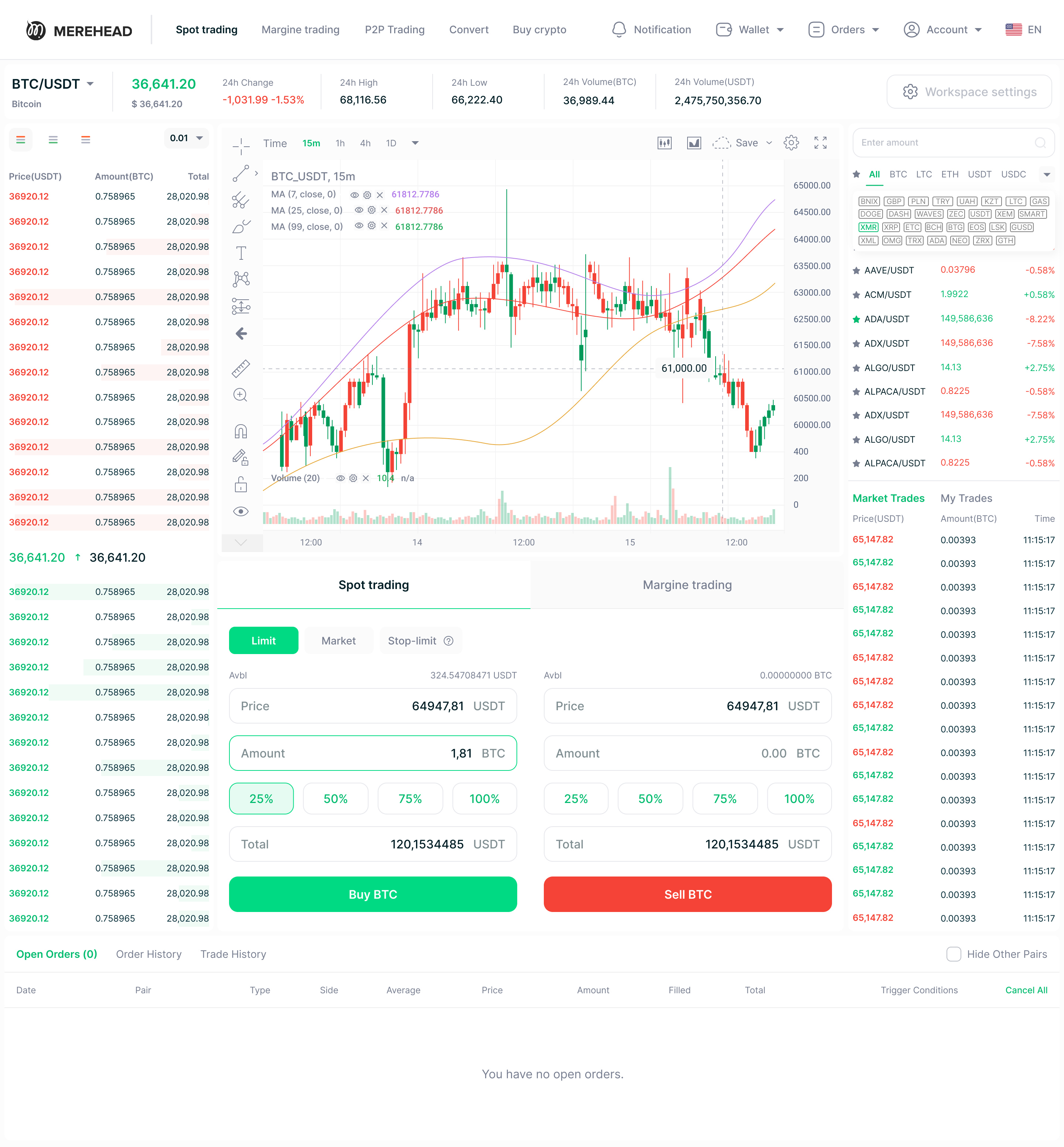
- Order book and market data services — maintains live bid/ask depth per trading pair and streams it to clients.
- Wallet infrastructure — hot, warm, and cold wallet segmentation for custody and liquidity.
- Risk and compliance layer — pre-trade validation, AML/KYC screening, transaction monitoring.
- Infrastructure and scaling layer — load balancing, service isolation, DDoS mitigation, multi-region failover.
Building this stack from scratch typically runs $95,000–$260,000+ and takes 3–7 months, depending on scope (spot-only vs. spot+margin+derivatives+P2P). A white-label core with custom modules cuts that to $33,000–$130,000 and 1–3 months. We break down both paths below, with real cost data and real engineering decisions from platforms we've built.
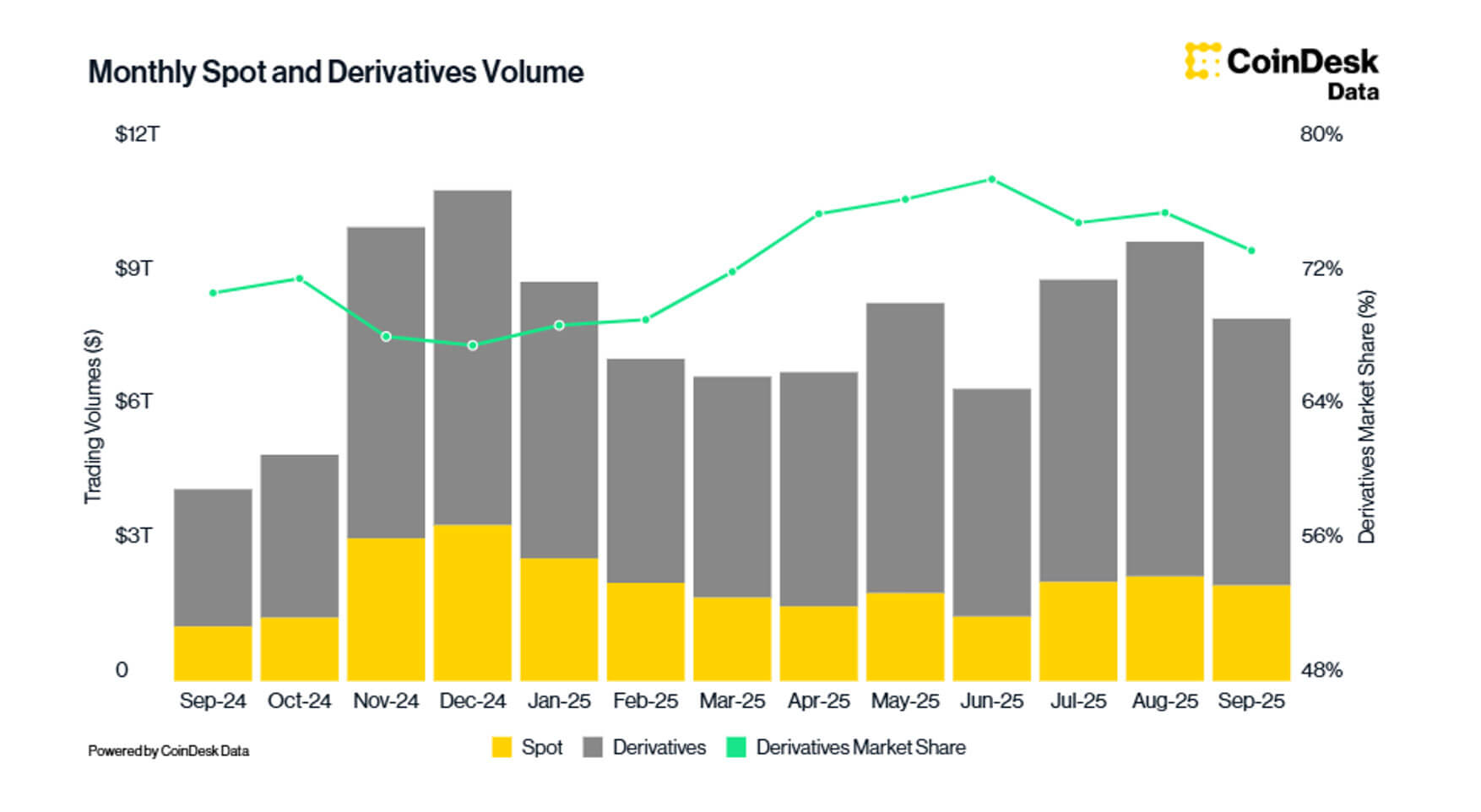
Centralized exchanges moved almost $10 trillion in a single month in 2025 — Binance alone reported over $7 trillion in spot volume and $25 trillion in futures volume for the year. At that scale, how you build a crypto exchange stops being a coding exercise and becomes an infrastructure decision that determines whether your platform survives its first liquidation cascade.
This article walks through the components that make up crypto exchange architecture, the tradeoffs we see clients hit in real projects, and the engineering decisions — including a few we got wrong the first time — that separate a platform that survives a volatility spike from one that goes dark during it.
Crypto Exchange Infrastructure: The Core Components
A crypto exchange breaks down into five layers that each scale, fail, and get audited independently. Here's what each one does and why the separation matters.| Layer | What it does | Why it's isolated |
| Matching engine | Matches buy/sell orders by price-time priority, executes trades in milliseconds | Needs in-memory speed; a bug here can't be allowed to touch wallets |
| Order book / market data | Maintains live bid/ask depth per pair, streams updates over WebSockets | Read-heavy, scales horizontally, feeds bots and UI separately from trading logic |
| Wallet infrastructure | Manages hot/warm/cold custody, deposit/withdrawal pipelines | Holds user funds — the highest-value attack surface on the platform |
| Risk & compliance | Pre-trade validation, AML/KYC/KYT screening, transaction monitoring | Regulatory logic changes independently of trading logic and by jurisdiction |
| Infrastructure layer | Load balancing, DDoS mitigation, autoscaling, multi-region failover | Absorbs traffic spikes without letting them cascade into trading services |
Trading Engine and Order Matching Engine
The order matching mechanism compares buy and sell orders in real time, evaluates price and timestamp under a price-time priority model, and executes trades within milliseconds. The trading engine wraps around it: it accepts incoming orders, calculates commissions, confirms execution, and pushes the result back to the wallet and the user interface.Price-time priority works on a simple rule: the matching engine fills the best price first, and if two orders share a price, it fills whichever arrived first. In a BTC/USD order book with two identical-price buy orders sitting next to each other, the engine executes the earlier one — that ordering is what keeps execution fair and predictable at scale.
By 2025, exchanges routinely process millions of orders per second; that throughput is the baseline expectation for any crypto exchange matching engine serving a global user base, not an advanced feature.
The engine also handles partial fills: if you want to buy 10 BTC and only 6 BTC sit available at the best price, it fills 6 and keeps the remainder open. Under concurrent load, race conditions become a real risk once multiple orders hit the system simultaneously — teams solve this by splitting order books per trading pair or using lock-free data structures instead of locking the whole book on every match.
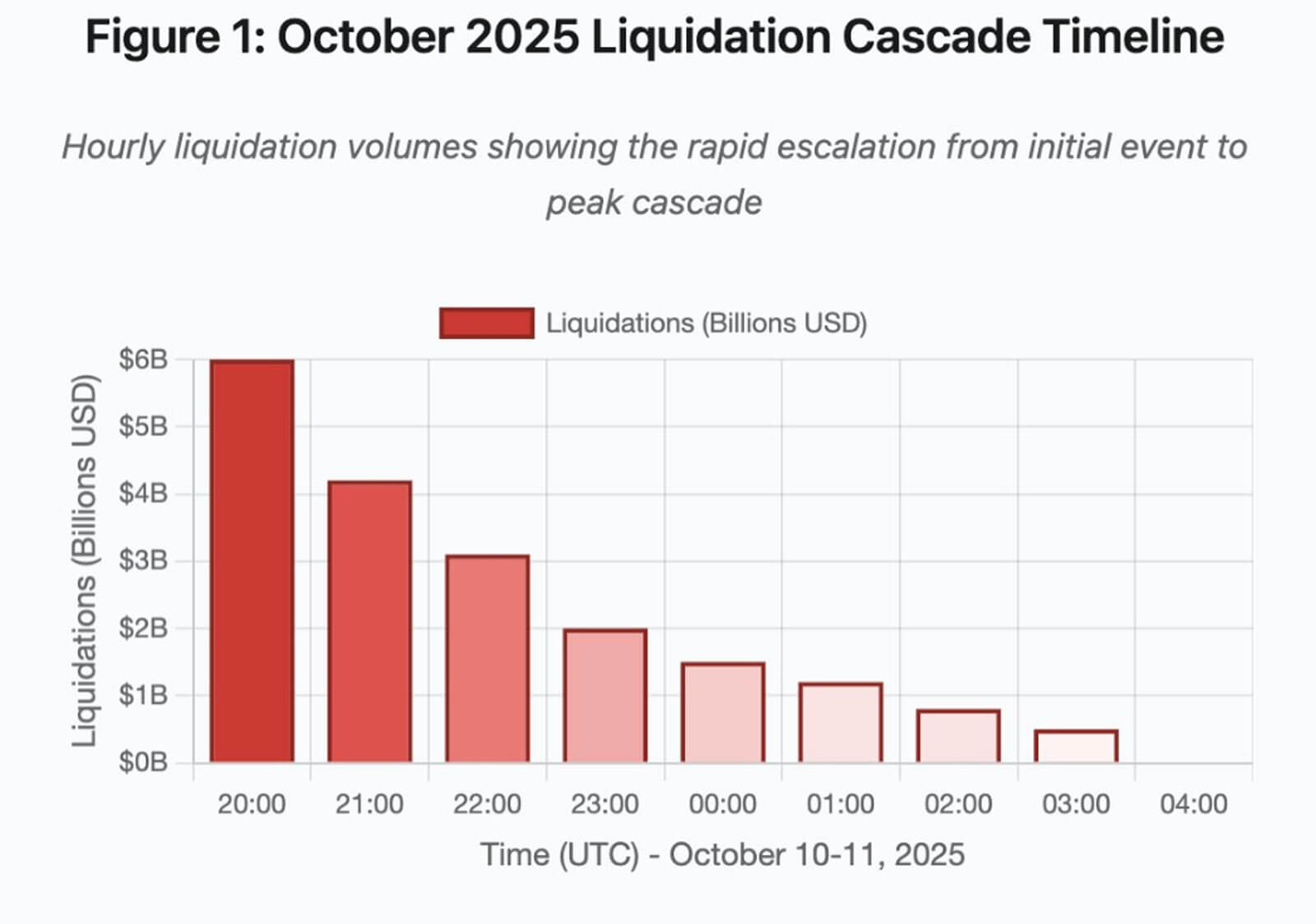
Order matching systems still fail under extreme load. In October 2025, a wave of forced liquidations exceeding $9.5 billion in 24 hours overwhelmed the matching engines of several exchanges, and queue overflow, back-pressure on the risk system, and message rates past design throughput all compounded at once. That's exactly why the build-vs-buy decision on your matching engine matters as much as any other architectural call you'll make — running a naive implementation into a live liquidation cascade is how platforms end up in the outage headlines.
costs to develop
your crypto platform
Crypto Exchange System Design: Monolith vs Microservices
One of the earliest calls a development team makes is monolith vs. microservices — and at trading volume, that choice compounds fast.A monolithic exchange runs all logic — trading, wallets, risk, market data — inside one deployable process. Scaling means replicating the entire application even when only one component needs more capacity, and a failure in any module risks taking the whole platform down with it. Microservices split the same system into independently deployable services — trading, wallet management, market data, authentication, risk — that talk to each other over APIs.
| Monolith | Microservices | |
| Scaling | Scale the whole app, even for one hot component | Scale trading, wallet, or market data independently |
| Failure blast radius | One module failure can take down the platform | Fault isolation — a wallet-service bug doesn't stop matching |
| Release speed | Single deploy pipeline, slower iteration under load | Independent releases per service, faster iteration |
| Operational cost | Lower — one runtime, one monitoring stack | Higher — needs mature DevOps, observability, orchestration |
| Network latency | None — in-process function calls | Inherent — services communicate over HTTP/gRPC/queues |
Microservices win by default for a platform with real trading volume, but they're not free — they demand mature DevOps practices, per-service monitoring and tracing, and teams organized around domains rather than around a single shared codebase. If your organization isn't ready to run five to ten independently deployed services, adopting microservices on day one adds overhead you don't yet need.
CTO case: scaling AML monitoring from one provider to four without a rebuild
Challenge: A platform's AML/transaction-monitoring system locked into a single risk-scoring provider, and the business needed to run four providers in parallel — without touching the underlying data model or taking the system offline.
Solution: We normalized the data layer to accept any number of providers under one shared schema, rebuilt the UI to display parallel provider cards side by side, converted all transaction values into a single base currency for consistent risk visualization, and split the AML decision logic by transaction type, since deposit risk rules and withdrawal risk rules aren't the same thing.
Result: The platform now runs multi-provider AML scoring on its original database schema, with new-provider integrations landing in roughly three hours thanks to the normalized structure.
Real-Time Data and Event-Driven Architecture
Traders expect instant price updates and trade confirmations, and institutional clients expect sub-second data delivery comparable to traditional markets. Modern exchanges deliver this over WebSockets — a persistent, full-duplex connection that pushes updates instantly instead of forcing clients to poll over HTTP — and WebSocket streams now routinely hit latencies in the tens of milliseconds, close to imperceptible against order execution time.Under the hood, a mature crypto exchange rarely pushes data straight from core systems to every connected client. It runs an event-driven architecture instead: the matching engine and market data services emit events on every price change, trade, or order update; a message broker — Kafka, RabbitMQ, or a managed event bus — publishes those events at high throughput; clients subscribe to the topics they need; and lightweight stream processors filter or aggregate data before it goes out. This decouples data generation from data consumption, so a slow consumer never backs up the matching engine.
Most exchange market-data layers choose eventual consistency deliberately — traders value speed over perfect concurrency on a price feed, and modern streaming platforms deliver billions of events a day in under a second regardless.
CTO case: isolating the control plane before it becomes a single point of failure
Challenge: One exchange's Kubernetes cluster ran the control plane and worker nodes on the same physical node — a traffic spike from something as ordinary as a chart request could take down the entire cluster, and horizontal autoscaling sat configured in the manifests but never turned on.
Solution: We flagged the shared-node setup as a production blocker, redesigned the topology to separate control plane from worker plane, and pulled the GitLab CI/CD runner out of the production cluster onto a dedicated build machine with Docker layer caching, so release pipelines stopped competing with live trading traffic for the same resources.
Result: The platform eliminated a single point of failure at the infrastructure level, cut the "ghost bug" rate caused by drift between production and pre-production environments, and held uptime steady through both release windows and traffic spikes.
Scalability, Fault Tolerance, and High Availability
Trading volume can spike tens of times over within minutes, and a scalable crypto exchange backend has to absorb that without degrading. In October 2025, several major platforms watched their APIs and database connections — the same components that handled routine trading fine — become bottlenecks the moment thousands of traders adjusted positions simultaneously during a liquidation cascade; autoscaling alone couldn't absorb the surge.Horizontal scaling distributes load across servers instead of relying on a single bigger box: edge load balancing absorbs peaks in external traffic, internal service meshes handle microservice-to-microservice communication efficiently, and global traffic management routes users to the nearest data center. Together, this forms a scalable, flexible network architecture for cryptocurrency trading platforms that holds response times steady even under a twenty-fold spike in traffic.
Fault tolerance means the rest of the system keeps running when one part — a server, a database segment, an entire data center — goes down. Exchanges achieve this with backup matching-engine clusters that take over on failure, multi-regional deployment so a regional network outage doesn't touch users elsewhere, and automatic circuit breakers with health checks that stop cascading failures before they spread.
Combined with real-time monitoring and alerting, this is how platforms hold a 99.999% uptime SLA — the same bar traditional financial institutions operate against. In many 2025 incidents, infrastructure overload — not software bugs — caused the outage, which is a strong argument for treating capacity planning as an architecture decision, not an ops afterthought.
CTO case: moving deposit and withdrawal processing onto independent job queues
Challenge: Cron-based deposit and withdrawal processing created real latency risk as volume grew, and the compliance team needed to segment user funds by risk profile without pausing the platform to do it.
Solution: Our engineers moved deposits and withdrawals onto separate job queues, so every transaction runs as an independent unit of work instead of a scheduled batch, and built a multi-hot-wallet model where each wallet carries a risk label — geography, entity type, risk tier — with users bound to a wallet at the account level and free to move between isolated liquidity pools in bulk when a risk event requires it. We backed this with double-entry ledger duplication across two independent services that continuously reconcile against each other and halt operations automatically on any mismatch.
Result: Transaction throughput now scales linearly with no queue bottleneck, compliance can reassign users between risk segments without downtime, and the dual-ledger check gives the platform bank-grade accounting integrity.
Crypto Exchange Wallet Security and Compliance Architecture
Every dollar on the platform needs protection that's technical and regulatory at once. Institutional participation keeps growing, regulators keep tightening scope, and attackers keep getting more sophisticated about where they probe.Hot, Warm, and Cold Wallet Segmentation
| Wallet type | Share of assets | Purpose | Risk profile |
| Hot | 2–5% | Active trading, instant withdrawals | Highest — over 80% of exchange hacks trace back to poorly managed hot wallets |
| Warm | Small operational buffer | Large withdrawals with extra verification | Moderate — faster than cold, more controlled than hot |
| Cold | 95–98% | Long-term reserves, offline and often geographically distributed | Lowest — requires physical or procedural compromise |
Nearly 62% of exchange losses over the past year trace back to hot wallet mismanagement, which is why keeping the overwhelming majority of assets offline isn't optional. Beyond the split, mature crypto wallet app development layers in multi-signature schemes, hardware security modules, and segregated storage per asset class, on top of accurate real-time balance accounting.
Multi-Chain Wallet Infrastructure and Liquidity Access
Most platforms need to support 60–70 assets across Ethereum, Tron, Solana, and BNB Chain, plus custom stablecoin deployments. One fix that removes a whole class of user error: generating a single unified EVM address per user that works across every EVM-compatible network instead of forcing separate addresses per chain — it cuts the "sent to the wrong network" support tickets almost to zero.Deposit and Withdrawal Pipelines
A secure pipeline follows a fixed sequence: the system generates a unique deposit address per user, a blockchain-monitoring service tracks incoming activity and credits the internal ledger after enough confirmations, trading balances live on that internal ledger without touching the blockchain until the user actually withdraws, and every withdrawal request passes a risk check before release — with large or unusual withdrawals routed to a warm-wallet flow with extra verification.DDoS Protection and Rate Limiting
Exchanges stay online through cloud-based DDoS scrubbing that cleans traffic before it reaches core services, rate limiting on APIs and entry points to block abuse and brute-force attempts, and web application firewalls with behavioral analytics that catch attack patterns in real time. By 2025, attackers can generate traffic in the terabits-per-second range — enough to disable a poorly protected endpoint in minutes — which makes this layer non-negotiable rather than a nice-to-have.KYC/AML as an Architectural Constraint
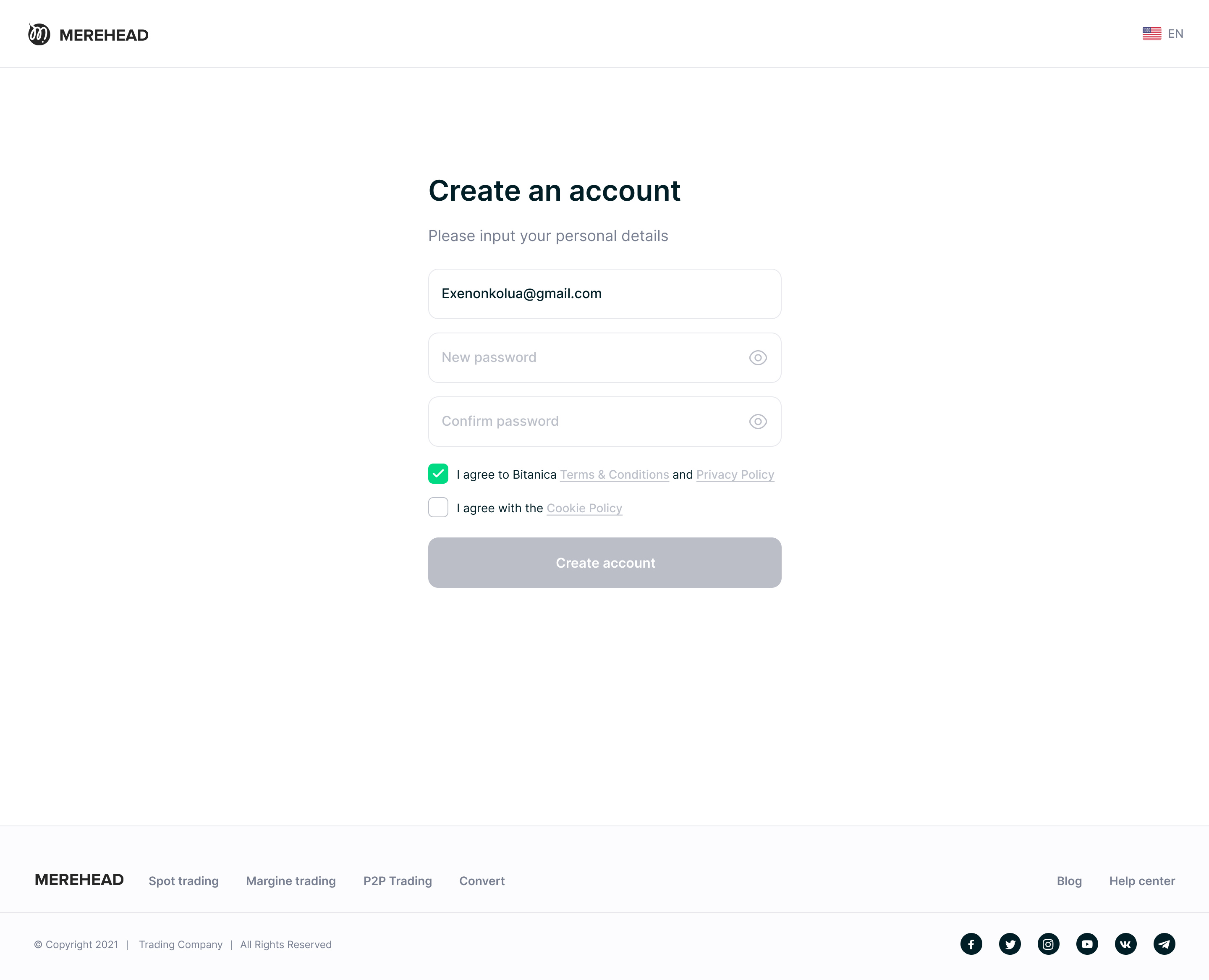
KYC/AML isn't a compliance checkbox bolted on after launch — it's an architectural constraint from day one. 92% of centralized exchanges now run fully compliant KYC, up from roughly 81% a year earlier, and compliant platforms saw a 43% jump in institutional trading volume after tightening their KYC protocols.Building this into your architecture means real-time identity-verification pipelines at registration, transaction monitoring that screens every deposit and withdrawal against sanctions lists and wallet reputation before funds move, and immutable audit logs covering every user action and compliance decision. Teams evaluating how to structure this layer often start by mapping out how to use KYC data across onboarding, monitoring, and reporting before writing a line of the risk engine.
White-Label vs Custom Build: What It Actually Costs
Building a BingX-level exchange from zero is a scale-stage investment, not a startup move — full custom development for a spot+margin+derivatives platform runs $300,000–$500,000+. Most teams don't need that on day one. Here's what real projects actually cost, based on estimates we've delivered:| Build approach | Starting cost | Timeline | Best fit |
| White-label core (spot+margin, backend+admin+web-app+2 native apps) | from $33,400 | 1–2 months | Fast market test, MVP validation |
| Full white-label CEX (web + 2 native apps, deeper customization) | from $95,000 | 1.5–3 months | Launch-ready platform with brand control |
| Same scope, built from scratch | ~30% higher (web layer alone runs $48K vs. $36K) | 2–3 months, 30–50% longer | Full IP ownership, no white-label constraints |
| Extended platform (launchpad, staking, advanced trading tools) | from $187,000 | 4–5 months | Exchange + token-economy features |
| DeFi-integrated platform (governance, DAO voting, IFO launchpad) | from $263,000 | 6–7 months | Exchange as part of a broader token ecosystem |
The pattern holds across every project we've priced: a white-label core with custom modules ships in 1–3 months at 25–40% less budget than the same scope built from scratch, because you're not re-implementing an order book and wallet layer that already exists and works.
If you're comparing a cryptocurrency exchange infrastructure solution against a ground-up build, that gap is usually the deciding factor — not feature parity, since a modular white-label core scales into derivatives and P2P without a core rewrite. Full custom development still wins when you need IP ownership free of any vendor's license terms, or when your product requires trading logic no white label crypto exchange core supports out of the box.

Common Architectural Mistakes in Crypto Exchange Development
Simplified Order Matching Systems
A matching engine that works fine under light load and collapses under real market stress is the single most common failure point we see. It shows up as delayed execution, stalled order-book updates, and outages during exactly the moments traders need reliability most. The fix isn't complicated in concept — sub-millisecond latency targets, in-memory data structures, and rigorous load testing before launch — but skipping it is how platforms end up as case studies in someone else's outage post-mortem.Poor Service Separation
Teams that ship a rigid monolith, or fail to separate critical services even inside a "microservices" label, inherit the same risk: one component's failure takes the whole platform down with it. Modular, distributed design isn't a nice-to-have at scale — it's the difference between a wallet-service bug and a full outage.Ignoring Scalability at the MVP Stage
Skipping scalable architecture at MVP stage almost always produces the same outcome later: system crashes, delayed market data, and capped trading capacity right as adoption picks up. Platforms that invest early in scalable data pipelines, load balancing, and cloud infrastructure avoid the expensive rework that comes from retrofitting scalability onto a system already carrying live user funds.Security Gaps That Become Incidents
Security has to sit in the architecture from day one, not get layered on after launch. The industry lost over $2.4 billion to more than 120 security incidents by mid-2025, with centralized exchanges accounting for roughly $1.88 billion of that. Over 80% of those hacks trace back to poorly managed hot wallet systems — weak or misconfigured private keys and access controls — while API vulnerabilities account for about 17%. Almost every one of these starts at the architectural level: unencrypted storage, missing multi-factor authentication, absent rate limits, poor wallet segregation. Fixing it after the fact costs far more than designing it correctly the first time.How We Approach Crypto Exchange Architecture
We don't start a crypto exchange build with a feature list — we start with the tradeoffs the client actually has to live with: performance against simplicity, scalability against budget, security against release speed, and a white-label core against a fully custom system. Real projects rarely let you optimize for all four at once, and pretending otherwise is how platforms end up over-engineered for a launch that never needed that much infrastructure, or under-built for the volume that shows up six months after launch.That's the same judgment call behind every case in this article: normalizing four AML providers onto one schema instead of a rebuild, splitting a shared Kubernetes node before it became a single point of failure, moving deposit processing onto queues instead of scaling a cron job that was never going to hold. None of these are exotic decisions — they're the ones that separate a platform that survives its first liquidation cascade from one that doesn't. If you're weighing a centralized exchange development path against a white-label starting point, that's exactly the conversation worth having before the first sprint, not after the first outage.
FAQ
What is crypto exchange architecture?
Crypto exchange architecture is the combination of systems — matching engine, order book, wallet infrastructure, risk engine, and compliance layer — that a trading platform uses to accept, validate, execute, and settle trades in real time. Each layer scales and fails independently, which is what lets an exchange stay online when one component comes under stress.
How much does it cost to build a crypto exchange in 2026?
A white-label core with custom modules starts around $33,400 for a basic spot+margin build and runs to roughly $164,000 for a fully custom-branded platform, shipping in 1–3 months. A full custom build from scratch for the same scope typically costs 30% more and takes 2–3 months longer, while a DeFi-integrated platform with governance and launchpad features runs $187,000–$263,000+ over 4–7 months.
Should I build a matching engine from scratch or use a white-label core?
Building from scratch makes sense when you need trading logic or IP ownership no white-label core supports. For most launches, a white-label matching engine with custom modules gets you to market in 1–3 months at 25–40% lower cost, and it scales into derivatives or P2P later without a core rewrite.
What percentage of crypto exchange assets should stay in cold storage?
Industry practice keeps 95–98% of assets in cold, offline storage and only 2–5% in hot wallets for active trading. Nearly 62% of exchange losses over the past year trace back to hot wallet mismanagement, which is why that ratio isn't optional at scale.
Microservices or monolith for a crypto exchange?
Microservices win for any platform expecting real trading volume, since they isolate failures and let you scale trading, wallet, and market-data services independently. They do demand mature DevOps and observability — if your team isn't ready to operate five-plus independently deployed services, that overhead is worth factoring into the timeline.
How long does it take to launch a centralized crypto exchange?
A white-label-based launch typically takes 1–3 months including discovery. A fully custom build for the same scope runs 2–3 months longer, and a platform with DeFi features like staking or governance voting takes 4–7 months.