- B2Broker — best for brokers and white-label exchange operators; covers spot, CFDs, FX, and crypto with credit line access via B2Prime.
- Cumberland — best for institutional OTC; DRW-backed, deep BTC/ETH liquidity, no public fee disclosure.
- Galaxy Digital — best for regulated institutional access; multi-segment (trading, VC, mining), US-regulated, Michael Novogratz-led.
- GSR Markets — best for token projects and derivatives; FCA + MAS regulated, in-house trading technology since 2013.
- B2C2 — best for institutional OTC and API-first integrations; 24/7 execution, narrow spreads, multi-jurisdiction compliance.
What Is a Crypto Liquidity Provider?
A cryptocurrency liquidity provider (LP) is an individual or organization that maintains a pool of digital assets and makes them continuously available for trading on an exchange. The provider acts as an intermediary between buyers and sellers, ensuring that any order placed can be filled at a competitive price — regardless of whether a natural counterpart exists on the other side of the trade at that moment.
LPs operate in various organizational forms: investment banks, proprietary trading firms, financial groups, or decentralized autonomous organizations (DAOs) that pool capital from multiple participants. In the DeFi context, any participant who deposits assets into an automated market maker (AMM) protocol also functions as a liquidity provider.
When a new exchange launches without a liquidity provider, its order book is empty. Users see no bids, no asks, and no reason to trade. Some platforms compensate by displaying fabricated volume — inflated numbers with no real capital behind them. A real LP solves this problem structurally, not cosmetically.
 Yuri MusienkoBusiness developer, Merehead
Here is how the LP mechanism works in practice for a standard centralized exchange:
- A buyer places an order for 100 units of a given cryptocurrency.
- Without an LP, the exchange must find a natural seller willing to match the exact price and quantity — which may take minutes or not happen at all.
- With an LP connected, the exchange routes the order to the provider's pool, which fills the trade instantly from its available reserves.
- The exchange credits the buyer's wallet and debits the LP's pool accordingly.
- When the opposite trade occurs — another user selling the same coins — the exchange can return the assets to the LP, restoring the pool's original depth.
The LP's total pool value does not permanently decline through this process. Assets cycle in and out as trades execute. To compensate providers for the risk of holding volatile assets and the opportunity cost of capital, most platforms issue LP tokens — on-chain receipts representing the provider's proportional claim on the pool — and distribute a share of trading fees continuously.
How Liquidity Functions in the Crypto Market
Liquidity, in the most operational sense, measures how quickly and cheaply an asset can be converted to another without moving the market price. High liquidity means large orders execute close to the quoted price. Low liquidity means even modest trades can cause significant price deviation — what traders call slippage.
In the cryptocurrency market, liquidity performs several critical functions simultaneously:
- Price stability — On highly liquid platforms, large-volume orders are absorbed by deep order books without significant impact on the quoted price. On thin markets, a single $50,000 sell order can move the price by several percent.
- Slippage minimization — Liquid platforms consistently execute at prices close to the displayed rate. The gap between expected and actual execution price is a direct function of available depth at each price level.
- Market confidence — Institutional investors and high-frequency traders require confidence that orders will execute at predictable prices. A platform with erratic fills — regardless of its UI quality — will not retain serious participants.
- Institutional participation — The entry of large-capital players (hedge funds, family offices, crypto prime brokers) depends directly on whether the platform can handle their order sizes without excessive market impact.
- Feature enablement — Spot trading, margin positions, and OTC desks all require minimum liquidity thresholds to function. You cannot operate a leveraged trading module on a thin book without catastrophic liquidation cascades.
Market Maker vs. Liquidity Provider: What's the Difference?
These terms are often used interchangeably, but they describe distinct roles with different obligations and risk profiles.
| Dimension | Market Maker | Liquidity Provider |
| Core function | Continuously posts both bid and ask quotes for a specific asset, profiting from the spread | Supplies capital/assets to a pool or exchange, often earning fees passively |
| Obligation | Often contractually required to maintain quotes within defined spread/depth limits | Typically voluntary; can withdraw capital at will (subject to lock-up periods in DeFi) |
| Risk exposure | Inventory risk from holding one-sided positions during volatile moves | Impermanent loss in AMM pools; counterparty risk in CeFi arrangements |
| Environment | Primarily CEX order books, OTC desks | CEX pools, DeFi AMMs (Uniswap, Curve), institutional prime brokerage |
| Revenue model | Bid-ask spread capture, exchange rebates | Fee share from pool volume, LP token rewards, yield on deployed capital |
In practice, institutional entities like Cumberland or B2C2 operate as both: they provide deep capital reserves (LP function) and continuously quote tight spreads on major pairs (market maker function). For an exchange operator, the distinction matters primarily for contract negotiation — market making agreements come with SLAs on spread width and uptime, while pure LP arrangements do not.
When evaluating liquidity providers for a mobile perp DEX integration, we compared three architectures: a Cosmos AppChain with full validator infrastructure, EVM-based contracts limited to Arbitrum/Avalanche depth, and an API-based purpose-built perp infrastructure with institutional-grade order book performance. For projects that need trading functionality without running their own validator or indexer, API-based providers win on time-to-market — but you accept a dependency on their uptime rather than owning the stack.
Yuri MusienkoBusiness developer, MereheadBest Crypto Liquidity Providers: Full Comparison
| Provider | Best For | Products | Capital / Credit | Regulation |
| B2Broker | Brokers, white-label operators | Spot pairs, CFDs, FX, metals, indices | Margin from 1%; credit lines via B2Prime | CySEC, FCA |
| Cumberland | Institutional OTC, large blocks | OTC spot & derivatives, prime brokerage | DRW balance sheet backing | US-regulated (DRW subsidiary) |
| Galaxy Digital | Regulated institutional access | Trading, asset management, VC, mining | Multi-segment capital base | SEC-registered, publicly traded |
| GSR Markets | Token projects, derivatives | OTC trading, derivatives, market making | In-house technology stack | FCA (UK), MAS (Singapore) |
| B2C2 | API-first institutional OTC | Spot OTC, electronic market making | 24/7 execution, narrow spreads | FCA, multi-jurisdiction |
B2Broker
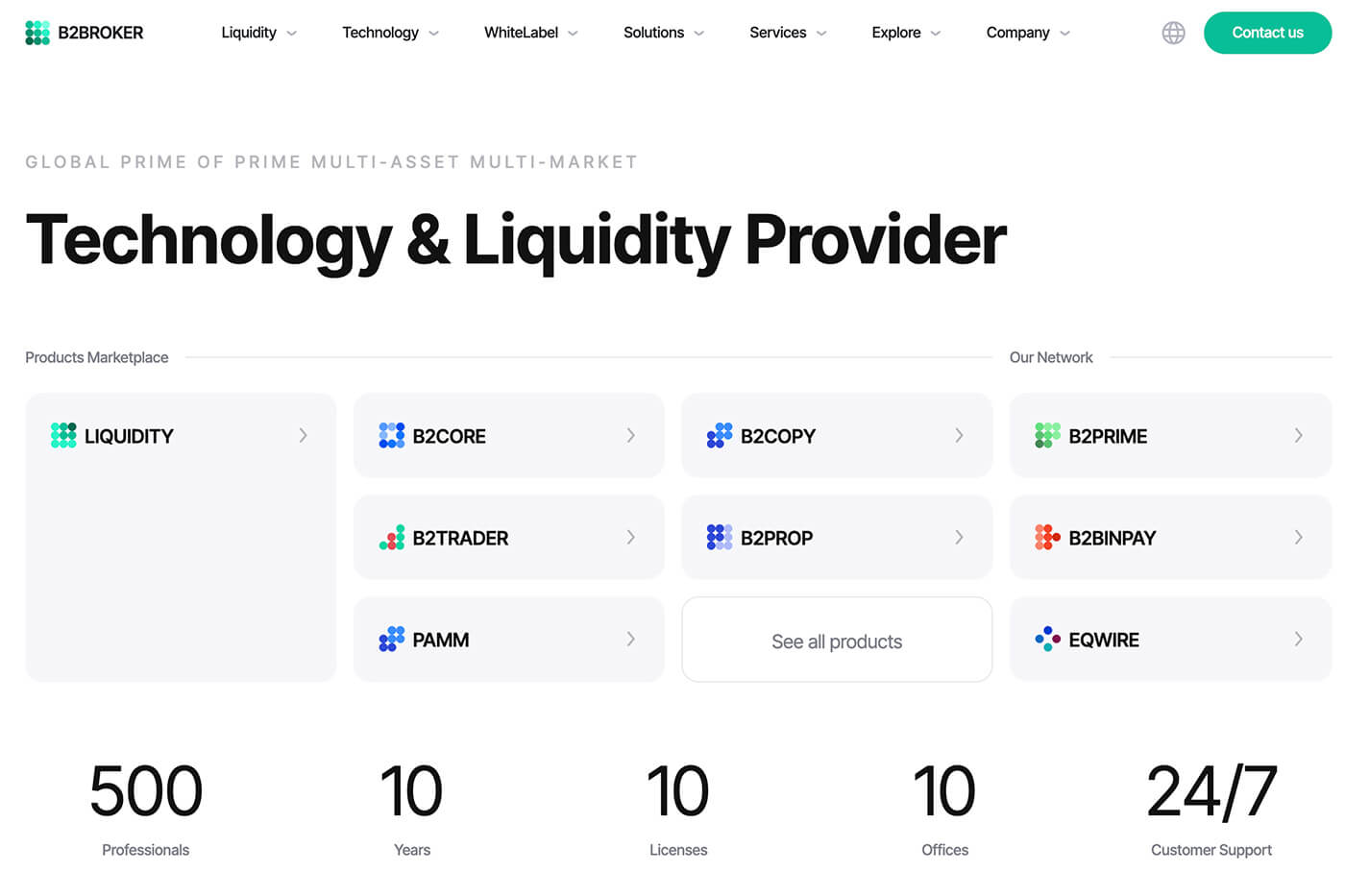
B2Broker is a multi-asset liquidity and technology provider serving crypto brokers, exchanges, and financial institutions. Its product stack covers spot cryptocurrency pairs, CFDs, FX, metals, indices, and NDFs — making it one of the few providers that can serve both crypto-native platforms and traditional finance operators expanding into digital assets.
Strengths:
- Breadth of instruments — Spot cryptocurrency pairs alongside CFDs, FX, and metals in a single integration is operationally significant; it reduces the number of provider relationships an exchange needs to manage.
- Credit infrastructure — Margin trading with leverage from 1% and access to credit lines via the B2Prime arm means clients can operate with capital efficiency rather than requiring full pre-funding of every position.
- White-label ecosystem — B2Broker bundles its liquidity with exchange technology (trading terminals, broker CRM, risk management tools) and licensing guidance. For operators building a new white-label cryptocurrency exchange, this reduces the integration surface significantly.
- Regulatory presence — Regulated under CySEC and FCA, with licensing guidance as part of the service package — a material advantage for operators navigating EU or UK regulatory frameworks.
Weaknesses:
- Pricing opacity — Specific spread and commission data is not disclosed publicly; pricing is negotiated on a per-client basis, which complicates pre-integration cost modeling.
- Complex onboarding — The full B2Broker stack (liquidity + technology + CRM) can take 4–8 weeks to configure properly. Teams that need a pure liquidity API without bundled technology may find the setup overhead excessive.
Cumberland
Cumberland is the digital assets division of DRW, one of the world's largest proprietary trading firms. Founded in 2014, it operates as an institutional OTC desk and prime broker, providing liquidity primarily for large-block trades in BTC, ETH, and a curated set of altcoins.
Strengths:
- DRW balance sheet depth — Being a subsidiary of a multi-billion-dollar proprietary trading firm means Cumberland can absorb order sizes that would move the market on any exchange. For institutions executing $10M+ block trades, this depth is non-negotiable.
- Market presence since 2014 — Cumberland has operated through multiple crypto market cycles, giving it an institutional track record that newer entrants cannot replicate.
- OTC-first architecture — Trades execute directly against Cumberland's own inventory rather than being routed through an exchange order book. This eliminates market impact for large transactions and provides price certainty at execution.
- 24/7 trading desk — Staffed around the clock with experienced traders, not just automated systems.
Weaknesses:
- No retail access — Cumberland operates exclusively with institutional counterparties. Minimum trade sizes effectively exclude all but the largest crypto businesses.
- Non-transparent pricing — All pricing is OTC and relationship-based. There is no public fee schedule, and spreads vary by relationship tier and asset.
- Limited altcoin coverage — Cumberland's deep liquidity is concentrated in BTC and ETH. For long-tail token pairs, you will need to supplement with additional providers.
Galaxy Digital
Galaxy Digital is a publicly traded digital asset financial services company founded by Michael Novogratz in 2018. It operates across trading, asset management, investment banking, and mining — functioning more as a full-spectrum institutional financial group than a pure liquidity provider.
Strengths:
- Institutional credibility — SEC-registered, publicly traded on the NYSE. For institutional investors requiring regulated counterparties, Galaxy's compliance posture is a direct qualification criterion.
- Diversified capital base — Galaxy does not depend on a single revenue stream. Its capital is deployed across trading, VC, asset management, and mining, which provides structural resilience during individual segment downturns.
- TradFi bridge — Galaxy's primary strategic value is connecting traditional financial institutions to crypto markets through a format they understand: SEC-registered, audited, with familiar counterparty risk frameworks.
- Strategic partnerships — Collaborations with major financial institutions expand distribution and service capabilities beyond what a pure crypto-native firm can offer.
Weaknesses:
- Regulatory concentration risk — Being SEC-registered means Galaxy is highly exposed to US regulatory shifts. A change in SEC enforcement posture directly impacts its operating model in ways that offshore providers can avoid.
- BTC/ETH concentration — A significant portion of Galaxy's balance sheet and trading volume is concentrated in the two largest assets, limiting its utility as a liquidity source for projects with non-standard token pairs.
- No retail or SME access — Galaxy's minimum engagement thresholds are institutional by design. Small exchange operators or early-stage projects will not qualify.
GSR Markets
GSR Markets is a global digital asset trading and market-making firm founded in 2013. It provides OTC trading, derivatives execution, and programmatic market making — with a particular focus on serving cryptocurrency projects that need liquidity support for their own tokens at launch or during periods of low organic volume.
Strengths:
- Token project specialization — GSR has deep experience providing liquidity for newly launched tokens that lack organic order book depth. This is a distinct use case that most institutional LPs do not serve.
- In-house technology — All trading software is developed internally, allowing GSR to build custom integrations and execution algorithms specific to each client's needs rather than relying on third-party infrastructure.
- Dual regulatory coverage — FCA authorization in the UK and MAS authorization in Singapore provides two of the most credible regulatory stamps in global finance, relevant for both European and Asian market access.
- Derivatives depth — GSR's derivatives execution capabilities extend beyond simple OTC spot trades into structured products and options, which is relevant for exchanges building more complex product suites.
Weaknesses:
- Reputation variance — Third-party trust assessments have returned mixed results for GSR in some jurisdictions. Due diligence should include direct reference checks with current counterparties, not just regulatory status verification.
- Niche positioning — GSR's token-project specialization is a strength for that specific use case but means it may not be the optimal choice for exchanges focused solely on BTC/ETH liquidity depth.
B2C2
B2C2 is an institutional electronic market maker and OTC liquidity provider, acquired by SBI Group in 2020. It operates as an API-first provider, offering institutional clients direct programmatic access to deep liquidity for spot and derivatives markets, with execution designed for minimal market impact on large orders.
Strengths:
- API-first architecture — B2C2's primary integration model is programmatic: REST and WebSocket APIs with documented endpoints for streaming quotes, submitting RFQs, and executing trades. This is the right model for exchanges that need to embed liquidity into their own matching engine rather than routing manually.
- Tight spreads at institutional scale — B2C2 is consistently cited by institutional clients for narrow spreads on major pairs, which translates directly to lower execution costs for the exchange's own users.
- 24/7 execution availability — Unlike traditional finance liquidity sources that close on weekends, B2C2 operates continuously, which is essential for any crypto exchange targeting global retail or institutional users.
- Multi-jurisdiction compliance — FCA-regulated in the UK, with compliance frameworks covering multiple major jurisdictions, reducing regulatory friction for counterparty onboarding.
- Asset breadth — Beyond BTC and ETH, B2C2 covers a significant range of altcoins — important for exchanges that cannot afford to maintain separate LP relationships for each asset class.
Weaknesses:
- Institutional-only access — Retail traders and small operators cannot access B2C2 directly. The minimum qualification thresholds and KYB process are calibrated for institutional counterparties.
- Limited operational transparency — As a private firm operating OTC, B2C2's internal risk management, collateral policies, and pool composition are not publicly disclosed. For platforms requiring full transparency into their liquidity source's mechanics, this is a structural limitation.
How Liquidity Integration Actually Works: Engineering Reality
The tradeoff of the mirroring model is operational overhead: you need real-time monitoring of margin utilization, borrow limits, and collateral positions. We run automated alerts on all critical thresholds. If any component of the mirroring pipeline fails, user trades fail — there is no graceful degradation without prior instrumentation.
This architecture is particularly relevant for teams building a crypto exchange from scratch, where organic liquidity in the early months is near zero and the cold-start problem is the primary launch risk.
Resilient Architecture for Unstable Providers
In production environments, liquidity providers can go offline for weeks — API instability, regulatory pauses, or infrastructure issues are not edge cases in this industry. Platforms built with a single provider dependency have no fallback.
The architectural answer is a pluggable provider layer: each provider is a module that can be enabled, disabled, or swapped without touching core trading logic. We treat this as a non-negotiable requirement in any exchange we build.
Yuri MusienkoBusiness developer, MereheadThe practical implication: when evaluating a crypto liquidity provider, assess not just their current uptime SLA, but their historical incident record and your ability to switch providers within hours, not weeks. An LP that offers superior spreads but requires a 30-day offboarding process is a concentration risk you cannot afford on a live trading platform.
Understanding the crypto exchange architecture that underlies your platform determines whether provider switching is a configuration change or a 6-week development project. Design for replaceability from the start.
How to Choose the Best Crypto Liquidity Provider
The selection criteria depend heavily on your platform type. An institutional OTC desk evaluates providers differently than a retail spot exchange or a DeFi protocol. Below are the dimensions that consistently differentiate suitable from unsuitable providers across all contexts.
| Criterion | What to Evaluate | Red Flags |
| Liquidity depth | Order book depth per pair at your typical order sizes; ask for test API access before signing | Depth metrics only available for BTC/ETH; no data for other pairs you need |
| API architecture | WebSocket streaming for real-time quotes; REST for order management; documented latency SLAs | REST-only API; no rate streaming; latency above 50ms for quote updates |
| Regulatory standing | Jurisdiction of registration; active licenses; counterparty compliance requirements | No verifiable regulatory status; offshore-only registration; no KYB process |
| Redundancy model | What happens during provider downtime? Is there a failover mechanism or does trading halt? | Single-provider dependency with no documented failover procedure |
| Asset coverage | Full list of supported pairs, not just majors; availability of emerging assets you plan to list | Only top-10 assets covered; no path to adding custom pairs |
| Cost structure | Spread width at your volume tier; any monthly minimums; settlement and custody fees | No public pricing; refusal to provide indicative spreads before contract |
| Settlement mechanics | How are fiat settlements handled? What are the cut-off times? SWIFT, SEPA, or crypto-only? | Crypto-only settlement with no fiat path; T+3 or longer settlement windows |
For exchanges integrating DeFi liquidity pools alongside CeFi providers, the evaluation extends to smart contract audit status, TVL depth of the underlying protocol, and impermanent loss exposure for the asset pairs you're routing. If you're building a DeFi exchange, liquidity sourcing is architectural — not a vendor relationship — and needs to be designed into the protocol from the start.
Future Trends in Crypto Liquidity Infrastructure
The liquidity landscape is being restructured by three converging technical developments: cross-chain interoperability, AI-driven order routing, and the blurring boundary between CeFi and DeFi liquidity sources.
- Cross-chain liquidity aggregation — Protocols like Omnichain allow pools from different L1/L2 networks to be accessed through a single interface, eliminating the fragmentation that currently forces exchange operators to maintain separate LP relationships per chain.
- Next-generation AMMs — Concentrated liquidity models (pioneered by Uniswap v3) and dynamic fee structures allow liquidity providers to deploy capital with significantly higher capital efficiency than uniform-distribution AMMs. Hybrid CeFi/DeFi models that route orders to whichever source offers better depth are already in production.
- AI-powered liquidity management — Predictive models are beginning to influence how LPs allocate capital across pairs and price levels — adjusting inventory positions in real time based on macro signals, on-chain data, and order flow analysis.
- Prime brokerage integration — Institutional clients increasingly require combined custody, lending, and liquidity services from a single counterparty. Prime brokerage models (analogous to traditional finance) are consolidating what were previously three separate vendor relationships.
- Pluggable API liquidity layers — The architectural pattern of abstracted, swappable provider connections is becoming standard in modern exchange infrastructure, driven by the same resilience requirements described in the engineering section above.
FAQ
There is no universally best provider — the right choice depends on your platform type, order sizes, regulatory jurisdiction, and asset coverage requirements. For institutional OTC and large-block trades, Cumberland and B2C2 lead. For white-label exchange operators needing bundled technology, B2Broker is the most complete package. For token project market making, GSR Markets has the most relevant specialization. Always request test API access and negotiate spreads based on your projected volume before committing.
A liquidity pool is a smart contract holding reserves of two or more tokens, used by decentralized exchanges to execute trades algorithmically without a traditional order book. A crypto liquidity provider, in the CeFi context, is an institutional counterparty that holds and deploys capital through API connections to a centralized exchange. Pools are permissionless and on-chain; institutional LPs are relationship-based and off-chain. Many modern platforms source from both simultaneously.
Institutional CeFi providers earn primarily through the bid-ask spread — the difference between the price at which they're willing to buy and sell an asset. In DeFi pools, LPs earn a percentage of every swap fee proportional to their share of the pool. Secondary revenue streams include exchange rebates (maker fee discounts for posting liquidity), interest on collateral held with prime brokers, and market-making fees negotiated directly with token projects.
Most institutional providers (Cumberland, Galaxy, B2C2) have implied minimum thresholds of $100,000–$500,000+ per trade or $1M+ monthly volume before they will engage in commercial discussions. B2Broker and GSR Markets have lower effective minimums and serve earlier-stage exchange operators. White-label platform packages from B2Broker can include LP access as part of a broader technology agreement, which lowers the standalone liquidity procurement hurdle.
Yes — and for production exchanges, it is strongly recommended. Connecting two or more providers simultaneously allows the platform to route each pair to the source with the best depth and spread, provides a fallback when one provider experiences downtime, and prevents single-counterparty concentration risk. The implementation requires a liquidity aggregation layer in the exchange backend that maintains parallel WebSocket connections and applies routing logic in real time.
OTC (over-the-counter) liquidity means trading directly against a provider's inventory at a negotiated price, without going through a public order book. This eliminates market impact for large trades — a $5M OTC block trade will not move the exchange price. Exchange-based liquidity routes orders through public order books, which provides price transparency but exposes large orders to front-running and slippage. Institutional platforms typically use OTC desks for block trades above a threshold and exchange liquidity for standard retail volume.