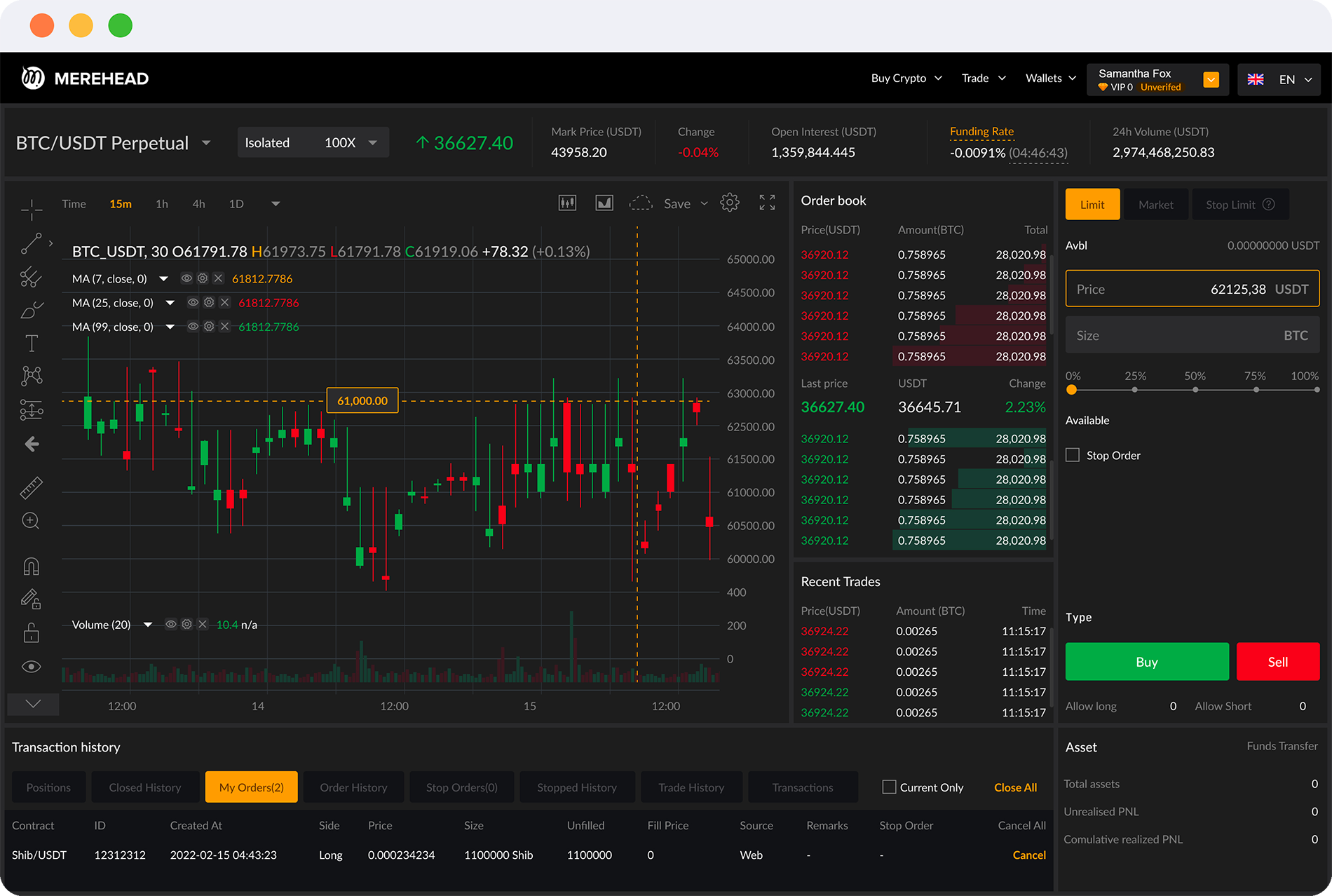
White Label Digital Asset Exchange Platform
Launch a Fully Branded Crypto Exchange in Weeks
Real matching engine, built-in liquidity solution, KYC/AML compliance. Trusted by exchanges in production.
Access to Demo
Most companies shopping for a white label digital asset exchange hit the same wall. The vendor demos look identical. Every pitch deck promises "spot + margin + futures + admin panel + KYC + liquidity." But once you ask which component is a real matching engine and which one is an API wrapper routing to Binance, half those vendors go quiet.
This isn't a minor distinction. It's a business-model question. If your platform routes user orders to an external exchange, every trading fee — maker, taker, spread — accrues to that exchange, not to you. You're operating a marketing interface for someone else's revenue.
The architecture difference between these two types of systems is not cosmetic. A real white label digital asset exchange is a distributed financial infrastructure: matching engine with its own order management system, wallet accounting per blockchain network, liquidation mechanics for margin and futures, a separate admin layer with granular role permissions, and a compliance stack wired into every transaction lifecycle — not just registration. An API wrapper is a frontend.
This guide covers what a production white label exchange actually contains, where the engineering complexity lives, and how to evaluate whether a vendor's offering is real — based on what we've built and shipped in production.
When clients engage us to deploy a white label exchange, they usually picture the trading interface. What they consistently underestimate is the scope underneath. In one of our large exchange deployments, the final platform included six distinct trading modules: spot trading, margin with configurable leverage, futures in a B-book model, options pricing based on the Black-Scholes model, an instant conversion module (crypto-to-crypto without order book exposure), and a full admin panel with role-based access control down to the individual widget level. Each module has its own order management logic, wallet accounting rules, and failure modes.
Bitcoin full node synchronization takes 5–10 days on dedicated hardware. If it isn't started in parallel with development from day one, it becomes the critical path item blocking go-live. We've seen this delay production launches by a week or more on otherwise fully-complete platforms.
BNB Smart Chain and TRON nodes sync in 1–3 days; Ethereum takes 3–5 days. Start all of them on project day one, regardless of whether integration work has begun.
The modules that typically surprise clients — because they aren't visible in a demo but are critical in production:
Wallet accounting per network. The platform must track balances independently for every supported blockchain. In our deployments, we've integrated 15+ blockchain networks — Bitcoin, Ethereum, TRON, BNB, Solana, XRP, ADA, AVAX, DOT, Polygon, Optimism, Arbitrum, TON, ATOM, and others — into unified platform infrastructure. Each has its own node, synchronization timeline, address derivation scheme, and fee estimation logic. This isn't a one-time configuration; it requires ongoing maintenance as networks fork and fee markets change.
Liquidation mechanics. Margin and futures trading require a liquidation engine that operates independently of the matching engine. When a user's margin ratio drops below the maintenance threshold, the system must close positions at market price automatically — even under high-load conditions. The liquidation price calculation, partial liquidation logic, and insurance fund management are separate engineering concerns that a trading UI demo will never reveal.
Admin panel with role granularity. An operational exchange requires different admin roles: compliance officers who can freeze accounts and review AML flags, finance teams who approve fiat withdrawals, support staff with read-only access, and platform administrators who configure trading parameters. One of our projects went through seven distinct capability layers in the admin panel — from multi-account VIP tiers to per-user commission overrides to forced wallet resets triggered by compliance events.
For a deeper look at the matching logic and order book performance characteristics, the matching engine architecture breakdown covers the technical implementation in detail — including the latency constraints that separate production systems from demo environments.
Every new exchange faces the same chicken-and-egg problem: traders won't come without liquidity, and you can't build liquidity without traders. Most white label vendors don't have a real answer to this. They'll tell you to "connect a liquidity provider" and hand you an API key.
In one of our exchange deployments, we implemented a production model that solves this: OKX order book mirroring for the spot market. The flow works as follows. When a user places a sell order, the system simultaneously borrows the equivalent amount on OKX using 3× margin, executes the sell on OKX's market at the current price, credits the user's USDT balance on the platform, then settles the OKX borrow position when funds are available. From the user's perspective, they're trading against a live order book with real depth. From the infrastructure perspective, the exchange is routing through OKX to source liquidity on demand.
In another deployment, we connected two external liquidity providers simultaneously — Binance and Kraken — with the admin panel allowing the operator to map each trading pair to a specific provider or route by best available rate. Rate display and balance updates used WebSocket connections to both providers in parallel, ensuring users always see live rates, not cached values.
The fail-safe architecture matters as much as the routing logic. In our production implementations, a trading order is only committed after provider confirmation. If external execution fails, frozen collateral is released immediately and the user receives a clean error — not a phantom position or a locked balance. This prevents the class of reconciliation failures that plague exchanges built on optimistic order creation.
| Liquidity Model | Cold-Start Ready | Revenue to Operator | Infrastructure Complexity | Key Risk |
| API Wrapper (Binance-based) | Yes | Fees go to Binance | Low | Hard platform dependency |
| OKX / Binance Order Book Mirroring | Yes | Full spread captured | High — requires margin monitoring | Collateral liquidation risk |
| Dual-Provider Routing (Binance + Kraken) | Yes | Best-rate capture | High — dual WebSocket + routing | Provider downtime risk |
| Native Market Making (own order book) | No — requires volume | Maximum | Very High | Inventory risk |
The fastest deployment we've executed — from signed contract to live, branded platform — took under two weeks. That figure gets cited in sales conversations and it's true, but it requires context to be useful.
The process: deploy the existing production-tested platform to a dedicated server, connect the client's domain with SSL configuration, replace API credentials for all third-party integrations (payment processor, SMS provider, email service, trading data feed), apply the client's brand design tokens (logo, color scheme, typography), run smoke tests across critical user flows — deposit, trade execution, withdrawal — then hand over admin credentials with documented runbooks.
This timeline is only achievable because the underlying product was already built and battle-tested in production across multiple prior deployments. In our white-label work, the same base platform serves multiple clients with completely different brand identities. Fork the codebase, apply design tokens, configure payment gateways, update API keys, connect the domain. The trading logic, admin panel, and compliance flows are identical across deployments.
The reuse model cuts the client's cost by 60–80% compared to building from scratch and reduces their risk to near zero on core trading mechanics. What they're paying for isn't the code that already exists — it's the configuration, customization, and the years of engineering that went into making the base production-ready.
What extends timelines in practice:
The complete guide to launching a crypto exchange in 2026 covers the full infrastructure milestone checklist — including the provisioning steps that most project plans miss and that consistently become blockers.
Most white label exchange vendors describe their compliance offering as "KYC integrated." What that typically means: a SumSub or Veriff widget on the registration flow, document upload, and a status flag on the user record. That's necessary but not sufficient for a platform intending to operate under US or EU regulatory scrutiny — or that wants to avoid being the venue through which sanctioned addresses move funds.
The distinction that matters is between KYC (Know Your Customer — identity verified at registration) and KYT (Know Your Transaction — risk-scored at the point of each transaction). They operate at different layers of the compliance stack and have different failure modes.
In our production deployments, KYT is wired to every inbound deposit — not just high-value ones, not just flagged users. When a deposit arrives, the system submits the originating wallet address to the AML scoring engine before crediting the balance. The engine returns a risk score, category flags (sanctions, darknet market association, mixer usage), and a USDT-equivalent exposure figure. If the score exceeds the operator-configured threshold, the system creates an admin review task and freezes the deposit. The user sees a "pending" status. Their balance does not update until a compliance officer clears the transaction.
Chainalysis has stronger coverage on Bitcoin and Ethereum; other providers perform better on TRON and BNB Chain. Multi-provider aggregation gives the compliance team a more complete risk picture without manual cross-referencing between tools. The dashboard surfaces the highest-risk result from any provider as the operative score — conservative by design.
One of the more sophisticated features we've built in this area is forced wallet regeneration triggered by a risk event. When a user's deposit address is flagged — either by the AML scoring system or manually by a compliance officer — the system automatically generates a new deposit address for that user across all supported networks and retires the flagged address.
Any future deposits to the old address are quarantined. This breaks the association between the user and the flagged address without revealing the compliance trigger in the user-facing notification ("your deposit address has been updated for security reasons").
The compliance architecture described above is detailed further in the context of crypto exchange security in 2026 — including how transaction monitoring integrates with the broader security posture and where institutional buyers probe first during due diligence.
A crypto-only exchange is operationally straightforward compared to a platform that also handles fiat. Fiat on-ramps and off-ramps introduce a different class of complexity: settlement windows, banking partner dependencies, SEPA vs SEPA Instant behavioral differences, and a parallel set of user states that don't map cleanly onto the crypto transaction model.
In one deployment, we implemented a full fiat module alongside the crypto spot market — single UI, unified balance display, real-time conversion to the user's preferred currency. The balance logic required tracking crypto balances, fiat balances, and a conversion layer that calculated the display value in real time without triggering unnecessary exchange operations. Adding a fiat tab synchronized with the crypto component sounds incremental; in practice, it required separate deposit and withdrawal state machines, because fiat pending states have different meaning and different resolution paths than crypto pending states.
The fee engine for fiat operations is also structurally different — range-based tiers, with the fee at execution time snapshotted and stored immutably for the compliance record.
For the fee engine: fiat fee structures often involve range-based tiers — different rates for different transaction size buckets — with the fee at the moment of execution snapshotted and stored immutably. If fee structures change post-launch, the historical record of what the user was charged at execution time must be preserved exactly. This is a compliance requirement, not just an accounting nicety.
White label exchange vendors commonly list supported blockchains as a feature bullet. In practice, each blockchain integration is a separate engineering deliverable with its own node infrastructure, synchronization timeline, address derivation scheme, fee estimation logic, and confirmation requirements.
The operational characteristics differ significantly across networks:
Beyond sync times, each network requires separate handling for its fee model. Bitcoin uses UTXO-based fee estimation tied to mempool congestion. EVM-compatible chains use gas-based pricing that changes with network utilization. TRON uses an energy/bandwidth model that behaves differently again. The withdrawal engine must calculate fees accurately for each network in real time — not using stored estimates that go stale — because underfunded transactions fail silently or get stuck in unconfirmed state.
Address generation at scale also matters. For high-volume exchanges, generating a new deposit address per user per network requires either a deterministic derivation scheme (HD wallets with per-user paths) or a deposit address pooling model. Each approach has different implications for key management, cold storage architecture, and recovery procedures.
For teams evaluating which architecture best fits their model, the detailed comparison of white label versus open source crypto exchange approaches lays out exactly where the engineering responsibility shifts — and what each path costs in real time and money — depending on which route you choose.
One observation from our exchange deployment work that most vendor conversations skip: the final platform almost never matches the initial scope. It evolves through client feedback over a 6–12 month period after launch, and the architecture needs to anticipate this from day one.
In one project, the initial scope was a standard spot trading platform. Over 6–12 months of post-launch feedback, the platform accumulated seven additional capability layers: multi-tier VIP account structures, AML-triggered forced wallet resets, per-user custom commission structures configurable by admin without redeployment, OKX liquidity mirroring on the spot market, overdraft functionality for institutional users, per-currency interest rates for overnight fiat balances, and an updated liquidation model for margin positions. None of these were in the initial contract. All of them made business sense in hindsight.
The practical lesson for white label buyers: evaluate not just what the platform includes at launch, but how the vendor handles extension requests after launch. A platform with a well-documented extension architecture, clean service boundaries, and a vendor team that has actually built those extensions before is worth significantly more than one that ships a feature-complete v1 with no clear path to v2.
The cost of a white label digital asset exchange solution breaks down across three categories that vendors rarely present clearly:
Licensing / base platform fee. Ranges vary widely — from low four-figures for offshore script-based solutions to mid-six-figures for enterprise platforms with production pedigree. The variance reflects not just feature count but production readiness: how many real clients are running on this platform, how long has it been in production, and how many known failure modes have been fixed.
Configuration and customization. Brand adaptation, third-party API integration (payment processors, KYC providers, AML services), domain and infrastructure setup, and any feature modifications from the base. For a lean deployment with no custom features, this is 2–4 weeks of engineering time. For a platform with custom trading modules or fiat integration, budget 2–4 months.
Ongoing operational costs. Node infrastructure hosting, KYC/AML provider fees per verification (typically $0.50–$1.00 per KYC check at scale, more for liveness checks), trading data feeds, monitoring infrastructure, and engineering support for extension development. These costs scale with user volume and are consistently underestimated in initial business plans.
| Cost Category | White Label | Custom Build | Notes |
| Initial development | $30K–$150K | $250K–$800K+ | WL saves 60–80% upfront |
| Time to market | 2 weeks – 3 months | 12–18 months | Assumes mature base platform |
| Core mechanics risk | Near zero | High | WL trading logic is production-tested |
| Custom feature timeline | Weeks (if arch permits) | Variable | Depends on extension architecture quality |
| Ongoing node infra | $500–$3K/mo | $500–$3K/mo | Same regardless of build model |
The 60–80% cost reduction versus building from scratch is real — but only when the base platform is genuinely production-tested. A platform that looks mature in a demo but hasn't been stress-tested with real user deposits, real blockchain transactions, and real compliance events will fail in ways that cost more to fix post-launch than the savings on initial development.
We don't consider a platform ready for launch until deposit and withdrawal flows have been tested with actual mainnet assets — real USDT, real BTC, real ETH. Not testnet tokens. Not simulated transactions.
Testnet behavior differs from mainnet in ways that matter for real money: transaction confirmation times vary with actual network congestion, fee estimation algorithms behave differently under live mempool conditions, and minimum withdrawal amounts enforced by network economics only appear with real assets. In our final testing phase, we fund test wallets with small amounts of real cryptocurrency and run full deposit → trade → withdrawal cycles on each supported network before declaring a platform production-ready.
1. Production access delays. Development complete, staging tests passing, but the client's DevOps team hasn't provisioned production credentials. We've seen this add 2–3 weeks. Our contract now explicitly lists infrastructure readiness milestones as client deliverables with dates.
2. BTC node sync. 5–10 days on modern hardware. If not started on day one of the project, it blocks go-live regardless of everything else being done.
3. Non-deterministic test failures. Crypto transactions depend on network state. Test cases that pass in the morning sometimes fail in the afternoon because mempool conditions changed. We design test suites to distinguish infrastructure variance from application bugs — they're different failure modes requiring different responses.
This is the single most important architecture question. An API wrapper that routes to Binance or another CEX gives you no control over fee revenue, no ability to customize matching logic, and a hard dependency on the external exchange's uptime and terms of service. A real white label exchange runs its own order book and matching logic — you control the spread, the fee structure, and the trading pairs.
If the vendor's answer is "connect a liquidity provider API," ask what happens when that provider's API is down. A production-grade solution includes a fail-safe model: orders only commit after provider confirmation, collateral releases on failure, and monitoring on all critical thresholds. Bonus points if the vendor has actually run this in production and can describe what went wrong the first time.
Registration-time KYC verifies identity once. Transaction-level KYT scores every deposit against AML risk criteria before crediting the balance. If a vendor's compliance stack doesn't include the second layer, the platform is not suitable for operating in regulated markets or serving institutional users who will scrutinize your compliance posture.
Ask specifically: who runs the nodes, where are they hosted, what is the SLA for uptime, and what happens to deposit detection if a node falls behind on synchronization. Shared node infrastructure introduces tail risks — your exchange's deposit detection is coupled to other clients' traffic patterns. Dedicated node infrastructure per blockchain is the production standard for exchanges handling real volume.
Vendors who have deployed multiple instances of the same platform have documented runbooks: step-by-step configuration procedures, infrastructure checklists, API key replacement sequences. Vendors who configure a new system for each client won't. The difference matters for your timeline, your post-launch support quality, and your confidence that the vendor actually knows what's inside the platform they're selling you.
Ask for specific examples of features added post-launch to existing client deployments. A vendor with real extension experience can describe the architectural boundary they had to work within, how long it took, and what the integration looked like. A vendor without this experience will give you a roadmap slide.