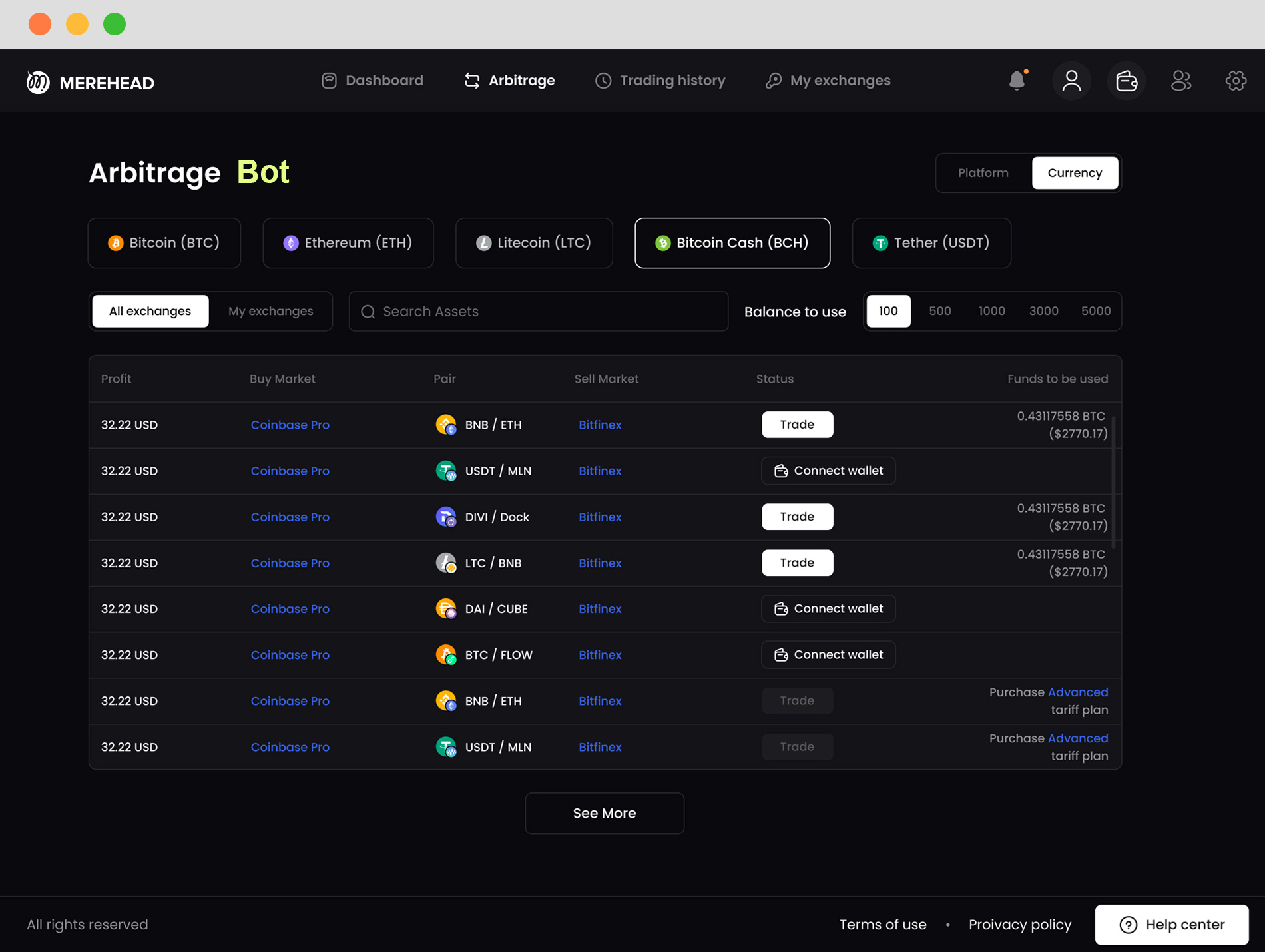
A white label crypto trading bot is a pre-built, fully customizable automated trading system that companies can rebrand and launch as their own product — without building the underlying technology from scratch. These solutions typically support multiple strategies including arbitrage (CEX-to-CEX and CEX-to-DEX), DCA (Dollar Cost Averaging), GRID trading, scalping, and AI-driven portfolio management.
Key characteristics of white label crypto trading bots:
- Exchange connectivity via REST and WebSocket APIs (Binance, Bybit, Kraken, MEXC and others)
- Strategy modules that can be enabled or disabled per deployment
- Branded UI with admin panel and user-facing dashboard
- Full source code ownership after delivery
- Typical delivery timeline: 2–6 weeks vs. 6–12 months for custom development
- Cost range: $10,000–$40,000 depending on feature set, compared to $80,000–$150,000+ for custom builds
White label solutions are used by crypto startups, fintech companies, and exchanges that want to offer automated trading to their users without the overhead of a dedicated development team.
The cryptocurrency bot market is growing fast — in 2024 it is already valued at $52 billion and continues to expand along with the DeFi sector. Every month, more traders are looking for automation: some want to save time, others want to reduce risks or test new strategies without staring at charts all night.
But creating such software from scratch is a long and expensive process. You need a development team, trading expertise, security audits, and months of testing. That's why more and more companies choose a white label crypto trading bot — a ready-made product that can be customized to your brand and launched within weeks.
With a white label solution, you get a proven trading system — arbitrage, DCA, GRID, or AI-based — adjust the interface to your needs, add your logo, and the platform is ready. For startups, exchanges, and fintech companies, this is a fast track to enter the automated trading market with lower costs and less risk.
What Is a White Label Crypto Trading Bot?
A white label product is ready-made software that you rebrand, customize, and launch as your own. Instead of spending months building every component from scratch, you start with a working foundation and adapt it to your business.
For trading bots, this means you get a system that already connects to exchanges via APIs or smart contracts, runs strategies, and handles orders in real time. Then you add the parts that make it yours: interface design, brand identity, and the specific features your audience expects.
The core advantage is straightforward: you don't waste resources reinventing proven technology. You get a system that has already been battle-tested in production, and you shape it into a product that feels native to your company. For businesses looking to start a crypto business in 2026, white label bots represent one of the fastest paths to a market-ready product.
White Label vs. Building from Scratch: What You Actually Get
| Parameter |
White Label Bot |
Custom Development |
| Time to market |
2–6 weeks |
6–12 months |
| Development cost |
$10,000–$40,000 |
$80,000–$150,000+ |
| Technical risk |
Low (proven codebase) |
High (untested logic) |
| Customization |
UI, strategies, branding |
Full architecture control |
| Exchange integrations |
Pre-built (Binance, Bybit, Kraken…) |
Built from scratch |
| Ongoing support |
Included with vendor |
Requires in-house team |
| Source code ownership |
Full (after delivery) |
Full |
The savings on white label development go directly into marketing, customer acquisition, or additional features. For many of our clients, this isn't just about convenience — it's about getting a professional-grade trading product without the 12-month runway and high upfront risk that custom development demands.
Types of White Label Crypto Trading Bots
Not every trading bot works the same way. Each type follows its own logic and serves a different market segment. Here are the most widely deployed variations in white label packages:
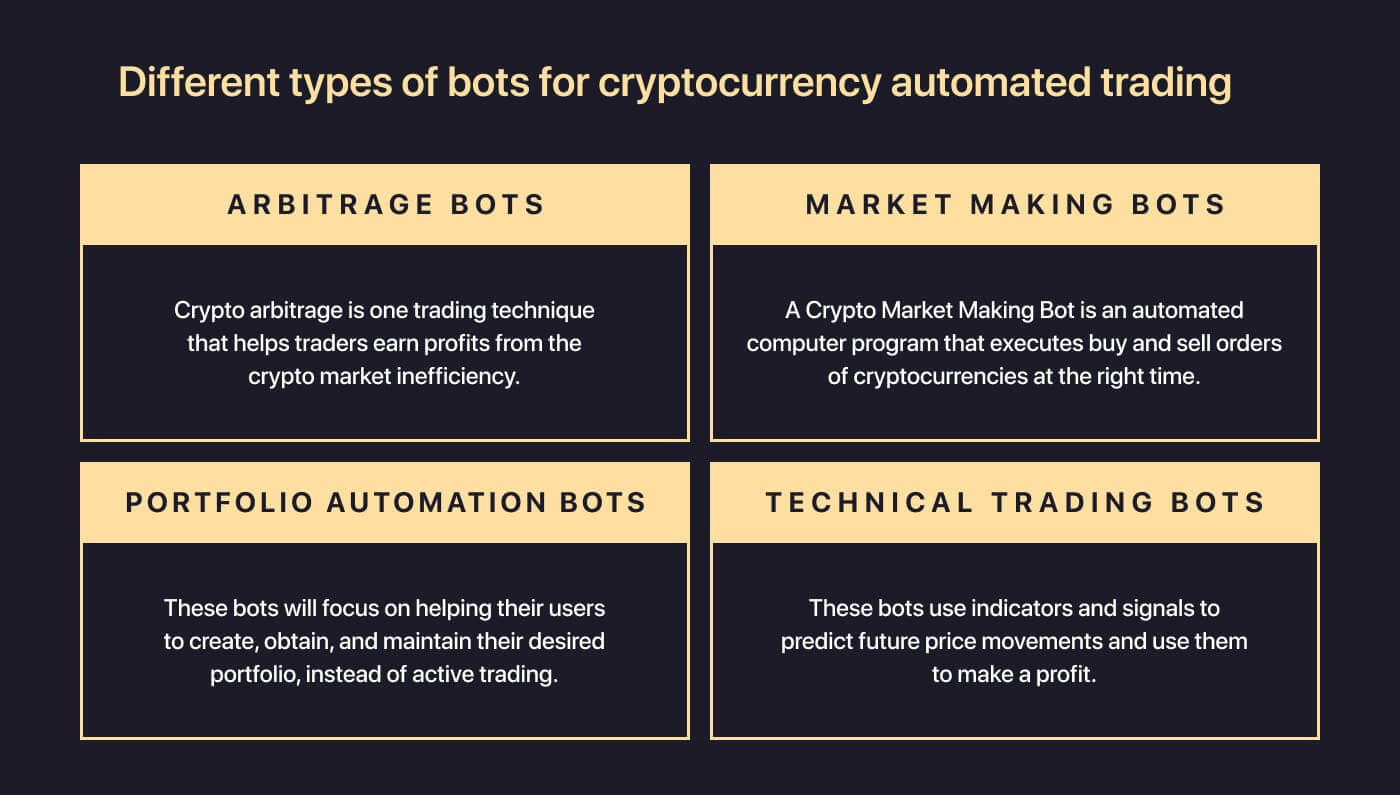
- Arbitrage bots. Buy low on one exchange, sell high on another — CEX-to-CEX or CEX-to-DEX. The core challenge isn't the logic but the infrastructure: gas optimization, slippage calculation per liquidity tier, and sub-second execution. We cover the full architecture breakdown in the section below.
- DCA bots. Accumulate assets at regular intervals regardless of price. Simple to configure, popular with retail platforms. Low infrastructure overhead, high user retention.
- GRID bots. Place a grid of buy and sell orders within a defined price range. Profit from volatility without predicting direction. Works best in ranging markets.
- Scalping bots. High-frequency execution — dozens of small trades per day based on micro price movements. Requires low-latency infrastructure and proximity to exchange servers.
- AI/ML bots. Use machine learning to detect patterns, adapt strategies over time, and rebalance portfolios dynamically. Increasingly in demand as traders want data-driven automation beyond rule-based systems. If you want to go deeper on the AI side, our guide on creating an AI trading bot covers the model selection and training pipeline in detail.
- Trend-following bots. Enter positions when momentum confirms a trend, exit when it fades. Suitable for volatile assets with clear directional movement.
- Market-making bots. Post both bid and ask orders simultaneously to profit from the spread. Adds liquidity to the platform. Particularly effective in calmer market conditions.
- DEX sniper bots. Monitor new pool creation on decentralized exchanges and execute buy orders in the first seconds of a token's listing. Technically complex — see our production case study below.
Most white label platforms we build support several strategies simultaneously, allowing users to choose the approach that fits their risk profile and market conditions.
How a Crypto Trading Bot Works: Cross-Exchange Arbitrage
Every bot follows a set of rules, but the execution depends entirely on the chosen strategy. Let's walk through cross-exchange arbitrage — one of the most common and technically demanding use cases:
- The bot connects to multiple exchanges via their APIs and continuously monitors Bitcoin prices.
- It detects that on Binance, 1 BTC is selling for 64,000 USDT, while on Bybit the price is 64,100 USDT.
- The bot instantly buys 1 BTC on Binance at the lower price.
- It transfers the BTC to Bybit.
- The bot sells on Bybit for 64,100 USDT.
- Net profit is calculated after all fees are deducted and the result is logged.
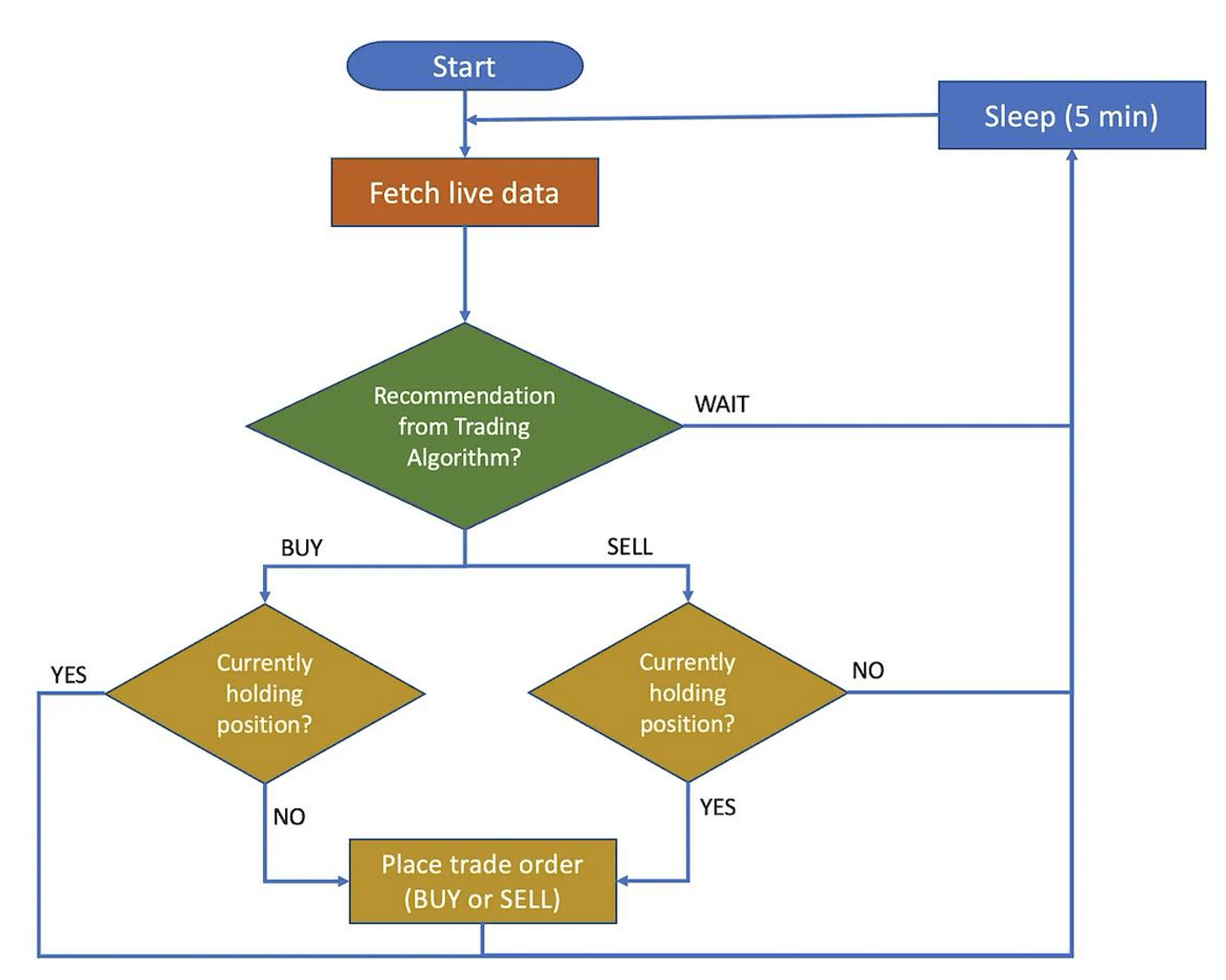
Simple bot logic for cryptocurrency trading
For a human, spotting and executing this in time is impossible — the price gap vanishes in milliseconds. A bot reacts instantly, making such trades repeatable and profitable at scale.
Want to go deeper? Our full guide explains
how to build a crypto arbitrage bot from architecture design to exchange integration.
From Our Practice: Three Architectural Levels of an Arbitrage Bot
Clients often ask whether a bot can "buy instantly". Technically, yes — but the real speed is defined not by the code, but by the exchange infrastructure: API rate limits, account verification tier, and ping to exchange servers.
In our projects, we always go through a structured architecture decision before writing a single line of code:
| Level |
Architecture |
When it fits |
Complexity |
| 1 |
Pure arbitrage bot |
High-liquidity pairs, stable CEX-to-CEX spread |
Medium |
| 2 |
Arbitrage + AMM |
Mixed CEX/DEX pools, periodic rebalancing needed |
High |
| 3 |
Arbitrage + AMM + MEV |
Competitive networks (Ethereum, Solana), front-running environment |
Very High |
A critical component in all three levels is per-asset liquidity classification: high / medium / low. For each tier, the bot applies a different acceptable slippage threshold. At execution time, two prices are calculated in parallel: the theoretical arbitrage price and the realistic price accounting for market impact. A trade is executed only when the gap between them remains positive after gas costs.
The choice between Level 2 and Level 3 is not about ambition — it's about the target network. On Ethereum, MEV competition is so intense that a pure arbitrage bot without MEV protection is practically non-viable in 2026.
Production Case: DEX Sniper Bot on Solana — Where the Real Bottlenecks Are
One of the most requested use cases in our practice: a bot that buys a token in the first seconds of a new pool appearing on a DEX. We've built this on Solana using Jupiter as the aggregator.
Architecturally, the solution is a dedicated microservice that runs on the server every second, compares available tokens against a local database, and fires an API call when a new token appears.
The data volume challenge is significant: in strict mode (verified tokens only) — around 2–3 new tokens per hour, manageable. In all mode — 2–3 new tokens per minute, with a database exceeding 100,000 records. This requires multithreading or parallel processing depending on the implementation language, plus infrastructure capable of handling that query load continuously.
The real bottlenecks in DEX sniper bots — and how to address them:
1. Exchange rate limits. The microservice needs to fire API calls near-continuously. Rate limits are typically resolved by raising account verification level or reaching the required trading volume tier. In several projects we've resolved this through direct negotiations with the exchange's API team.
2. Server ping. This is completely outside the developer's control. Neither the development team nor exchange support can reduce it. The only real solution: co-locate the server in the same data center as the exchange node.
3. Database scale at "all tokens" mode. With 100K+ records growing in real time, naive sequential lookups fail. The solution is sharding or parallel processing — the architecture must account for this from day one, not as an afterthought.
4. Gas reserve management. The bot holds back ~10% of wallet balance for transaction fees. Insufficient reserve = failed orders at peak moments when speed matters most.
Production Case: White Label Platform with External Liquidity Provider
In several projects we built a hybrid model where the white label platform doesn't maintain its own order book, but connects to an external liquidity provider. This gives the client fast time-to-market without the need to seed the order book with their own capital.
The architecture: order is created in the client's system → forwarded for execution to the third-party provider → result is synchronized back. The hardest part is not the base API integration — it's managing the discrepancies between internal business logic and the external service's constraints.
In practice, the most time-consuming work isn't the initial integration. It's the edge cases: partial fills, canceled states, limit mismatches between platforms, and synchronizing fee calculations down to the decimal place. These are what separate a demo-level integration from a production-ready one.
What we implemented in this class of projects:
- Multi-layer fee management: commission = external fee + platform fee, fully configurable via admin panel without a new deployment
- Anti-double-execution protection: button locked until API response received, prevents duplicate order submissions under load
- AML multi-provider checks: parallel verification through multiple providers, with separate logic for deposit vs. withdrawal flows
- Multichain deposit handling: ETH, BNB, TRX — each network has its own flow, with TRX requiring special handling for activation fees
- Fee snapshots: the commission state is captured at the moment of transaction, so fee changes don't retroactively affect open orders
This architecture is also foundational when building a full white label crypto exchange solution — the same patterns apply to spot trading platforms, not only standalone bots.
Crypto Bot Market Dynamics: 2026
Since 2021, the automated trading tools market has been on a steady upward trajectory. Analysts at Verified Market Research project a CAGR of approximately 8.7% from 2024 to 2031. This isn't hype — it's a long-term structural shift driven by technology adoption, user demand, and global capital flows into fintech.
Key growth drivers:
- Rising retail demand. Investors aged 25–35 increasingly prefer automation — it saves time, removes emotional bias, and enables round-the-clock execution.
- AI integration as standard. Machine learning and advanced analytics are no longer premium add-ons. They're becoming baseline expectations. Bots that don't adapt based on data are losing ground.
- Macroeconomic tailwind. PricewaterhouseCoopers projects global GDP growth of ~3% annually through 2030, supporting both investment activity and appetite for financial automation tools.

Forecasted Crypto-Bots Market Dynamics
Regionally, Asia-Pacific leads the crypto bot market in 2026. North America and Europe hold second place, but forecasts indicate North America will take the lead by 2026–2027 as adoption accelerates among both retail and institutional traders.
For companies building platforms, the signal is clear: deliver solutions that combine multiple bot types, real-time analytics, and integrated risk management in a single product. Fragmented, single-strategy tools are losing to full ecosystem platforms.
White Label Bot vs. SaaS Subscription: What to Choose for Your Business
The market splits into two models: white label (you own the product) and SaaS subscriptions like Cryptohopper, 3Commas, or Pionex (you resell access). For B2B purposes, these serve entirely different needs:
| Parameter |
White Label Bot |
SaaS Subscription Platform |
| Branding |
Full — your logo, domain, UI |
None — you use their brand |
| Business model |
Own SaaS, one-time sale, licensing |
Reseller or end-user only |
| Data ownership |
Full control |
Provider controls user data |
| Customization |
Full — strategies, UI, integrations |
Minimal (preset strategies only) |
| Recurring costs |
Server + support only |
$24–$79/month per user seat |
| Exit risk |
None — you own the code |
High — provider can change pricing or shut down |
| Target buyer |
Startups, exchanges, fintech companies |
Individual traders |
The leaders in this space don't just sell bots — they sell ecosystems. Platforms that bundle multiple bot types, real-time analytics, and user management tools tend to win both casual traders and institutional clients. A white label solution lets you build that ecosystem under your own brand from day one.
What to Check Before Buying a White Label Crypto Bot
Not all white label packages are equal. Before signing with a vendor, validate these technical and commercial checkpoints:
- Exchange connectivity. Confirm which exchanges are integrated and whether the API connections are maintained long-term. Rate limit handling, WebSocket support, and reconnection logic matter as much as the list of supported platforms.
- Strategy architecture. Are strategies modular and independently toggleable? Can you add a custom strategy without touching core code? This determines how much flexibility you actually have post-launch.
- Infrastructure requirements. Cloud-native or self-hosted? What are the minimum specs? Low-latency requirements for scalping bots may dictate co-location — make sure the vendor has addressed this.
- Security model. How are API keys stored? Is there key encryption at rest? Multi-factor auth for the admin panel? For platforms handling user funds, this isn't optional.
- Testing protocol. Was the codebase backtested across multiple market conditions? Has it been through a security audit? Ask for documentation, not promises.
- Source code and IP ownership. Ensure the contract explicitly transfers full ownership. Some vendors maintain back-door dependencies — verify there are no licensed third-party components that constrain your rights.
If you're building a more comprehensive product, these same principles apply to white label cryptocurrency exchange solutions — the due diligence framework is the same regardless of whether it's a bot or a full trading platform.
How Much Does a White Label Crypto Trading Bot Cost?
| Package Type |
Price Range |
Delivery Time |
What's Included |
| Basic |
$10,000–$15,000 |
2–3 weeks |
1–2 strategies, basic UI, 3–5 exchange integrations |
| Standard |
$15,000–$25,000 |
3–5 weeks |
Multiple strategies, admin panel, custom branding, reporting |
| Advanced |
$25,000–$40,000 |
5–8 weeks |
AI/ML strategies, DEX support, risk management module, full customization |
| Enterprise |
$40,000+ |
8+ weeks |
MEV/AMM architecture, multi-chain, liquidity provider integration, AML |
For a detailed cost breakdown by component — including exchange API integration, strategy module development, and ongoing maintenance — see our full guide on crypto trading bot development costs in 2026.
Find out
how much it
costs to develop
your crypto trading bot
Share your requirements with our Solutions Architect — we'll send back a per-module hour breakdown within 48 hours, at no cost.
Request an estimate
Conclusion
White label crypto trading bots aren't shortcuts to instant revenue — they're infrastructure. How effective they are depends entirely on the strategy behind them and how carefully the technical foundation is built.
For startups and fintech companies, the white label path removes the largest barrier to entry: time. The months you save on development go directly into building your user base, refining your product, and establishing market presence before competitors catch up.
The right approach is to start with a validated scope, test in a controlled environment, and scale once the unit economics are clear. A well-built bot removes execution uncertainty — it acts the moment the condition is met, whether you're asleep or reviewing the next sprint.
If you're evaluating options and need a clear picture of what's technically possible within your budget and timeline, our team has built production-ready bots across CEX arbitrage, Solana DEX snipers, and full white label trading platforms with external liquidity providers. The conversation starts with your use case — not a sales deck.
FAQ
What is the difference between a white label crypto trading bot and a SaaS bot platform?
A white label bot is software you own, brand, and deploy as your own product. A SaaS platform like Cryptohopper or 3Commas is a subscription service — you're a user or reseller, not an owner. White label gives you full IP ownership, custom branding, and the ability to build your own business model on top. SaaS is suitable for individual traders; white label is designed for companies building products.
How long does it take to launch a white label trading bot?
Typically 2–6 weeks from contract to deployment, depending on the feature scope. A basic package with 1–2 strategies and 3–5 exchange integrations can go live in 2–3 weeks. Advanced configurations with AI strategies, DEX support, or liquidity provider integration take 6–8 weeks. Compare that to 6–12 months for a fully custom build.
Which exchanges can a white label crypto bot connect to?
Pre-built integrations typically cover Binance, Bybit, Kraken, Coinbase, MEXC, and KuCoin. DEX connectivity (Raydium, Jupiter, Uniswap, THORChain) is available in advanced packages. Custom exchange integrations can be added for any platform with a documented public API — the timeline depends on the quality of that API and the rate limit structure.
What trading strategies are available in white label bot packages?
Standard packages include arbitrage (CEX-to-CEX and CEX-to-DEX), DCA, GRID, scalping, and trend-following. Advanced packages add AI/ML-based strategies, mean reversion, market-making, and DEX sniper logic. Most platforms are modular — strategies can be toggled independently and new ones added post-launch without touching the core codebase.
Is it safe to build a trading business on a white label bot?
Safety depends on the technical foundation: how API keys are stored (encrypted at rest), whether there's proper rate limit handling, how the system behaves during exchange downtime, and whether the codebase has been through a security audit. Always request documentation of the testing protocol and verify you receive full source code with no hidden dependencies or licensed third-party modules that limit your control.
Can a white label bot work on decentralized exchanges (DEX)?
Yes. DEX integration — particularly on Solana (Jupiter, Raydium) and Ethereum (Uniswap, dYdX) — is available in advanced packages. The architecture differs significantly from CEX bots: instead of REST API calls, the bot interacts with smart contracts and on-chain data. This introduces unique challenges around gas management, slippage at the pool level, and infrastructure co-location near blockchain nodes.