- choose a programming language (Python is the industry standard for ML-heavy bots)
- select target exchanges and their APIs
- define a trading strategy (arbitrage, scalping, mean reversion, or trend-following)
- implement technical indicators (RSI, MACD, ATR)
- integrate and train an ML model (TensorFlow or PyTorch)
- deploy on cloud infrastructure and run backtests before going live.
Development cost ranges from $10,000 for a basic bot to $80,000+ for enterprise-grade AI trading systems with custom ML pipelines and multi-exchange integration.
What Is an AI Trading Bot?
An AI-powered trading bot is software that automates the full trading cycle: market data ingestion, signal generation, order execution, and portfolio management. Unlike rule-based bots that follow static if/then logic, AI bots use machine learning models to adapt their behavior based on new data — improving decision quality over time without manual reconfiguration.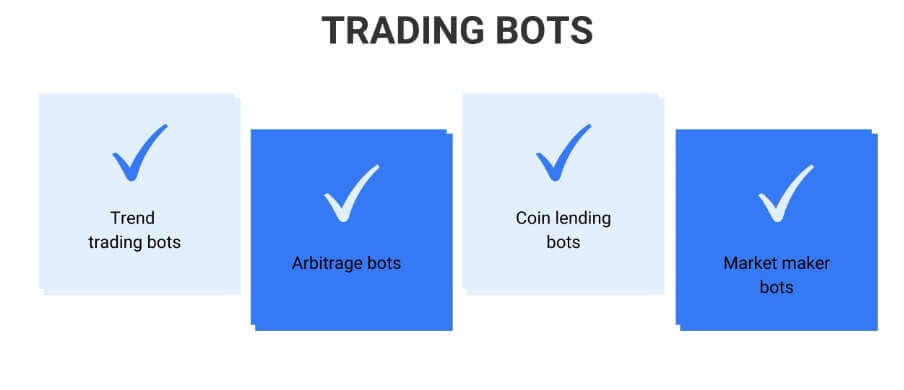
AI, ML, and Automation — Key Differences
These three terms are frequently used interchangeably, but they describe distinct layers of a trading system:| Concept | Definition in Trading Context | Example |
|---|---|---|
| Automation | Pre-defined decision rules executed without human input | Place a sell order when RSI > 70 |
| Machine Learning | Models that improve performance by learning from historical and live data | A Random Forest model predicting price direction |
| Artificial Intelligence | Broadest scope — any intelligent software that mimics cognitive functions | NLP sentiment analysis of financial news |
A production-grade AI trading bot integrates all three: automation handles execution speed, ML handles signal quality, and AI-level techniques (neural networks, LLMs for news parsing) handle market context.
How an AI Trading Bot Works
The operational pipeline of an AI trading bot consists of four stages:- Data ingestion. The bot pulls price data, order book depth, trading volume, and — for AI-enhanced systems — news feeds, social media sentiment, and on-chain metrics. Sources can be free (public exchange APIs) or paid (Bloomberg, CoinMetrics).
- Signal generation. The ML model processes ingested data and generates buy/sell/hold signals based on learned patterns. Technical indicators (RSI, MACD, ATR) often serve as features fed into the model.
- Order execution. When signal conditions are met, the bot places orders on the exchange via API — market, limit, or stop orders — in milliseconds.
- Portfolio management. The system tracks open positions, applies risk parameters (stop-loss, drawdown limits), and rebalances the portfolio based on predefined rules or ML-driven adjustments.
Core Advantages of AI-Based Trading Bots
- 24/7 autonomous operation. The bot trades continuously without fatigue, capturing market opportunities across all time zones and sessions.
- Elimination of emotional bias. Decisions are made purely by algorithm. Panic selling and FOMO buying — the primary loss drivers for retail traders — are removed from the equation.
- Multi-source data analysis at scale. AI models process thousands of data points per second: price action across exchanges, news in multiple languages, on-chain flow data — simultaneously.
- Adaptive self-learning. With neural network support, the bot refines its trading tactics as market conditions evolve, without requiring manual strategy updates.
- Execution speed. Orders are placed at machine speed — critical in volatile markets where a 50ms advantage over manual trading means the difference between profit and slippage.
Market Context: AI in Algorithmic Trading
Institutional adoption of AI in trading has accelerated sharply. According to JP Morgan's 2024 survey of 4,000+ institutional traders, 61% identified AI as the primary factor shaping trading from 2024 to 2027 — up from just 25% in 2022. The same data shows a shift toward multi-asset coverage: the majority of professional traders are expanding AI bot usage beyond crypto into stocks, commodities, G10 rates, and indices.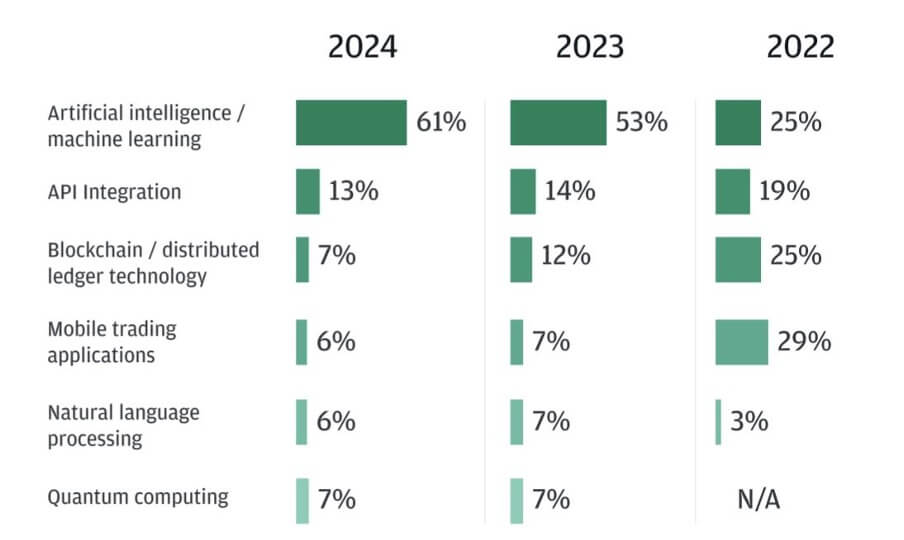
This shift has direct implications for bot development: a wider addressable market means bots that support multiple asset classes and exchange types will have significantly broader commercial viability than crypto-only solutions.
Risks and Technical Limitations
Any honest guide to AI trading bot development must address the failure modes:1. Overfitting to historical data. ML models trained heavily on backtesting data tend to perform well on paper but poorly in live markets. The model learns noise, not signal. Regularization, walk-forward testing, and out-of-sample validation are mandatory, not optional.
2. API latency and rate limits. Exchange APIs impose request limits. In high-frequency scenarios, hitting those limits freezes the bot at the worst possible moment. Planning for tiered verification and rate limit negotiation with exchanges is part of the architecture, not an afterthought.
3. Slippage and liquidity mismatch. A signal that looks profitable in backtesting may generate losses in live trading due to slippage — especially on low-liquidity pairs. Every bot must model realistic fill prices, not theoretical mid-market prices.
4. Security vulnerabilities. API keys, wallet private keys, and database credentials are high-value targets. Multi-layer security architecture (encrypted key storage, IP whitelisting, 2FA on exchange accounts) is non-negotiable.
How to Build an AI Trading Bot: Step-by-Step
Building a production-grade AI trading bot requires decisions across six technical layers. Below is the complete development roadmap.Step 1: Choose Your Programming Language
Language choice directly affects ML integration capability, execution speed, and long-term maintainability:| Language | Best For | ML Support | Weakness |
|---|---|---|---|
| Python | ML-heavy bots, rapid prototyping | Excellent (TensorFlow, PyTorch, scikit-learn) | Memory-intensive tasks; GIL limits true multithreading |
| C# | High-frequency, low-latency execution | Good (ML.NET) | Steeper learning curve; smaller ML community |
| JavaScript / Node.js | Multi-API request handling, lightweight bots | Limited | Poor for complex mathematical computations |
| Rust / Go | Ultra-low latency, memory-safe execution layers | Minimal | Small ML ecosystem; longer development cycles |
For most AI trading bot projects, Python handles the ML pipeline and strategy logic, with C# or Rust used for the execution layer in performance-critical architectures.
Step 2: Select Target Markets and Exchanges
The choice of market determines which exchanges you integrate and which APIs you'll need to support. AI bots operate across: crypto spot and derivatives (CEX and DEX), Forex, binary options, CFDs, indices, metals, and commodities.Key criteria when evaluating exchanges for API integration:
- Open API availability with documented WebSocket and REST endpoints
- Rate limit thresholds and upgrade paths for high-volume trading accounts
- Trading volume and liquidity on target pairs — thin order books kill arbitrage strategies
- Geographic restrictions — some exchanges block US-based accounts entirely
- Account verification tiers — higher tiers unlock higher API rate limits
Popular CEX options: Binance, Kraken, Bybit, OKX, KuCoin. DEX options: Uniswap, Raydium, THORChain.
Step 3: Define Trading Strategy and Indicators
The strategy determines the bot's entire decision logic. Choosing the wrong strategy for a target market is the most common reason bots fail after launch.Core strategies:
- Arbitrage. Exploiting price differences of the same asset across exchanges (inter-exchange) or within one exchange across different pairs (triangular arbitrage). Speed and slippage modeling are critical.
- Scalping. High-frequency capture of small price movements. Requires sub-second execution and tight spread control.
- Mean Reversion. Betting that asset price will return to its moving average after deviation. Works well in range-bound markets, fails in sustained trends.
- Trend Following / Position Trading. Long-term position held in the direction of a strong trend. Lower execution frequency, higher per-trade profitability target.
- Sniper / Listing Bot. Buys a new token within seconds of pool creation on a DEX. Requires real-time liquidity pool monitoring and sub-second execution.
Technical indicators to implement as ML model features:
- RSI (Relative Strength Index) — probability of trend reversal
- MACD — trend strength and momentum
- ATR (Average True Range) — asset volatility measurement
- ADX — trend intensity
- MA / EMA — moving average baselines for mean reversion signals
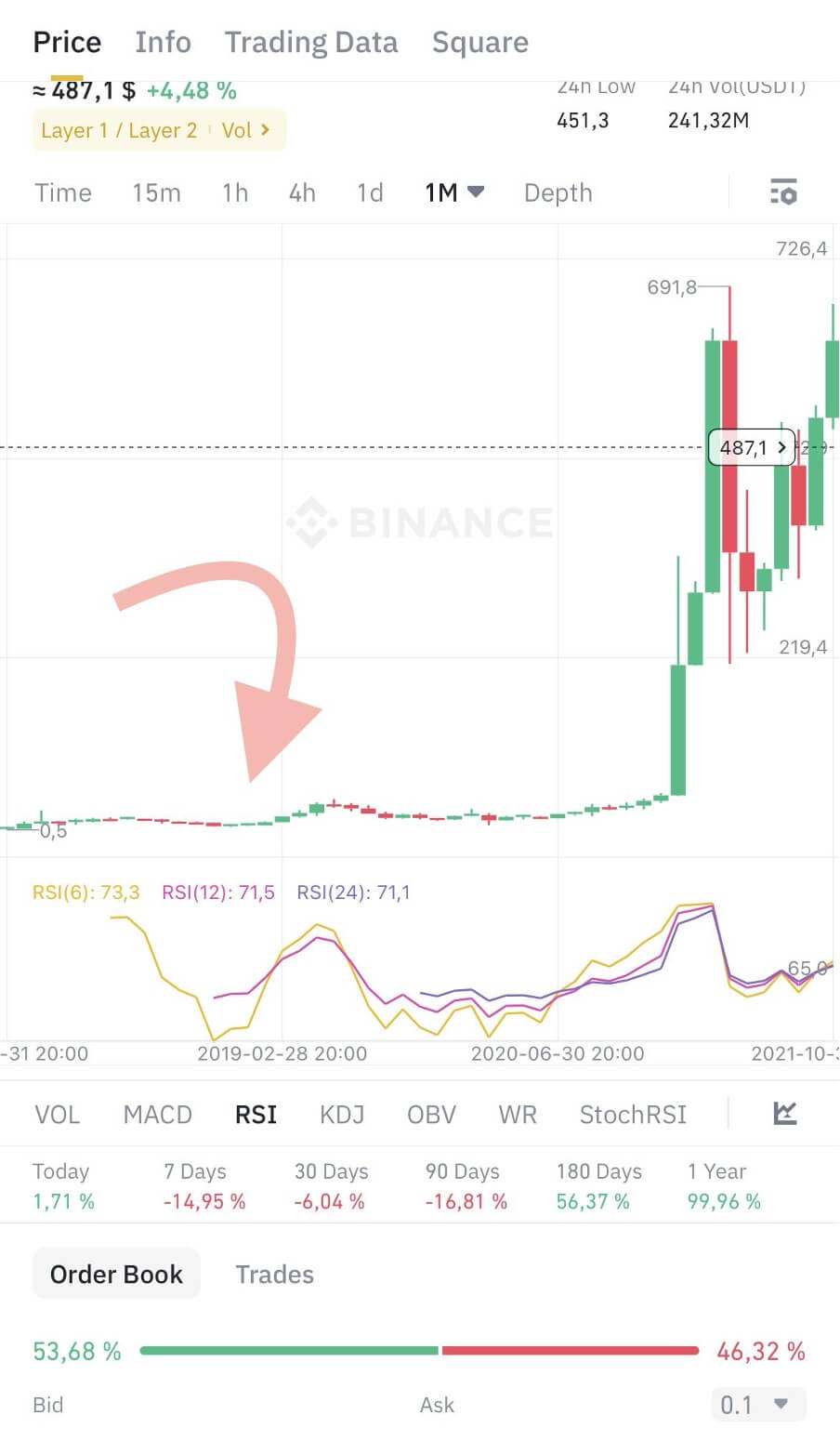
Custom indicators built on proprietary mathematical models are possible — but require parallel expertise in quantitative finance and software engineering.
Step 4: Select AI Framework and ML Model
The ML model is the intelligence layer of the bot. Model selection depends on the strategy type, data volume, and latency requirements.ML model options by use case:
- Logistic Regression / Linear Regression — fast, interpretable, suitable for simple signal classification
- Decision Tree / Random Forest — handles non-linear relationships in market data, good baseline for feature importance analysis
- LSTM (Long Short-Term Memory) — neural network architecture built for time-series data; strong for price sequence prediction
- Reinforcement Learning — the model learns by interacting with a simulated market environment; highest potential, highest development complexity
- Transformer / LLM-based — for NLP tasks: parsing earnings reports, regulatory filings, news sentiment in real time
AI frameworks:
- TensorFlow — largest community, production-proven, highest number of trading bot projects on GitHub. Best for teams that need mature tooling.
- PyTorch — preferred for research and rapid iteration; excellent for custom LSTM and reinforcement learning architectures.
- Keras — high-level API on top of TensorFlow; best for prototyping before production optimization.
Step 5: Infrastructure and Deployment Architecture
Infrastructure choice directly affects bot uptime, execution latency, and security posture. A dedicated server gives maximum control; cloud deployment gives scalability and managed availability.Recommended cloud providers for trading bots:
- AWS — widest range of services; EC2 instances co-located near major exchange data centers reduce network latency
- Google Cloud — strong ML tooling integration (Vertex AI); good for bots with heavy model inference workloads
- DigitalOcean — simpler setup, lower cost; suitable for mid-complexity bots without HFT requirements
Infrastructure setup checklist:
- Virtual machine configuration with appropriate CPU/RAM for ML inference under load
- WebSocket connections to exchange APIs for real-time data streaming
- Database setup for trade logs, token state, and user configuration
- Secure key vault for API keys and wallet credentials
- Monitoring and alerting stack (Prometheus + Grafana or equivalent)
For bots monitoring a small set of tokens (dozens), a single-threaded polling loop is sufficient. The architecture breaks down at scale. In a DEX sniper bot operating in "all tokens" mode, the token database exceeds 100,000 records with 2–3 new tokens appearing per minute.
At that scale, comparing the aggregator state against the local database within the polling interval requires multithreading (Python) or goroutines (Go) — without it, the bot misses listings before the next cycle begins. Additionally, always reserve ~10% of the trading wallet balance as a gas fee buffer. During network congestion spikes, transactions without sufficient gas priority are either dropped or confirmed with critical delay, negating any latency optimization in the execution layer.
Step 6: UI/UX and User Interface
A trading bot without a usable control interface creates operational risk — traders need to monitor positions, adjust parameters, and trigger emergency stops without touching the codebase.Interface options range from a Telegram bot command interface (lowest development cost, fastest time-to-deploy) to a full web dashboard with TradingView chart integration, portfolio analytics, and admin controls.
Standard Telegram command interface for trading bots:
| Command | Function |
|---|---|
/start, /setup | Initialize bot, configure wallet and trading parameters |
/trade_on | Activate automated trading |
/buy [PAIR], /sell [PAIR] | Manual trade execution override |
/stop [PAIR] | Stop monitoring a specific pair |
/status | Portfolio status, open positions, P&L summary |
/trade_off, /stop_bot | Emergency stop — halts all trading activity |
For full-scale platforms, use prototyping tools (Figma, Adobe XD, Axure RP) before development to validate UX flows — especially for deposit/withdrawal, KYC, and admin panel interactions.
Advanced Architecture: Arbitrage Bots and DEX Integration
For developers targeting DeFi markets, arbitrage bot architecture involves decisions that go well beyond basic bot development. Here is the complete architectural breakdown based on our production experience.CEX ↔ DEX Arbitrage: Key Technical Challenges
Cross-venue arbitrage between a centralized exchange and a DEX sounds straightforward in theory. In practice, it generates a specific set of engineering challenges:A CEX confirms an order in milliseconds. A DEX transaction requires on-chain block confirmation — anywhere from 400ms (Solana) to 12+ seconds (Ethereum mainnet). By the time the DEX leg of the trade confirms, the price on the CEX has often already moved. Strategies that ignore this latency gap are profitable in backtesting and loss-generating in production. The engineering solution is to model each asset in three liquidity tiers — high, medium, low — and apply dynamic slippage buffers per tier.
Two price outputs are computed for every opportunity: the theoretical arbitrage price (what backtesting would show) and the realistic fill price (accounting for slippage, gas cost, and confirmation latency). Only opportunities where the realistic price exceeds a profitability threshold trigger execution.
Three Arbitrage Architecture Models: Comparison
| Architecture | Profitability | Technical Complexity | Primary Risk | Best For |
|---|---|---|---|---|
| Standard Arbitrage Bot | Low without large capital | Medium | API latency, slippage on execution | Proof-of-concept, learning |
| Arbitrage + AMM Integration | Medium — stable income from LP fees + arbitrage | High | Impermanent loss in volatile markets | Production DeFi bots |
| Arbitrage + AMM + MEV | High but volatile | Very High | Regulatory, ethical, front-running detection | Advanced quant teams only |
For DEX platforms using AMM-based liquidity (as opposed to order book models), the Arbitrage + AMM architecture is the recommended production configuration. It combines arbitrage opportunity capture with LP fee income and portfolio rebalancing through liquidity pool participation — reducing overall variance in P&L compared to pure arbitrage.
Intra-Platform Arbitrage with Portfolio Rebalancing
A simpler and often more practical architecture for teams without HFT infrastructure: arbitrage across multiple pairs within a single DEX, combined with an automated rebalancing mechanism.Core functional requirements for this architecture:
- Real-time price monitoring across all available trading pairs on the target platform
- Automatic trade execution when price differentials exceed the profitability threshold (net of gas and slippage)
- Scheduled portfolio rebalancing — either time-based (weekly) or trade-count-based (every 5–10 trades) — to maintain target asset allocation
- Transaction cost modeling that accounts for gas fees, slippage, and tax implications at rebalance time
- Detailed reporting per trade: execution price, fill vs. theoretical price, gas cost, realized P&L
AI Trading Bot Development: 5-Milestone Roadmap
Structuring development into milestones creates clear delivery gates and makes cost estimation predictable. Below is the standard roadmap we use in production:| Milestone | Deliverable | Key Technical Work |
|---|---|---|
| M1: Analysis & Architecture | System design document, tech stack decision | Architecture design, API analysis (DEX/CEX), database schema, security key management strategy |
| M2: Prototype | Working prototype with basic buy/sell | Core bot initialization, exchange API integration, basic order execution, Telegram interface skeleton |
| M3: Trading Engine | Full strategy implementation | ML model integration, trading algorithm implementation, real-time market monitoring, signal-to-order pipeline |
| M4: UI & Notifications | User interface, reporting system | Telegram command interface or web dashboard, trade notification system, portfolio status reporting |
| M5: Optimization & QA | Production-ready bot | Performance optimization, dynamic parameter adjustment, backtesting suite, security audit, deployment |
Testing an AI Trading Bot
Testing is the highest-leverage stage of bot development. A bug in production means real capital loss. The testing pipeline must cover three distinct validation layers:Algorithm and Execution Testing
Verify that every conditional branch in the trading logic executes correctly: buy triggers fire on correct conditions, stop-loss orders execute before drawdown exceeds limits, and concurrent trades don't create conflicting position states.Security Testing
AI trading bots are high-value attack targets. Security testing must cover:- API key exposure in logs, environment variables, and version control
- Injection attacks on the database layer storing trade history and user configs
- Unauthorized access to the Telegram command interface
- Private key security for DEX-integrated bots with direct wallet access
Backtesting and Profitability Validation
Backtesting on historical data is mandatory but insufficient on its own. Standard metrics:| Metric | What It Measures | Red Flag Threshold |
|---|---|---|
| ROI | Overall trading profitability | Positive in backtest, negative in paper trading = overfitting |
| Profit Factor | Ratio of gross profit to gross loss | < 1.2 indicates marginal edge at best |
| Max Drawdown | Largest peak-to-trough portfolio decline | > 20% suggests insufficient risk controls |
| Avg. Trade Execution Time | Speed of order placement and fill | Depends on strategy — critical for scalping and arbitrage |
| Sharpe Ratio | Risk-adjusted return | < 1.0 = poor risk/reward profile |
AI Trading Bot Development Cost
Cost varies by complexity, ML model depth, number of exchange integrations, and UI requirements:| Bot Type | Description | Estimated Cost |
|---|---|---|
| Basic AI Bot | Single exchange, one strategy, Telegram interface, basic ML model | $10,000 – $25,000 |
| Mid-Tier Bot | 2–3 exchanges, multiple strategies, web dashboard, custom indicators | $25,000 – $50,000 |
| Enterprise-Grade Platform | Multi-exchange, custom ML pipeline, AMM/DEX integration, full admin panel, security audit | $50,000 – $80,000+ |
| DEX Arbitrage + AMM | Cross-chain architecture, AMM liquidity management, MEV-optional module | $40,000 – $70,000 |
Conclusion
Building a production-grade AI trading bot is a multi-layer engineering project that spans ML model selection, exchange API integration, infrastructure deployment, security hardening, and backtesting. The core development decisions — language, strategy, ML architecture, and deployment model — have compounding effects on bot performance that can't be fixed post-launch without significant rework.The most commercially viable bot architectures in 2025–2026 are multi-asset (not crypto-only), multi-exchange, and built on adaptive ML models rather than static rule sets. For DeFi-focused development, the Arbitrage + AMM architecture strikes the best balance between profitability, complexity, and risk.
For over 9 years, our crypto trading bot development company Merehead has built AI trading bots across CEX, DEX, Forex, and binary options markets. We handle the full stack: strategy design, ML model development, exchange API integration, security architecture, and production deployment. To discuss your project and get an accurate development estimate, contact us via the form on our main page.
FAQ
What programming language is best for building an AI trading bot?
Python is the standard choice for AI trading bots due to its mature ML ecosystem (TensorFlow, PyTorch, scikit-learn) and ease of API integration. For performance-critical execution layers, C# or Rust are used alongside Python. JavaScript is suitable for lightweight bots with multi-API handling but lacks the ML tooling for serious AI workloads.
How does an AI trading bot differ from a regular trading bot?
A standard trading bot follows fixed if/then rules — it executes predefined logic without learning. An AI trading bot incorporates machine learning models that improve their decision-making over time based on new market data. AI bots also typically integrate NLP for news sentiment analysis and use neural networks for pattern recognition that rule-based bots cannot perform.
How much does it cost to build a custom AI trading bot?
Basic AI trading bots with a single exchange integration and standard ML model cost between $10,000 and $25,000. Mid-tier systems covering multiple exchanges and custom strategy logic range from $25,000 to $50,000. Enterprise platforms with custom ML pipelines, DEX/AMM integration, and full admin infrastructure range from $50,000 to $80,000+.
What is overfitting and why is it a major risk for AI trading bots?
Overfitting occurs when an ML model is trained too heavily on historical data — it learns the noise of past price action rather than generalizable market patterns. The result: outstanding backtest performance and poor live trading results. Prevention requires out-of-sample validation, walk-forward testing, and regularization during model training.
Can an AI trading bot work on both CEX and DEX?
Yes — and cross-venue arbitrage bots specifically exploit price differences between centralized and decentralized exchanges. The main engineering challenge is execution latency asymmetry: CEX order confirmation takes milliseconds while DEX on-chain confirmation takes hundreds of milliseconds to several seconds. Profitable CEX↔DEX arbitrage requires dynamic slippage modeling and careful gas fee management, not just fast signal generation.
What is a sniper bot and how does it work on a DEX?
A sniper (listing) bot buys a new token within the first seconds of its liquidity pool appearing on a DEX aggregator. It works by running a monitoring service that polls the aggregator every second, compares discovered tokens against a local database, and immediately fires a buy order when a new pool is detected. At scale — monitoring 100,000+ tokens in "all tokens" mode — this requires parallel processing architecture and a dedicated gas reserve (~10% of wallet balance) to ensure transaction priority during network congestion.
What is the difference between arbitrage bot, AMM bot, and MEV bot?
An arbitrage bot profits from price differences across venues. An AMM bot interacts directly with liquidity pools — acting as both trader and liquidity provider, earning trading fees in addition to arbitrage spreads. A MEV (Maximal Extractable Value) bot captures value from transaction ordering within blockchain blocks — front-running or back-running other users' trades. MEV bots offer the highest potential profit but carry significant regulatory, ethical, and technical risk. For most production projects, the Arbitrage + AMM combination offers the best risk/reward balance.