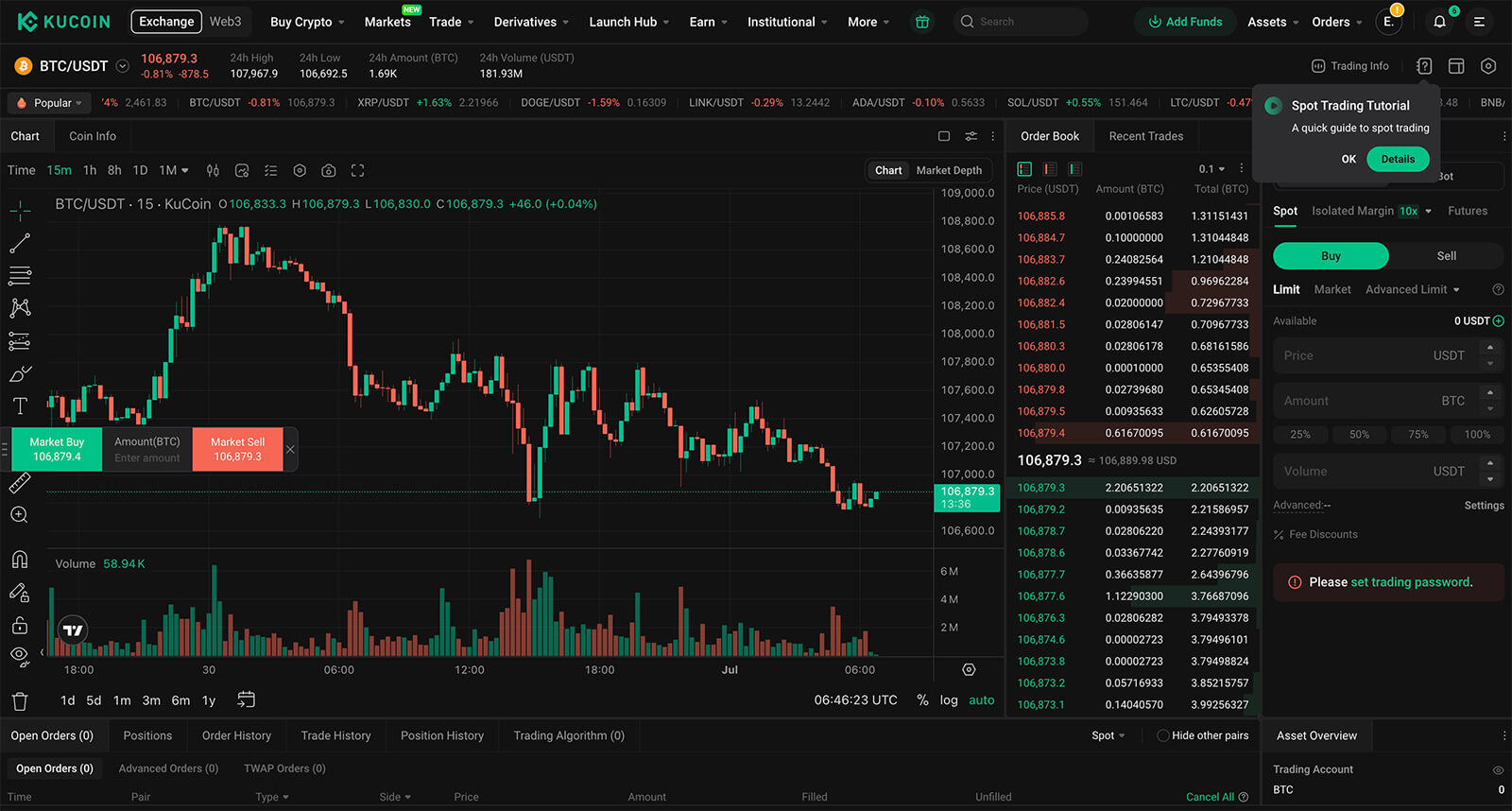
Launching a crypto exchange like KuCoin can be both profitable and strategically smart — if you understand what makes KuCoin's model worth replicating. It isn't the biggest exchange by volume. It isn't the most regulated. What KuCoin is, specifically, is the most feature-dense exchange for altcoin traders: 600+ listed cryptocurrencies, built-in trading bots that retail users run without writing code, leveraged tokens with 3x exposure and no liquidation risk, and a native token that pays daily dividends from platform revenue.
That combination is why KuCoin has built a loyal professional trader base rather than competing on price with Binance or simplicity with Coinbase. A KuCoin clone script lets you replicate this model — matching engine, wallet system, bot infrastructure, KYC flow, and earn products — and launch in weeks rather than years.
Instead of building from scratch, many startups today choose to develop a crypto trading platform based on proven business models. This reduces development costs, shortens time-to-market, and lowers the risks associated with launching a new exchange. In this guide, we'll break down exactly what a KuCoin-style exchange includes, why the architecture matters, what it costs, and how to avoid the operational mistakes that sink most new platforms.
KuCoin Clone vs Binance Clone vs Coinbase Clone: Which Model Is Right for You?
Before committing to KuCoin architecture, it's worth being precise about what you're choosing — and for whom. These three exchange models solve different problems for different audiences.
| KuCoin Clone | Binance Clone | Coinbase Clone | |
|---|---|---|---|
| Primary audience | Altcoin traders, bot users, earn-focused | Global volume traders, derivatives | US retail, fiat-first beginners |
| Asset breadth | 600+ coins (long-tail altcoins) | 350+ (blue-chip + majors) | 100–200 (regulated, vetted) |
| Trading bots | Built-in for retail users | Third-party API only | Minimal |
| Leveraged tokens | Yes — native feature | Via third parties | No |
| Fiat integration | P2P market, limited direct | Multiple rails | Core — ACH, SEPA, cards |
| Native token model | KCS dividend + fee discount | BNB fee discount + ecosystem | None |
| Starting cost | From $40,000 | From $40,000 | From $40,000 |
| Best for | Altcoin-first exchange, emerging markets, earn products | High-volume global exchange, derivatives | US market, fiat-first onboarding |
Business Model: How a KuCoin-Style Exchange Makes Money
Since its launch in 2017, KuCoin has focused on professional traders rather than beginners — a deliberate positioning that created a defensible niche. The core KuCoin business model revolves around diversified revenue streams that scale with user growth, not with capital deployment.
- Trading Commissions. KuCoin charges fees on each transaction, typically between 0.05% and 0.1% depending on volume tier and KCS holdings. At $1B daily volume, even 0.05% generates $500,000/day.
- Margin and Futures Fees. Advanced traders using margin or futures pay interest on borrowed capital and funding rates on perpetual contracts. This segment generates disproportionate revenue relative to user count.
- Listing Fees. New token projects pay to get listed. On mid-tier exchanges, listing fees run $20K–$100K per project. On KuCoin's scale, significantly more.
- Earn Products. KuCoin Earn — lending, staking, flexible savings — generates revenue from the spread between what users receive and what the platform earns deploying those assets.
- Launchpad (IEO/IDO). Token sales on KuCoin's launchpad generate fees plus trading volume on newly listed tokens.
The KCS Native Token: Why It Changes the Economics
KuCoin Shares (KCS) is the single feature that most separates KuCoin's economics from generic exchanges. Three mechanics work together: fee discounts for token holders (the more KCS you hold, the lower your trading fees), daily dividends paid from 50% of platform trading fee revenue to all KCS holders proportional to their stake, and launchpad priority access for new token offerings gated by KCS holding tier.
This creates a retention flywheel: users buy KCS to reduce fees → holding KCS generates daily income → income creates organic buy pressure → rising KCS price attracts more holders → more holders = more fee revenue distributed → higher income per token.
Full Feature Checklist: What a KuCoin Clone Includes
A production-ready KuCoin clone script goes far beyond spot trading. Here's the complete module breakdown:
| Module | What's Included | KuCoin Differentiator |
|---|---|---|
| Spot Trading | Market, limit, stop-limit orders; order book; TradingView charts; partial fills; 600+ pairs | Long-tail altcoin coverage |
| Margin Trading | Up to 10x leverage; auto-liquidation engine; interest calculation; collateral management; cross/isolated margin | Both modes available |
| Futures | Perpetual contracts; quarterly delivery; TP/SL; funding rate; USDT-margined and coin-margined | Futures Grid Bot integration |
| Trading Bots (Built-in) | Grid Bot; DCA Bot; Futures Grid; Spot Martingale — configurable via UI, no coding required | Retail-accessible, no API needed |
| Leveraged Tokens | 3x/5x long/short tokens; no liquidation risk; daily rebalancing; configurable assets | Unique to KuCoin-style platforms |
| KCS-style Native Token | Fee discounts by holding tier; daily dividend from fee revenue; launchpad access priority; staking | Retention + revenue flywheel |
| KuCoin Earn | Flexible lending; fixed-term staking; savings products; structured earn products | Passive income without withdrawing |
| P2P Trading | Fiat-to-crypto via escrow; 100+ payment methods; user reputation system | Regional fiat access |
| Launchpad (IEO) | Token sale management; whitelist; vesting schedule; overflow return; KCS tier access | Platform revenue + new listings |
| Wallets | Per-user multi-chain wallets; hot/warm/cold segregation; multi-sig treasury; BTC/ETH/BNB/TRX/SOL | All major chains + long-tail tokens |
| KYC / AML | 3-tier verification; SumSub/Jumio integration; AML transaction monitoring; SAR reporting | Configurable per jurisdiction |
| Admin Panel | User management; fee configuration; liquidity settings; compliance reporting; fraud monitoring | Full operational visibility |
| Mobile Apps | Native iOS + Android; biometric login; push notifications; full trading/wallet/bot functionality | Flutter or React Native |
| API | Private REST API; WebSocket real-time feeds; rate limit management for bot strategies | Critical for market maker onboarding |
Trading Bots as a Platform Feature: KuCoin's Real Differentiator
On most exchanges, trading bots are third-party tools — users connect via API to services like 3Commas or Pionex. KuCoin built bots directly into the platform interface. Any retail user, without writing code or connecting external tools, can launch a Grid Bot, a DCA Bot, or a Futures Grid Bot.
This matters for three business reasons. Retention: bots keep capital deployed on your platform. A user with an active Grid Bot has a financial incentive to keep funds in your exchange rather than withdraw. Volume: automated strategies generate continuous trading volume independent of market conditions — a platform with active bot strategies produces baseline volume even in flat markets. User acquisition: "trading bots for beginners" is a powerful narrative in retail markets.
Architecture for Scale
Behind every successful crypto exchange like KuCoin lies an architecture built for speed, resilience, and horizontal scalability. A monolithic codebase can't handle thousands of transactions per second across multiple trading modules simultaneously.
Modern exchanges use microservices architecture: independent services for order matching, wallet management, user authentication, KYC processing, notifications, and analytics. Each scales independently.
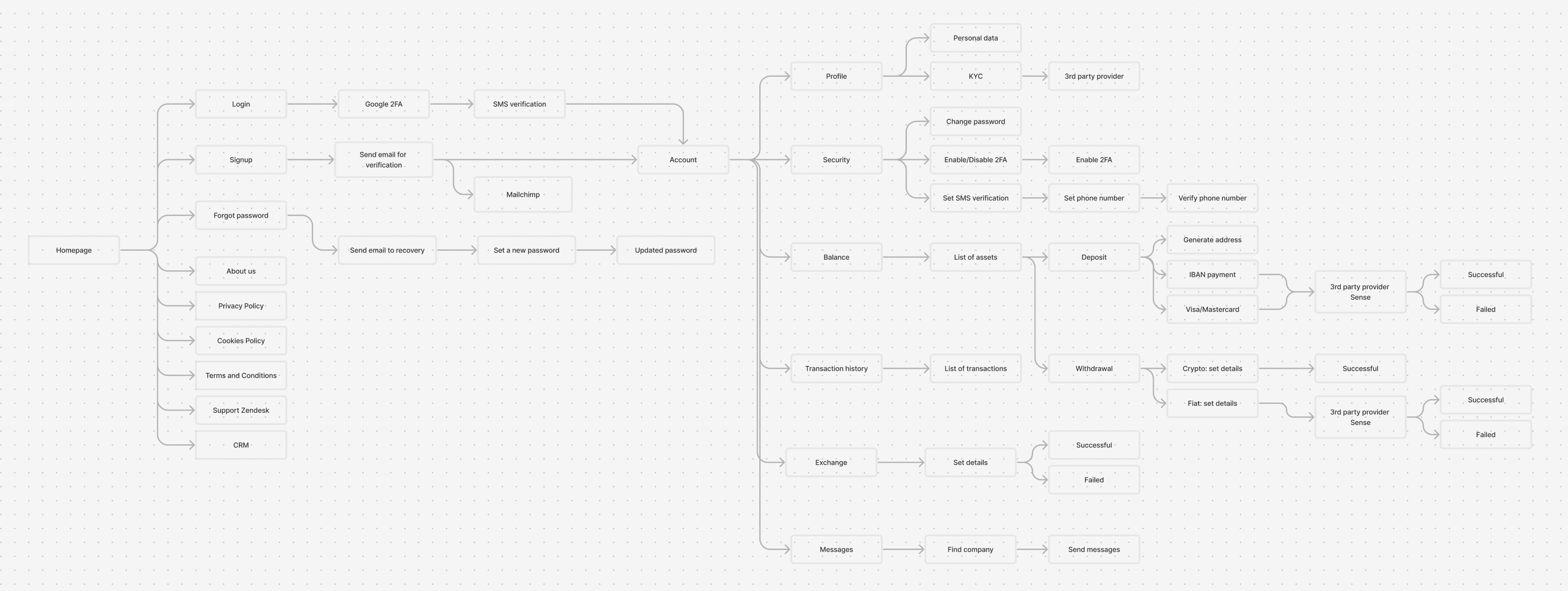
A typical KuCoin clone architecture:
- API Gateway — unified entry point for frontend, mobile apps, and external integrations (trading bots, market maker APIs)
- Trading Engine — the core module matching buy and sell orders in real time; isolated service that can scale independently
- Wallet Service — deposits, withdrawals, cold/hot storage management, blockchain node connectivity
- User Service — KYC, profiles, permissions, session management
- Notification Service — email, SMS, in-app, and Telegram/Slack operational alerts
- Reporting & Analytics — data pipeline for admin dashboards and regulatory reporting
- Security Layer — encryption, authentication, fraud detection, rate limiting
Liquidity Bootstrap: The Real Launch Challenge
A beautiful interface with an empty order book is a dead exchange. Every new platform faces the same problem: users need liquidity to trade, but liquidity providers need users to deploy capital. Breaking this chicken-and-egg problem is where most new exchanges fail.
External liquidity API integration. Connect to an established exchange (Binance, OKX, Kraken) via API to mirror their order book depth from day one. Your platform displays their depth; orders that can't be matched internally route through the API. This solves cold-start at the cost of operational complexity: real-time monitoring of the API connection, margin utilization, and reconciliation logic when the API has downtime.
Market maker onboarding. Before launch, negotiate with at least two professional market makers to provide quotes on primary trading pairs. Minimum viable terms: taker fee below 0.1%, API rate limits generous enough for HFT-style quoting, and a reliable WebSocket feed for real-time order book data.
Liquidity incentive programs. For new token listings, temporary fee rebates or token rewards for LPs who maintain spread and depth requirements bootstrap the appearance of a live market during the launch window.
The most effective cold-start solution we've implemented is an OKX margin-borrow liquidity model: when a user places a sell order, the system borrows the equivalent on OKX, executes against their market depth, credits the user's balance, and repays the borrow at settlement. From the user's perspective, the trade executes against a deep order book from day one. The operational requirement is continuous monitoring of OKX margin utilization — we run Telegram alerts on all critical thresholds.
 Yuri MusienkoBusiness developer, Merehead
UX/UI for Professional Traders
Even the fastest KuCoin-like crypto exchange fails if the interface gets in the way. KuCoin's UI succeeds because it balances depth and accessibility — advanced tools are always one click away without cluttering the core trading view.
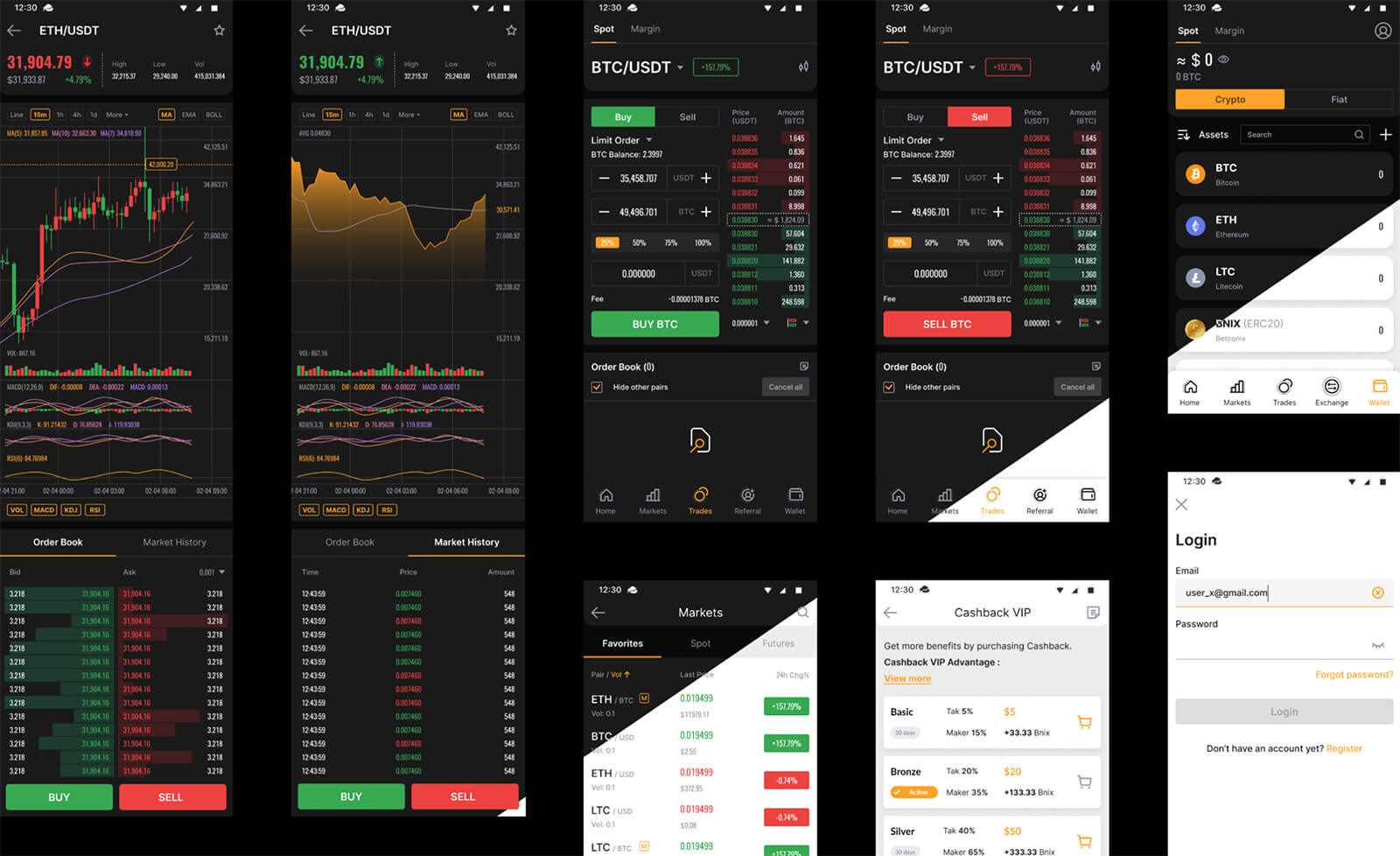
Key UX principles for a KuCoin clone: Onboarding — progress bar for KYC steps, tooltips explaining data requirements, clear confirmation screens. Trading Dashboard — real-time order book, interactive price charts, buy/sell modules with all order types, collateral requirements visible for margin positions. Wallet Management — all balances in one view, clear deposit/withdraw buttons with fee and processing time transparency. Mobile — native apps with biometric login, full trading functionality, and push notifications for order fills and price triggers.
A design system — shared components, colors, and typography — ensures visual consistency and credible professionalism across the platform.
Technology Stack
A production KuCoin clone requires a proven, cohesive stack — not every available tool, but the right combination for performance, security infrastructure, and maintainability.
| Layer | Technology | Role |
|---|---|---|
| Backend | Go, Rust, or Java | High-throughput order processing, sub-millisecond latency |
| Database | PostgreSQL + Redis | Transactional data integrity + ultra-fast caching for order state |
| Message Bus | Kafka / Redpanda | Async event processing between microservices |
| Frontend | React.js or Vue.js | Dynamic dashboards with real-time WebSocket updates |
| Charts | TradingView | Professional charting with 100+ technical indicators |
| Mobile | Flutter or React Native | Cross-platform iOS + Android with shared codebase |
| Infrastructure | Docker + Kubernetes | Container orchestration, autoscaling, zero-downtime deployments |
| Secrets | HashiCorp Vault | Encrypted storage for private keys, API credentials |
| Auth | OAuth2 + JWT | Secure session management, API key scoping |
| Monitoring | Prometheus + Grafana + ELK | Metrics, alerting, log analysis |
Development Cost and Timeline
| Package | Scope | Timeline | Starting Cost |
|---|---|---|---|
| Core CEX | Spot trading, basic KYC, external liquidity API, hot/cold wallets, admin panel | 8–10 weeks | From $40,000 |
| KuCoin Standard | Core + margin, futures, native token, staking/earn, mobile apps | 12–16 weeks | From $80,000 |
| KuCoin Full | Standard + trading bots, leveraged tokens, launchpad, P2P market, lending products | 16–24 weeks | From $150,000 |
| Enterprise | Full + institutional custody APIs, OTC desk, multi-region Kubernetes, compliance module | 6–12 months | From $300,000 |
Ongoing infrastructure costs: $2,000–$8,000/month depending on trading volume — blockchain node hosting, cloud infrastructure, KYC API calls, monitoring services.
Frequently Asked Questions
A KuCoin clone script is a pre-built crypto exchange platform replicating KuCoin's core architecture: spot and futures trading, margin, built-in trading bots, staking and earn products, a native token system, and a launchpad for token listings. Unlike a Binance clone (volume-first) or Coinbase clone (fiat-first), a KuCoin clone is optimized for altcoin traders who want advanced earning tools and automated trading strategies without leaving the platform.
A production-ready KuCoin clone starts at $40,000 for a core spot exchange with basic KYC and external liquidity. A standard platform with margin, futures, native token, and mobile apps: $80,000–$120,000. A full KuCoin-style deployment with trading bots, leveraged tokens, launchpad, and lending products: $150,000–$250,000. Ongoing infrastructure adds $2,000–$8,000/month depending on volume.
KuCoin's differentiators: 600+ listed cryptocurrencies (more altcoin coverage than any top-10 exchange), built-in trading bots accessible to retail users without API knowledge, leveraged tokens with 3x exposure and no liquidation risk, and a native token (KCS) that pays daily dividends from platform fee revenue. If your target audience is altcoin traders or emerging markets where earn products outcompete local bank interest rates, KuCoin architecture is the right model.
Core spot exchange: 8–10 weeks. Standard KuCoin platform with margin, futures, and native token: 12–16 weeks. Full platform with bots, leveraged tokens, and launchpad: 16–24 weeks. The most common delay: blockchain node synchronization. Bitcoin nodes take 5–10 days; Ethereum, BNB Chain, and TRON nodes take 1–3 days each. Start node sync on day one of the project, not after exchange development completes.
Not technically — but without a native token you lose KuCoin's most powerful retention mechanic. The KCS dividend model (daily fee revenue shared with holders) creates financial incentive to keep assets on your platform rather than withdrawing. Fee discount tiers reduce churn among high-volume traders. If you're building for long-term market position rather than MVP validation, a native token is worth the additional development and legal structuring investment.
Unlike third-party bot integrations, KuCoin's bots live inside the platform UI — retail users configure a Grid Bot or DCA Bot without any API keys or external accounts. The Grid Bot automatically buys low and sells high within a configured price range. The DCA Bot dollar-cost averages into a position over time. The technical foundation is a high-performance order management system that handles automated order flows at high frequency. This needs to be planned in the initial architecture — retrofitting bot support onto an exchange not built for it is significantly more expensive than building for it from the start.
Three approaches work in practice: connect to external liquidity APIs (Binance, OKX, Kraken) to mirror their order book depth from day one; pre-launch market maker onboarding on primary trading pairs (minimum two market makers); and liquidity incentive programs for new token listings. The most operationally robust solution is an external liquidity API integration with real-time margin utilization monitoring — without this monitoring, API failures translate directly to failed user trades.
At minimum: hot/warm/cold wallet segregation (95%+ in cold storage), multi-signature treasury withdrawals, HashiCorp Vault for secrets management (no private keys in code or environment files), 2FA enforcement, IP whitelisting for admin access, rate limiting on all APIs, and DDoS protection. Before launch: third-party penetration testing and a security audit of wallet key management flows. One compromise on a new exchange is typically fatal — there's no "we'll fix it in the next update" when user funds are involved.