Real estate crowdfunding has moved well beyond the hype cycle. In 2025, fractional property investment platforms collectively manage billions in tokenized assets — and the infrastructure gap between «idea» and «compliant, production-ready product» is exactly where most founders underestimate the work. This guide covers what it actually takes to build a real estate crowdfunding platform from the ground up: legal architecture, blockchain stack, smart contract logic, KYC/AML compliance, and the UX decisions that separate institutional-grade products from failed MVPs.
If you're looking for a market overview of existing platforms — this isn't that article. This is a technical and legal blueprint for builders.
What Is a Real Estate Crowdfunding Platform — and What Are You Actually Building?
A real estate crowdfunding platform is a regulated digital marketplace where multiple investors collectively fund the acquisition or development of a property by purchasing tokenized ownership units. Each token represents a fractional share of a specific asset, entitling its holder to proportional rental income, capital appreciation, or both.
At the infrastructure level, you're building four interconnected systems simultaneously:
- Web marketplace — property listings, token purchase flow, investor dashboard
- Admin panel — property management, KYC controls, dividend distribution, financial reporting
- Native mobile apps (iOS + Android) — full-feature parity with the web platform
- Blockchain layer — smart contracts for token issuance, transfer, burning, and automated income distribution
Each of these is a standalone engineering workstream. Treating them as sequential tasks rather than parallel tracks is the most common cause of schedule overruns.
Legal Architecture: How to Structure the Platform in the US
Before a single line of code is written, the legal structure must be finalized. In the United States, this is the most consequential architectural decision you'll make — and the one most founders defer too long.
Serial LLC: The Standard US Model
The most practical and scalable legal framework for a US-based real estate crowdfunding platform is the Serial LLC structure. The parent company registers a master LLC. Under it, each individual property is spun off as a separate «Series LLC» entity — Series LLC #1 for Property A, Series LLC #2 for Property B, and so on. The tokens issued on-platform are legally equivalent to equity shares in that specific Series LLC.
This structure provides two critical protections:
- Liability isolation: losses, liabilities, or legal actions related to one property cannot cross-contaminate other assets in the portfolio
- Ownership clarity: 100% acquisition of all tokens for a given property equals 100% ownership of that Series LLC, which holds 100% of the underlying asset
Secondary trading must be disabled at launch — not as a workaround, but as a hard legal requirement. You need explicit SEC clearance before enabling token resale between investors on your own platform.
 Yuri MusienkoBusiness developer, Merehead
Accredited Investor Verification Flow
If your platform operates under Regulation D, every US-based user must pass an accreditation gate during registration — before accessing any investment functionality. The user must self-certify under one of the SEC's definitions:
- Net worth exceeding $1M, excluding primary residence
- Individual income exceeding $200K/year for the past two consecutive years
- Joint income with spouse exceeding $300K/year for the past two years
- Holder of an SEC-approved Series 7, 65, or 82 license
- Family client of a registered Family Office
Users who select «None of the above» must be hard-blocked from investment flows — with a clear UX message explaining the restriction and, optionally, a waitlist for when Regulation CF access opens the platform to non-accredited investors. The waitlist itself (collecting name, email, desired investment size) is legally permissible; taking money from unqualified investors is not.
Blockchain Layer: Choosing Your Stack
Which Blockchain for Real Estate Tokenization?
The choice of blockchain is an architectural decision with long-term consequences for transaction costs, smart contract flexibility, and investor familiarity. Here's the practical comparison for production platforms:
| Blockchain | Standard | Avg. Gas Fee | Finality | Best for |
|---|---|---|---|---|
| Ethereum | ERC-20 / ERC-721 | $2–20 | ~12 sec | Institutional, high-value assets |
| Binance Smart Chain | BEP-20 / BEP-721 | $0.05–0.30 | ~3 sec | Retail-focused platforms, high tx volume |
| Polygon | ERC-20 (L2) | <$0.01 | ~2 sec | Micro-investments, frequent dividends |
| Solana | SPL Token | <$0.001 | ~0.4 sec | High-frequency trading, secondary markets |
For platforms targeting retail investors in the $100–$10,000 investment range, BSC or Polygon are the pragmatic choices — transaction fees must not erode small investment positions. For trophy real estate tokenization ($1M+ assets, institutional buyers), Ethereum's established custodial infrastructure and higher security reputation justify the higher gas costs.
Token Type: Fungible vs. NFT
The choice between fungible tokens (ERC-20/BEP-20) and non-fungible tokens (NFT, ERC-721) depends on the ownership model you're building:
| Model | Token Type | Unit of ownership | Divisibility | Secondary market |
|---|---|---|---|---|
| Fractional fungible | ERC-20 / BEP-20 | Share (e.g. 1 token = 1 sq.m.) | Yes | DEX-compatible |
| NFT per property | ERC-721 | Unique property interest | No | OpenSea / custom marketplace |
| Fractionalized NFT | ERC-721 + ERC-20 | NFT split into N fungible shards | Yes | Custom platform required |
In practice, the fractionalized NFT model offers the best of both worlds: a unique, auditable NFT anchors each property on-chain (providing clear legal traceability), while fungible shards allow retail-scale fractional ownership and future secondary market liquidity. The architectural complexity is higher, but it's the model best aligned with US securities law treatment of property tokens.
The biggest UX mistake on tokenization platforms is designing for crypto traders. The interface must feel as simple as an e-commerce checkout — not a crypto exchange. Your target retail investor needs to go from property discovery to token purchase in under 3 minutes, with zero blockchain knowledge required. Every technical abstraction layer you add on the frontend is a conversion you're saving.
Yuri MusienkoBusiness developer, MereheadSmart Contract Architecture: What the Code Must Do
The smart contract layer is the operational core of the platform — and the component with the highest cost of error. A bug in a deployed contract is not a hotfix; it's a potential loss of investor funds and an SEC compliance incident. Here's what a production real estate tokenization contract must handle:
Core Smart Contract Functions
- Token creation (mint): issue a defined supply of tokens linked to a specific property NFT or asset address
- Token transfer: peer-to-peer transfer with whitelist verification (only KYC-verified wallets can hold tokens)
- Token burning: reduce supply when a property is sold or restructured
- Dividend distribution: automatically split rental income across all token holders proportionally, at a defined cadence (monthly/quarterly)
- Lock/unlock logic: tokens remain non-transferable until a defined
token_unblock_date; if no date is set, tokens are locked by default — the admin must explicitly set a release date - Token rate control: admin-accessible function to update token price in manual mode (for Coming Soon / pre-sale phases)
- Wallet verification gate: restrict token receipt to addresses that have passed KYC verification on-platform
Platform Features: Full Scope Breakdown
Investor-Facing Frontend
| Module | Key Features | Priority |
|---|---|---|
| Authentication | Registration, login, password recovery, 2FA, email confirmation (24h link validity) | MVP |
| KYC / Accreditation | Government ID upload, accredited investor self-certification, Customer Agreement e-signature | MVP |
| Property Marketplace | Listings with status (Coming Soon / Live / Sold Out), funded % progress bar, search + filter by country/type/yield | MVP |
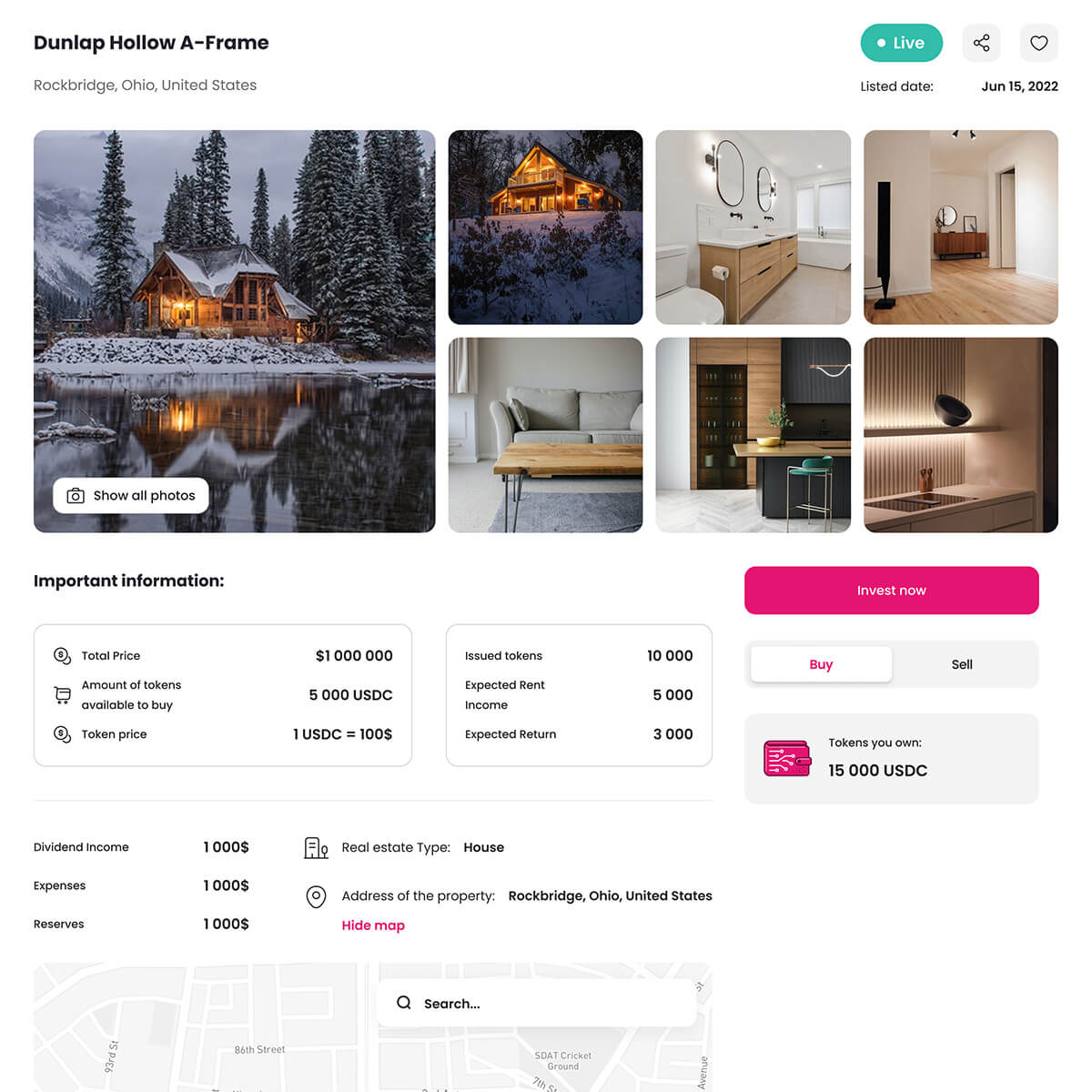
| Property Page | Photos gallery, financials (purchase price, offering costs, target return), token price, quantity selector, Offering Details block | MVP |
| Token Purchase | Order flow, buying power display, token quantity input, order confirmation | MVP |
| Waitlist / Submit Interest | Join Waitlist modal for Coming Soon properties, desired investment size, email notification on launch | MVP |
| Wallet | Fiat balance (USD via wire transfer), crypto balance (BTC, ETH, USDT), deposit / withdrawal flows | MVP |
| Portfolio Dashboard | Tokens owned per property, dividend history, total portfolio value | MVP |
| Secondary Market | Token resale between investors | Post-SEC clearance only |
| My Documents | Signed Customer Agreement PDF, transaction history export | Phase 2 |
Admin Panel
The admin panel is not a simple CMS — it's a financial operations hub. Core capabilities required:
- Property management: create / edit / unpublish listings; manage status transitions (Coming Soon → Live → Sold Out); control publication separately from Save (Save ≠ Publish)
- Token controls: set token price, set/update
token_unblock_date, manually override funded percentage and total investor count - KYC management: review submitted IDs, approve/reject users, manage accredited investor status
- Dividend distribution: per-property view showing each token holder's proportional payout; admin inputs rental income → system auto-distributes
- User financials: manual balance adjustment (for wire deposits), withdrawal request approval with bank account verification, transaction history
- Waitlist management: view and export interest submissions per property
- Commission settings: configure platform fee per transaction
- Notification system: trigger email/push notifications on property status changes, dividend payouts, secondary market availability
Payment Infrastructure: The Layer Most Teams Underestimate
The payment layer of a crowdfunding platform is effectively a project within a project. It requires integration of three separate financial rails: fiat processing, crypto on-ramp/off-ramp, and blockchain-native transfers.
Fiat Rail
For US-based retail investors, the primary fiat on-ramp at launch is typically wire transfer — credit card processing for securities purchases involves additional compliance requirements (Regulation E, card network rules) that delay the MVP. Wire transfer deposits with manual admin approval are slower but legally simpler. Credit card and PayPal integration should be planned for Phase 2.
Crypto Rail
Minimum viable crypto support: BTC and ETH deposits, with USDT (ERC-20) as the stablecoin layer. Expand to BNB, USDC, and chain-specific tokens based on your chosen blockchain. The instant exchange mechanism — converting any supported crypto to the platform's base currency — requires either a custodial exchange integration (Coinbase Prime, Binance) or an internal liquidity pool. The latter is significantly more complex to build and regulate.
Master Node and Blockchain Node Integration
Running your own nodes eliminates dependency on third-party RPC providers (Infura, Alchemy) and avoids rate limits under load. For BSC, a full node requires approximately 2TB of storage and 16GB RAM at minimum. For production, deploy a load-balanced cluster of at least two nodes in separate regions — this is not optional for a financial platform.
KYC / AML Architecture
KYC and AML are not a single feature — they're a compliance pipeline with multiple enforcement points:
| Checkpoint | What It Does | Implementation |
|---|---|---|
| Identity verification (KYC) | Government ID + selfie match; confirms investor identity | Third-party API (Sumsub, Jumio, Onfido) |
| Accredited investor gate (US) | Self-certification + supporting documentation | Custom form + admin review workflow |
| Customer Agreement e-signature | Legally binding acceptance of platform terms | DocuSign API or custom e-sig with PDF generation |
| Anti-Phishing | Unique phrase shown to users in all communications | User-defined phrase stored in profile, injected in emails |
| Wallet whitelist | Only KYC-verified wallets can receive tokens | Smart contract-level enforcement |
| AML transaction screening | Flags and blocks high-risk inbound transactions | Chainalysis / Elliptic API integration |
| Ongoing monitoring | Periodic re-screening of existing users against sanctions lists | Automated cron job + manual review queue |
A critical UX note: Cookie Policy, AML Policy, and legal agreement links should open in modal overlays — not new tabs or page navigations. A user who clicks a legal link during the registration flow and loses their input data will abandon the form. This is a conversion issue with a legal compliance root cause.
Real Estate Tokenization: Market Scale and Investment Thesis
The market context matters for anyone building in this space. Conservative analyst projections estimate US real estate tokenization will grow at roughly 2.9% annually — reaching approximately $5B by 2034. However, if adoption follows the trajectory of comparable fintech categories (online brokerage, peer-to-peer lending), the realistic growth rate is closer to 21% annually, implying a $26B US market by 2034 and over $80B by 2040.
| Year | Conservative forecast ($B) | Realistic forecast at 21% CAGR ($B) |
|---|---|---|
| 2024 | 3.8 | 3.8 |
| 2025 | 3.91 | 4.60 |
| 2026 | 4.02 | 5.56 |
| 2027 | 4.14 | 6.73 |
| 2028 | 4.26 | 8.15 |
| 2029 | 4.38 | 9.86 |
| 2030 | 4.51 | 11.93 |
| 2031 | 4.64 | 14.43 |
| 2032 | 4.78 | 17.46 |
| 2033 | 4.91 | 21.13 |
| 2034 | 5.06 | 25.56 |
| 2040 | 6.00 | 80.23 |
The investment thesis for tokenization is straightforward: blockchain-based property ownership removes the friction of traditional real estate transfer. Buying, selling, re-selling, and rental income distribution can all be handled by smart contracts — eliminating notaries, title companies, and weeks of escrow processing. The re-registration of ownership that currently takes 30–90 days in the US becomes a transaction confirmed in seconds.
The geography of tokenization demand is also expanding beyond the US and Western Europe. Trophy real estate — assets with exceptional historical, cultural, or architectural value, representing under 2% of elite inventory globally — is becoming an increasingly active tokenization category, as fractional ownership is the only mechanism that makes these assets accessible to non-UHNW investors.
Tokenization isn't disrupting real estate — it's removing the infrastructure tax that's kept 95% of potential investors out of the asset class entirely. The market isn't the product; the infrastructure is.
Yuri MusienkoBusiness developer, MereheadPlatform Deployment: Cloud Architecture Recommendations
A production real estate crowdfunding platform is a financial-grade system. Infrastructure decisions made at launch are expensive to reverse. Minimum viable production architecture:
- Cloud provider: AWS (preferred for US compliance — SOC 2, HIPAA-eligible infrastructure) or GCP
- Containerization: Docker + Kubernetes for all microservices — required for the payment layer and blockchain node management
- Database: PostgreSQL for relational data (user accounts, transactions, KYC records); Redis for session management and real-time balance caching
- CDN: CloudFront for property images and static assets — marketplace load performance directly impacts conversion
- Redundancy: all critical services deployed across minimum two availability zones; blockchain nodes in separate geographic regions
- Backup policy: daily automated backups of all database instances, retained for 30 days minimum
- Monitoring: Datadog or AWS CloudWatch with alerting on payment processing failures, smart contract errors, and KYC queue backlogs
What Does It Cost to Build a Real Estate Crowdfunding Platform?
Cost estimation depends heavily on scope, jurisdiction, and whether you use custom real-estate tokenization development or White Label foundations. Here's a realistic breakdown for a full-scope US-compliant platform:
| Component | Estimated Cost | Notes |
|---|---|---|
| Technical documentation + architecture | $5,000–$12,000 | Non-skippable; defines everything downstream |
| UI/UX design | $8,000–$20,000 | Custom; White Label solutions available from $3K |
| Smart contract development + audit | $15,000–$60,000 | Audit cost scales with contract complexity |
| Web platform + admin panel | $40,000–$100,000 | Depends on feature scope and team location |
| iOS + Android apps | $30,000–$70,000 | Native development; React Native reduces cost ~30% |
| KYC/AML integration | $3,000–$8,000 | Plus ongoing per-verification API costs ($1–3/check) |
| Legal (SEC counsel, LLC formation) | $20,000–$80,000 | Highly variable; Reg D filing cheaper than Reg CF |
| Infrastructure (Year 1) | $12,000–$30,000 | AWS + blockchain nodes + monitoring |
| Total Range | $133K–$380K | Full scope, US-compliant, production-ready |
Platforms that cut costs by skipping the smart contract audit, using a single-key admin wallet, or deferring legal structure typically discover the price of those shortcuts at the worst possible moment — under SEC scrutiny or after a contract exploit.
Crowdinvesting Models: Active vs. Passive, REIG Syndicates
Beyond the technical architecture, the real estate platform's business model determines its regulatory path and investor experience. Two primary models dominate the market:
Passive crowdinvesting: investors deposit capital, receive tokens, and collect dividends without involvement in asset management. The platform operator (or a contracted property manager) handles all operational decisions. This model is simplest to regulate under Regulation D but offers investors the least control.
Active crowdinvesting / REIG syndicate model: a managing partner handles acquisitions and operations; passive LPs (limited partners, represented by token holders) provide capital and receive proportional returns. REIG-based syndicates allow investors to diversify across 10–30 properties with an entry as low as $500–$1,000, targeting 10–30% annual returns across the portfolio. This is the structure most aligned with SEC's treatment of real estate securities.
One practical rule applies to both models: platforms operating an «all-or-nothing» funding model (where 95% raised is still returned to investors) are significantly harder to build and operate than «keep what you raise» structures. For early-stage platforms, the latter — where collected funds are transferred to the property offering regardless of whether the target is fully met — is the operationally and legally simpler path.
FAQ
Yes — tokens representing property ownership are securities under US law. You must either register with the SEC or qualify under an exemption. Regulation D (accredited investors only, no dollar cap) is the fastest path to market. Regulation CF allows non-accredited investors but caps raises at $5M/year and requires using an SEC-registered funding portal. Operating without registration or a valid exemption exposes you to enforcement action regardless of platform size.
For retail-focused platforms ($100–$10,000 investment range), Binance Smart Chain (BSC) or Polygon are the practical choices due to low transaction fees. For institutional or high-value assets, Ethereum's established custodial infrastructure justifies higher gas costs. Solana is optimal if secondary trading and high transaction throughput are core to your product from day one. The choice is irreversible post-launch without a costly migration, so make it in conjunction with your legal counsel's view on jurisdictional blockchain risk.
Under Regulation D, no. Non-accredited investors can only participate if the platform operates under Regulation CF, which caps total raises at $5M per 12-month period and requires listing through an SEC-registered funding portal. A practical approach: launch under Reg D for accredited investors, build a waitlist for non-accredited users with a clear communication timeline for when Reg CF access becomes available. Never accept funds from unqualified investors — the liability exposure is not worth any short-term revenue gain.
The Serial LLC structure allows you to create a master LLC (the platform entity) with individual «Series» LLCs under it — one per property. Each Series LLC holds 100% of a specific asset, and tokens issued for that property are legally equivalent to equity in that Series. The critical advantage is liability isolation: a legal dispute, foreclosure, or loss on Property A cannot affect the assets or investors in Properties B, C, or D. It's the standard legal architecture for scalable US real estate crowdfunding operations.
Only after receiving explicit SEC clearance. Secondary trading — where investors buy and sell tokens between each other on your platform — triggers broker-dealer registration requirements if not properly structured. At launch, the secondary market UI must be technically disabled, not just hidden. Displaying an «estimated availability date» to users is acceptable; accepting or facilitating any resale transactions without clearance is not. Build the secondary market infrastructure in advance, but gate it behind an admin switch that only activates post-approval.
Web platform + admin panel: 3 months minimum (assuming design and smart contract work begin on day one). Full scope including native iOS and Android apps: 4–5 months. These timelines assume a dedicated team, finalized legal structure, and no scope changes during development. Legal setup (SEC filing, LLC formation) runs in parallel and typically takes 2–4 months — start it before the first line of code is written.
There is no regulatory minimum — it's a product decision. Most platforms operate in the $10–$500 range for retail investors, with some setting minimum ticket sizes of $1,000–$5,000 to reduce KYC overhead per investor. The token price can be set to any value: $20/token for a $2M property tokenized into 100,000 units, or $10,000/token for trophy assets targeting UHNW investors. The minimum should be set in coordination with your target investor profile and the economics of your KYC/onboarding cost per user.