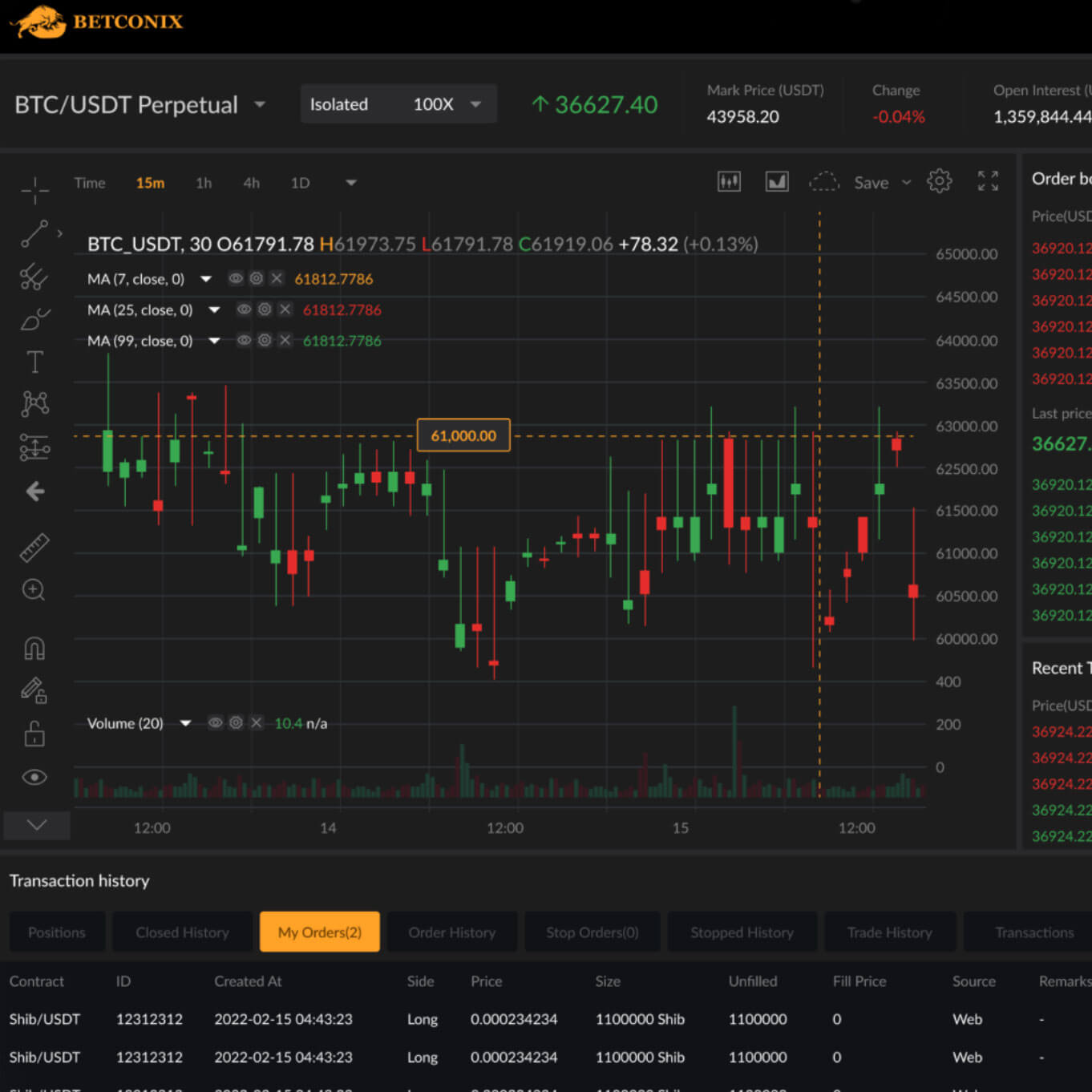
A matching engine is the core software component that pairs buy and sell orders in a trading system — it maintains the order book, applies price-time priority (or another matching algorithm), and executes trades the moment a bid and an ask cross.
Every exchange, brokerage, or trading platform runs on one, whether it's built in-house or licensed from a liquidity provider.
CTOs evaluating a trading platform generally choose between three architectural paths:
- Buy (A-book): route orders to a Tier-1 liquidity provider via API and run a thin broker layer on top.
- Build (B-book): develop an internal order book engine that matches orders directly, with full control over execution and fees.
- Hybrid (liquidity abstraction): run internal liquidity for common pairs and clear the balance periodically against an external exchange.
We've shipped all three models for clients ranging from early-stage brokerages to BingX-scale exchange builds, and the engineering trade-offs are more concrete than most comparison articles suggest. This piece breaks down what each model actually costs, where it breaks under load, and how to decide which one fits your order volume and compliance posture — with real numbers pulled from our own project estimates.
What a Matching Engine Actually Does (and Why This Decision Is Expensive to Get Wrong)
Strip away the marketing language and a matching engine is a deterministic state machine: it ingests order events (new, cancel, amend), maintains a sorted book per trading pair, and applies a matching algorithm — almost always price-time priority for spot and derivatives — to generate trades.
The engine also has to handle partial fills, self-trade prevention, and market-data broadcast to every connected client in the same event loop, which is where most naive implementations start to fall apart under real load.
If you want the low-level mechanics — how a production-grade engine handles order book data structures, why most teams reach for Rust or C++ instead of a garbage-collected language once they cross five-figure orders per second, and what a real matching engine architecture looks like end to end — that's a separate deep dive. For this article, the operative point is simpler: the matching engine sits on the critical path of every trade, so its architecture decision ripples through custody, licensing, and your infrastructure bill for years.
If you don't own the matching engine, you don't own an exchange — you own an interface to somebody else's business. That's not a criticism, it's a strategic choice, and it's the right one for most stage-1 products.
 Yuri MusienkoBusiness developer, Merehead
The Three Architectural Models — A-book, B-book, and Hybrid Liquidity Abstraction
A-book — Broker Layer Over Tier-1 Liquidity Provider
In an A-book setup, your platform never runs its own order book. Every order a user places gets routed through REST or WebSocket to a liquidity provider — Kraken and OKX are the two we integrate most often — and your backend acts as an orchestrator: it proxies the order, tracks the resulting position, and syncs balances and trade history back to your frontend. You're not a counterparty to the trade; you're a risk-management and UX layer sitting in front of somebody else's liquidity provider infrastructure.
Challenge: A founder wanted spot and perpetual futures trading live fast, without raising the capital or hiring the quant team needed to run internal liquidity and a matching engine from day one.
Solution: We built the platform as a thin broker layer over a Tier-1 provider's API — proxying orders, syncing positions and trade history in real time, and running isolated margin only, since broker-mode APIs typically don't support cross-margin. The frontend rendered funding rate, open interest, and order book depth pulled straight from the provider feed through a TradingView-based charting integration.
Result: Futures went live in roughly 3 months by developing spot and futures in parallel instead of sequentially. The platform carries no custody liability and no internal matching-engine risk — every trade executes on the liquidity provider's book, and our client's legal exposure stayed at "interface operator" rather than "exchange operator."
B-book — Internal Matching Engine
A B-book platform runs the opposite model: every trade executes inside your own system. You own the order book, the matching algorithm, and — critically — the spread. This is the model that turns a product into an actual exchange rather than a reseller of someone else's execution.
Challenge: A platform that had relied on an external bot-driven liquidity solution for spot trading hit a ceiling: no transparency into how orders actually filled, dependence on a third party's uptime SLA, and no way to capture spread as revenue.
Solution: We moved spot trading to pure order-to-order matching — an internal order book engine supporting market, limit, and stop-limit order types, with no bot in the execution path. Before cutting over, we refactored the balance service into a unified account model — a single funding account plus a single trading account, isolated margin only — which eliminated the multi-account technical debt that would have complicated risk control once the internal engine went live.
Result: The platform gained full control over core trading logic and execution pricing, and cut its dependency on a third-party liquidity vendor. The trade-off is real complexity growth, which we contained by keeping the matching engine strictly isolated from the wallet and admin services — so the added complexity didn't leak into the rest of the architecture.
Hybrid — Liquidity Abstraction with Periodic Clearing
Between the two extremes sits a model we've shipped more than once: internal liquidity and margin trading for the pairs that matter, with periodic clearing against an external exchange rather than continuous custody transfer.
| Criteria | A-book (Buy) | Hybrid | B-book (Build) |
| Upfront CAPEX | Lowest — broker layer only | Moderate — internal liquidity + clearing logic | Highest — full order book engine + risk system |
| Time-to-market | 1–2 months | 2–3 months | 3+ months, plus ongoing hardening |
| Control over execution & spread | None — provider sets fill price | Partial — internal for hedged pairs | Full — you set the matching logic |
| Custody & regulatory exposure | Low — you're not the counterparty | Moderate — partial custody | High — full custodial and matching liability |
| Vendor lock-in risk | High — dependent on provider API/SLA | Moderate | None |
| Scalability ceiling | Capped by provider's API rate limits | Depends on internal engine capacity | Limited only by your own infrastructure |
Real Cost Breakdown — What CTOs Actually Pay in 2026
Pricing for "build a trading platform" varies wildly depending on what you're actually asking for, so here's what we see across real estimates, broken into the same three tiers most clients request: Basic, Standard, and Advanced.
| Component | Basic | Standard | Advanced |
| Web platform — modular build on existing architecture (A-book/hybrid) | $29,000–36,000 | $38,000–49,000 | $64,000–69,000 |
| Backend + admin — thin broker layer, spot + margin via API | $17,000 | $37,000 | $46,000 |
| Web platform — development from scratch (internal matching engine) | $48,000 | $64,000 | $81,000 |
| Two native mobile apps | $24,000–34,000 | $28,000–46,000 | $58,000–60,000 |
| One cross-platform mobile app | $20,000–25,000 | $26,000–32,000 | $40,000 |
The delta that matters most for a build-or-buy decision sits in that third row. Development from scratch — meaning a platform that includes its own order book engine rather than proxying to a liquidity provider — runs roughly $12,000–17,000 more than a modular build at the same tier, and that's just the web layer. It doesn't include the risk engine, the additional security audit surface, or the compliance work that comes with taking on matching-engine liability.
A full production-ready B-book stack — wallet infrastructure, admin panel, multi-module trading (spot, margin, futures, options), and compliance stack — lands in the $300,000–500,000+ range for a BingX-scale build, which is why we rarely recommend a from-scratch build as a first move; see our crypto exchange development cost breakdown for the full component list.
Team composition stays consistent across tiers: front-end and back-end teams, blockchain developers, a project architect, and QA engineers. The Discovery phase — technical documentation, user flow, architecture design, platform design — takes about a month regardless of which model you pick, since that's where the build-or-buy decision itself gets locked in.
Timeline follows the same pattern as cost. A-book / broker-layer builds ship in 1–2 months. A full modular platform with spot, margin, and futures runs 1.5–3 months depending on tier. Development from scratch — including a production-grade order book engine — takes 2.5–3+ months for the core system alone, before compliance review or exchange listing work starts.
If your board is asking for a white label crypto exchange cost comparison against a custom build, this is the number to put in front of them: the A-book path gets you to product-market-fit validation for $20,000–50,000 in 1–2 months, versus $300,000+ and 6–12 months for a from-scratch matching engine — and you can migrate to internal matching later once order volume justifies it.
Infrastructure Risks Nobody Talks About Until Production
Connection Pool Exhaustion Under Load
Challenge: A production incident produced recurring 500 errors during peak trading windows — the database connection pool was exhausting itself. Root cause: CronJob processes weren't closing database connections cleanly on SIGTERM, and worker nodes (spot, wallet, admin services) were periodically getting killed by the OOM killer, leaving sleeping connections open behind them.
Solution: Instead of reactively scaling pod resources — which would have masked the problem and scaled infrastructure cost linearly with traffic — we added a termination handler that guarantees graceful connection closure on SIGTERM, and temporarily set wait_timeout=300 / interactive_timeout=300 at the database level to force-kill stuck sleeping connections. In parallel, we profiled worker memory consumption to fix the OOM root cause instead of just papering over it.
Result: We eliminated a class of production incidents that hit trading and wallet operations directly — exactly the components most exposed to load spikes around a matching engine. The team avoided linear infrastructure cost growth by fixing the connection lifecycle instead of brute-force scaling pods.
Execution Precision and Decimal Governance
A less obvious failure mode: uncontrolled decimal precision across trading, wallets, deposits/withdrawals, and any internal converter. When precision comes from an external provider's API (as it does in an A-book model), you need a governance layer that separates display precision from execution precision — otherwise rounding drift between the two produces phantom balance discrepancies that are miserable to debug in production. This is a small detail on paper and a recurring source of support tickets in practice, particularly once you're pulling precision from more than one liquidity source.
Security & Access Control for the Matching Layer
The same principle that governs wallet key management applies directly to a matching engine: developers should never have direct access to the components that can move money or fill orders. In our wallet builds, this means self-hosted nodes plus remote RPC access, mandatory 2FA, and manual approval on back-office withdrawals — keys and approval flows stay outside the development team's day-to-day access.
Carry that principle into the matching engine itself: the order book, the risk engine, and the liquidation logic belong in a control plane isolated from general application deploys, with audit trails on every privileged action. If you're evaluating vendors or your own team's posture here, our crypto exchange security guide walks through the full threat model.
A Decision Framework — When to Build, When to Buy, When to Migrate Later
Run through these questions before committing capital to either path:
- Order volume: under a few thousand orders per day, an A-book broker layer is almost always the right call — you won't hit the ceiling that justifies internal matching for a long time.
- Licensing status: if you don't yet hold a license that permits acting as a market counterparty, A-book keeps you at "interface operator" rather than "exchange operator," which materially changes your regulatory burden.
- Runway and budget: under $100,000 in dev budget rules out a from-scratch matching engine as a first release — you'll spend it all on the order book and have nothing left for wallets, compliance, or growth features.
- Time-to-market pressure: if you need to validate demand in under two months, buy first, build later once you have real volume data to justify the investment.
- Team maturity: a from-scratch build hands you full source code and full responsibility — you need a team that can operate a risk engine and matching logic in production, not just ship features.
- Revenue model: if spread capture is core to your monetization (not just fees on a proxied trade), internal matching eventually becomes the more profitable model — the question is when, not if.
| Risk category | A-book | Hybrid | B-book |
| Custody risk | Low — provider holds funds during execution | Moderate — partial custody | High — full custodial responsibility |
| Execution risk | Low — provider's matching engine, proven at scale | Moderate — internal engine for a subset of flow | High until battle-tested under real load |
| Regulatory risk | Lower — you're not a market counterparty | Moderate | Higher — full exchange-operator obligations |
A workable pattern we've implemented more than once: start A-book to validate the product, migrate high-volume pairs to an internal engine once daily order counts justify the engineering investment, and keep low-volume or exotic pairs routed externally indefinitely. This mirrors how a custom trading platform build typically evolves in practice — nobody launches with the full B-book stack on day one, including the exchanges you'd recognize by name.
FAQ
A production-grade internal matching engine as part of a full platform build — wallets, admin panel, compliance stack, multi-module trading — typically runs $300,000–500,000+ for a BingX-scale exchange. As an isolated web-layer component built from scratch, expect roughly $48,000–81,000 depending on tier, before wallet, risk-engine, and compliance costs.
Yes, if you architect the broker layer with that migration in mind from the start — keep the frontend decoupled from the execution backend via a stable internal API, so swapping the provider proxy for an internal order book engine doesn't force a frontend rewrite.
1–2 months for a Basic-tier build covering spot and margin through a liquidity provider's API, assuming the Discovery phase (architecture, documentation, UX flow) runs in parallel with early development.
No — futures can run entirely through an A-book model against a Tier-1 provider's API, including funding rate, open interest, and leverage data, with isolated margin only since most broker-mode APIs don't expose cross-margin.
Connection lifecycle management under load — specifically database connection pool exhaustion from ungracefully terminated worker processes and CronJobs. It's rarely caught in staging and shows up as intermittent 500 errors exactly when trading volume peaks.