Want to create a decentralized exchange from scratch but not sure where to start? This guide covers everything you need to know about DEX development in 2026 - from choosing the right architecture (AMM vs. order book vs. hybrid) to deploying smart contracts, bootstrapping liquidity, and launching a secure, scalable platform.
The numbers back this up. According to CoinGecko, DEXs' share of global spot trading volume grew from 6.9% in 2024 to 13.6% by early 2026 — nearly doubling in a single year. Perpetual DEX volume is growing even faster: platforms processed $739 billion in the first months of 2026, an eightfold increase over the prior two years. If you're building a DEX now, you're entering a market that's still early enough to compete but mature enough to have real users on day one.
To build a decentralized exchange (DEX) in 2026, teams typically complete four critical steps:
- choosing a blockchain network;
- development of smart contract architecture;
- liquidity creation;
- Conducting security audits and testing.
A production-ready decentralized exchange requires robust smart contracts (Solidity/Rust), infrastructure with RPC nodes (RPC Nodes) and WebSockets, DeFi logic (AMM pools, LP tokens, Chainlink price oracles), and effective security mechanisms such as replay protection and multi-signature wallets.
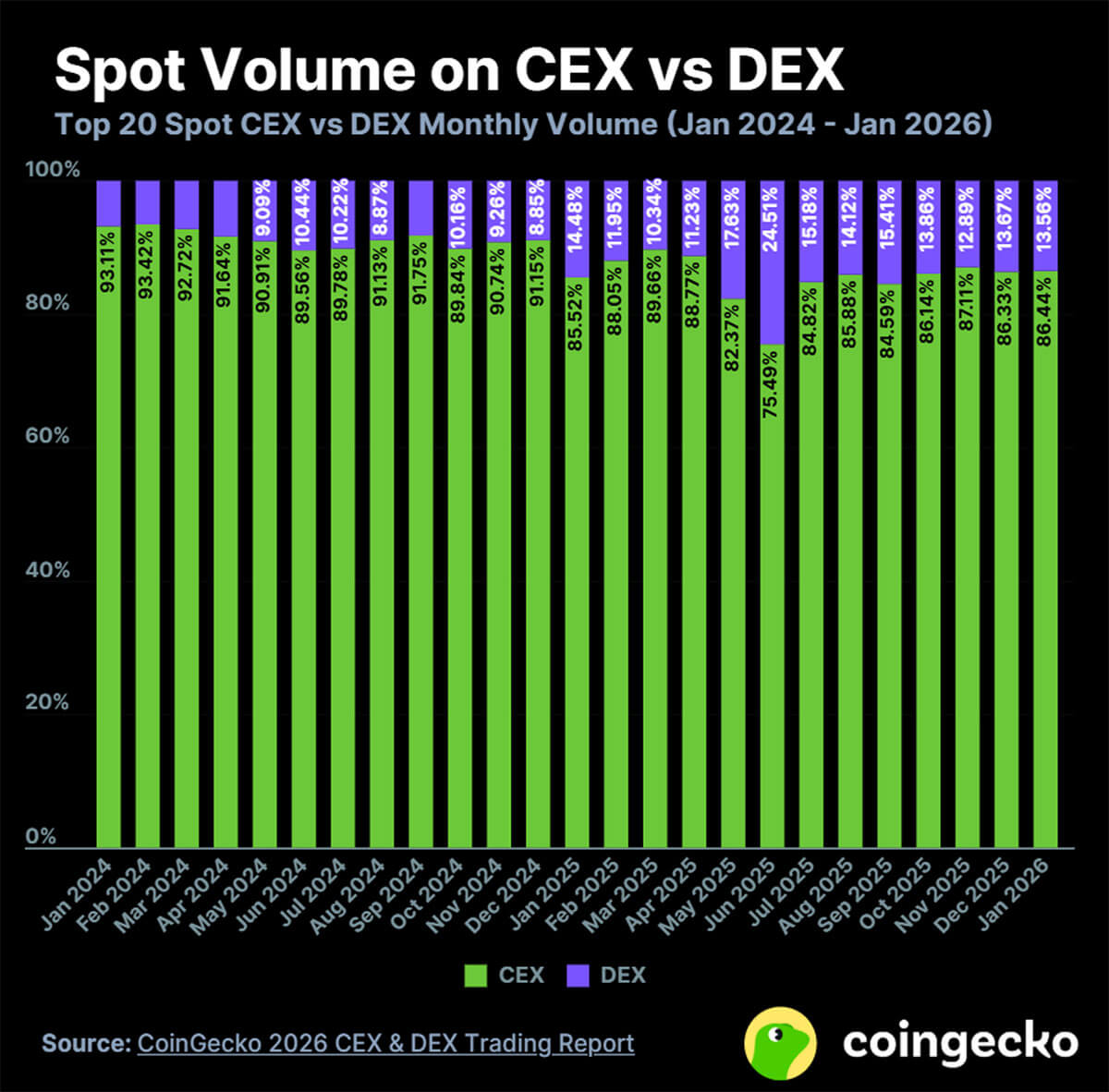
DEX platforms like Pancakeswap, Uniswap, and Hyperliqiud are now among the top ten cryptocurrency exchanges in the world, posing strong competition to Coinbase and OKX.
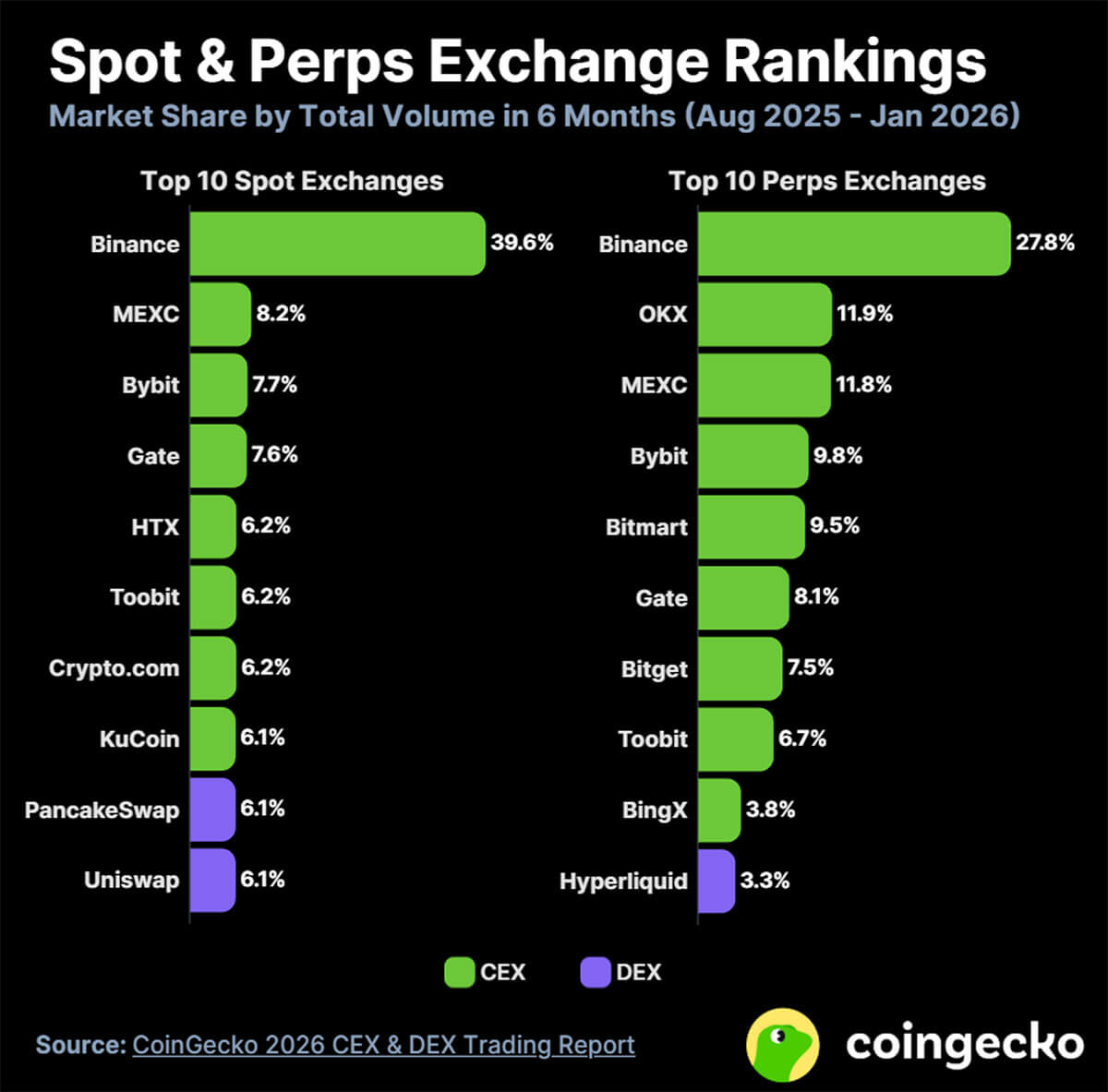
In practice, creating a competitive decentralized exchange isn't simply a matter of cloning an existing product (e.g., Uniswap). It requires a customized approach, taking into account the integration of cross-chain exchange, protection against MEV transformations, hybrid order books, and a liquidity mining system.
Thus, a turnkey decentralized exchange will combine high performance, user convenience, and a highly competitive market position.
Architectural Decisions: AMM vs. Order Book vs. Hybrid Model
The first architectural decision when building a DEX is the trade matching mechanism. Three models dominate the decentralized finance (DeFi) sector:- AMM (Automated Market Maker) - AMM (Automated Market Maker);
- on-chain order book;
- hybrid order book.
Understanding the underlying crypto exchange architecture is vital for handling high-frequency trading and cross-chain settlements.
Below is a comparison table of all models.
| Architecture | Examples of protocols | Operating principle | Advantages | Flaws |
| AMM (Automated Market Maker) | Uniswap, Curve | Users trade against liquidity pools using mathematical formulas | simple architecture, high composability | slippage increases with low liquidity |
| On-chain order book | Serum/OpenBook | orders are stored directly in the blockchain | complete transparency | slow execution, expensive gas |
| Hybrid order book | dYdX, Hyperliquid | Orders are matched off-chain, settlements are on-chain | speed like CEX (centralized exchanges) | more complex architecture |
AMMs are no longer an experiment — they're the backbone of on-chain trading. Uniswap alone cleared over $148 billion in 30-day volume across chains in 2025, according to CoinGecko. That's more than most centralized mid-tier exchanges handle in a year, running entirely on smart contracts with no order book.
However, traders who work with derivatives prefer models with order books.
When an off-chain order book makes sense
Off-chain matching mechanisms significantly improve the user experience by reducing latency. Instead of sending each order to the blockchain, orders are matched in a centralized mechanism, while settlements remain decentralized.In practice, the architecture choice comes down to who's trading on your platform. Retail users tolerate AMM latency — they're swapping once, not scalping. But professional traders notice every millisecond. When a client needed Binance-level execution speed without giving up on-chain settlement, we built a hybrid: off-chain order matching for instant responses, on-chain settlement for trust. The result was sub-100ms execution with full custody security. That's the model we now recommend for any DEX targeting active traders.
This model is increasingly being adopted by decentralized perpetual futures exchanges. According to reports, these platforms processed $739 billion in trading volume as of the beginning of this year . Over the past two years, this growth has grown eightfold.
Tech Stack: Solidity vs. Rust and Why It Matters
Choosing the right programming stack determines the performance and scalability of a DEX.Popular DEX development stacks are presented in the table below.
| Blockchain ecosystem | Language | Key frameworks | Use cases |
| Ethereum/EVM | Solidity | Hardhat, Foundry | AMM DEX, liquidity pools |
| Solana | Rust | Anchor Framework | High-frequency trading |
| Space | Rust/Go | CosmWasm | Order book-based derivatives |
You can explore our practical experience in our case study on how we built a crypto exchange with own token.
EVM Stack (Ethereum, Arbitrum, Base)
The EVM ecosystem remains the most mature environment for DeFi development.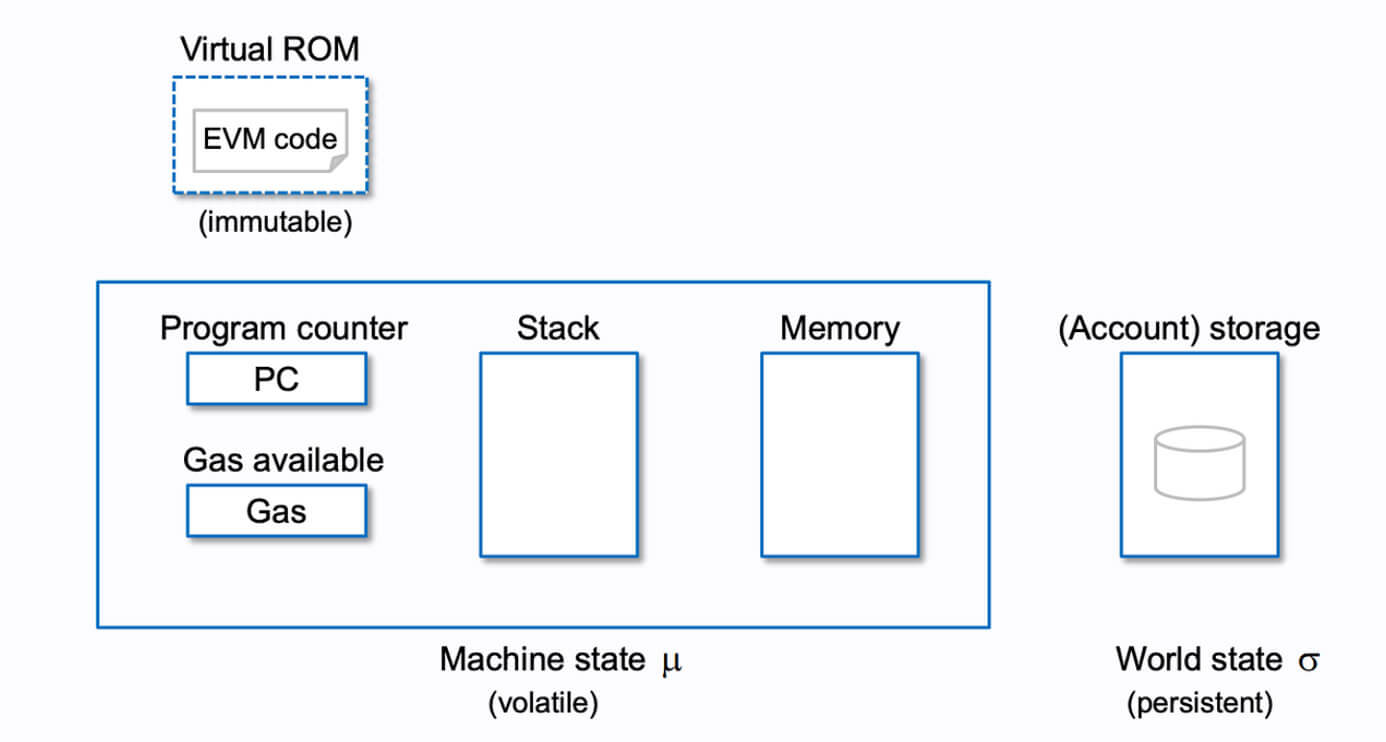
Its key components include:
- Solidity smart contracts;
- Proxy Contracts for upgradeability;
- Reentrancy Guard to ensure security;
- Optimization technologies;
- Infrastructure: RPC nodes, WebSockets and Indexers.
A typical infrastructure stack looks like this:
| Layer | Tools |
| Access to the blockchain | RPC nodes |
| Event streaming | WebSockets |
| Data indexing | The Graph/Subgraphs |
| Interacting with the frontend | Ethers.js |
Solana stack
Solana-based decentralized exchanges use the Rust language for performance.Important concepts of Solana include:
- Anchor framework;
- software derived addresses (PDA);
- integration with DEX Serum/OpenBook infrastructure.
Why Rust is becoming the standard
Rust as a programming language offers low-level memory management and higher throughput, which is important for high-frequency trading.The performance gap between Rust and Solidity isn't marginal — it's architectural. Solidity on EVM tops out around 15-50 TPS under realistic load. Rust on Solana handles 65,000+ TPS with sub-second finality. For derivatives DEXs where a single trader might place hundreds of orders per minute, that difference determines whether your platform is usable or not. Solana's DEX ecosystem crossed hundreds of billions in 2025 volume largely because Rust made high-frequency on-chain trading viable for the first time.
How to Create a DEX: Step-by-Step Development Process
Launching a decentralized exchange requires up to six months of development. All processes are divided into several key stages. Let's look at each in more detail.Stage 1: Smart Contract Core
The first step is to create the core logic of DeFi.The main modules include:
- Exchange mechanism.
- Liquidity pools.
- LP Tokens.
- Distribution of commissions.
- Mechanics of Yield Farming.
Modern DEX systems are increasingly integrating custom hooks similar to Uniswap v4 . This allows developers to create complex pool mechanisms, such as dynamic fees or automatic rebalancing.
The main functions of a smart contract should include:
- Proxy contracts for upgradeability.
- Re-entry protection.
- Flash Loan Protection.
- Gas optimization.
Stage 2: Oracle Layer
Decentralized exchanges (DEXs) rely on accurate price data. Building your own oracle is extremely risky, as attackers can manipulate liquidity pools to influence prices. Instead, most production protocols integrate Chainlink's Price Oracles.The advantages of this approach:
- secure off-network data flows;
- tamper-proof price reporting;
- Protection against manipulation with instant loans.
Price oracles are especially important for:
- derivatives trading;
- liquidation engines;
- margin protocols.
Step 3: Frontend and Indexing
Smart contracts alone are not enough. A modern decentralized exchange requires fast front-end and indexing infrastructure.A typical stack is a system like this:
| Component | Technology |
| Web3 Interoperability | Ethers.js |
| Event streaming | WebSockets |
| Data indexing | Graph |
| Subgraphs | Transaction history and analytics |
Using The Graph indexers, a decentralized exchange can display:
- real-time trading charts;
- liquidity pool analytics;
- historical transactions.
Our clients often experience time constraints. Without indexing layers, querying blockchain data would take minutes instead of milliseconds.
Step 4: Smart Contract Deployment
Before deploying to mainnet, every DEX smart contract must be tested on a public testnet — Sepolia for Ethereum, Devnet for Solana. Use Hardhat or Foundry for local development: they provide deterministic test environments and fast compilation that lets you simulate thousands of swap scenarios before touching real funds.A minimal AMM contract implements three core functions: token swap execution using the constant product formula (x * y = k), liquidity deposit (adding both tokens in correct ratio), and liquidity withdrawal (burning LP tokens to reclaim assets). Even a simple implementation requires careful handling of integer overflow, rounding errors, and reentrancy protection.
Here is a minimal example of the swap() function structure in Solidity:
function swap(address tokenIn, uint amountIn) external {


  uint reserveIn  = reserves[tokenIn];


  uint reserveOut = reserves[tokenOut];


  // Constant product: (x + dx) * (y - dy) = x * y


  uint amountOut = (amountIn * reserveOut) / (reserveIn + amountIn);


  require(amountOut > 0, 'Insufficient output');


}
Stage 5: Frontend and Web3 Integration
The frontend connects user wallets (MetaMask, WalletConnect) to your smart contracts via a provider library such as ethers.js or viem. The critical UX decisions are: how you display price impact before a swap, how you handle failed transactions, and how you communicate on-chain settlement latency to the user.An indexer (The Graph, Subsquid) reads on-chain events and builds a queryable database of all trades, pool states, and LP positions. Without it, your frontend would need to scan every block — which is neither fast nor scalable.
Stage 6: Security Audit and Testnet Launch
Before mainnet deployment, run at minimum one external smart contract audit. Budget 4-8 weeks and $15,000-$80,000 depending on contract complexity. Firms like Trail of Bits, OpenZeppelin, and Certik are commonly used. After audit remediation, deploy to testnet with real users for 2-4 weeks of stress testing. Only then move to a guarded mainnet launch — limiting deposit size and pair count to reduce attack surface.Security and testing
DeFi lost over $3.1 billion to exploits in 2025, according to Chainalysis and Immunefi. The number is large enough to be abstract — until you look at the cause breakdown. Most of these weren't sophisticated cryptographic attacks. They were logical errors: a reentrancy guard missing in one function, an oracle that could be manipulated with a flash loan, a fee calculation that behaved differently under edge conditions.The kind of bugs that a proper audit catches. We've reviewed post-mortems on a dozen of these incidents, and the pattern is consistent: protocols that skipped or rushed the audit lost money. Protocols that treated security as a phase rather than a constraint didn't.
That's why modern DEX development involves not only coding but also a multi-layered system of testing, auditing, and infrastructure monitoring. In large DeFi projects, security accounts for up to 40–50% of development time, including market simulation, automated testing, and independent audits.
The most common attack vectors in DEX protocols
Before talking about testing, it's important to understand which vulnerabilities are most commonly exploited by scammers.
| Attack type | Description | Example of action |
| Reentrancy | calling a function again before pre-execution completes | withdrawal of funds from pools |
| Flash Loan Attacks | using instant loans to manipulate prices | AMM manipulation |
| Oracle Manipulation | influence on price sources | liquidations or incorrect swaps |
| Logical Errors | errors in the protocol business logic | Incorrect calculation of LP rewards |
| MEV Exploits | front-running and sandwich attacks | traders' losses |
For a deeper dive into protecting your assets, check out our comprehensive guide to crypto exchange security. In many cases, even a small logical error can cost a protocol tens of millions of dollars, especially if it involves a liquidity pool.
Secure smart contract architecture
The first layer of protection is proper smart contract architecture. Modern DEXs use the following mechanisms, presented in the table below.| Security component | Target |
| Reentrant Security Guard | protection against repeated calls |
| Proxy contracts | update control |
| signature wallets (Gnosis Safe) | protection of administrative functions |
| Emergency pause (circuit breaker) | emergency shutdown of the protocol |
| Instant loan protection | limitation of manipulation |
Proxy contracts allow protocol logic to be updated without liquidity migration, but they must be implemented correctly to avoid the risk of replay attacks.
Gnosis Safe multi-signature wallets ensure that no developer or administrator can independently change critical protocol parameters.
Emergency Pause and Incident Response
A DEX protocol must have a rapid incident response mechanism. Such systems are typically implemented through an Emergency Pause (Circuit Breaker).If abnormal activity is detected, you can:
- stop swaps;
- block the withdrawal of liquidity;
- temporarily disable individual pools.
Here's a number that surprises most clients: writing the smart contracts is roughly 30% of the security work. The other 70% is building the response infrastructure — emergency pause mechanisms, multi-sig controls, monitoring dashboards, incident playbooks. A DEX that can detect abnormal pool activity and freeze withdrawals within 60 seconds has a fundamentally different risk profile than one that can't. We build circuit breakers into every protocol we deploy, not as a nice-to-have but as a launch requirement.
MEV protection
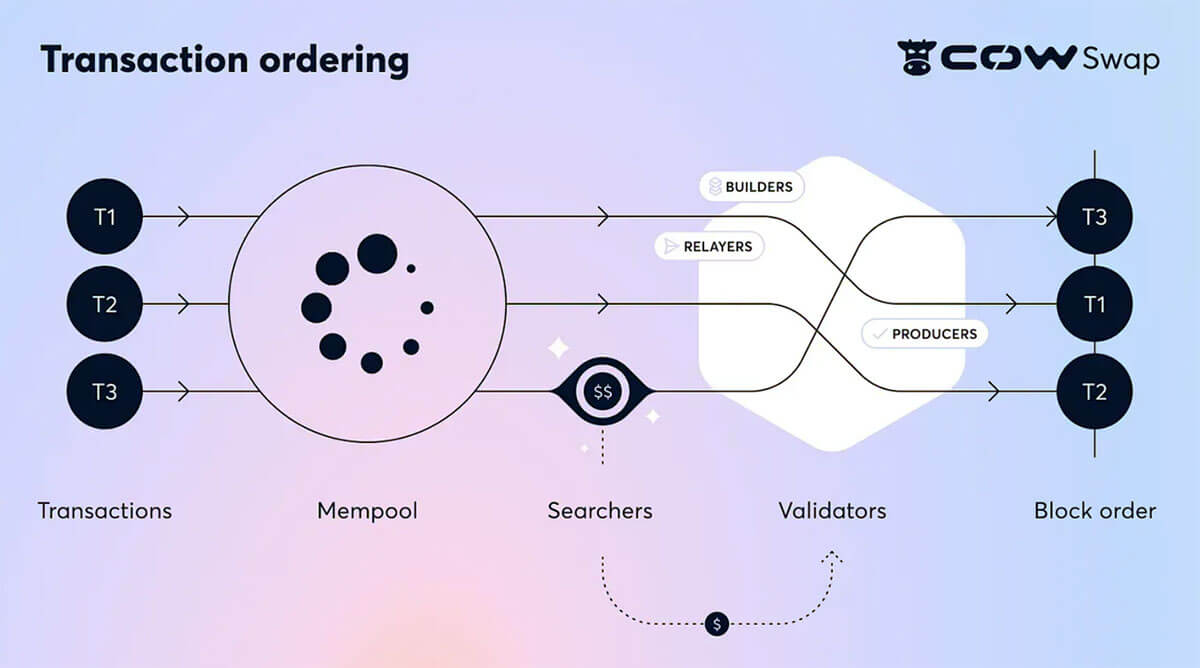
Another critical risk is MEV (maximum extractable value).MEV bots analyze the mempool and are capable of:
- act proactively;
- create sandwich attacks;
- manipulate large swaps.
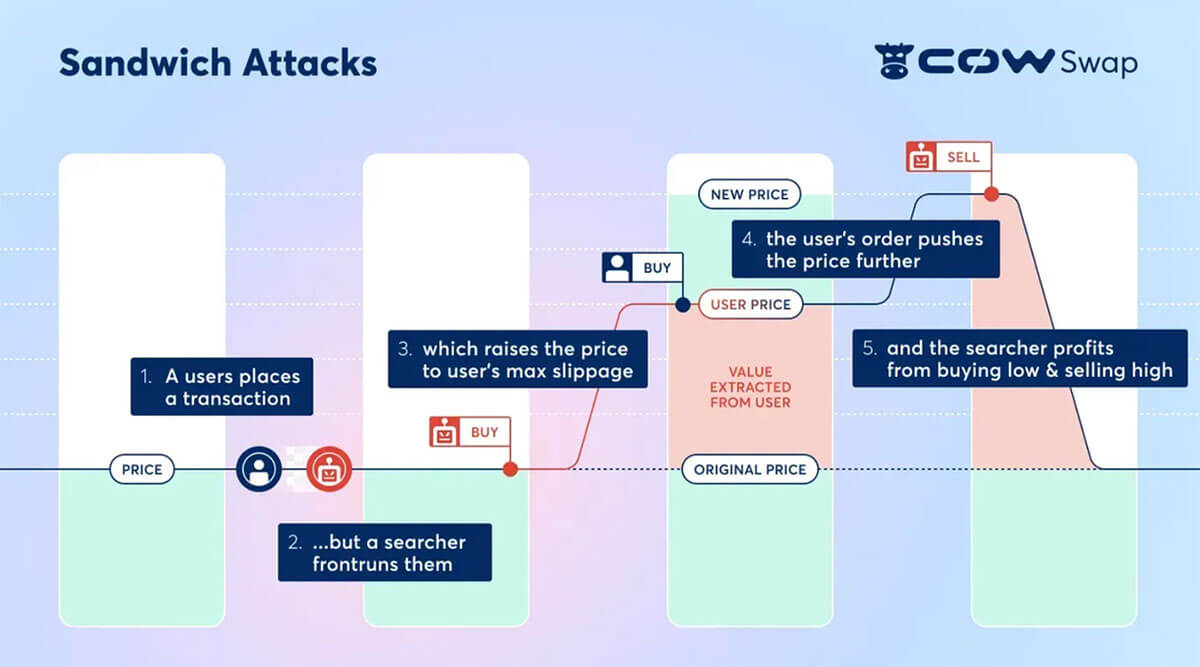
Our clients often experience difficulties with protection.
MEV protection isn't optional in 2026 — it's table stakes. A DEX without it will eventually show up in someone's Twitter thread as the platform that got its users sandwiched on a $50K swap. We've seen it happen. The fix isn't complicated: MEV-Share or Flashbots Protect handles the heavy lifting. What takes time is integrating it properly so it doesn't add latency to normal-sized trades. In our experience, users don't consciously notice MEV protection — they just notice when it's absent.
How MEV protection occurs is shown below.
Infrastructure stress testing
After implementing smart contracts, the next step is intensive testing. One effective tool for this is the Foundry framework and the local EVM simulator Anvil.It allows you to:
- launch a local blockchain;
- simulate thousands of transactions;
- test the behavior of contracts under extreme conditions.
Our experience: Before launch, we simulate trading activity using Foundry Anvil. This allows us to test how smart contracts behave during black swan events, such as when an asset's price drops 30% in 10 minutes. We monitor slippage levels and the stability of the Chainlink oracle.
Main types of tests:
| Test type | Target |
| Unit tests | testing individual functions |
| Integration tests | interaction between contracts |
| Fuzz testing | random data for bug hunting |
| Stress testing | high volume trading simulation |
A decentralized exchange must operate stably even in extreme market conditions.
Therefore, during testing, simulation scenarios are carried out:
- a sharp drop in the price of an asset;
- mass liquidations;
- large outflow of liquidity.
This allows us to test the stability of the AMM algorithm, the behavior of price oracles (Chainlink), and the stability of liquidity.
In decentralized finance, trust is built not by branding, but by protocol reliability. We've observed that new DEX projects that invest in security early on gain community trust faster and attract more liquidity.
Conversely, even one serious exploit can permanently destroy the protocol's reputation.
Liquidity Strategy: How to Avoid a "Ghost Town"
The most technically impressive DEX we ever worked on failed within six months of launch. The smart contracts were clean, the UI was polished, the audit came back green. But they launched with $180K in seeded liquidity on a platform targeting $10M daily volume. Slippage was brutal. Users came once and didn't return.Liquidity isn't a post-launch problem — it's a pre-launch architectural decision. By the time you're writing the frontend, you should already know who your market makers are and what your mining incentive schedule looks like.
The methods of self-financing liquidity are presented in the table below.
| Strategy | Description |
| Liquidity mining | Rewarding liquidity providers with tokens |
| Income farming | Stimulating long-term liquidity |
| Market maker programs | Professional liquidity providers |
| Token incentives | Trading rewards |
Integrating with top-tier crypto liquidity providers is the most effective way to minimize slippage during the launch phase.
Working with market makers
Professional market makers provide tight spreads.Typical agreements include:
- liquidity depth obligations;
- target trading volumes;
- discounts on commission.
Vampire attacks
Decentralized exchanges sometimes attract liquidity from competitors. The most famous example is the SushiSwap "vampire" attack on Uniswap, where the protocol incentivized liquidity providers to transfer funds. This strategy accelerates liquidity growth but requires significant token incentives.Understanding Impermanent Loss
Every liquidity provider in an AMM-based DEX faces impermanent loss — the difference between holding tokens outright versus depositing them into a liquidity pool. When the price ratio of two pooled assets changes significantly, the pool automatically rebalances, leaving LPs with less of the appreciated asset than they would have held otherwise.For example: if you deposit ETH and USDC into a 50/50 pool and ETH price doubles, the pool rebalances to give you less ETH and more USDC than your original deposit. The "loss" is impermanent because it reverses if prices return to the original ratio — but it becomes permanent if you withdraw at the wrong time.
As a DEX builder, you need to communicate this risk clearly to liquidity providers. Platforms that display real-time impermanent loss estimates (like Uniswap v3's position management UI) retain LPs significantly better than those that don't.
Liquidity Bootstrapping: From Zero to Functional
A DEX with empty pools is a ghost town — no liquidity means high slippage, which drives users away before they even make their first trade.The most proven bootstrapping strategies in 2026 are:
- Seed pools: Deploy initial liquidity from project treasury or founding team. This sets a baseline price and enables the first real trades.
- Liquidity mining: Distribute governance tokens to liquidity providers proportional to their pool share and time. Yield farming incentives can multiply TVL quickly.
- Market maker partnerships: Professional market makers (Wintermute, GSR, Amber Group) will provide liquidity in exchange for fee sharing or token allocation.
- Liquidity bootstrapping pools (LBP): Used at launch to distribute tokens and discover initial price via a declining price curve — popularized by Balancer.
Track your TVL (total value locked) from day one. It is the primary health metric that traders, investors, and listing aggregators use to evaluate a new DEX.
Cross-Blockchain Integration: Trading 20 Leading L1 Tokens
Three years ago, 'cross-chain support' was a differentiator. In 2026, it's a baseline expectation. According to on-chain analytics, cross-chain transactions now account for over 25% of all DeFi activity — and that number keeps climbing as users move fluidly between Ethereum, Solana, BNB Chain, Avalanche, and the L2 ecosystem. A DEX that forces users to bridge manually before trading is asking them to do work that your architecture should be doing for them.Therefore, cross-chain integration has become a standard feature for new DEX platforms. According to analytical data, the share of cross-chain transactions in DeFi will exceed 25% of all transactions by 2025–2026. This demonstrates the importance of multi-chain liquidity for traders and market makers.
The main goal of cross-chain integration is to create a unified liquidity for assets from different blockchains. This allows users to swap between native tokens without complex bridging processes.
Without cross-chain integration, traders are forced to:
- transfer tokens across the bridge;
- pay a commission;
- wait for confirmation;
- perform a swap on another network.
This process creates poor user experience and additional security risks. A DEX with cross-chain support allows for all of this to be accomplished in a single transaction through a unified routing engine.
Main Cross-Chain DEX Architectures
There are several technical approaches to implementing cross-chain swaps. They are presented in the table below.| Architecture | Operating principle | Advantages | Risks |
| Wrapped Token Bridges | the asset is locked in network A and a wrapped token is issued in network B | simple implementation | risks of bridge breaches |
| Liquidity Pools (Liquidity Networks) | Liquidity pools exist in different networks | fast swaps | requires high liquidity |
| Messaging Protocols | Cross-chain messages synchronize transactions | without wrapped tokens | complex infrastructure |
Modern traders expect cross-chain trading. Decentralized exchanges must support cross-chain exchanges between major L1 ecosystems.
Today, most new protocols utilize cross-chain exchange, which allows data to be transferred between networks without custodial bridges.
The most popular solutions:
- LayerZero;
- Wormhole;
- Axelar;
- Chainlink CCIP.
These systems allow for the creation of atomic cross-chain swaps, where a transaction is either completed in full or reversed.
Native Swaps Without Wrapped Tokens
One of the biggest problems in the DeFi sector in recent years has been bridge vulnerabilities. According to Chainalysis, over $2 billion was lost due to bridge exploits between 2022 and 2024, forcing the industry to seek more secure solutions.This is why the new generation of DEXs is aiming to implement native cross-chain swaps, where assets are not converted into synthetic tokens.
The technical process is as follows:
- user initiates a swap ETH > SOL;
- the transaction is sent to the Ethereum smart contract;
- The cross-chain messaging protocol passes confirmation to Solana;
- Liquidity on Solana pool is regulated;
- The user receives the native SOL, not the wrapped token.
This approach significantly reduces counterparty risks and increases trust in the protocol.
Cross-chain liquidity routing
Another important component is the routing mechanism, which determines the best path for the swap. For example, if you want to exchange ETH > AVAX, the system might use the following route:- ETH > USDC (Ethereum pool);
- USDC > USDC (inter-chain transfer);
- USDC > AVAX (Avalanche pool).
Routing mechanism analysis:
- liquidity depth;
- commissions in different countries;
- transaction completion speed.
This allows for minimizing slippage and commissions for the trader.
Wrapped token bridges have lost over $2 billion to exploits since 2022, according to Chainalysis. That's not a theoretical risk — it's a documented pattern. For one project that needed ETH<->SOL swaps, we implemented native cross-chain settlement via LayerZero: the user sees a single transaction, no wrapped token ever touches their wallet. It's more complex to build than a wrapped bridge, but the security difference is significant enough that we now recommend it by default for any protocol supporting assets across more than two chains.
How Much Does It Cost to Create a DEX in 2026?
The question we get most often before a project starts is some version of 'how much does this actually cost'?The honest answer: it depends on whether you're building a product or a protocol. A product — something you can fork, brand, and launch — starts around $16K for a white-label MVP. A protocol — something with novel mechanics, cross-chain support, and a governance layer — realistically starts at $75K and scales past $300K for institutional-grade builds. The biggest hidden variable is the security audit: budget it separately, not as a line item inside development. Here's the full breakdown:
| Component | MVP / White-label | Custom DEX | Enterprise |
| Smart contracts | $5,000–$15,000 | $30,000–$100,000 | $100K+ |
| Frontend (UI/UX) | $3,000–$8,000 | $15,000–$40,000 | $50K+ |
| Security audit | $5,000–$15,000 | $15,000–$80,000 | $80K+ |
| Indexer & backend | $2,000–$5,000 | $10,000–$30,000 | $40K+ |
| Infrastructure & DevOps | $1,000–$3,000 | $5,000–$15,000 | $20K+ |
| Total estimate | $16,000–$46,000 | $75,000–$265,000 | $290K+ |
Development Timeline
Timeline varies significantly based on scope:- White-label solution: 4–8 weeks to launch. Uses pre-audited contracts with custom branding. Lowest cost, fastest time-to-market, least flexibility.
- Custom MVP (single chain): 3–5 months. Core AMM functionality, basic security audit, one blockchain. Recommended for market validation.
- Full custom DEX (multi-chain): 6–12 months. Cross-chain support, advanced liquidity management, governance system, comprehensive audit.
For companies prioritizing time-to-market over customization, white-label DEX solutions — pre-built on battle-tested contracts like Uniswap v3 or SushiSwap forks — can cut development time and cost by 60-70% while still allowing frontend and feature customization.
Conclusion
Building a DEX in 2026 is genuinely hard — not because the technology is immature, but because the bar has moved. Users who came up on Uniswap expect sub-second execution. Traders who survived the 2022 CEX collapses demand non-custodial custody. Liquidity providers who got burned on impermanent loss want transparent risk metrics before they commit capital.Meeting all three is an engineering and product challenge simultaneously. Whether you're forking an existing protocol, deploying a white-label solution, or building from scratch, the fundamentals don't change: audited contracts, a liquidity plan that predates launch, and a UX that doesn't punish users for using it.
If you want to launch your own DEX with production-grade architecture, Merehead's team has built and deployed decentralized exchanges across Ethereum, Solana, and multiple L2 networks. Talk to our engineers to define the right architecture for your project.
FAQ
The Best Blockchain Platforms for Building a High-Performance DEX
Ethereum's second-layer networks, such as Arbitrum and Base, remain popular due to their liquidity and tooling. Solana is preferred for high-frequency trading due to its throughput and Rust-based runtime.
How to provide liquidity for a new decentralized exchange?
Most protocols combine liquidity mining, token incentives, and partnerships with professional market makers. Building liquidity in the early months is crucial to preventing high slippage.
What are the typical costs associated with launching your own DEX?
Building a production-ready decentralized exchange typically costs between $150,000 and $600,000, depending on the architecture, security audit, and cross-chain integration.
Key security aspects for a decentralized exchange protocol
DEX security requires protection against reentrancy attacks, flash loans, and oracle manipulation. Multi-signature wallets, MEV protection, and emergency pause mechanisms are also essential.
What are the regulatory challenges for operating a decentralized exchange in the US?
DEX operators must consider AML compliance, securities regulations, and derivatives trading restrictions. Some protocols restrict access to certain features for US users due to regulatory uncertainty.
How do decentralized exchanges handle liquidity and order matching?
DEXs use either AMM liquidity pools or order-book matching mechanisms. Hybrid architectures match orders off-chain for speed and complete settlements on-chain for security.
How to create a DEX like Uniswap?
Creating a DEX like Uniswap means building an automated market maker (AMM) that uses liquidity pools instead of an order book. The core mechanism is the constant product formula: x * y = k, where x and y are token reserves and k is a constant. When a user swaps token A for token B, the formula adjusts reserves to maintain k, setting the output amount automatically.
To create a Uniswap-style DEX you need: (1) a factory contract that deploys pair contracts for each trading pair, (2) a router contract that handles multi-hop swaps and slippage protection, (3) an LP token system that mints ERC-20 tokens representing pool share, and (4) a frontend that connects to user wallets and displays real-time pool data.
Uniswap v3 adds concentrated liquidity — allowing LPs to allocate capital within specific price ranges for higher capital efficiency. Uniswap v4 introduces hooks, enabling custom logic at key swap lifecycle points. For a new DEX in 2026, starting with a v3-style architecture on an L2 (Arbitrum, Base, Optimism) significantly reduces gas fees while maintaining Ethereum security guarantees.