
- Launch time: 6 weeks standard · 4 weeks for a single-chain branded deployment · 10–16 weeks with custom modules
- Cost: from $20,000 (Starter) to $70,000+ (Enterprise) one-time — no monthly licence
- Networks: Ethereum, BNB Chain, Polygon, Arbitrum, Solana, Tron, Bitcoin
- Ownership: full source code and repository handover, no vendor lock-in
- Security: static analysis before handover; independent third-party audit coordinated separately
- Warranty: 90 days of free defect fixes after release
What Ships in the Platform
Every module below runs in production on client platforms today. Nothing here is a roadmap item.
| Module | What it does | Technical detail |
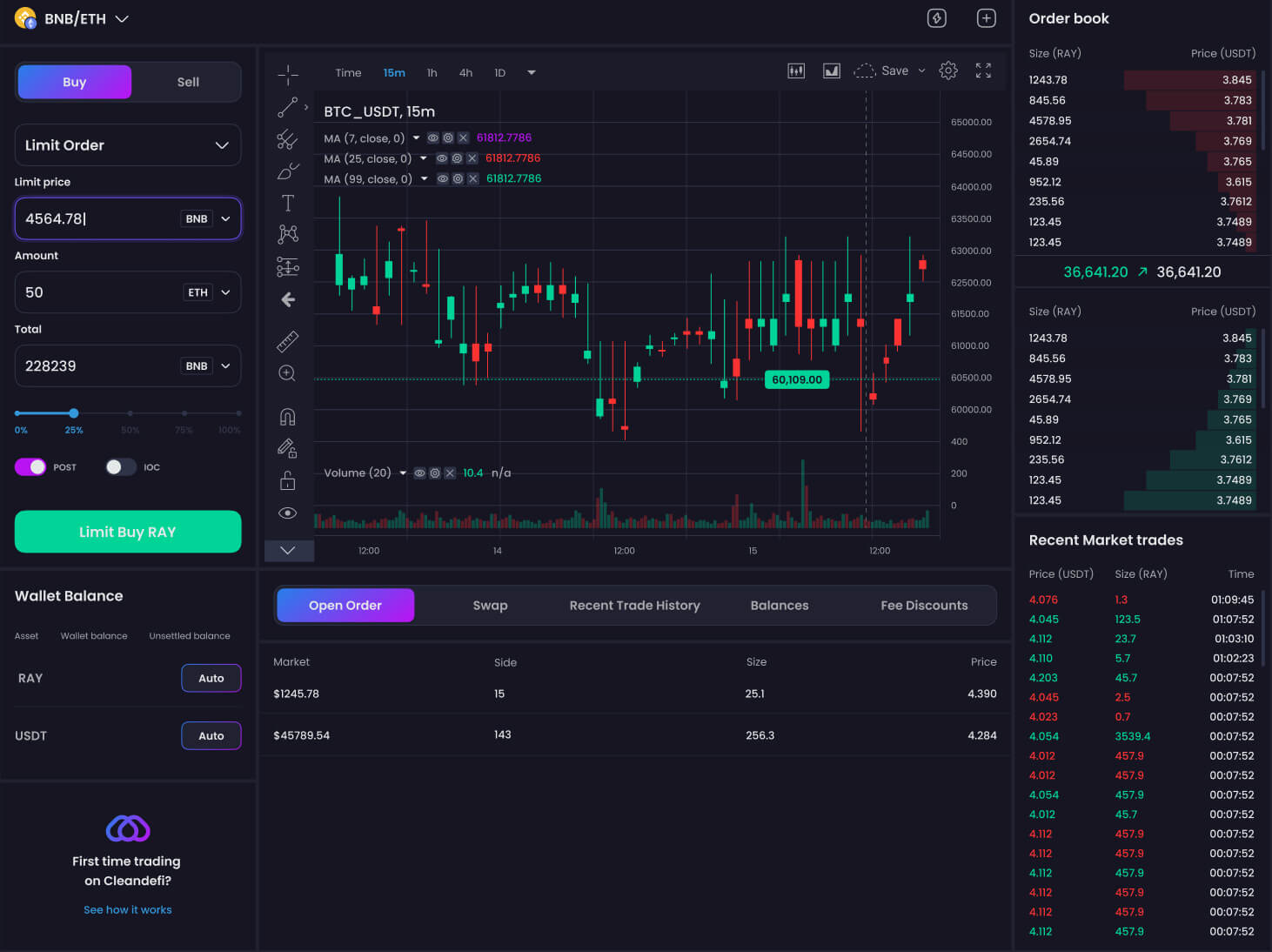
| AMM Swap Engine | Token-to-token swaps against pooled liquidity, no counterparty needed | Uniswap V2/V3 protocol layer with slippage tolerance, minimum-received and full price breakdown before signature |
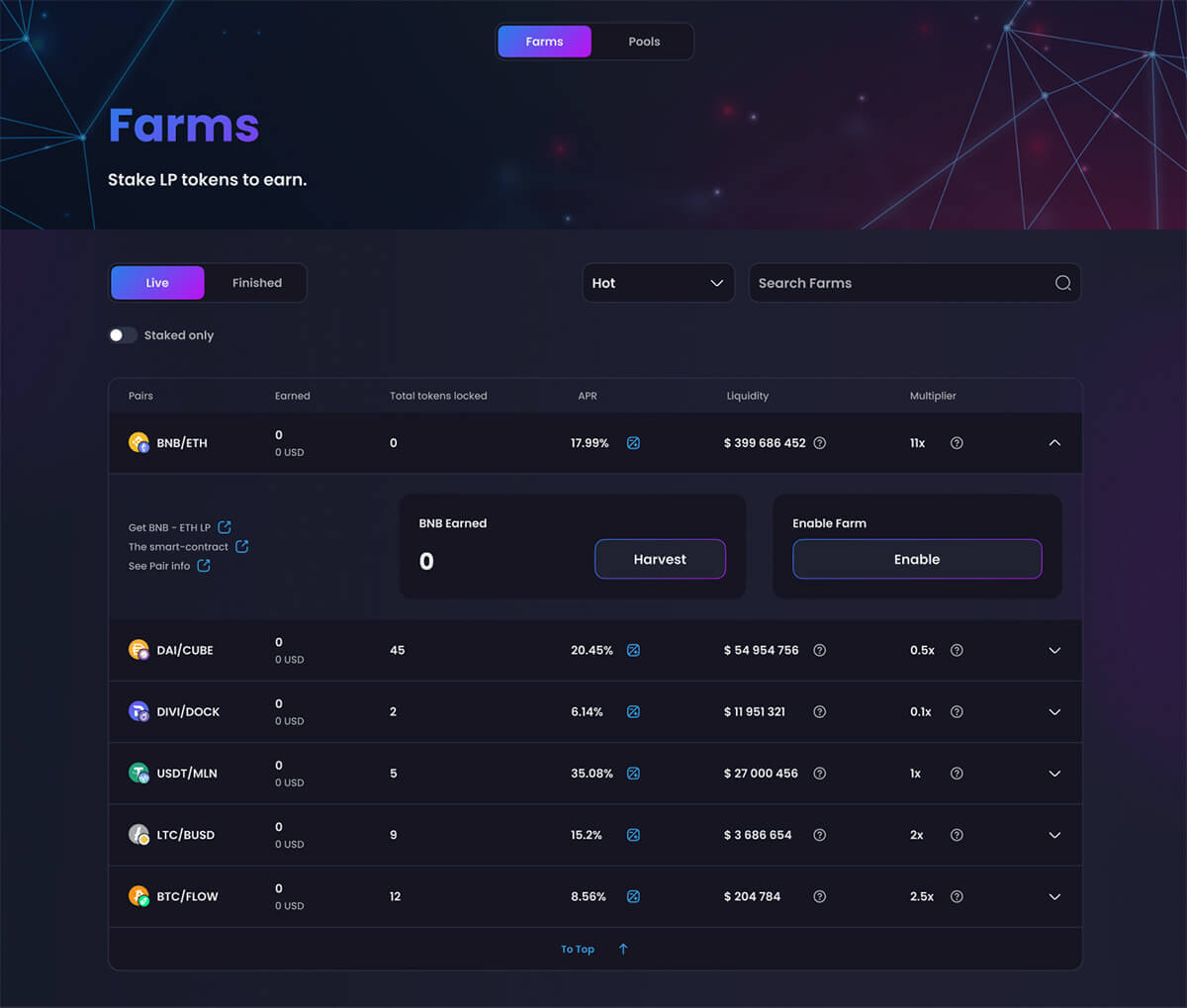
| Liquidity Pools | Users deposit token pairs and earn a share of trading fees | Create pool, add liquidity, remove by 25/50/75/100%, live share-of-pool and 24h volume per pool |
| Hybrid Liquidity Routing | Routes orders to an external venue when your pools are thin | Backend switches between Binance, WhiteBIT, Kraken or internal pool per pair; admin maps pair to provider or routes by best rate |
| Multi-Chain Deployment | One branded DEX across several networks | Ethereum, BNB Chain, Polygon, Arbitrum, Solana, Tron, Bitcoin. Own nodes, external RPC, or a hybrid split |
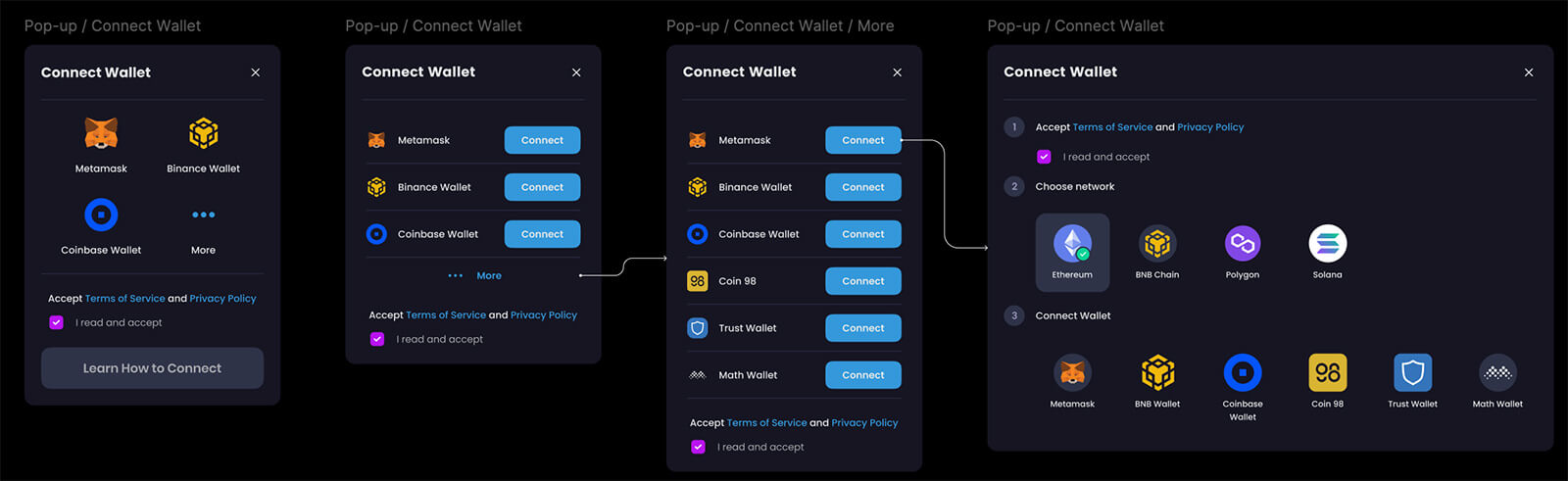
| Web3 Wallet Layer | One-click connect, the entry point for every user | MetaMask, WalletConnect, Trust Wallet, Coinbase Wallet, Math Wallet, plus hardware wallets over WalletConnect |
| Perpetual Futures | Leveraged perps inside the same interface | HyperLiquid integration: order book, market/limit/stop-limit, TP/SL, cross and isolated margin, leverage selection, TradingView charts |
| Admin Panel & Fee Engine | Operators control fees, listings and access without a release | Dynamic fees by turnover, custom token listing, role-based permissions, IP and country access control, CSV export |
| KYC / KYT Layer | Optional compliance gate for regulated markets | SumSub or Ondato for identity; Crystal or Elliptic for transaction risk scoring before balance credit |
| Analytics | Operator and trader dashboards | Top tokens by volume, top pools, per-pool liquidity and volume, LP position view, order and trade history |
Architecture and Infrastructure
The frontend sits behind an API layer, separated from the trading core. That separation is what makes rebranding a configuration task instead of a rewrite — and it is the same principle behind any serious crypto exchange architecture built to run more than one instance.
Security Model
- Key custody: self-hosted nodes with multisig, external RPC, or a hybrid split by regulatory requirement. Key management stays outside developer access.
- Withdrawals: manual back-office approval on configurable thresholds, with partial automation below them.
- Account security: 2FA over email, SMS and Google Authenticator, plus anti-phishing codes.
- Transaction risk: KYT scoring at the deposit wallet, before the balance is credited. Scores below 0.5 auto-approve, scores above 0.5 route to manual review.
- Infrastructure: Cloudflare DDoS protection, load testing at 100 concurrent users with p95 and p99 latency reporting per API method.
- Contract review: static analysis before handover. An independent audit is coordinated with a third-party firm and quoted separately from $20,000.
White Label vs Custom DEX Development
| Factor | White Label DEX | Custom Build from Scratch |
| Time to launch | 4–8 weeks | 4–12 months |
| Development cost | $20,000–$70,000 | $300,000–$500,000+ |
| Cost reduction | 60–80% versus scratch build | Baseline |
| Source code ownership | Full handover | Full |
| Protocol customisation | UI, fees, networks, module set | Complete, including a novel AMM curve |
| Core trading risk | Near zero — mechanics already production-tested | Carried in full by your team |
| Warranty | 90 days post-release | Contract-dependent |
| Best for | Market entry, validation, regional launches | Protocol-level innovation as the product itself |
The honest split: if your differentiation is distribution, brand or a regional fiat corridor, white label wins on every axis. If your differentiation is the protocol itself — a new curve, novel tokenomics, an unusual settlement pattern — then building a DeFi exchange from first principles is the correct call, and we quote it as custom development.
Where the Market Sits
| Option | Cost | Launch | Source code |
| Open-source kit, self-hosted | $0 + $99–$299/mo hosting | 1–4 weeks | Yours — you carry audit and ops |
| Decentralized exchange script / clone | $5,000–$25,000 | 2–6 weeks | Yours — audit, deploy and maintain alone |
| Hosted SaaS DEX | $5,000–$15,000 setup + monthly | 1–3 weeks | No — access is rented |
| Merehead white label DEX | $20,000–$70,000 one-time | 4–8 weeks | Full handover, no licence fee |
| Enterprise white label licence | $60,000+ plus ~$5,000/mo | 8–16 weeks | Licensed, not owned |
| Fully custom development | $300,000–$500,000+ | 4–12 months | Full |
Packages and Pricing
| Starter | Pro | Enterprise | |
| Price | from $20,000 | from $45,000 | from $70,000 |
| Launch time | 4–6 weeks | 6–10 weeks | 10–16 weeks |
| Networks | 1 chain | 3 chains | Multi-chain + Layer 2 |
| Core modules | Swap engine, liquidity pools, wallet connect, admin panel | Everything in Starter + hybrid liquidity routing, dynamic fee engine, KYC/KYT, analytics | Everything in Pro + perpetual futures, custom modules, dedicated infrastructure |
| Branding | Colours, logo, typography | Full UI adaptation | Full UI + custom flows |
| Infrastructure | Single instance | Kubernetes, autoscaling policy | Multi-instance, GitOps deployment |
| Source code | Full handover | Full handover | Full handover |
| Warranty | 90 days | 90 days | 90 days |
Priced Add-Ons
- External liquidity integration — $4,000 per provider. Picking one is a commercial decision as much as a technical one; the trade-offs between crypto liquidity providers shape your spread and your margin.
- Additional network or node — $800–$1,000 each
- Custom utility token for fee settlement — $3,500
- ERC-20 token listing (node already integrated) — $200
- KYC/AML provider integration — $1,600 per service
- Payment gateway integration — $1,500 per gateway
- Independent security audit and white-hat review — from $20,000
- Microservice architecture — +20% of platform cost
- Additional interface language — $300
Discovery is a separate one-month phase in every package. You receive technical documentation, user flows and the platform architecture as deliverables you own — whether or not you continue into development with us.
 Yuri MusienkoBusiness developer, Merehead
Proof of Capability
Three engagements, described by Oleksandr Blinkov, Head of Project Management. Client names stay confidential; the architecture and the numbers do not.
Cold-Start Liquidity: A DEX Interface Without an Order Book
Challenge. The client wanted a non-custodial trading experience but had neither market makers nor capital to seed pools. An empty book kills conversion in the first weeks, and no amount of interface polish fixes it.
Solution. We split UX from execution. The frontend stayed a DEX interface with MetaMask authorisation. Each user received a generated buffer wallet with keys encrypted in the database; funds aggregated to a corporate hot wallet, and execution ran through Binance and WhiteBIT APIs under a single master account. The backend routed each pair to an external venue or to internal liquidity, where prices came from the exchange API and settlement was a balance change rather than an on-chain transaction. Crystal handled transaction risk scoring at the deposit wallet before any credit.
Result. The platform launched across Ethereum, Bitcoin, Tron and Solana with no market makers and no proprietary liquidity. Internal swaps carried zero gas cost. Fee margin stayed fully under operator control, and the compliance threshold — auto-approve below 0.5, manual review above — kept AML overhead proportional to volume.
We separate UX from execution on purpose: the user works with a DEX interface while liquidity and trading run through exchange infrastructure. That is how you launch without market makers or an order book of your own.
Yuri MusienkoBusiness developer, MereheadPerpetual Futures Inside a Non-Custodial Wallet, in Three Months
Challenge. A client running a live iOS and Android non-custodial wallet on TrustWalletCore wanted perpetual futures inside the app — without operating a validator set, an indexer or any exchange infrastructure.
Solution. We evaluated three paths. dYdX v4 gives sovereignty through a Cosmos AppChain but carries heavy infrastructure overhead, which is why a dYdX clone script only pays off at scale. GMX runs on EVM but confines liquidity to Arbitrum and Avalanche. HyperLiquid offered an API-first perp DEX with real depth on BTC, ETH and SOL.
We integrated order placement, position management and funding rate data, then built TradingView charts, a full order book, market, limit and stop-limit orders, TP/SL, cross and isolated margin, and leverage selection. Work ran from a private fork of the client repository through pull requests their tech lead reviewed.
Result. Three months from kickoff to merged module. Users never leave the wallet. Zero spend on proprietary exchange infrastructure, with latency comparable to centralised venues on major pairs. The trade-off we state to every client considering this route: you depend on HyperLiquid uptime instead of owning it.
Modular White Label Architecture Under Real Load
Challenge. A client specified a Tier-2 exchange with spot, margin and perpetual futures. A scratch build priced at $300,000–$500,000 and years of delivery. In parallel, their existing product lost stability under peak load.
Solution. We proposed a modular white label launch instead: convert, spot, margin, perpetual futures, options on Black-Scholes and P2P escrow, each switchable against licensing constraints. Wallet architecture stayed isolated per module — separate spot, margin, P2P and futures balances moving through an internal transfer layer. On infrastructure we containerised 17 microservices under Kubernetes, set requests and limits per pod, moved deployment configuration into a GitOps repository, and lifted the trade service memory ceiling from 512 MB to 768 MB as a targeted fix rather than scaling the whole cluster.
Result. Time to market dropped to 3–6 months against years. Reuse cut development cost 60–80% versus a scratch build — a pattern we have repeated across white label deployments, with the fastest brand-to-live handover completing in under two weeks. Load testing runs 100 concurrent users over three-minute cycles, and we report p95 and p99 per API method rather than medians.
What White Label Does Not Give You
Knowing the limits before signing prevents expensive surprises after launch.
- Protocol-level innovation. White label deployments share a common architecture. A fundamentally new AMM curve or an unusual settlement pattern requires custom smart contract development and its own audit budget.
- Blanket audit coverage. Static analysis covers the base codebase. Anything you customise needs separate audit scope, and that line item is the one most often missing from first budgets.
- Liquidity. Software does not create depth. Budget 20–30% of development cost for liquidity bootstrapping, or plan for external routing from day one.
- Matching engine ownership. Hybrid configurations route through third-party venues. If owning execution matters to your model, the build-or-buy matching engine decision belongs at the start of the project, not after launch.
Deployment Timeline
| Phase | Duration | Output |
| Discovery | 1 month | Technical documentation, user flows, architecture, design |
| Deployment & node sync | Week 1–2 | Server provisioning, node synchronisation started in parallel |
| Branding & configuration | Week 2–4 | Design tokens applied, modules activated, fee model set |
| Integration | Week 4–5 | Liquidity provider, KYC/KYT, payment gateway, API credentials |
| Testing | Week 5–6 | Load testing, full deposit → trade → withdrawal cycles on mainnet |
| Go-live & handover | Week 6 | Production launch, admin credentials, repository transfer |
We start blockchain node synchronisation on day one, in parallel with development. A Bitcoin full node takes five to ten days on dedicated hardware; Ethereum, Tron and BNB Chain sync in one to three. Teams that start node sync after development finish their code and then wait — we have seen that push launches back by a week or more.
Yuri MusienkoBusiness developer, MereheadWhat You Receive at Handover
- Full source code — smart contracts, frontend, backend services and deployment configuration, transferred to your repository with no licensing fee and no restriction on modification or redeployment
- Technical documentation from the discovery phase: architecture, user flows, API specification
- Admin credentials and operational runbooks
- 90-day warranty — every defect that appears after release is fixed at no cost
- The delivery team: business analyst, project manager, project architect, blockchain developers, frontend and backend engineers, QA
If you are weighing a DEX against a centralised model, or need both, our decentralized exchange development team scopes each path against your licence position and target market before quoting.
FAQ
Packages start at $20,000 for a single-chain Starter deployment with swap, pools, wallet connect and admin panel. Pro runs from $45,000 across three chains with hybrid liquidity routing, dynamic fees and compliance. Enterprise starts at $70,000 with multi-chain, Layer 2 and perpetual futures. All prices are one-time, with no monthly licence. Add-ons are priced per module — external liquidity integration at $4,000, an additional network at $800–$1,000, an independent audit from $20,000. Send your requirements and you receive a per-module hour breakdown within 48 hours at no cost. For context on the wider market, our cost to build a DEX breakdown compares MVP, mid-level and enterprise scopes.
Yes. Every project ends with a full repository handover: smart contracts, frontend, backend services, deployment configuration and documentation. There is no ongoing licence fee, no vendor lock-in and no restriction on modifying or redeploying the platform. Your team can push updates the day after handover without contacting us. This is the structural difference between our model and SaaS DEX platforms, which rent access on a subscription and retain the codebase.
Six weeks is the standard timeline from contract to public launch, following a one-month discovery phase. A single-chain branded deployment with no custom features can complete in four weeks — our fastest platform handover took under two weeks, on a product that required only branding, payment credentials and a domain. Multi-chain rollouts or significant custom modules extend the timeline to 10–16 weeks. The most common delay is not code: it is production infrastructure access on the client side, and Bitcoin node synchronisation if it starts late.
Base contracts pass automated static analysis before handover. A full independent audit is coordinated with a third-party firm of your choice and quoted separately, from $20,000 including white-hat review and remediation. We recommend running the audit against your final configuration rather than the base code alone, because any customisation you add falls outside the base scope. Budgeting the audit separately from the platform is deliberate — it keeps the auditor independent of the vendor being audited.
Ethereum, BNB Chain, Polygon, Arbitrum, Solana, Tron and Bitcoin, with Layer 2 deployment available for new and existing rollups. We run these nodes in production and know their real synchronisation windows. You can deploy the same branded DEX across several networks simultaneously — the shared backend serves all instances while brand differences stay isolated in the frontend layer. Adding a network post-launch is a priced module, not a rebuild.
Yes, both are modular. Perpetual futures integrate through HyperLiquid — we delivered a complete perp module inside a live non-custodial wallet in three months. Fiat on and off-ramps connect through payment provider APIs at $1,500 per gateway, with separate handling for pending fiat deposits and confirmed crypto balances. Plan for these at architecture stage even if you defer them: retrofitting fiat accounting onto a platform that never anticipated it costs considerably more than designing the seam upfront.
The 90-day warranty covers all defects that surface after release at no charge. Beyond that, support is contracted separately and scoped to what you need — most clients take either an SLA-backed retainer or a per-sprint arrangement for feature work. Because you own the source code, you are never obliged to use us: some clients hand the repository to an in-house team at day 91. If you are still choosing a vendor model, our comparison of crypto exchange development companies lays out what to check before signing.