

What Is a DeFi App?
A DeFi app — or decentralized finance application — is software that provides financial services (trading, lending, borrowing, yield generation) through smart contracts on a blockchain, without a central company controlling user funds or making decisions about transactions. Users interact with the application directly from their own wallets; the smart contracts enforce the rules automatically.
The defining characteristic is custody. In a traditional finance app, the company holds your money and can freeze it, restrict withdrawals, or go insolvent. In a DeFi application, your assets stay in your wallet until the moment a transaction executes — and the transaction terms are encoded in smart contracts that neither the app developer nor any regulator can change retroactively. This is why DeFi platforms handled over $40 billion in weekly trading volume at peak in 2025-2026 — not because of marketing, but because they removed the counterparty risk that centralized finance carries by design.
When you build a DeFi app, you're building a system with two layers. The on-chain layer — smart contracts that hold the business logic and any funds the protocol manages — runs autonomously on the blockchain. The off-chain layer — the frontend interface, data indexing, price feeds, analytics — provides the user experience wrapped around it. The boundary between these layers is the most important architectural decision in DeFi app development: what must be on-chain for trustlessness, and what can be off-chain for cost and performance.
Main types of DeFi platforms
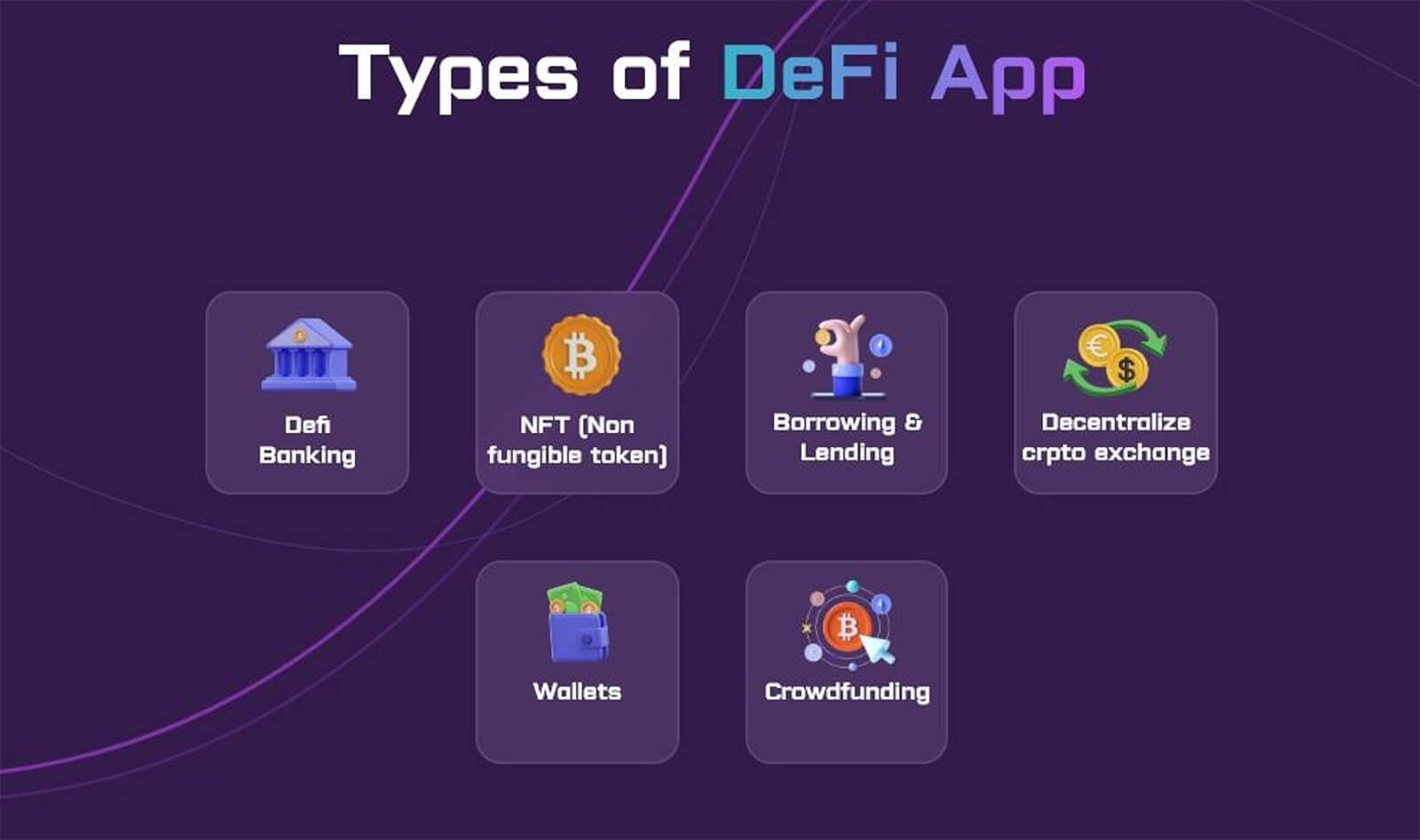
Lending
Lending platforms allow users to deposit their cryptocurrencies and earn interest, as well as take out crypto loans. Users who deposit their tokens receive regular interest payments. These funds are then lent to borrowers or used for other investment purposes.
In order to obtain a loan, users typically need to provide collateral and pay an interest rate, which varies depending on the platform. The lending and borrowing processes are similar to bank deposits and loans, but do not require a lot of paperwork and take only a few minutes. All transactions are carried out using smart contracts.
Key features:
- The ability to earn income even with small deposit amounts;
- Instant loan issuance and favorable interest rates for borrowers;
- The average annual percentage yield (APY) can reach 15% depending on the platform and cryptocurrency. Excessively high rates are often a sign of platform unreliability;
- TVL (Total Value Locked) reflects the total amount of locked (deposited) assets: the higher this indicator, the more reliable the platform.
Platform examples: AAVE, MakerDAO, Compound.
Decentralized exchanges (DEX)
DEX stands for decentralized exchanges, where users can exchange cryptocurrencies. Unlike centralized exchanges, all transactions are conducted through smart contracts, without the involvement of intermediaries, making the process truly decentralized.
You can learn more about the differences between centralized and decentralized exchanges in a separate article.
Key features:
- Confidentiality (no registration or control by a centralized authority);
- Ease of usage: simply connect a crypto wallet (possibly even via a QR code);
- Exchanges are easy — after selecting the tokens for exchange, DEX displays the transaction price;
- Interaction takes place not with individual sellers, but with liquidity pools — these are cryptocurrencies that other users have locked in the platforms' smart contracts to earn passive income.
Popular DEX: Uniswap, PancakeSwap, dYdX.
DEX aggregators
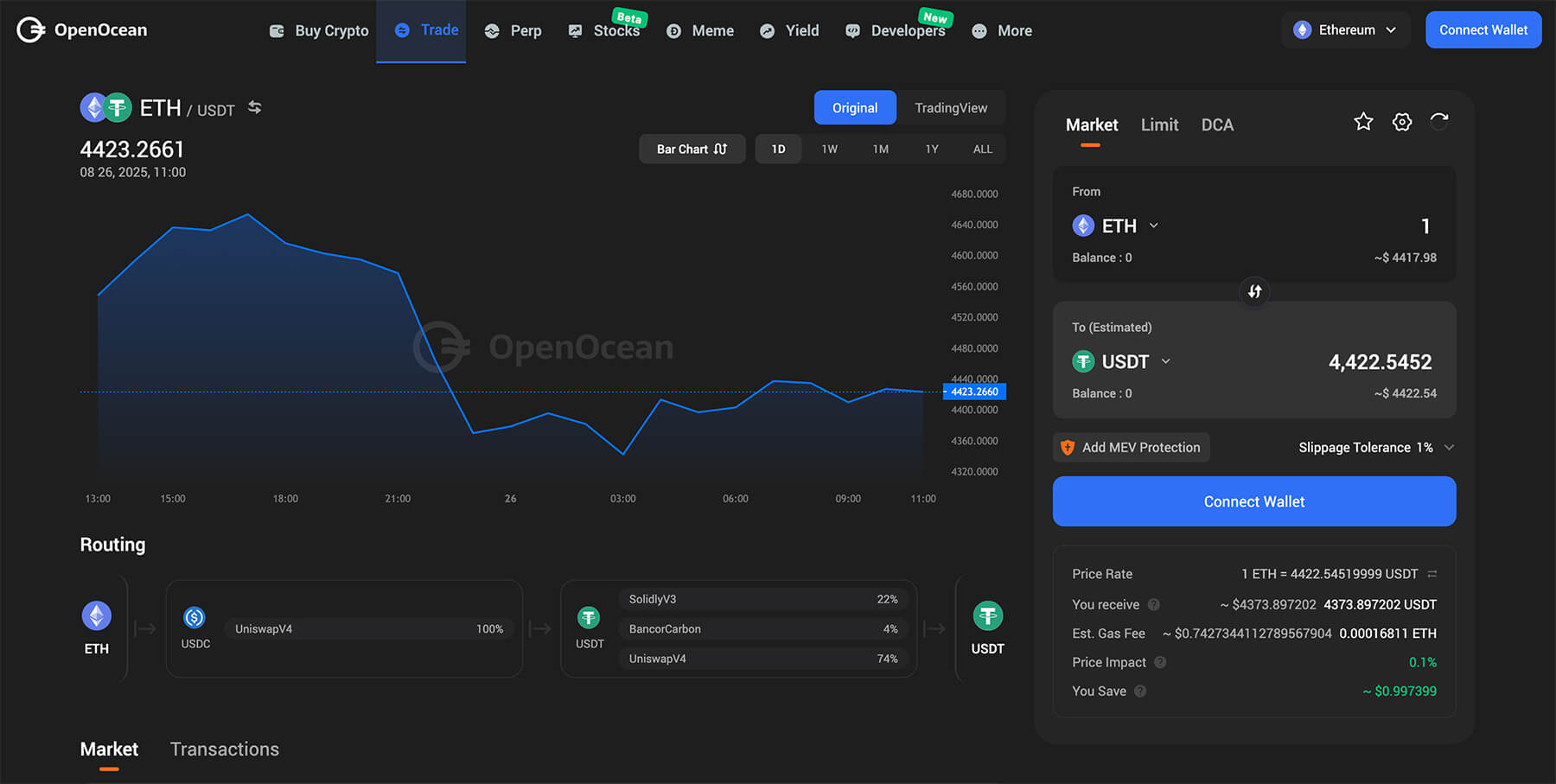
DEX aggregators work similarly to airline ticket or hotel aggregators. They collect data on cryptocurrency rates from hundreds of DEXs and automatically offer users the most favorable exchange rate, saving them time, money and efforts.
Key features:
- Aggregators allow you to access multiple DEXs and their liquidity pools through a single interface — exchanges can be made directly in the app, dApp, or wallet.
- A transaction can be split between multiple DEXs to get a better price than on a single exchange.
- Some aggregators offer features available on centralized exchanges (such as limit orders), which is useful for advanced traders. They optimize gas costs and reduce slippage, making exchanges more profitable and secure. For example, 1inch has implemented an innovative model called 1inch Fusion, which allows transactions to be made without gas fees.
Examples of aggregators: OpenOcean, velora.
A distinctive feature of 1inch is that it has gone further by offering Fusion swaps, in which liquidity is collected not only from DEXs but also from CEXs (centralized exchanges).
Liquidity Farming
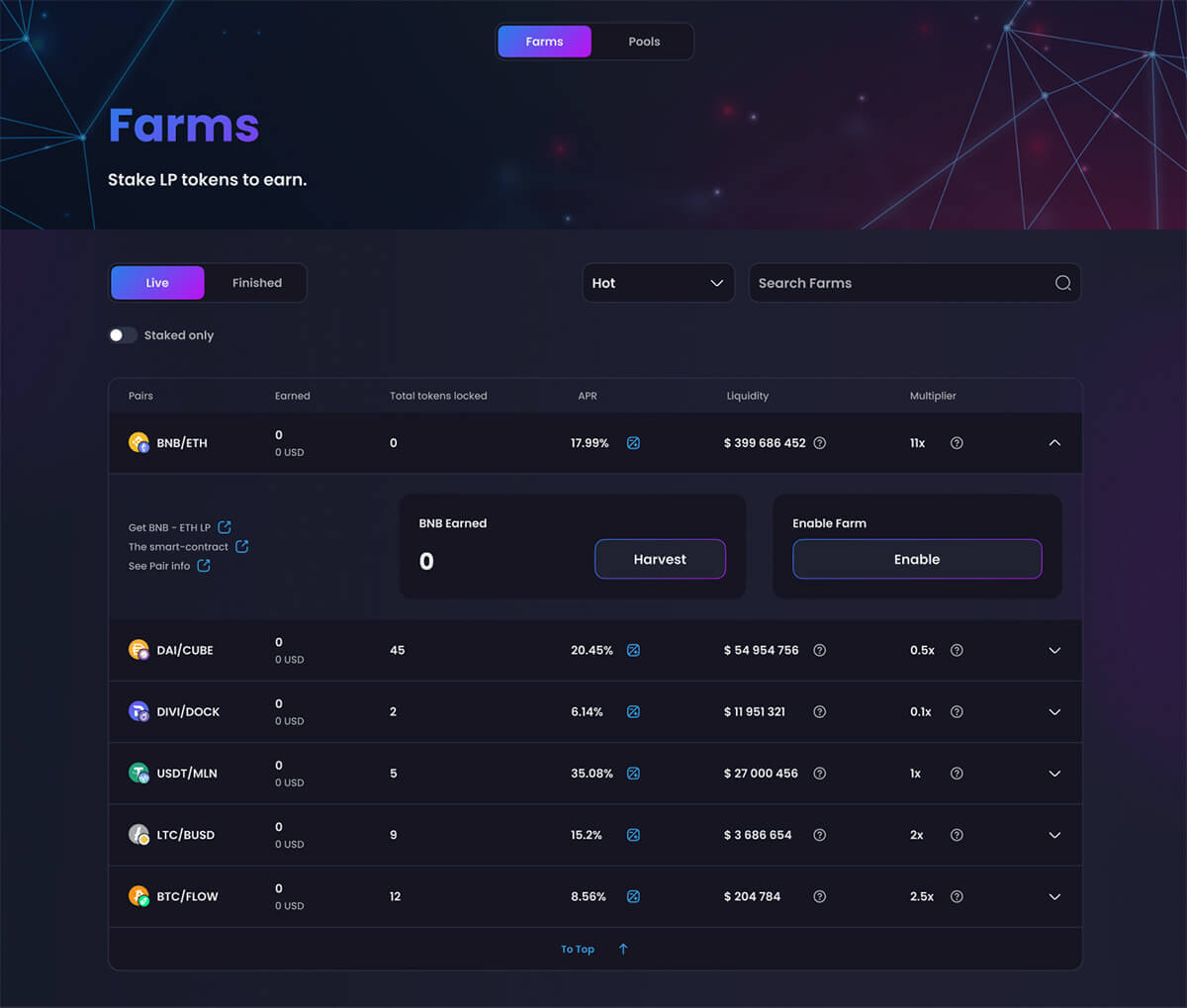
Liquidity farming is similar to a bank deposit, but with potentially higher returns. Users place cryptocurrency in a liquidity pool and receive rewards. These tokens are used for exchanges, and a portion of the commissions is distributed among liquidity providers.
It is important to consider liquidity and trading activity when choosing a platform for farming.
Key features:
- Yield (APY) varies from 5% to 100%;
- On average, stablecoin farming yields 5–15% per annum, while volatile token farming yields up to 25–30%. Little-known tokens can yield up to 100%, but with high risk;
- Impermanent loss is the loss incurred if a token loses value after being placed in a pool. Upon withdrawal, the user may receive less than they invested. Losses depend on the volatility of the token. For example, if the price of a token falls by 4 times, the loss will be about 20%.
Popular DEX for farming: Uniswap, Curve, Sushiswap.
Yield Aggregators
These platforms simplify the farming process by automatically selecting the best pools and asset placement periods. Aggregators combine returns from different platforms, creating reinvestment chains. This is similar to how a fund manager works with a user's investment portfolio.
Key features:
- Each aggregator works with a limited number of pools;
- Automating liquidity placement, profit collection, and reinvestment saves time and increases profitability;
- However, the user loses complete control over the process, so aggregators must be chosen carefully, checking their reliability and the liquidity of the supported pools.
Examples of aggregators: Beefy Finance, Harvest Finance, Yearn.Finance.
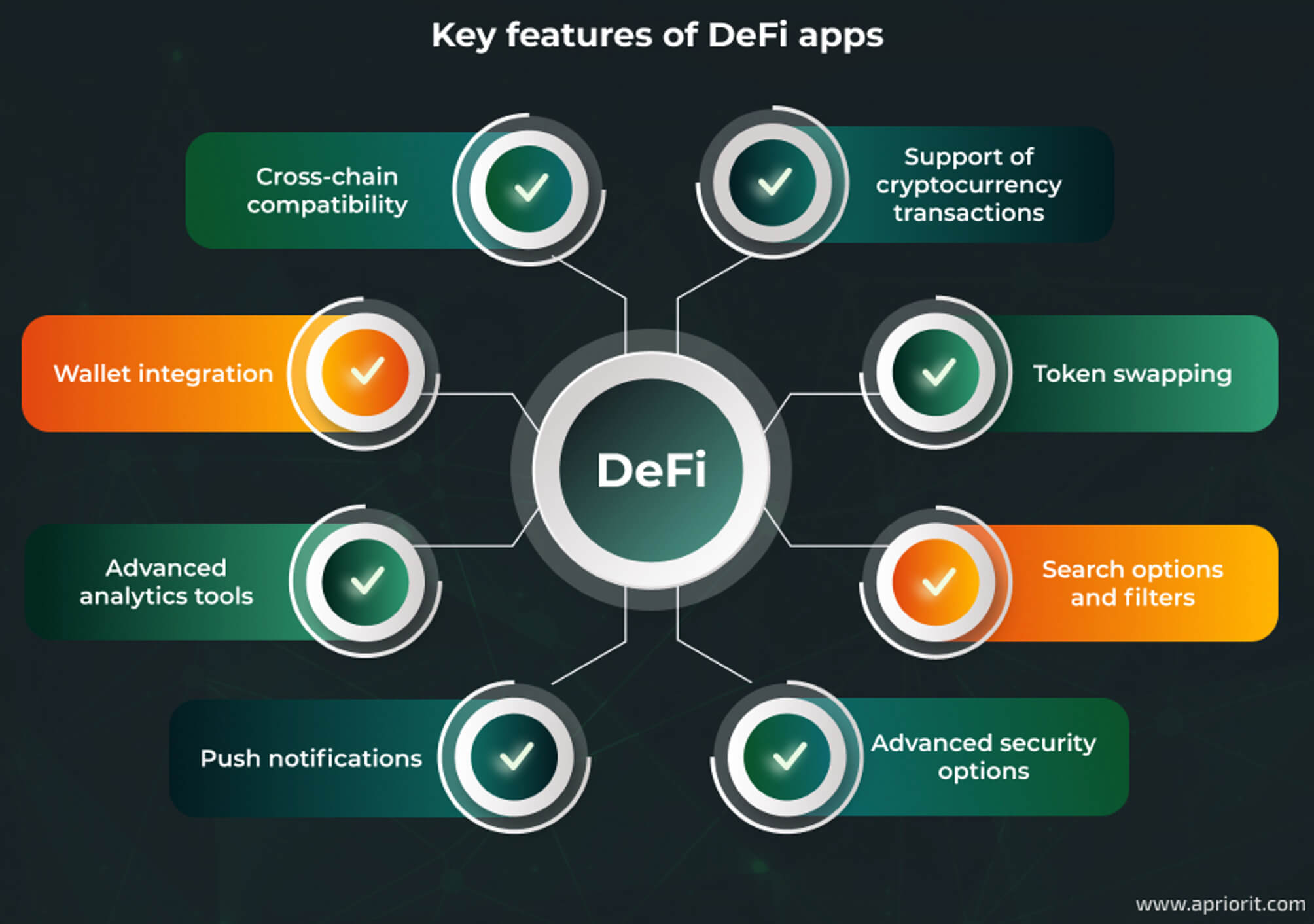
Key features of decentralized finance (DeFi)
The characteristics of DeFi applications become particularly clear when considering their advantages. It is these advantages that demonstrate the value proposition of DeFi and the features that you can implement in your solutions. Below are the main features inherent in DeFi.
Permissionless Access
Any wallet address can interact with a DeFi protocol — no KYC form, no credit check, no geography restriction. This is not just a philosophical stance; it's a technical property of public blockchain deployment. A smart contract that accepts any valid transaction cannot discriminate between addresses. This makes DeFi apps accessible to the 1.4 billion adults globally without bank accounts, for whom permissionless finance is not an ideological preference but a practical necessity.
Programmability
Smart contracts encode financial rules as executable code. A DeFi application can automate interest accrual, liquidation triggers, governance votes, and fee distribution without human intervention — eliminating the operational layer that makes traditional finance slow and expensive. Programmability also enables composability: DeFi protocols connect to each other via standardized interfaces, so a lending protocol can automatically collateralize a yield farming position, creating financial instruments that have no equivalent in traditional finance.
Transparency
Every transaction on a DeFi app is recorded on a public blockchain and verifiable by anyone with a block explorer. Protocol reserves, fee rates, liquidation thresholds, and governance votes are all on-chain and inspectable. This contrasts sharply with traditional finance — and even with centralized crypto exchanges — where the internal ledger is a private database accessible only to the operator. The FTX collapse demonstrated the cost of opacity; DeFi's transparency makes equivalent fraud structurally impossible.
Immutability
Deployed smart contracts cannot be altered retroactively. A DeFi protocol's rules at the time you deposit funds are the rules that govern your position. This provides certainty that traditional platforms cannot — Celsius, Voyager, and BlockFi all changed terms and froze withdrawals after users deposited. Immutability has a trade-off: bugs in deployed contracts cannot be patched without a migration, which is why pre-deployment security audits are non-negotiable for any production DeFi app.
Interoperability
DeFi protocols on the same blockchain are composable by default — they share standardized token interfaces (ERC-20, ERC-721) and can call each other's functions. When you build a DeFi app, you can integrate with Aave for lending, Uniswap for liquidity, and Chainlink for price feeds without permission from any of them. Cross-chain interoperability — bridging assets between Ethereum, Arbitrum, Solana, and other chains — is increasingly handled by bridge protocols and cross-chain messaging systems like LayerZero and Wormhole.
Non-Custodial
A non-custodial DeFi app never holds your private keys. You sign transactions with your own wallet; the protocol receives the signed transaction and executes it. This means no withdrawal approvals, no account freezes, and no counterparty insolvency risk on the protocol side. The trade-off: if you lose your seed phrase, no customer support can recover your funds. This transfers risk from counterparty risk (the platform fails) to self-custody risk (the user fails) — and designing UX that helps users manage self-custody safely is one of the most important challenges in DeFi app development.
Key challenges faced by DeFi projects
One of the most pressing issues remains the security of smart contracts. Since they manage user assets and protocol logic, even the slightest error in the code can lead to serious consequences — from loss of funds to complete platform collapse. Hacker attacks, exploits, logic errors, unstable integration with oracles — all these risks constantly accompany DeFi development. Teams are required to invest resources in security audits, testing, and formal code verification, which significantly increases the cost and launch time.
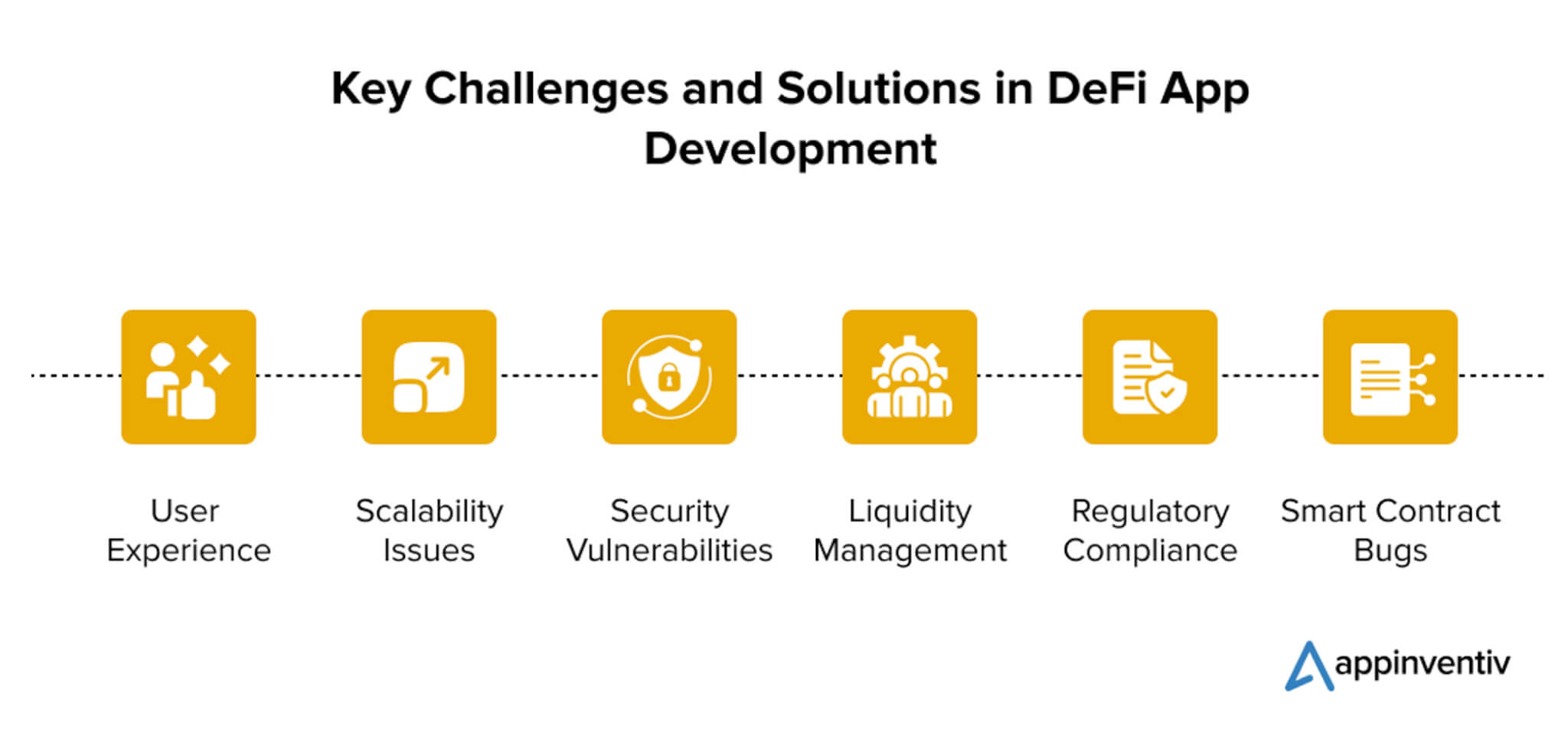
DeFi is undoubtedly a revolutionary technology, but it also has a number of limitations. Let's take a look at the main ones.
1. Lack of regulation and compliance
DeFi is a decentralized system that is not controlled by central or even crypto banks, government agencies, or third parties. It operates independently, which creates certain difficulties in complying with regulatory requirements. While traditional financial systems are strictly regulated due to the risks of money laundering and terrorist financing, transactions in centralized banks are carefully monitored, and if fraud is suspected, the sender's and recipient's accounts are blocked. DeFi does not offer such protection.
2. Vulnerabilities: hacks and cyber threats
Although blockchain is an immutable ledger, making it difficult to alter records, individual DeFi components remain vulnerable to hacking attacks. It can lead to data leaks and loss of funds. According to the REKT Database, losses from hacks, exploits, and fraud in DeFi protocols have already exceeded $4.75 billion. The most common type of attack is honeypots, which lure users into fake protocols.
The weak protection of DeFi protocols causes not only financial damage but also reputational damage to entrepreneurs and businesses.
3. Scalability and performance
Among the main advantages of DeFi are transparency and security. However, low performance is one of the key problems. Compared to centralized systems, DeFi applications are characterized by slow transaction processing and limited scalability. It negatively affects the speed of operations and the overall efficiency of the network.
4. Shortage of qualified specialists
Many companies working on DeFi projects face difficulties in hiring developers and experts. Creating a high-quality DeFi application requires specialists who are knowledgeable in both blockchain and financial processes. One reason for the talent shortage is the rapid development of the crypto market: developers are forced to learn and master new technologies constantly in order to remain competitive.
5. High commissions and low liquidity
In the context of cryptocurrencies, liquidity refers to the ease with which a digital asset can be bought or sold. For example, the Ethereum DApp market is flooded with various tokens, and due to constant changes in their value, it is difficult for users to choose a suitable asset. Low liquidity means high volatility and a shortage of available assets.
The consequence is an increase in transaction costs, especially in cases where the required token is unavailable and one has to overpay for the defi exchange. It prevents the rapid conversion of assets and reduces the efficiency of the entire financial system.
6. Smart contract limitations
As mentioned earlier, smart contracts replace intermediaries in DeFi and perform their functions. Therefore, their correctness and security are critically important. Errors in the code can lead to loss of funds or disruption of the protocol — deletion of users, theft of tokens, failures in the logic of operations.
Common problems include:
- Low performance of smart contracts
- Erroneous payments
- Operational failures
Furthermore, since DeFi places the responsibility for storing and managing assets entirely on the user, the lack of tools and interfaces can lead to human error, undermining the reliability of the entire system.
Technology stack for developing DeFi applications
Developing a DeFi application requires the usage of a complex and multi-layered technology stack, including smart contracts, blockchain infrastructure, Web3 client libraries, interface components, security tools and systems for interacting with external services. Unlike Web2 products, DeFi prioritizes transparency, security and fault tolerance, so choosing the right technological components is critically important.
1. Blockchain platform (Layer 1 / Layer 2)
The base layer of the stack is the blockchain on which the DeFi protocol will be deployed.
Popular networks:
- Ethereum — the primary choice for most DeFi protocols due to its EVM support, liquidity and infrastructure.
- Arbitrum, Optimism, Base — layer 2 solutions built on Ethereum, offering low fees and high speed.
- BNB Chain — a high-performance EVM network with a developed ecosystem and support for BEP-20 tokens.
- Polygon PoS — a scalable network with EVM support and compatibility with Ethereum infrastructure.
- Solana — a high-throughput blockchain using the Rust programming language.
- Avalanche, Fantom, Sui, Aptos — alternative networks selected based on the scaling model, programming language and project specifics.
The choice of network affects the development language, tokenomics, UX (due to fees) and audience.
2. Languages and frameworks for developing smart contracts
Smart contracts are at the heart of any DeFi logic: managing liquidity pools, lending, staking, voting and other processes.
Main languages:
- Solidity — the de facto standard for EVM-compatible networks (Ethereum, Arbitrum, BNB Chain, etc.).
- Vyper — a more rigorous, Python-like language for Ethereum, with an emphasis on security.
- Rust — used in Solana, Near, Polkadot.
- Move — applicable in Sui and Aptos blockchains, designed with transaction security and modularity in mind.
Frameworks and development tools:
- Hardhat — a modern, powerful framework with plugins, a testing environment, and integration with Ethers.js.
- Foundry — a high-performance tool for Solidity developers with its own test runner and CLI.
- Truffle — a classic framework, less popular today but still in use.
- Anchor — for development on Solana (Rust).
3. Web3 integration and working with wallets
The front end of a DeFi application must be able to interact with the blockchain via Web3 libraries, send transactions, and process signatures.
Libraries for Web3 interaction:
- Ethers.js — the most popular and lightweight library for EVM networks.
- Web3.js — an outdated alternative, used in older projects.
- Viem — a modern, typed library for interacting with blockchains, compatible with Wagmi.
- Wagmi — React library with hooks for Web3 integration, supports contracts, accounts, networks and caching.
Connecting wallets:
- WalletConnect — a protocol for connecting mobile wallets.
- Web3Modal, RainbowKit — ready-made widgets for integration with MetaMask, Coinbase Wallet, Trust Wallet, and others.
- Ledger, Trezor — hardware wallets for secure transaction signing.
4. Front end and interface part
User interaction with the DeFi protocol should be as transparent, fast and understandable as possible. Standard web technologies are used here, but with the specifics of Web3 taken into account.
Main tools:
- React.js — the main framework for developing interfaces.
- Next.js — SSR and dApp loading speed optimization.
- Tailwind CSS — the utility CSS framework for creating responsive interfaces.
- Framer Motion — for animations and smooth UX.
It is also necessary to implement interfaces for managing transactions, displaying status, switching networks and signing via wallets.
5. Oracles and external data
DeFi applications often require external data — for example, asset prices, exchange rates, indices and volatility.
Popular decentralized oracles:
- Chainlink — market leader, reliable and proven external data provider.
- Pyth Network — particularly popular in Solana and other L1.
- Band Protocol, RedStone, Witnet — alternative solutions depending on the selected network.
Oracles are critical for ensuring the sound and secure logic of lending, derivatives and stablecoin protocols.
7. Decentralized storage and metadata
If the application works with NFTs, DAOs or requires storing files and configurations outside the blockchain, decentralized storage is used.
Storage facilities:
- IPFS (InterPlanetary File System) — a foundation for storing metadata and files.
- Arweave — a solution for long-term data storage.
- Filecoin — decentralized cloud storage.
8. Data indexing and analytics
Blockchain is not optimized for fast queries. Indexing is used to display information about transactions, pools, positions and metrics.
Tools:
- The Graph — a subgraph protocol that allows you to obtain structured data from the blockchain quickly.
- Covalent, Moralis, Dune — for more flexible analytics and data visualization.
9. RPC infrastructure and nodes
RPC providers are used to connect dApps to the blockchain:
- Infura — the standard choice for Ethereum and L2.
- Alchemy — high reliability and advanced DevTools.
- QuickNode, Ankr, Blast API — alternatives with multi-chain support.
- Own nodes — for advanced protocols requiring autonomy.
10. Security, testing and auditing
DeFi projects must pay special attention to security — compromises are unacceptable in this industry.
Tools and practices:
- Slither, MythX, Echidna — for analyzing vulnerabilities in contracts.
- Tenderly — transaction simulation and monitoring.
- OpenZeppelin Defender — contract management automation.
- Bug bounty — public vulnerability search programs.
- Audits from third-party firms— CertiK, Hacken, Trail of Bits, etc.
11. Governance and tokenomics
DeFi protocols often use governance tokens and DAO models:
- Snapshot — a voting platform with no gas commissions.
- Aragon, Tally — frameworks for managing DAOs.
- Safe (ex-Gnosis Safe) — multisig wallets for storing and distributing funds.
Implementation of governance functionality requires a well-thought-out management model and legal stability.
How to create your own DeFi application: 10 key steps
The process of creating a DeFi application can vary depending on the project's goals and the set of required features, but in most cases it includes the following stages:
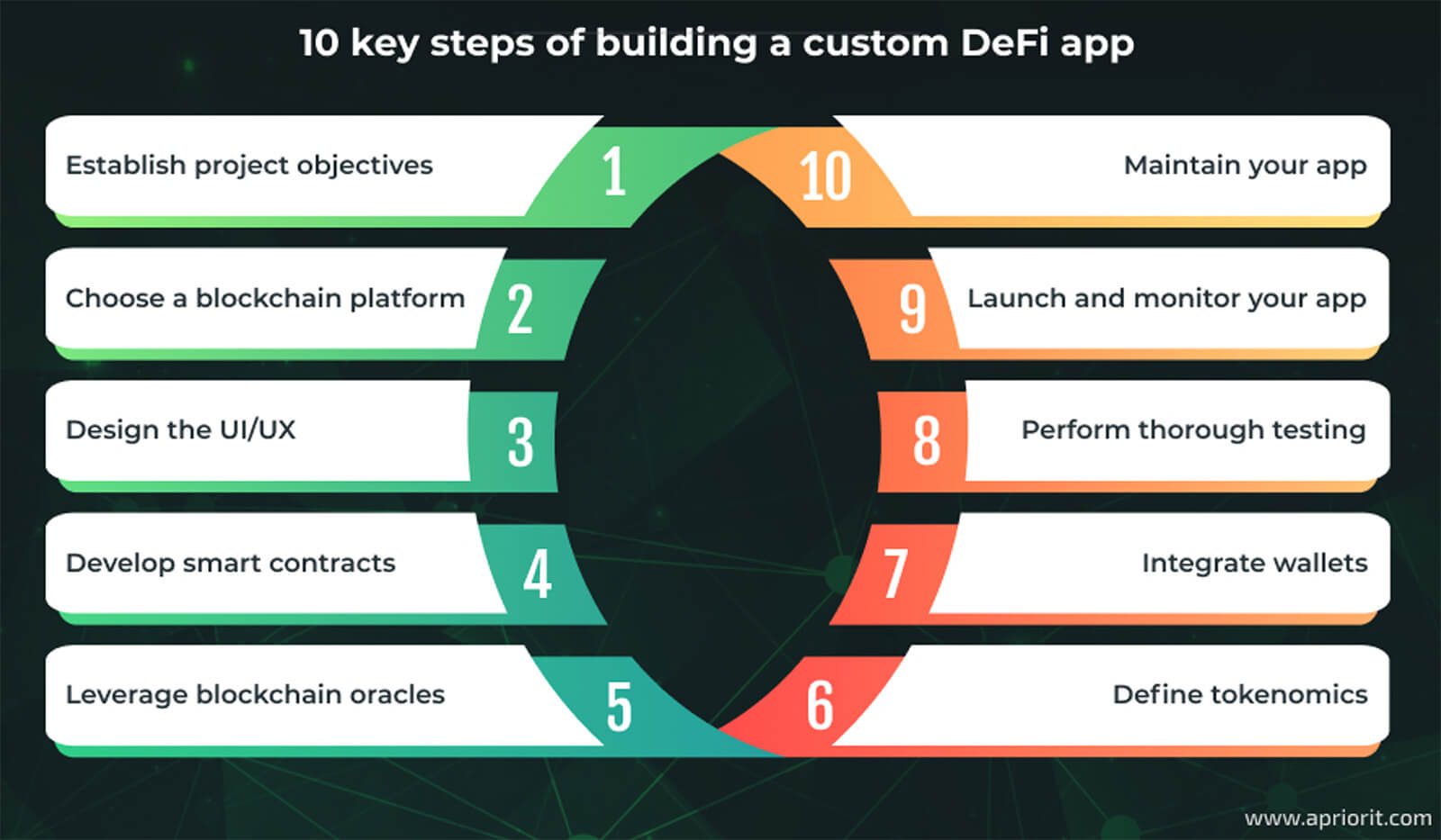
1. Define the Project Goals
Define the DeFi app type (DEX, lending, staking, yield aggregator), target blockchain, user persona, and the specific financial problem the protocol solves. The most expensive mistake in DeFi development is starting smart contract development before the tokenomics and fee model are locked — these decisions cascade through every contract interface. Document them explicitly before writing a line of Solidity. Output: product spec, user stories, tokenomics document, and on-chain/off-chain boundary map.
2. Select a blockchain platform
Select a blockchain that will meet the technical and business objectives of the project. Consider parameters such as scalability, security, speed and transaction costs. Popular options:
- Ethereum — leader in terms of the number of DeFi protocols, smart contract support and a broad ecosystem.
- BNB Chain — low fees and high speed.
- Solana — high scalability and fast transaction processing.
When choosing, consider factors such as security, scalability, gas cost, ecosystem and available development tools.
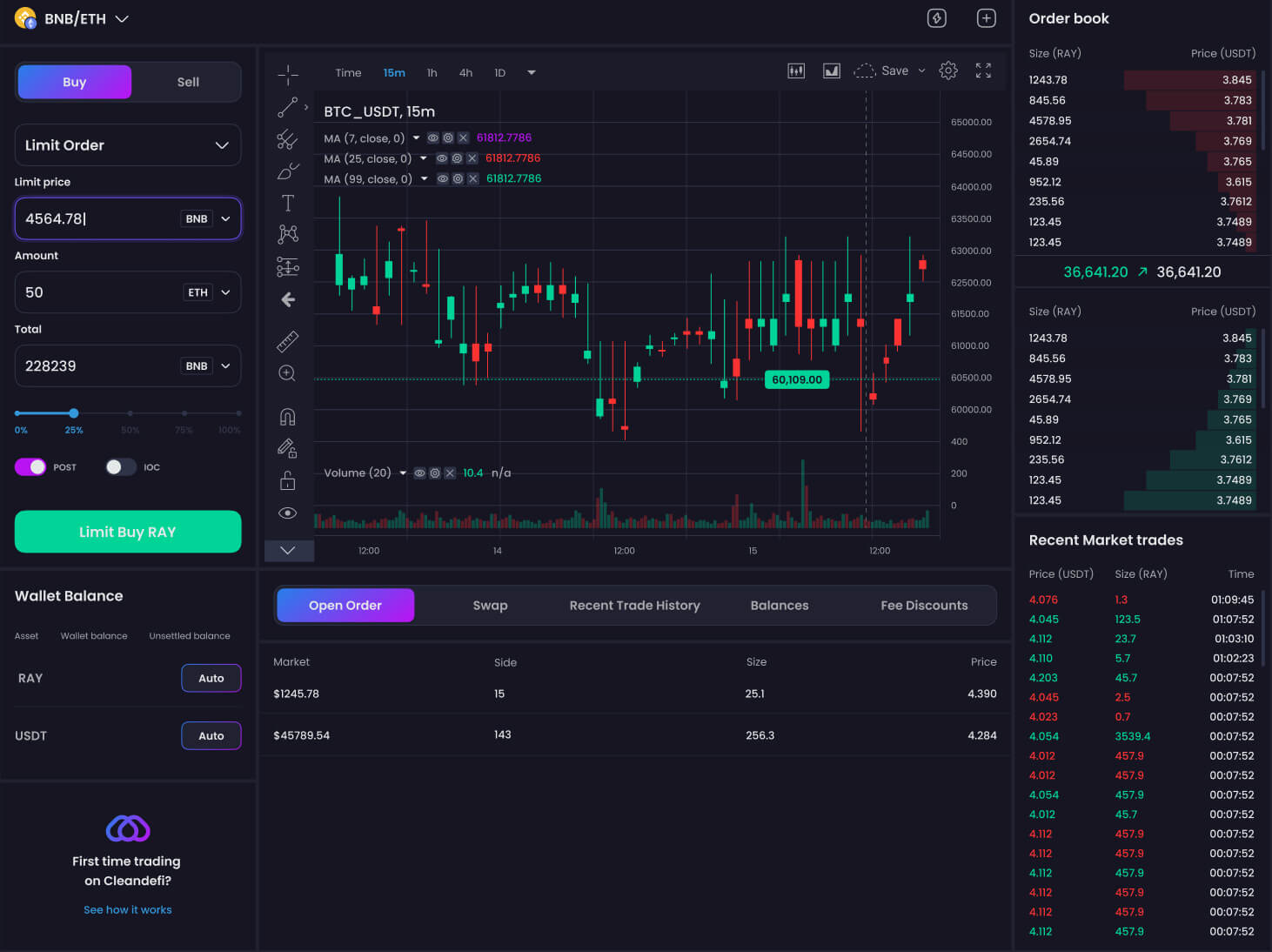
3. Develop the interface (UI/UX)
Create a clear and user-friendly interface that simplifies interaction with your system. To improve usability, you can also conduct usability testing and collect feedback from users.
4. Smart Contract Development
Write smart contracts in Solidity using OpenZeppelin's audited base contracts for standard patterns — ERC-20, access control, upgradeable proxies. Structure contracts modularly: core logic contracts, peripheral contracts (routers, adapters), and governance contracts as separate deployable units that can be upgraded independently. Test with Hardhat or Foundry: unit tests for each function, integration tests for multi-contract flows, and fuzz tests for any math-critical logic (AMM price formulas, interest rate calculations). In our DeFi builds, fuzz testing consistently finds edge cases that unit tests miss in financial calculation functions.
5. Blockchain Oracle Integration
Oracles provide external data — price feeds, interest rates, randomness — to smart contracts that cannot access the internet directly. For most DeFi apps, Chainlink Price Feeds are the default: they aggregate prices from multiple sources with cryptographic verification and are battle-tested across hundreds of production protocols. Use Pyth Network for low-latency price updates on Solana and high-frequency trading applications. Never use a single centralized price source as an oracle — the flash loan attacks of 2020-2022 mostly exploited single-source price manipulation. TWAP (time-weighted average price) mechanisms add manipulation resistance for AMM-based price feeds.
6. Tokenomics Development
Tokenomics design determines whether your DeFi protocol builds sustainable liquidity or creates a pump-and-dump dynamic. Define: token utility (governance, fee discounts, collateral, staking rewards), distribution schedule (vesting for team and investors, community allocation), and emission rate for liquidity incentives. The fee switch mechanism — whether and how protocol fees flow to token holders vs. reinvestment — must be decided at the design phase. Retroactive governance votes on fee distribution are politically difficult and have delayed revenue distribution at major protocols for years.
7. Integration of Crypto Wallets
Wallet integration is the primary UX differentiator in DeFi app development. Use RainbowKit or Web3Modal for the wallet connection UI — these handle MetaMask, WalletConnect, Coinbase Wallet, and 20+ other wallets in a standardized dialog. For consumer apps targeting non-crypto-native users, implement embedded wallets (Privy, Magic.link) that create a wallet via email or social login — this single decision typically improves onboarding conversion by 3-5x. Always implement transaction simulation before signing: show users exactly what a transaction will do before they confirm, not after. This reduces failed transactions and support volume significantly.
8. Complete testing
Conduct comprehensive functionality and security testing. Regular security audits are necessary to identify and eliminate vulnerabilities before launch.
Before launching, you must complete the following steps:
- Unit testing (testing each part of the code)
- Integration testing (interaction between components)
- Load testing
- Security audit by a third-party company
At this stage, you need to make sure that the application is resistant to hacking and that all functions work correctly in combat conditions.
9. Launch and Monitoring
Deploy to mainnet only after testnet validation and external security audit clearance. Use a deployment script (Hardhat Ignition or Hardhat Deploy) that records deployed addresses and constructor arguments — this documentation is essential for contract verification on Etherscan and future upgrades. Immediately after deployment: verify contracts on the block explorer, configure monitoring with Tenderly or OpenZeppelin Defender for anomaly alerts, and publish your audit report publicly. Real-time monitoring should alert on: unusual withdrawal volumes, sudden TVL drops, repeated failed transactions from the same address, and governance proposal submissions.
10. Support and Updates
Post-launch support for a DeFi application differs from Web2 because smart contract bugs cannot be patched with a server deploy. If your contracts use an upgradeable proxy pattern (UUPS or TransparentProxy), you can push logic updates through governance. If not, users must migrate to a new contract version — which requires explicit communication, migration tooling, and incentives. Build incident response procedures before you need them. Maintain a multi-sig wallet (Safe) for emergency protocol pauses if you've implemented pause functionality. In our experience, platforms that design incident response before launch resolve incidents 3-4x faster than those that improvise under pressure.
DeFi App Development Cost in 2026
| App Type | Development Cost | Audit Cost | Timeline |
| DeFi MVP (staking, basic yield) | $20,000–$50,000 | $10,000–$20,000 | 2–4 months |
| Medium DeFi app (tokenomics, governance) | $50,000–$120,000 | $20,000–$50,000 | 4–7 months |
| Full DeFi platform (DEX, DAO, multi-chain) | $100,000–$300,000+ | $50,000–$150,000+ | 7–14 months |
The security audit cost is the item most consistently underestimated when planning to build a DeFi app. Developers budget for development then discover the audit adds 30-50% on top — and the best audit firms (Trail of Bits, OpenZeppelin, Certik) are booked 6-8 weeks in advance. In our experience across DeFi projects: engage your audit firm before development completes, share contract specifications early, and many firms will review architecture at the design phase — finding issues that cost 10x more to fix in code.
Liquidity bootstrapping is the second underestimated budget line. A technically perfect DeFi app with empty pools attracts no users. Budget $30,000–$500,000 for seed liquidity and market maker incentives depending on the number of trading pairs or lending markets you're launching. This is not a development cost — it's an operational cost that should appear in your financial model before you start building.
Key DeFi trends for 2026
Decentralized finance continues to transform, offering increasingly advanced solutions at the intersection of blockchain technology, artificial intelligence, tokenization of real estate and scalable infrastructure. In 2026, DeFi will become not just an alternative to traditional finance, but a platform for launching complex financial services of the new generation.
Here are the key trends shaping the direction of DeFi ecosystem development.
1. Integration of AI and DeFi (DeFAI)
AI agents are increasingly operating DeFi positions autonomously — executing trades, rebalancing liquidity, and responding to market conditions without human instruction. In 2026, several AI agent frameworks (ElizaOS, Virtuals Protocol) enable agents to hold crypto wallets, interact with DeFi protocols, and manage treasury positions. For DeFi app developers, this creates a new user segment: agents as protocol participants that need clear, machine-readable interfaces and predictable gas patterns. DeFAI also includes AI-powered risk scoring for lending protocols — replacing static liquidation thresholds with dynamic models trained on historical market behavior.
2. Growth of Multi-Chain and Cross-Chain Ecosystems
Liquidity is no longer concentrated on a single chain. In 2026, serious DeFi applications launch on at least 2-3 chains simultaneously — typically Ethereum mainnet for institutional credibility, Base or Arbitrum for retail gas cost sensitivity, and Solana for high-frequency use cases. Cross-chain bridging via LayerZero, Wormhole, and Axelar allows assets and messages to move between chains with cryptographic verification. When building a DeFi app today, multi-chain architecture should be designed from day one — retrofitting cross-chain capability into a single-chain protocol is significantly more expensive than building for it from the start.
3. Decentralized Stablecoins
Algorithmic and crypto-collateralized stablecoins — LUSD, crvUSD, GHO — are gaining ground over centralized alternatives (USDC, USDT) as DeFi protocols seek to minimize dependency on assets that can be frozen by regulators. The design space has matured significantly since the UST collapse of 2022: modern decentralized stablecoins use over-collateralization, interest rate mechanics to manage peg stability, and diversified collateral baskets rather than single-asset backing. For DeFi app builders, native stablecoin integration decisions now include regulatory risk assessment alongside technical criteria.
4. Layer 2 Solutions for Scalability
L2 deployment is now the default, not the advanced option. Base, Arbitrum, Optimism, and zkSync have collectively absorbed the majority of new DeFi app deployments in 2025-2026 — their gas fees are 100-1000x lower than Ethereum mainnet while inheriting Ethereum's security guarantees. For DeFi development in 2026, the practical question is which L2 to prioritize: Base has the largest retail user base (Coinbase distribution), Arbitrum has the deepest DeFi liquidity, and zkSync Era leads in zero-knowledge proof performance. App-specific rollups (using Arbitrum Orbit or OP Stack) are emerging for protocols that need customized execution environments.
5. Growth in Institutional Participation
Institutional capital is entering DeFi applications through structured products, tokenized treasuries (BlackRock BUIDL, Franklin Templeton BENJI), and permissioned DeFi pools that satisfy KYC/AML requirements without sacrificing non-custody. For DeFi app developers targeting institutional users in 2026, this means building KYB (Know Your Business) verification flows, role-based access controls for permissioned pools, and Proof of Reserves mechanisms that satisfy auditors. The technical infrastructure for institutional DeFi is identical to retail DeFi — the compliance and access control layers are what differentiate the products.
Frequently Asked Questions (FAQ)
To create a DeFi app, follow this sequence: (1) Define the protocol type and on-chain/off-chain boundary — what business logic must live in smart contracts vs. what can be off-chain. (2) Design tokenomics and fee architecture before writing any code. (3) Develop smart contracts in Solidity using OpenZeppelin base contracts, test with Hardhat or Foundry. (4) Build the frontend with React/Next.js, connect contracts via wagmi and Viem. (5) Integrate data indexing via The Graph for real-time portfolio and pool data. (6) Deploy to testnet and run security audit before mainnet. The audit is non-negotiable: DeFi protocols lost over $1.2B to smart contract exploits in 2024.
To build a DeFi app from scratch, start with the smart contract layer, not the frontend. Write and test contracts on a local Hardhat or Anvil node first — you need a stable contract interface before the frontend can be built meaningfully. Choose your blockchain based on your app's transaction frequency and gas tolerance: Base or Arbitrum for most new DeFi apps in 2026, Ethereum mainnet for protocols where maximum security and institutional trust outweigh gas costs, Solana for high-frequency applications. Minimum team for a production DeFi app build: 1-2 smart contract developers, 1 frontend developer with Web3 experience, 1 DevOps/security engineer. Total timeline from concept to mainnet: 4-12 months depending on complexity.
The cost to develop a DeFi application ranges from $20,000–$50,000 for a basic MVP (staking, simple yield) to $300,000+ for a full-featured multi-chain platform with DEX, DAO governance, and custom tokenomics. The security audit adds $10,000–$150,000 on top of development — this is not optional. Hidden costs that consistently surprise founders: liquidity bootstrapping ($30,000–$500,000), ongoing infrastructure ($1,000–$5,000/month for RPC providers and indexing), and governance contract maintenance. Total realistic budget for a competitive mid-tier DeFi app including audit and first-year liquidity: $100,000–$300,000.
DeFi yield farming can be profitable but requires understanding impermanent loss, smart contract risk, and token emission sustainability. Stablecoin farming on established protocols (Curve, Aave, Compound) typically yields 3-8% APY in 2026 — lower than the 50-200% APY of 2020-2021 but without the same token collapse risk. Volatile asset farming yields are higher but impermanent loss during price divergence can exceed fee income. The protocols with sustainable yields are those where fees come from real trading volume and lending demand, not solely from token emissions. As a rule: APY above 20% on any non-stablecoin pool warrants careful risk evaluation of the underlying token economics.