
A Bitcoin escrow script is backend logic that locks a buyer's funds in a neutral holding state until both sides of a P2P trade confirm delivery, then releases or refunds the balance based on the trade outcome. It replaces blind trust between two strangers with a rules-based release mechanism.
A production-grade bitcoin escrow build covers four architecture layers:
- Isolated wallet layer — escrow balances sit apart from spot/trading balances, so a lock never touches unrelated funds.
- Lock/unlock engine — the service that freezes, releases, or refunds an amount based on trade state and timeout rules.
- Node infrastructure — Bitcoin (and other chain) nodes that confirm deposits and withdrawals in real time.
- Compliance layer — KYC/KYT checks that run before a deposit ever reaches a releasable balance.
Bitcoin transactions don't reverse. Send coins to the wrong address, or release them to a counterparty who never delivers, and there's no chargeback, no support ticket that gets your money back. A bitcoin escrow script exists specifically to remove that risk from peer-to-peer trades: it holds the funds in a locked state until both sides confirm the deal went through, and it hands control of a dispute to a defined process instead of leaving two strangers to argue in a chat window.
We've built this exact mechanism inside a live exchange platform, and we've shipped the P2P/FIAT variant as a standalone mobile app — the same lock/unlock backbone that underpins any P2P crypto exchange script. Below, we walk through the architecture we'd actually recommend, the real engineering problems that show up once you run it under load, and the real cost/timeline numbers from our own estimates — not industry averages.
What a Bitcoin Escrow Script Actually Does
Strip away the marketing language, and an escrow script does three things: it freezes a specified amount, it checks a condition (payment confirmation, timeout, dispute resolution), and it moves the funds — to the seller, back to the buyer, or into a dispute queue. Everything else — the marketplace UI, the chat, the KYC — sits around that core.
There are two fundamentally different ways to build that core, and most articles on this topic blur the line between them:
| Model | How it locks funds | Where custody sits | Best fit |
| Custodial escrow (application-layer) | Backend service moves a user's balance into a locked state inside your own ledger; release/refund is a database-level state transition, not an on-chain transaction | Platform operator (you) | P2P marketplaces, exchanges, freelance platforms — anywhere you already run a wallet infrastructure |
| Non-custodial escrow (on-chain) | Bitcoin script (P2SH multisig, e.g. 2-of-3) or an HTLC locks the actual UTXO; release requires a valid signature combination | No single party — funds sit in a script-locked address | High-trust-minimization use cases; adds real complexity around key management and refund/timelock logic |
We built our real P2P escrow module as the first model — a custodial, application-layer lock — because it lets you keep the compliance layer (KYC/KYT, forced address rotation, admin dispute queue) in the same system that manages the lock state, instead of coordinating between an off-chain database and an on-chain script. If your product genuinely needs the trust-minimization of an on-chain multisig or HTLC, that's a heavier build — closer to how developing a smart contract from scratch works, with its own key-management and refund-timelock requirements — and it's worth scoping separately rather than bolting onto a custodial P2P flow.
Escrow isn't the smart contract itself — it's the isolated wallet layer and the lock/unlock state machine around it. Get that wrong, and no amount of UI polish fixes it.
 Yuri MusienkoBusiness developer, Merehead
The Lock/Unlock Engine: Where Escrow Actually Breaks
In one of our live P2P escrow deployments, a counterparty's funds lock for 15–30 minutes while the buyer confirms a fiat payment. The seller creates a buy/sell ad, a trade opens against it, and the backend moves the relevant balance into a locked state until the trade resolves. It sounds simple until two trades try to lock against the same balance at the same time.
Challenge: Under concurrent load, direct SQL balance updates on the escrow lock created a race condition — two competing lock requests could both pass an available-balance check before either write committed, effectively double-spending the same internal balance.
Solution: We moved P2P balances into an isolated wallet layer, separate from spot/margin/futures balances, connected through an internal transfer layer that treats lock/unlock as an atomic service-level operation rather than a raw database update. Dispute cases route into a separate admin queue through an event on our Kafka/Redpanda message bus instead of a synchronous call that could block the trade thread.
We also excluded the escrow-lock service from Horizontal Pod Autoscaler policy — unlike stateless services (API gateway, notifications), a stateful lock engine doesn't scale horizontally without extra coordination work.
Result: The race-condition class disappeared entirely, and the lock engine stayed stable through load testing that previously triggered inconsistent balance states under concurrent trades.
Bitcoin Node Reality: The Timeline Item Everyone Underestimates
For any escrow product that actually touches Bitcoin — not just USDT on a faster chain — node infrastructure is the most consistently underestimated line item on the project plan.
| Network | Full node sync time | Practical impact |
| Bitcoin | 5–10 days on dedicated hardware, longer on shared infrastructure | Becomes the critical path if not started on day one |
| Litecoin | 1–3 days | Rarely a bottleneck |
| Ethereum | 1–3 days | Rarely a bottleneck |
| Tron / BNB Smart Chain | 1–3 days | Rarely a bottleneck |
Challenge: On a project integrating Bitcoin deposits for escrow, the node didn't go up alongside development. Full BTC node sync ran 5–10 days on dedicated hardware — dramatically longer than the Ethereum/Tron/BNB nodes on the same project — and it turned into the critical path only after backend development had already wrapped.
Solution: We now spin up every crypto node — Bitcoin included — in the first week of a project, regardless of whether integration code exists yet. Where infrastructure cost or jurisdictional rules make sense, we split custody across a hybrid model: some assets on our own nodes, others through external RPC providers, chosen per network based on regulatory requirements and cost.
Result: On the next deployment, BTC node sync ran in parallel with 6–8 weeks of backend work and never touched the critical path — removing a delay class that had previously added a week or more to go-live.
This is exactly why we test every escrow deposit/withdrawal flow with real mainnet Bitcoin before calling anything production-ready — testnet fee estimation and confirmation timing don't match real mempool conditions, and an escrow timeout window built against testnet behavior will misfire on mainnet. Node timing is just one piece of the broader crypto exchange architecture question — the same sequencing problem shows up anywhere a project depends on blockchain infrastructure being ready before development wraps.
Security and Compliance: Where Trust Actually Gets Built
Cold storage, multi-signature wallets, and 2FA are table stakes — every serious crypto exchange security setup has them. The part that actually separates a production escrow system from a demo is what happens to a deposit before it's ever available to release.
Challenge: Checking KYC once at registration and trusting all subsequent activity leaves a gap: an escrow deposit can arrive from a flagged address after the user already passed verification, and a one-time check never catches it.
Solution: We wire KYT (Know Your Transaction) risk scoring to every inbound deposit through Elliptic/Crystal, before the balance becomes releasable. A score above threshold creates an admin review task and freezes the deposit — the user's balance doesn't update until a compliance officer clears it. When the scoring system or an officer flags a deposit address, we trigger forced wallet regeneration: the platform retires the flagged address across every supported network and issues a new one automatically, without exposing the compliance trigger to the user.
Result: Compromised or suspicious addresses stop accepting deposits the moment they're flagged, instead of continuing to receive funds until someone notices manually.
Two-factor authentication and cold wallets stop someone from stealing funds that are already in the system. KYT risk scoring on every deposit stops flagged funds from entering the system in the first place — and that distinction is what most escrow scripts skip.
Yuri MusienkoBusiness developer, MereheadTech Stack: What's Actually Running Underneath
For teams evaluating a build-vs-buy decision, here's the stack we run behind a P2P escrow module in production:
| Layer | Stack |
| Backend | Laravel, MySQL/PostgreSQL, Redis, MongoDB, WebSockets (Socket.io/Pusher) |
| Message bus | Redpanda / Kafka for inter-service events (lock triggers, deposit confirmations, dispute escalation) |
| Secrets management | HashiCorp Vault, integrated with GitLab CI pipelines |
| Orchestration | Kubernetes, Docker, Helm charts, Horizontal Pod Autoscaler (scoped per-service, not blanket) |
| Frontend | ReactJS, Redux Saga, NextJS, TypeScript |
| Compliance | Sumsub/Ondato (KYC), Elliptic/Crystal (KYT/AML) |
The Kubernetes/Vault/Kafka combination isn't an escrow-specific requirement — we use the same stack across exchange and payment infrastructure — but the split between stateless and stateful services matters more here than almost anywhere else, since a lock engine holding real user balances is exactly the kind of service you don't want misbehaving under an autoscaler that assumes it's stateless.
The wallet layer itself follows the same isolation principles as building a crypto wallet app from the ground up — separate balance states, separate signing logic, no shared code path between them.
Paxful, Remitano, and What Their Model Actually Proves
If you've researched this space, you've run into Paxful and Remitano. Both proved the same thing from different angles: Paxful with a simple, Western-market P2P flow, Remitano by leaning into regional bank transfers across Asia. Underneath both, the backbone is identical — an escrow engine that locks funds until both sides confirm the trade.
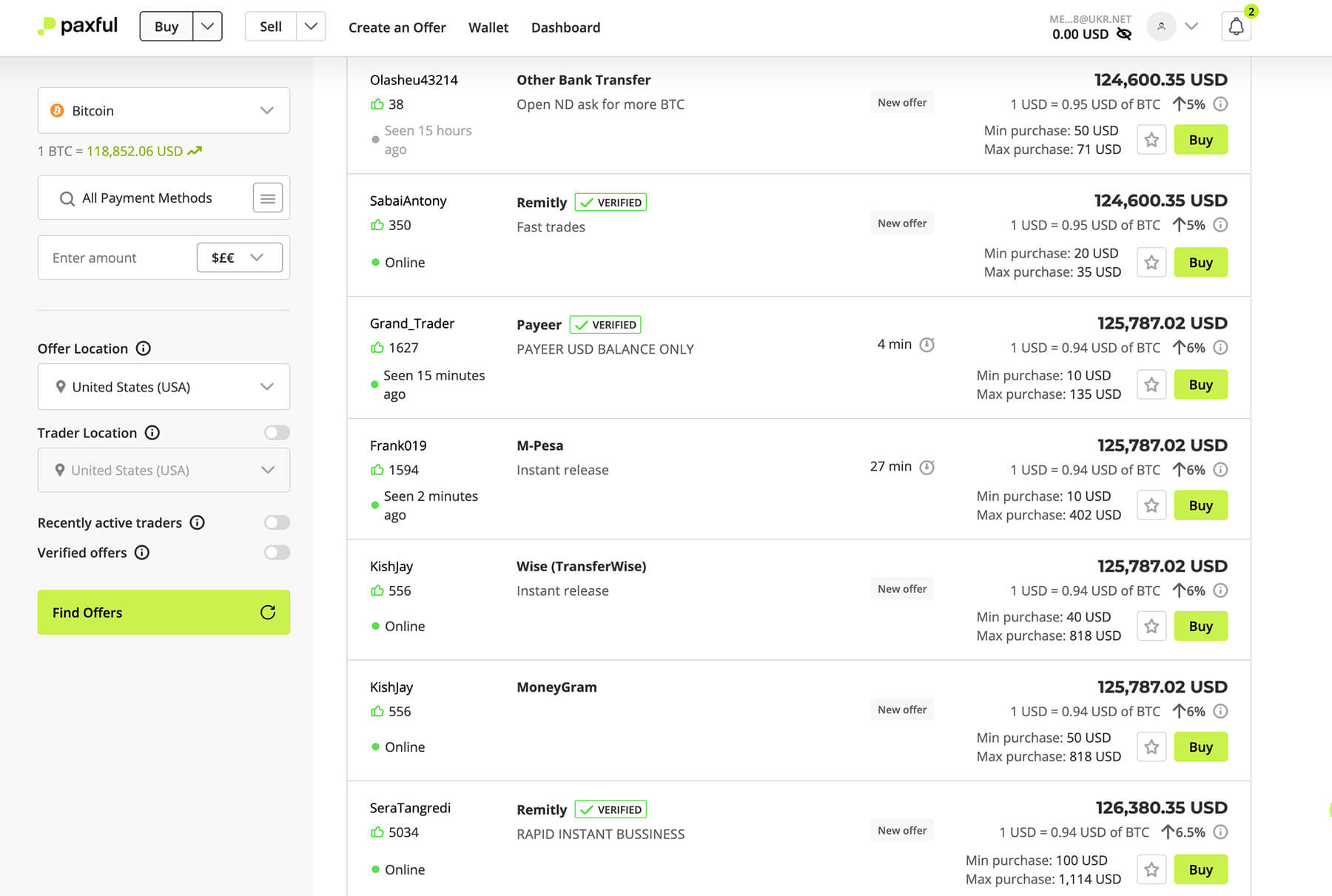
What's worth noting is that LocalBitcoins, one of the original players in this category, shut down entirely. Centralized P2P platforms carry real counterparty and regulatory risk at the platform level — a reminder that "escrow" solves the trade-level trust problem, not the platform-level one. If you're building your own, the platform's compliance stack and operational discipline matter as much as the lock mechanism itself.
Neither Paxful's simplicity nor Remitano's regional payment focus came from a fundamentally different escrow mechanism — they came from tailoring the same lock/unlock backbone to a specific audience and payment rail. That's the actual decision you're making when you scope your own build: not "which script," but which audience, which payment methods, and which compliance regime you're building for.
How We Build a Bitcoin Escrow Script
- Scope the audience and payment rails first. Freelance payouts, P2P fiat-to-crypto trades, and marketplace escrow each need a different feature set — dispute UX, fiat gateway integration, and coin support all shift depending on who's using it. This is the same groundwork covered in starting a P2P crypto exchange, since an escrow module rarely ships as a standalone product.
- Pick custodial vs. non-custodial architecture based on the trust-minimization requirement, not by default. Most P2P and marketplace products fit the custodial, application-layer model described above.
- Stand up node infrastructure in week one — Bitcoin included — in parallel with backend work, not after it.
- Build the isolated wallet layer and lock/unlock engine as atomic, service-level operations, with dispute cases routed through an async queue rather than a blocking call.
- Wire KYT risk scoring to every deposit, not just KYC at signup, and add forced address regeneration for flagged deposits.
- Test with real mainnet assets — actual BTC, not testnet coins — before calling the deposit/withdrawal/escrow cycle production-ready.
What a Bitcoin Escrow Script Actually Costs
Real numbers from our own commercial estimates for the closest comparable builds, not industry rules of thumb:
| Build | Price | Timeline |
| P2P web platform with escrow (base tier) | $32,000 – $53,000 | 2–3 months |
| P2P/FIAT mobile app, cross-platform | $36,000 – $45,000 | 2.5–3 months |
| P2P/FIAT mobile app, two native apps (iOS + Android) | $49,000 – $61,000 | 2.5–3 months |
| Full FIAT + crypto escrow marketplace (multi-currency smart-contract layer, KYC/AML, 3 bank integrations) | $64,000 – $75,000 | 2–3 months |
On top of a base package, the modules that most escrow projects end up needing:
| Module | Cost |
| KYC/AML service integration | $1,600 |
| Bank API integration (per bank) | $2,500 |
| Cold wallet integration (Ledger) | $1,300 |
| Cold wallet integration (Trezor / SecuX / Keepkey) | $2,300 each |
| Crypto payment gateway widget (resellable) | $30,000 – $60,000 |
| Non-custodial DEX wallet | from $50,000 |
A base P2P web build with escrow starts at $32,000 and ships in 2–3 months — that's the honest floor, not the $15K figure you'll see floated elsewhere, and it doesn't include KYC/AML, bank integrations, or cold wallet support as line items, since each of those gets priced separately above.
If you need the fiat rails and multi-currency escrow logic that a real B2B deployment requires, budget closer to $64,000–$75,000. Teams that plan to resell the payment layer to other platforms should scope it against a standalone crypto payment gateway build rather than folding it into the escrow estimate.
Where This Leaves You
The lock/unlock mechanism is the easy part to describe and the easy part to get wrong under load. The parts that actually determine whether your escrow platform survives contact with real users and real money are the ones rarely covered: an isolated wallet layer that prevents race conditions, a node infrastructure timeline that doesn't blow up your launch date, and a compliance layer that screens every deposit — not just every new signup.
If you're scoping a build, start with the audience and payment rails, confirm whether you actually need on-chain non-custodial escrow or whether the faster custodial model fits, and get your node infrastructure running before your first sprint planning meeting — not after.
If escrow is one piece of a larger platform, it's worth mapping it against your broader crypto exchange business plan before locking in scope — and if you'd rather hand the build to a team that's already solved these problems, our P2P crypto exchange development team can walk through your specific requirements.
FAQ
The script itself is just software. Legality depends on where and how you operate it — many jurisdictions require a money service license for platforms that hold user funds, even briefly, while others allow P2P escrow without one. Check local licensing requirements before launch, not after.
In our implementation, a disputed trade routes into a separate admin queue instead of blocking the trade thread or freezing unrelated balances. An operator reviews the evidence both sides submitted and releases the escrowed funds to whichever side the evidence supports. The funds stay locked — not released to either party — until that review closes.
If you're running a P2P marketplace, freelance platform, or exchange where you already manage user balances, custodial application-layer escrow is faster to build and easier to integrate with KYC/KYT. Non-custodial on-chain escrow (multisig or HTLC) removes you as a trusted party entirely, but it adds real complexity around key management and refund timelocks — worth it only if trust-minimization is a hard product requirement.
Transaction fees on completed trades are the primary model — a small percentage per trade that scales with volume. Flat per-trade fees work better for high-ticket transactions where users want a predictable cost. Beyond that, premium dispute handling, token listing fees, and affiliate programs are common secondary revenue streams once the core platform has volume.
A full Bitcoin node takes 5–10 days to sync on dedicated hardware — longer on shared infrastructure. If you don't start that sync on day one of the project, in parallel with development, it becomes the item blocking your launch after everything else is already done. Ethereum, Tron, and BNB Smart Chain nodes sync in 1–3 days and rarely cause the same delay.