
NFT art marketplace development means building a custom Web3 platform where artists mint digital artwork as tokens and collectors buy, sell, and bid on them, with ownership and royalties enforced on-chain by smart contracts.
Unlike a generic store, it splits logic across two layers: a blockchain layer that handles minting, payments, and royalties, and an off-chain layer that runs the catalog, search, and media.
A typical build moves through these stages:
- Scope & chain selection — pick the network(s), token standard (ERC-721 or ERC-1155), and supported NFT types.
- Smart contracts — minting, royalty distribution (EIP-2981), and auction/escrow logic, followed by an audit.
- Storage — connect IPFS or Arweave for media, with metadata stored on-chain or off-chain.
- Marketplace app — catalog, item pages, wallet connection, listings, bidding, and user profiles.
- Admin & compliance — moderation, fee management, KYC/AML, and analytics.
- Testing, audit & launch — load testing, mainnet gas calibration, and go-live with first creators.
NFT art has matured past the 2021 hype cycle into a working product category, and founders now ask a sharper question: not what an NFT is, but how to build a marketplace that creators trust and that holds up under real traffic. This guide walks through the architecture, features, tech stack, and real cost of building one, based on how our team actually ships these platforms.
NFT Art Marketplace Development Cost
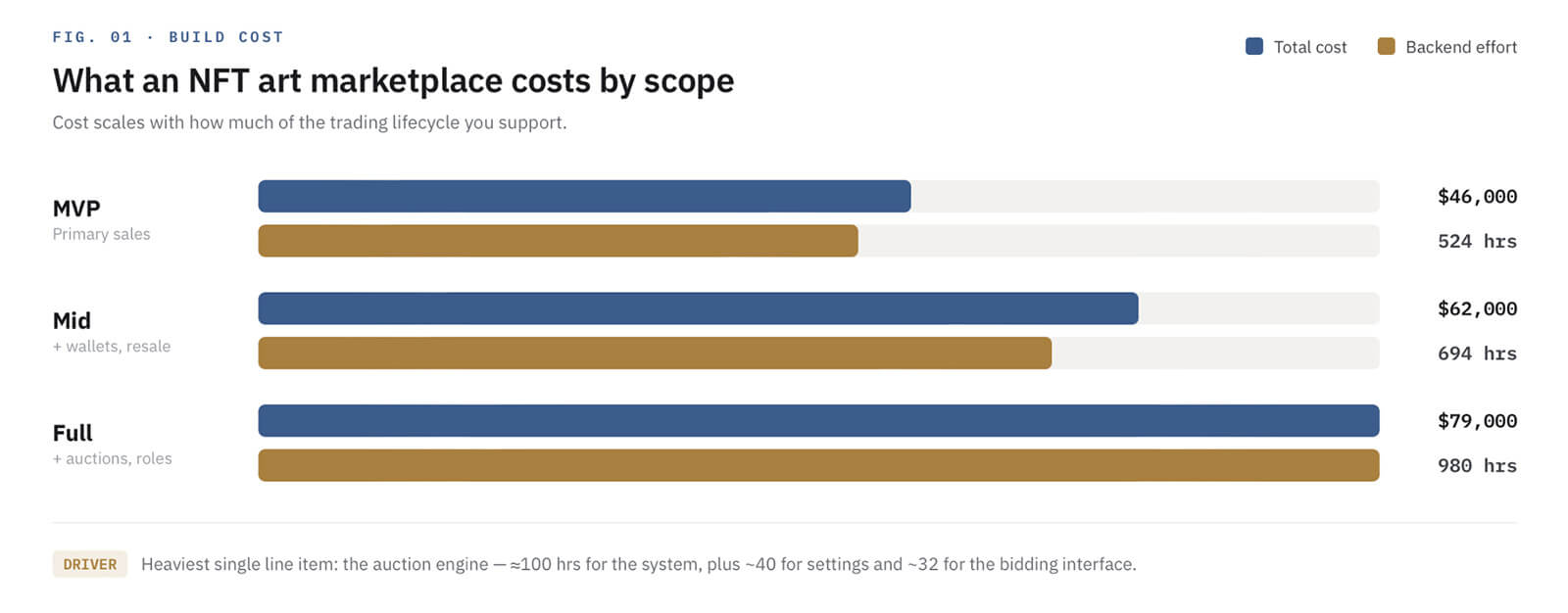
Cost scales with how much of the trading lifecycle you support. A primary-sales MVP is far cheaper than a full secondary-market platform with auctions and roles. Here is how we package an art NFT marketplace across three tiers, with the heaviest cost drivers called out.
| Tier | Price | Backend effort | What it covers |
| MVP | ~$46,000 | ~524 hrs | Minting + royalty smart contract, IPFS, fiat gateway, catalog, item page, profiles, admin (minting/listing, fees, notifications) |
| Mid | ~$62,000 | ~694 hrs | + MetaMask, balance, sell NFT, withdrawals, payment methods, subscriptions, social sharing, withdrawal approvals |
| Full | ~$79,000 | ~980 hrs | + ticket support, deposits, full auction system, bidding, role management, live auction monitoring |
The single biggest line item is the auction engine: roughly 100 hours for the system itself, plus ~40 for auction settings and ~32 for the bidding interface. The notification system and role management run ~60 hours each, and minting plus listing logic ~40. If your budget is tight, ship primary sales first and add auctions in a second milestone, rather than cutting corners on the contract layer. For a wider per-feature view across chains, see our full NFT marketplace development cost breakdown.
Architecture: On-Chain vs Off-Chain
The architectural decision that drives both cost and performance is what you put on-chain versus off-chain. Keep everything on-chain and you pay in gas and latency; push everything off-chain and you lose the transparency that makes an NFT marketplace worth building. We split the two layers deliberately.
On-chain we keep the parts that must be trustless and verifiable: token minting, ownership transfers, royalty distribution, and auction settlement. Off-chain we run the catalog, search, filtering, media delivery, user accounts, and most business logic, where a traditional backend is faster and cheaper. This is the same principle we apply across Web3 products.
Core Features and Token Standards
An art-focused marketplace needs a tight set of features that serve both sides of the trade. On the buyer side: a gallery catalog, keyword and trait search, item pages, wallet connection through MetaMask or WalletConnect, fiat and crypto checkout, and bidding. On the creator side: minting, collection management, listings, and a profile that builds reputation. Behind it all sits an admin panel for moderation, fee management, and payouts.
One of the first technical forks is the token standard. The choice affects gas, batch minting, and whether you support editions.
| Aspect | ERC-721 | ERC-1155 |
| Best for | 1-of-1 original artwork | Editions, collections, mixed asset types |
| Batch minting | One token per transaction | Many tokens in a single transaction |
| Gas efficiency | Higher cost per item | Lower cost at scale |
| Typical use | Premium single-edition art | Photography sets, generative drops, phygital lines |
Both the minting and royalty logic live in smart contracts, and this is where the EIP-2981 royalty standard matters: it lets a creator earn a percentage on every secondary sale, enforced by the contract rather than by the platform's goodwill. Audit this layer before launch — a reentrancy bug in a payout function is the kind of mistake you only make once.
NFT Marketplace for Artists: Creator-First Design
If your audience is artists rather than speculators, the product priorities shift. Creators care about three things: not paying to publish, getting paid on resales, and proving authenticity. You can address all three at the architecture level.
Lazy minting (also called gasless minting) lets an artist list work without paying gas upfront — the token is only minted on-chain when the first sale happens, and the buyer covers the cost. This removes the biggest friction point for new creators. Pair it with enforced royalties via EIP-2981 and a verified-creator profile, and you give artists a reason to choose your platform over a generic marketplace. Building on a low-fee network such as Polygon makes this even cheaper to operate; we cover that path in detail in our guide to Polygon NFT marketplace development.
NFT Art Marketplace Tech Stack
There is no single correct stack, but the layers below reflect what we reach for on most art marketplace builds.
| Layer | Typical choices |
| Blockchain | Ethereum, Polygon, Solana, plus L2s (Arbitrum, Optimism) |
| Smart contracts | Solidity, OpenZeppelin libraries, Hardhat/Foundry |
| Storage | IPFS or Arweave for media, on-chain or off-chain metadata |
| Backend | Node.js, PostgreSQL, Redis, event indexers |
| Frontend | React/Next.js, ethers.js, WalletConnect |
| Infrastructure | Kubernetes, centralized logging (ELK/Graylog), CI/CD via Git tags |
What We Learned Building Web3 Trading Systems
The hard parts of an NFT marketplace are rarely the parts that demo well. Below are three problems we hit on real platforms and how we solved them — useful whether you build with us or someone else.
Challenge: Mainnet gas economics broke a flow that passed every test
On a blockchain integration, our minting and payout flows ran cleanly on testnet, then failed on mainnet. The root cause was gas-fee logic calibrated against ideal testnet conditions that don't exist in production.
Solution: we moved to an elevated, buffered fee model and made it a rule that testnet is never the source of truth for transaction economics.
Result: failed mints and withdrawals dropped out of the picture.
Testnet never reflects the real economics of mainnet, especially in gas mechanics. We would rather overpay a little on gas than lose a user's transaction — a failed mint costs you the customer, not just the fee.
 Yuri MusienkoBusiness developer, Merehead
Challenge: Reputation can't be bolted on later
On a marketplace platform, open listings meant fraud risk grew with every new seller. Trust based on "deal with reputable creators" doesn't scale.
Solution: we built reputation into the architecture — ratings, blacklists and favorites, interaction history visible to both sides, partial payments tracked against an exact ledger, and a dispute flow with admin review, all on top of a single backend state machine.
Result: matching and settlement became a function of data, not blind trust.
Challenge: Manual sales don't scale, fully on-chain sales cost too much
On a token launch, the client needed automated primary sales without an expensive backend or manual payouts.
Solution: a deterministic smart-contract flow — the buyer sends funds, the contract mints and transfers the asset at a fixed rate with no human in the loop — while keeping catalog and analytics off-chain.
Result: minimal infrastructure, on-chain transparency, and a model that scales from dozens to thousands of users. The same pattern carried into a project where we tokenized real estate through NFTs.
Security and Compliance
Two layers of risk sit on every marketplace: contract risk and regulatory risk. On the contract side, audit minting, royalty, and settlement functions, and watch for reentrancy and integer issues in payout paths. On the regulatory side, fiat on/off-ramps usually pull KYC and AML into scope, and we typically integrate AML with configurable, multi-provider risk models so you can tune checks per jurisdiction without rewriting the flow.
How We Build It: Development Process
We run these projects as a roadmap rather than a single drop. We close v1.1 — usually primary sales and core marketplace — while scoping v1.2, which often adds auctions, secondary-market royalties, or extra chains. That keeps each release shippable and lets you put a working product in front of creators before the full feature set exists.
The team scales with complexity: smart-contract engineers, backend and frontend developers, a designer, and QA, coordinated by a product owner who translates business logic into a clear, lean spec. Over-documenting the wrong details slows delivery; we focus the spec on what developers actually need to decide. If you want a sense of who you need and what to watch for, our NFT marketplace development services page lays out how we staff and run these builds.
FAQ
A primary-sales MVP starts around $46,000, a mid-tier platform with wallets and resale runs about $62,000, and a full marketplace with auctions and role management lands near $79,000. The auction engine, notifications, and role logic are the heaviest cost drivers.
An MVP typically takes two to three months. A full platform with auctions, secondary-market royalties, and multi-chain support runs longer, which is why we ship it in milestones rather than one release.
Use ERC-721 for 1-of-1 original art and ERC-1155 for editions, collections, or mixed asset types where batch minting and lower gas at scale matter. Many platforms support both.
Yes. Lazy (gasless) minting defers the on-chain mint until the first sale, so the buyer covers gas. It removes the biggest friction point for new creators and pairs well with enforced EIP-2981 royalties.
White-label is faster and cheaper but limits branding and custom mechanics. A custom build costs more upfront and pays back when you need unique auctions, added chains, or DeFi modules as you grow.