Marketplace app development cost is the total budget required to design, build, and ship a two-sided platform that connects buyers and sellers (or clients and providers) and processes transactions between them.
In 2026, that cost runs from roughly $26,000 for a template-based niche marketplace to $140,000+ for a custom platform with escrow, KYC/AML, and multi-chain payments. The number you land on depends far less on the feature list and far more on three things: how money moves through the platform, how strictly you separate the two sides, and how much load the infrastructure must absorb.
A marketplace app development project moves through these stages:
- Discovery & documentation — technical specification, user flow, and architecture design.
- UI/UX design — buyer side, seller side, and admin/operations panel.
- Core marketplace logic — listings, search, the offer/proposal engine, and the data contract between roles.
- Payments & escrow — payment gateway, escrow state machine, payout logic, and (for crypto) smart contracts.
- Trust & compliance — KYC/AML integration, role-based access control, and fraud controls.
- Infrastructure & DevOps — microservices, CI/CD, observability, and scaling.
- QA, launch, and post-release support — typically a 90-day warranty window.
Below is a pragmatic, build-side view of what actually moves the number — written from the perspective of teams who ship these platforms rather than estimate them on a calculator. If you are still deciding on a model, our overview of marketplace development is a useful companion to this pricing breakdown.
What actually drives marketplace app development cost
Most pricing guides multiply hours by a blended rate and call it a day. That hides the real cost structure.
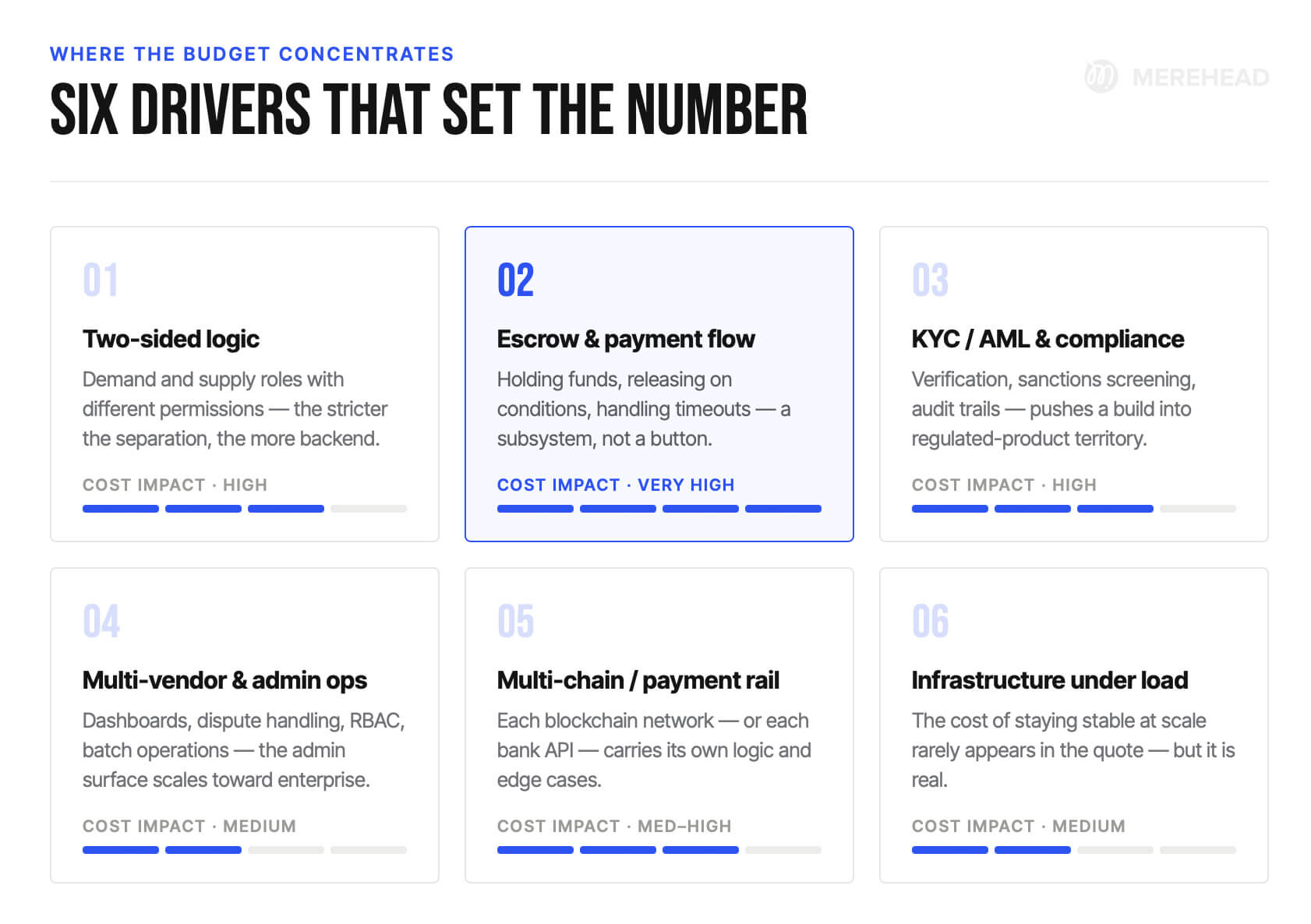
In our experience, the budget concentrates in six areas, and the gap between a $30K marketplace and a $130K one is almost always one of these crossing a complexity threshold:
- Two-sided logic. A marketplace is not a catalog with checkout. It is a system where one role creates demand and another responds to it, each with different permissions. The stricter that separation, the more backend work it takes.
- Escrow and payment flow. Holding funds between two parties, releasing them on conditions, and handling timeouts is a subsystem in its own right — not a button.
- KYC/AML and compliance. Verification, sanctions screening, and audit trails push a marketplace from "MVP" into regulated-product territory.
- Multi-vendor and admin operations. Dashboards, dispute handling, role-based access control, and batch operations scale the admin surface as you move toward enterprise.
- Multi-chain or payment-rail integration. Each blockchain network — or each bank API — carries its own logic and edge cases.
- Infrastructure under load. The cost of staying stable at scale rarely appears in the quote you get, but it is real.
Each of these maps directly to a price band. We will walk through the bands first, then go under the hood on the architecture.
Marketplace app development cost by type (real ranges)
These ranges come straight from commercial estimates we have prepared for US-market clients.
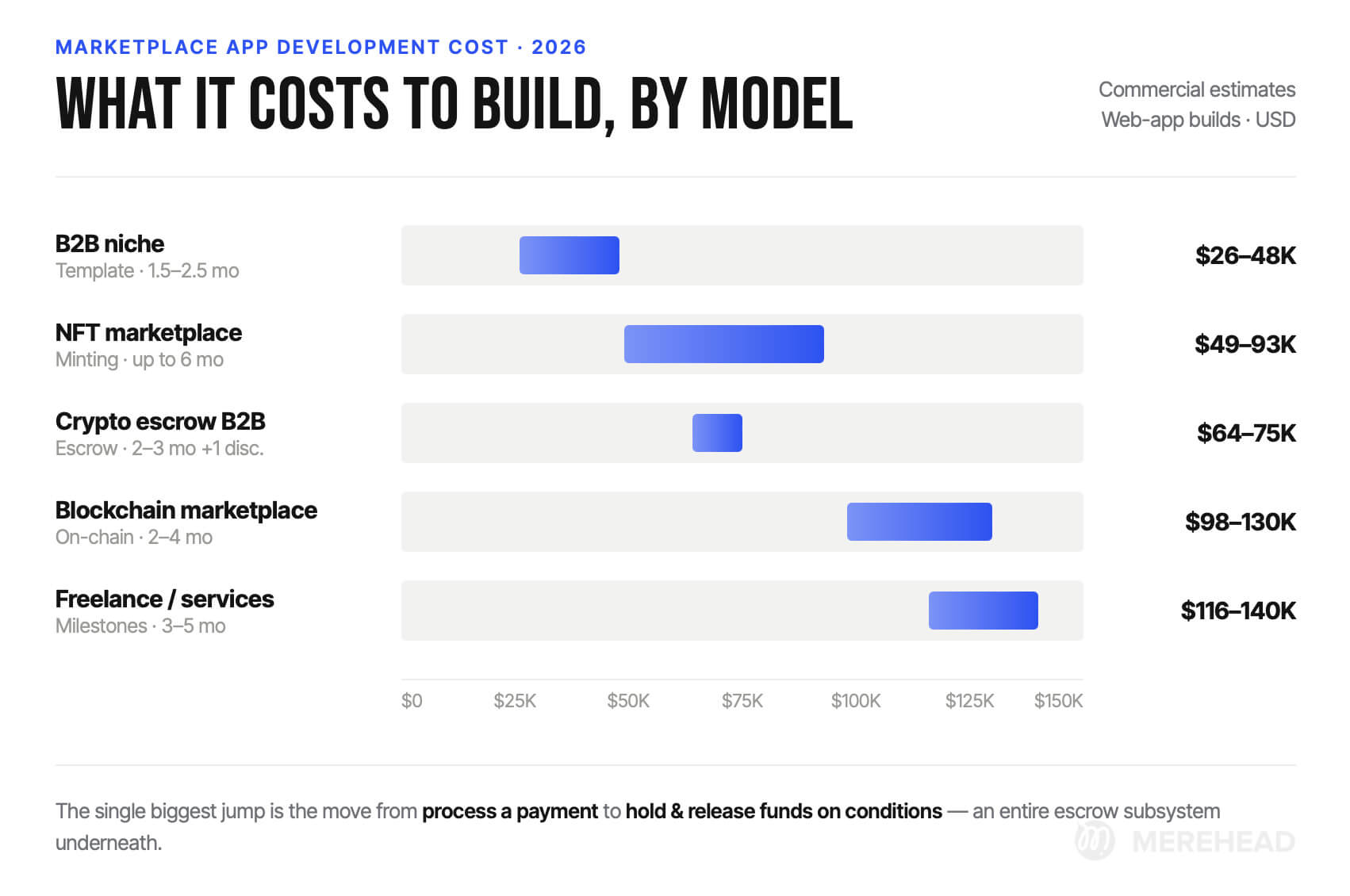
They reflect web-app builds with a tiered scope (a leaner tier and a fuller, enterprise-oriented tier), not theoretical averages:
| Marketplace type | Cost range (web app) | Timeline | What pushes the price |
| B2B niche (template-based) | $26K – $48K | 1.5–2.5 months | Listings, KYC, membership, admin dashboard |
| Crypto escrow B2B | $64K – $75K | 2–3 months (+1 month discovery) | Escrow smart contracts, KYC/AML, bank API, multi-chain nodes |
| Blockchain marketplace | $98K – $130K | 2–4 months | On-chain logic, wallet integration, tokenization |
| Freelance / services | $116K – $140K | 3–5 months | Escrow, milestones, timesheets, weekly-limit billing |
| NFT marketplace | $49K – $93K | up to 6 months | Minting, auctions, wallet/chain support, royalties |
If you want a sense of how these numbers shift for adjacent models, the pricing logic for an auction-style platform follows the same pattern: the bidding and offer engine is where the hours concentrate, not the storefront.
costs to develop
your online marketplace
Module-level pricing: where the money actually goes
Zoom in from the type-level ranges, and a consistent picture emerges. The "front of house" — listings, categories, search with filters, product pages, static pages — is rarely where budgets blow out. That work is well-understood and largely linear. The cost concentrates in the modules that carry money, trust, and state.
Three modules dominate the estimate on almost every project:
- The escrow / payment engine. A status machine, timers, payout conditions, and dispute paths. On a freelance-style platform, this also pulls in milestones, timesheets, and weekly-limit billing — which is why those builds start at $116K rather than $48K.
- The offer / proposal engine. The mechanism by which the responding side bids on demand. It looks small in a wireframe and behaves like a core system in production.
- Compliance and admin operations. KYC/AML, role-based access control, dispute resolution, and the operational tooling your team lives in every day.
For two-sided lending models — where escrow and milestone release work almost identically to a services marketplace — our breakdown of P2P lending platform software architecture and cost maps the same module-level reasoning onto a different vertical.
Under the hood: three engineering decisions that set the budget
This is where a generic cost article ends and real build experience begins. The following are anonymized accounts from platforms we have shipped — the metrics, stacks, and architectural decisions are real; the client names are not.
1. Escrow that protects both sides without freezing funds forever
Challenge: Clients asked for "simple payments," but a two-sided deal needs to protect both parties — without locking money indefinitely or letting either side game the system.
Solution: We built escrow as an explicit status machine with timers — roughly a 30-minute activity window and a 24-hour payment window, after which an unpaid request auto-deletes. Critically, we tied every status change to a confirmed action, not a UI click, so pressing "change provider" could never silently restart a payment timer. Payment delays route to an admin override that requires double approval from both sides before the timer extends.
Result: A transparent escrow flow with enforceable SLAs and built-in protection against timer abuse — while keeping a deliberate point of human control exactly where full automation would create financial risk.
That single design choice — treating escrow as a state machine rather than a payment call — is most of the difference between the $26K and the $64K tier in the table above.
2. Liquidity through a minimal offer engine
Challenge: An overloaded proposal form kills the number of offers a marketplace receives — and offer volume is what creates liquidity and competition between providers.
Solution: We stripped the offer form down to two fields — price and delivery time — and pulled every other parameter read-only from the client's original request through a strict data contract. That contract makes some fields immutable (set by the client) and a small set editable only by the responding provider, so the two roles can never overwrite each other's data.
Result: Lower friction for providers, which drove more offers, more competition, and cleaner standardized data for analytics. The data contract also removed an entire class of consistency bugs and fraud vectors that cheaper marketplaces typically discover in production.
This pattern — a tightly scoped offer engine on top of a clear role separation — is the backbone of most multi-vendor marketplaces, and it generalizes well beyond any single industry.

3. Staying stable at scale without a managed cloud
Challenge: A financial-grade marketplace has to stay stable under load, but one platform ran without AWS or GCP — meaning no native autoscaling to lean on.
Solution: We ran a Kubernetes cluster on Proxmox with the control plane and worker nodes split for stability, a single Helm chart across services, and HashiCorp Vault with JWT authentication for secrets. The asynchronous layer used Redis and Kafka; because the Laravel backend has no native Kafka support, we integrated it through a custom library with explicit session lifecycle management. Observability ran on Grafana and VictoriaLogs.
Result: A predictable production environment with a roughly 30–60 minute incident-response SLA, achieved while keeping infrastructure costs under control — proof that you do not need a managed cloud to run a stable platform if you organize the cluster and resources correctly.
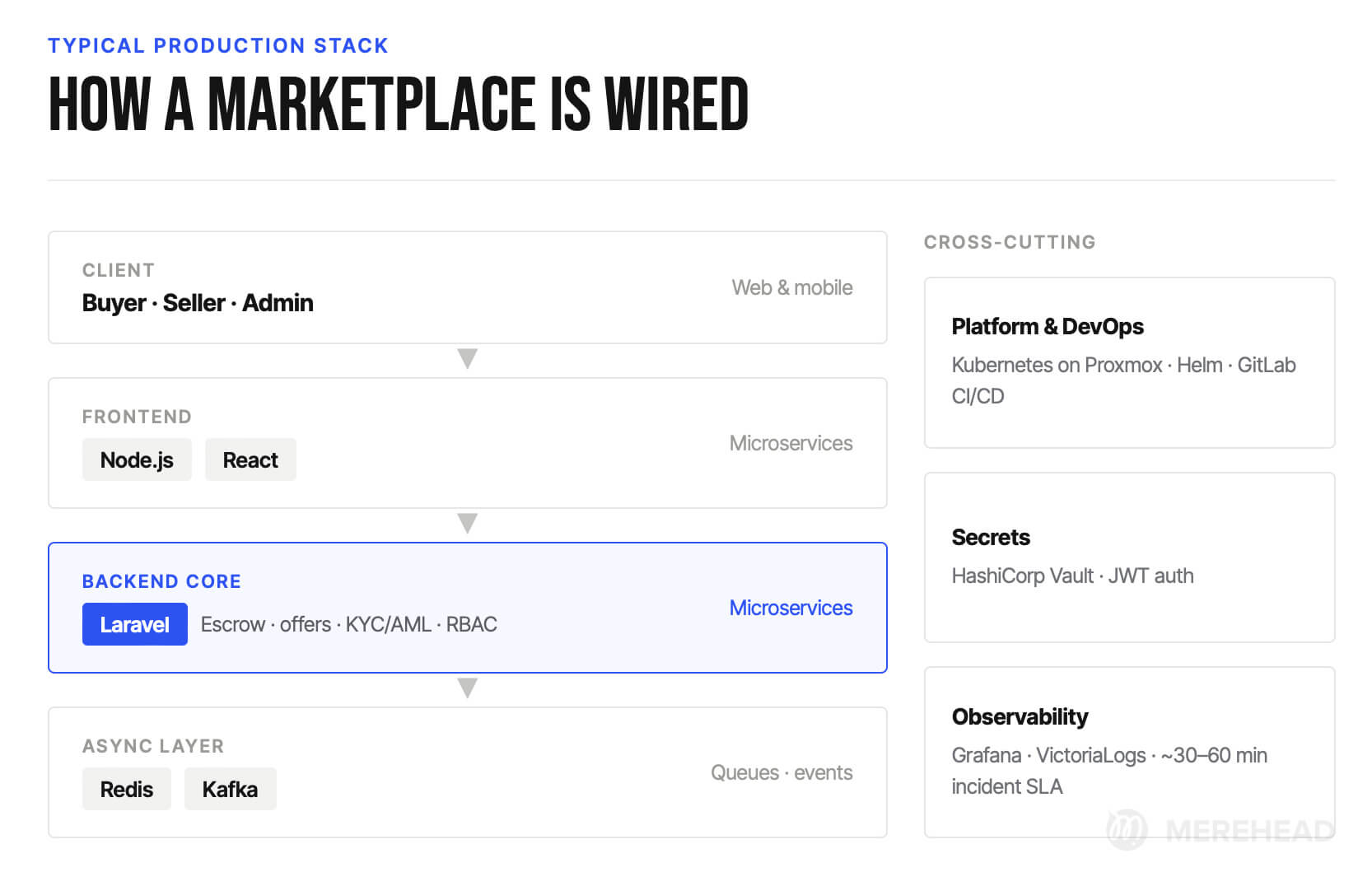
The stack here is worth noting because it is typical for these builds: a Laravel backend with a Node.js / React frontend, structured as microservices, with Redis and Kafka handling asynchronous work. That combination shows up across most of the marketplace and fintech platforms we ship.
The hidden costs nobody quotes you
Three line items reliably surprise founders who only compared sticker prices:
- Environment drift. When dev, staging, and production diverge, you pay for it in release bugs. Unifying environments (for example, moving everything onto Kubernetes) is upfront cost that buys release-quality predictability.
- Framework-mismatch integrations. When your stack does not natively support a piece of infrastructure — Kafka on Laravel being a classic example — you pay for custom integration and careful lifecycle handling.
- Lifecycle recovery and human-in-the-loop. Auto-deleting a stale request is easy; correctly restoring it — resetting the provider and returning it to a fresh tender state rather than resuming a dead deal — is logic you have to design and pay for. A restored request is a new tender, not a continuation of the old one.
One more architectural lever worth understanding: reusable UI architecture. On one platform, we added an entirely new vertical not by building a separate product but by extending the existing request flow through configuration — different field sets and visual markers over the same screens. That decision turned a multi-month build into a fraction of the cost and is the kind of choice that quietly determines whether your second and third feature lines are affordable.
Custom vs. template: which path fits your budget
If you are validating an idea, a template-based or white-label approach gets you a working MVP marketplace in the $26K–$48K range within a couple of months — enough to test product-market fit and early GMV. If you are building a defensible platform with escrow, compliance, and a real take-rate model, you are in custom territory, and the architecture decisions above will define your number.
For a structured view of the build itself rather than the budget, our guide on building a B2B marketplace from the ground up walks through scope decisions in the order you will actually face them. If your model is on-chain, the same logic adapted for decentralized marketplaces covers wallet integration and multi-chain considerations.
How we estimate a marketplace project
We do not quote from a feature checklist. We start from how money and trust move through your platform, identify which of the six cost drivers above you actually cross, and then break the budget down module by module. That is why two marketplaces with identical-looking feature lists can land $40K apart — and why an honest estimate has to look at the architecture, not the wireframe.
FAQ
How much does it cost to build a marketplace app?
A template-based niche marketplace starts around $26,000, while a custom platform with escrow, KYC/AML, and multi-chain payments runs to $140,000 or more. The driver is not the feature count — it is how funds move, how strictly the two sides are separated, and how much load the infrastructure must handle.
Why does escrow increase the price so much?
Escrow is a subsystem, not a button. It needs a status machine, timers, payout conditions, dispute handling, and an admin override with double approval. On crypto platforms it also adds smart-contract development. That subsystem alone explains much of the jump from the ~$30K tier to the ~$65K tier.
What tech stack do you use for marketplaces?
A typical build pairs a Laravel backend with a Node.js / React frontend, structured as microservices, with Redis and Kafka for asynchronous processing. Production runs on Kubernetes with CI/CD through GitLab, secrets in HashiCorp Vault, and observability via Grafana and VictoriaLogs.
Should I start with an MVP or a full custom build?
If you are validating demand, an MVP in the $26K–$48K range lets you test product-market fit fast. If you already know you need escrow, compliance, and a real take-rate model, a custom build is more economical over the full lifecycle than retrofitting those systems later.
How long does it take to develop a marketplace app?
Template-based B2B marketplaces ship in 1.5–2.5 months. Escrow-enabled and blockchain marketplaces run 2–4 months plus a discovery phase, and feature-heavy freelance or NFT platforms can reach 6 months.