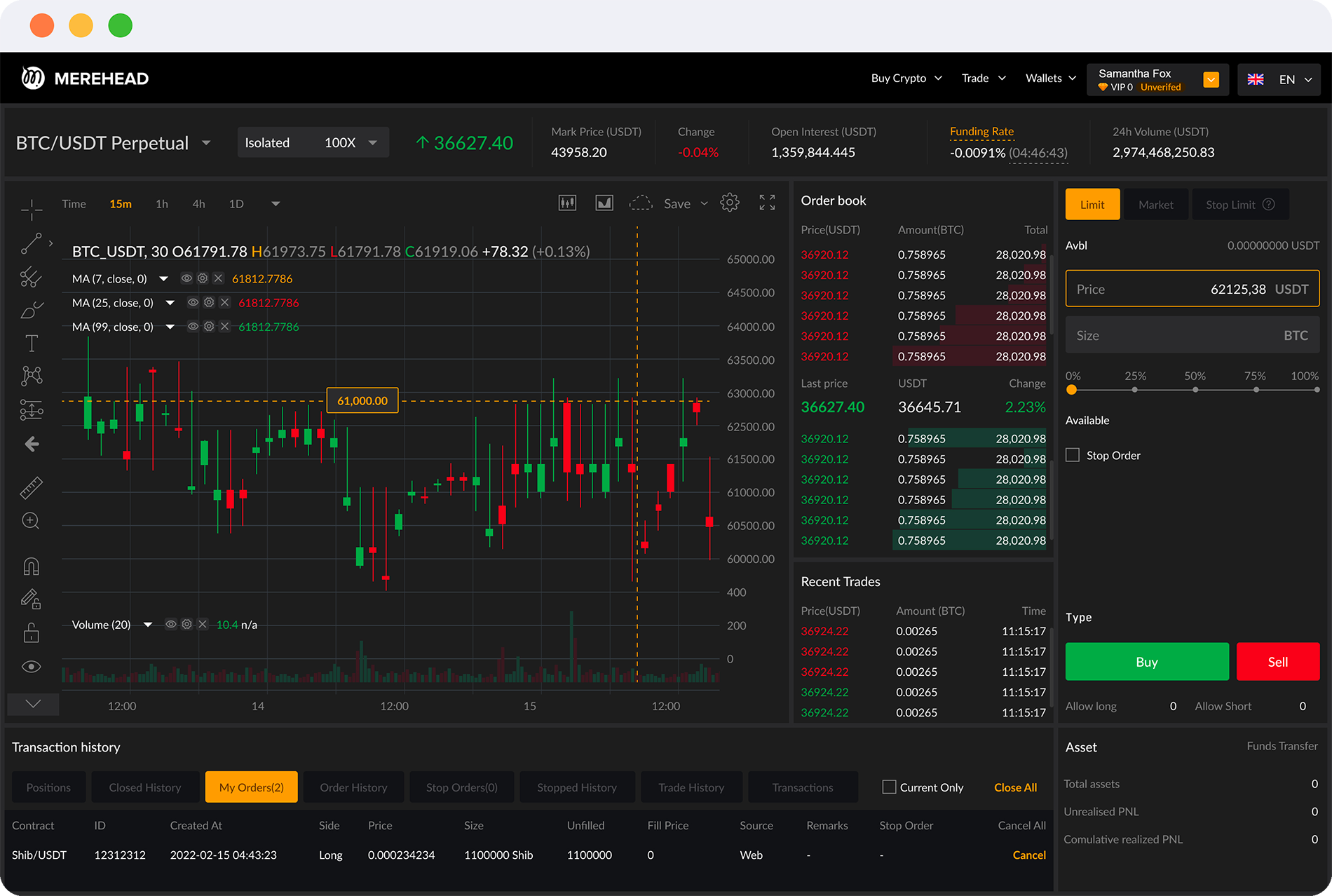
A
Bitfinex clone script is a pre-built crypto exchange codebase that replicates core CEX functionality — spot trading, margin engine, order book, wallet management, KYC/AML pipeline, and admin panel — so development teams skip 12–18 months of infrastructure work and launch a production-grade exchange in 6–14 weeks.
What a production-ready Bitfinex clone script must include on day one:
- Matching engine capable of processing thousands of orders per second (C++, Go, or Rust)
- Microservices architecture with independent scaling per module
- Multi-chain wallet infrastructure (BTC, ETH, TRX, BNB, and L2s)
- Spot, margin, and optionally perpetual futures trading modules
- KYC/KYT pipeline with AML scoring on every inbound transaction
- Liquidity layer: internal order book + external provider WebSocket feeds
- Cold storage + multi-sig withdrawal architecture
- Admin panel with role-based access, fee management, and compliance tools
Bitfinex launched in 2012 as a functional exchange, not an overnight success story. What made it institutionally relevant a decade later was the underlying engineering: modular architecture, deep API access for algorithmic traders, and liquidity that attracted market makers. A Bitfinex clone script gives you that foundation without the decade-long buildout — but only if you understand exactly what "clone" means technically and where the real complexity hides.
This guide covers the architecture decisions, real engineering timelines, tech stack trade-offs, and the infrastructure mistakes that kill exchange launches before they reach users.
Building a crypto exchange without understanding its real architectural layers is how you end up spending $300K and launching something that breaks under its first 500 concurrent users. The clone script accelerates the journey — it doesn't replace engineering judgment.
Step 1: Business Model — What Actually Generates Revenue
Every exchange lives or dies by volume. Bitfinex understood this early and built a model where revenue scales automatically with activity rather than requiring constant manual intervention.
For a Bitfinex clone script, the core revenue stack breaks down into five layers:
| Revenue Stream |
Typical Rate |
Scales With |
Implementation Complexity |
| Trading commissions (maker/taker) |
0.05–0.20% |
Volume |
Low — built into matching engine |
| Withdrawal fees |
Fixed per network |
User activity |
Low — wallet module config |
| Token listing fees |
$5K–$50K per listing |
Platform reputation |
None — admin panel function |
| Premium API access (algo traders) |
$200–$2,000/mo subscription |
Institutional user base |
Medium — rate-limiting tiers |
| Margin lending interest |
0.01–0.1%/day |
Open positions |
High — requires lending engine |
Bitfinex also built side businesses around lending and OTC desks. Our engineering practice shows these are phase-two additions — launching all five simultaneously creates scope that collapses timelines. Start with trading commissions and withdrawal fees, add the rest iteratively once you hit real user volume.
The fastest white-label exchange deployment in our practice went from contract to live platform in under two weeks — because the client scoped it to a single revenue model (trading commissions) with no custom modules. Every feature added after that becomes additive, not foundational. Plan your architecture for extensions from day one: retrofitting a fiat staking module onto an exchange not designed for fiat accounting costs 3–4x more than building it in from the start.
Step 2: Tech Stack — The Engineering Reality
The tech stack decision for a Bitfinex clone script isn't a preference question — it's a performance contract. Traders don't see your language choice; they feel its consequences in order execution latency and system uptime during high-volatility periods.
| Component |
Technology Options |
Production Choice |
Why |
| Matching Engine |
C++, Rust, Go |
C++ or Rust |
Sub-millisecond order processing; Go GC pauses unacceptable at scale |
| API Layer / Backend |
Go, Node.js, Python |
Go |
Concurrency model handles WebSocket connections at scale |
| Frontend |
React, Vue, Angular |
React |
Ecosystem depth for real-time order book rendering |
| Primary Database |
PostgreSQL, MySQL, CockroachDB |
PostgreSQL |
ACID compliance for financial transactions; battle-tested |
| Cache / In-memory |
Redis, Memcached |
Redis |
Order book state, session management, rate-limiting |
| Message Bus |
Kafka, RabbitMQ, Redpanda |
Redpanda (Kafka-compatible) |
Lower operational overhead than Kafka; same API surface |
| Container Orchestration |
Kubernetes, Docker Swarm, ECS |
Kubernetes + Helm |
Per-service autoscaling, secrets management via Vault |
| Secrets Management |
HashiCorp Vault, AWS Secrets Manager |
HashiCorp Vault |
GitLab CI integration; audit trail on secret access |
Critical scaling note most teams miss: Not all services in a Bitfinex clone architecture should autoscale horizontally. Stateless services — API gateway, notification service, KYC webhook handler — scale cleanly with Kubernetes HPA. Stateful services — matching engine, wallet manager — have state dependencies that make horizontal scaling non-trivial or outright dangerous. A wallet manager with two instances processing the same withdrawal creates double-spend exposure. Define your stateless/stateful service boundary in Helm charts before writing a single line of application code. In one of our large exchange deployments, we containerized 17 microservices and established explicit autoscaling policies for each: 8 stateless services with HPA, 9 stateful services with vertical scaling only. That architectural decision, made in week one, prevented significant rework at launch.
Step 3: What Your Bitfinex Clone Script Must Deliver
Traders decide in under ten seconds whether an exchange feels trustworthy. That judgment runs on two axes: performance (does order execution feel instant?) and completeness (does the platform have the tools I need?).
A production Bitfinex clone script covers both the trader-facing and operator-facing surface:
| Module |
Trader Panel Features |
Admin Panel Features |
Launch Priority |
| Onboarding |
Registration, KYC (doc upload + mobile ID app), 2FA, anti-phishing codes |
KYC review queue, compliance officer dashboard, user block/unblock |
P0 — required at launch |
| Spot Trading |
Limit, market, stop-limit orders; real-time order book; TradingView charts |
Fee configuration per pair, token listing/delisting, order monitoring |
P0 — required at launch |
| Wallet Management |
Deposit addresses per chain, withdrawal with whitelist, transaction history |
Cold/hot wallet ratio management, withdrawal approval thresholds |
P0 — required at launch |
| Margin Trading |
Leverage selection, position management, forced liquidation alerts |
Leverage limits per user tier, liquidation engine monitoring |
P1 — phase two |
| API Access |
REST + WebSocket API, sandbox environment, rate limit tiers |
API key management, rate limit configuration, usage analytics |
P1 — phase two |
| AML/Compliance |
Invisible to user (background KYT scoring) |
Risk score monitoring, freeze/unfreeze, forced wallet regeneration, audit export |
P0 — required at launch |
The table above reflects what our team actually delivers across exchange projects — not a marketing checklist. The P0 items are non-negotiable: an exchange without AML on inbound transactions is not just a compliance risk, it's a liability that can shut the entire business down before it reaches its first anniversary.
Step 4: Architecture That Keeps Your Exchange Online
Most exchange failures aren't security breaches — they're infrastructure failures during the moments that matter most: high-volatility periods when trading volume spikes and every component gets hit simultaneously. The architecture of your Bitfinex clone script determines whether you survive those moments.
Bitfinex moved to microservices architecture because the alternative — a monolithic system — creates a single point of failure. When your matching engine and your KYC module share the same process, a KYC provider timeout can freeze trading. Microservices isolate those failure domains.
The architecture layers that actually matter for a production Bitfinex clone:
Matching Engine — The core of your exchange. Processes orders in sequence, maintains the order book state, executes matches. Must be stateful, must not autoscale horizontally, must be written in a language with deterministic latency (C++ or Rust).
Wallet Service — Manages blockchain node connections, generates deposit addresses, processes withdrawals. Bitcoin node sync takes 5–10 days on dedicated hardware; start node provisioning on project day one, not after development completes.
API Gateway — Routes external requests, handles authentication, rate-limiting, and WebSocket connection management. Stateless — scales horizontally without risk.
KYC/AML Pipeline — Separate service that processes verification webhooks and transaction risk scores asynchronously. Decoupled from trading so a SumSub outage doesn't freeze order execution.
Liquidity Layer — WebSocket connections to external providers (Binance, Kraken, OKX). Redundant connections with failover. The matching engine reads from this layer when internal order book depth is insufficient.
Liquidity: The Cold-Start Problem
Every new exchange faces the same structural problem: traders need liquidity to trade, and liquidity comes from traders. Breaking this loop requires an external liquidity strategy that operates from day one.
In one of our exchange deployments, we built an OKX order book mirroring model for the spot market. The mechanics: when a user places a sell order, the system simultaneously borrows the equivalent on OKX using 3x margin, executes the sell on OKX's market, credits the user's USDT balance, then settles the borrow once funds clear. To the user, they see a populated order book and instant execution. Under the hood, OKX's liquidity depth backs every trade. This approach eliminates the cold-start problem without requiring paid market makers at launch.
The trade-off: you need real-time monitoring of OKX margin utilization, borrow limits, and USDT collateral positions. If any component fails, user trades fail. We run automated Telegram and Slack alerts on all critical thresholds — the operations team sees a problem before any user does.
Step 5: UX/UI — Performance Is the Design
Traders judge exchanges by a single metric before they place their first order: speed. Dark mode, clean charts, and a no-nonsense layout aren't aesthetic preferences in trading interfaces — they're functional requirements. Dark mode reduces eye strain during multi-hour sessions. Clean chart rendering at 60fps determines whether a trader can spot entry points. Mobile-first layout determines whether 70% of your potential user base can operate your platform at all.
Your Bitfinex clone script should deliver:
- Responsive order book — real-time updates via WebSocket, no polling, no visual lag during high-volume periods
- TradingView integration — free tier for basic deployment; Business/Enterprise plan required for 1-second timeframes, cluster charts, and volume oscillators that professional traders demand
- Mobile applications — React Native or native iOS/Android; not a mobile web wrapper. In one client engagement, mobile app completion added 6 weeks to the timeline — budget for it explicitly.
- Beginner onboarding flow — demo account with simulated balance reduces conversion friction significantly; the try-without-registration → observe live trading → convert to funded account path is worth the additional development investment
Good design in a trading platform is invisible when it works and catastrophic when it doesn't. An order book that freezes during a $50K BTC move costs you that trader permanently. Performance engineering and UI engineering are the same discipline at this level of the stack.
Step 6: Security Architecture — The Non-Negotiable Baseline
Every exchange founder describes their platform as "secure." The distinction is implementation depth. A proper security architecture for a Bitfinex clone script operates across four independent layers — and weakness in any one of them creates an exploitable surface.
| Security Layer |
Minimum Implementation |
Where Teams Cut Corners |
| Wallet Architecture |
95%+ funds in cold storage; multi-sig on all hot wallet withdrawals; threshold-based approval routing |
Hot wallet percentage too high; single-sig withdrawals for "speed" |
| Infrastructure |
DDoS mitigation (Cloudflare Enterprise or equivalent); WAF rules; rate limiting at API gateway level; geo-blocking for high-risk jurisdictions |
Shared hosting; no WAF; rate limiting only at application layer |
| Application Security |
2FA on all accounts; anti-phishing codes; session token rotation; IP whitelisting for withdrawals; login anomaly detection |
TOTP-only 2FA without hardware key option; no IP-based withdrawal controls |
| Compliance / AML |
KYT on every inbound transaction; risk score threshold triggers freeze + admin review; forced deposit address regeneration on AML flag |
KYC at registration only; no ongoing transaction monitoring |
Security is also operational, not just architectural. How quickly does your team freeze a compromised account? Who has access to production wallet keys and under what approval chain? When was your last full penetration test? These questions separate exchanges regulators trust from exchanges that become enforcement case studies.
The AML implementation most teams get wrong: standard KYC checks identity at registration and then trusts all subsequent transactions. Production-grade AML works differently. Every inbound deposit receives a risk score before the balance is credited. When a score exceeds the threshold, the system creates an admin review task and freezes the deposit — the user's balance doesn't update until a compliance officer manually clears it. Additionally, when a deposit address is flagged by the AML engine, the system automatically generates new deposit addresses across all supported networks and quarantines the old address. Any future deposits to the flagged address are rejected. The user receives a security notification with no mention of the compliance trigger. This is standard in EU 6AMLD-compliant platforms. It is not optional if you plan to operate in regulated markets.
Step 7: The Full Tech Stack — Backend to Frontend
The backend is the exchange's engine room. Order matching, deposit processing, withdrawal queuing, KYC verification, risk scoring — all of it runs here. The performance ceiling of your exchange is determined by choices made in this layer.
Bitfinex clone implementations that run at production scale share consistent backend patterns: a high-performance matching engine in C++/Rust, Go for API services and WebSocket handling, PostgreSQL as the primary financial data store, Redis for in-memory state (order book cache, session tokens, rate limit counters), and a message bus for async communication between services.
The frontend is your exchange's credibility signal. Modern frameworks like React or Vue handle real-time order book rendering efficiently — but only if the implementation uses proper WebSocket event handling rather than polling. A frontend that polls for order book updates every 500ms will never feel like a professional trading platform. WebSocket connections with server-side event diffing deliver the real-time experience institutional traders expect.
We don't sign off on a crypto exchange as ready for production until deposit and withdrawal flows have run on mainnet — real USDT, real BTC, real ETH. Not testnet. Testnet behavior diverges from mainnet in ways that matter: confirmation time variance, fee estimation under real mempool pressure, minimum withdrawal enforcement. Every network needs a real asset cycle before launch. It adds a week and a small direct cost. It's non-negotiable.
Step 8: Our Engineering Case Studies
Case Study 1: Solving the Cold-Start Liquidity Problem
Challenge: A new exchange launching in Eastern Europe needed a populated order book from day one without the budget for paid market makers and without the organic trading volume to attract them.
Solution: We implemented an OKX order book mirroring model for the spot market. User sell orders trigger a parallel execution path: the system borrows the equivalent on OKX at 3x margin, executes the sell, credits the user's USDT balance, and settles the borrow position asynchronously. The user sees a live, populated order book backed by institutional liquidity depth. We connected a secondary provider (Kraken) via parallel WebSocket for the instant exchange module — users always see a live rate, never a cached value. Telegram and Slack alerts monitor margin utilization, borrow limits, and USDT collateral positions in real time.
Result: The exchange launched with a populated order book across 12 trading pairs. The cold-start problem was eliminated without market maker contracts. Admin panel allows pair-by-pair routing between liquidity providers.
Case Study 2: Kubernetes Migration — 17 Services, One Policy Document
Challenge: A client's exchange had been running on a monolithic VM setup. Before production launch, the architecture couldn't handle projected peak load, and individual modules couldn't be scaled or updated independently.
Solution: We rewrite 17 microservices as Docker containers and establish Helm charts for deployment. HashiCorp Vault handles secrets management, integrated with GitLab CI pipelines for automated deployment. Redpanda (Kafka-compatible) serves as the inter-service message bus. The critical architectural decision: we classify all 17 services as either stateless (API gateway, notification service, KYC webhook handler — scale horizontally with HPA) or stateful (matching engine, wallet manager — vertical scaling only, no HPA). This policy document precedes Helm chart authoring by one sprint.
Result: Platform ready for production launch with documented autoscaling policies per service. Stateful services protected from double-spend exposure that horizontal autoscaling would have created.
Case Study 3: Full Compliance Pipeline — KYC/KYT Dual-Path Implementation
Challenge: A crypto processing platform needed to serve both local users (with national ID mobile verification) and international users (with document upload), while implementing transaction-level AML scoring on every inbound deposit — not just registration-time KYC.
Solution: We built a dual-path KYC system using SumSub as the primary provider. Path A: mobile identity app verification for local users (60-second verification flow). Path B: document upload for international users. Each path runs a separate state machine in the backend — the webhook schemas and status transitions are structurally different and cannot share logic. KYT runs asynchronously on every inbound deposit: each transaction receives a risk score before the balance is credited. Score above threshold → admin review task created, balance frozen, user sees "pending" without a compliance explanation. Forced deposit address regeneration activates automatically on AML flag across all supported networks.
Result: Platform meets EU 6AMLD compliance requirements. Zero high-risk deposits auto-credited. Dual-path KYC reduces verification friction for local users by an estimated 60–70% compared to document-only flows.
Step 9: Timelines and Costs — What Real Numbers Look Like
The $20–50K estimate for a "simple version" obscures what "simple" means technically. A bare exchange with spot trading, basic KYC, and three supported networks can reach that price point with a mature white-label base. Everything beyond that scales costs in non-linear ways.
| Scope |
Timeline |
Cost Range (USD) |
What's Included |
| White-label base deployment |
2–4 weeks |
$20,000 – $50,000 |
Spot trading, basic KYC, 3–5 networks, branding applied |
| Extended feature set |
3–4 months |
$80,000 – $150,000 |
Margin trading, mobile app, staking, API tier, multi-chain |
| Full institutional-grade CEX |
6–12 months |
$200,000 – $500,000+ |
Perpetuals, OTC desk, custom liquidity, B-book futures, compliance stack |
| Build from scratch |
18–36 months |
$800,000 – $2M+ |
Proprietary matching engine, full custom architecture, no reuse leverage |
The white-label reuse model cuts cost by 60–80% compared to a full custom build and reduces risk to near zero on core trading mechanics — because the base has already run in production. What you're paying for in a clone script deployment is configuration, customization, and the accumulated engineering judgment that went into the base.
Infrastructure timing: the most common launch delay we see. Three items consistently extend timelines beyond planned scope:
1. Bitcoin full node synchronization — 5–10 days on dedicated hardware. If you don't start the node on project day one, it becomes the critical path item blocking go-live. BNB and Tron nodes sync in 1–3 days; Bitcoin doesn't. Our standard: node provisioning starts in week one of every project, before integration work begins.
2. Production access delays — Development can be complete and staging tests passing, but if the client's DevOps team hasn't provisioned production credentials and infrastructure access, nothing ships. We've seen this add 2–3 weeks to otherwise finished projects. Our contracts now include explicit infrastructure readiness milestones as client deliverables with dates.
3. Non-deterministic test failures — Crypto transactions depend on network state. Test cases that pass Tuesday fail Thursday because mempool conditions changed. Treat this as normal infrastructure behavior, not application bugs, and design test suites accordingly.
Step 10: Customer Support — The Infrastructure You Don't See in a Tech Stack
Technical infrastructure doesn't keep users on a platform. The experience of getting help when something goes wrong does. A trader whose withdrawal has been pending for four hours at 2 AM doesn't care about your microservices architecture — they care whether someone answers.
A production exchange support operation requires three tiers: self-service (knowledge base with technical documentation for API traders and common operational issues), tier-one (24/7 availability for basic account, deposit, and withdrawal questions), and institutional support (dedicated account manager for clients moving significant volume, responding in under one hour). The exchange that treats these as operational costs rather than product investments loses institutional users to competitors who don't.
In crypto, trust is the product. Security architecture earns it technically. Support operations earn it operationally. Build both or you're building for short-term volume, not a sustainable platform.
FAQ: Bitfinex Clone Script — Technical Questions Answered
What exactly is a Bitfinex Clone Script at the code level?
A Bitfinex clone script is a pre-built exchange codebase that includes a matching engine, order management system, multi-chain wallet infrastructure, KYC/AML integration, admin panel, and trading UI. It follows the same functional model as Bitfinex — spot, margin, order book, API access — implemented as a microservices architecture you configure and brand rather than build from zero. The output is a production-deployable exchange, not a template.
Is using a clone script legal in the USA?
The software itself is legal. Operational compliance is what determines legality. To operate a crypto exchange in the USA targeting US persons, you need FinCEN MSB registration, state-level Money Transmitter Licenses (requirements vary by state — NY BitLicense is the strictest), and a documented KYC/AML program under the Bank Secrecy Act. The clone script gives you the technical compliance infrastructure (KYC flows, AML transaction monitoring, audit export). The legal compliance framework is a separate operational layer you build around it.
How long does a realistic Bitfinex clone deployment take?
A base white-label deployment with branding applied runs 2–4 weeks. A full feature set (margin trading, mobile apps, multi-chain, API tiers) takes 3–4 months. An institutional-grade platform with perpetuals, OTC desk, and a full compliance stack runs 6–12 months. One consistent delay factor: Bitcoin full node synchronization takes 5–10 days — start it on day one of the project or it becomes the critical path item blocking go-live.
What makes one clone script better than another?
Four things separate production-grade from template-grade: (1) matching engine performance — real TPS capacity under load, not stated specs; (2) wallet architecture — cold storage percentage, multi-sig implementation, network support breadth; (3) KYT integration depth — does AML run per-transaction or only at registration; (4) infrastructure design — whether stateful services (matching engine, wallet manager) are correctly isolated from horizontal autoscaling. Ask vendors for mainnet test results and architecture diagrams, not feature lists.
How do I solve the liquidity problem on a new exchange?
Two proven approaches: (1) External liquidity mirroring — connect to a tier-1 exchange (Binance, OKX, Kraken) via WebSocket and route user trades through their order book until your organic liquidity grows. Requires real-time monitoring of borrow limits and collateral positions. (2) Market maker agreements — paid arrangements with professional market makers to provide two-sided quotes on your order book. More expensive than mirroring at launch, but gives you independent liquidity depth. Most production exchanges use both in combination.
Can I add perpetual futures to a Bitfinex clone?
Yes — either by building a native perp futures engine (complex, 4–6 months, requires liquidation engine, funding rate calculation, cross/isolated margin logic) or by integrating an external perp DEX infrastructure like HyperLiquid via API. HyperLiquid integration delivers full perpetuals functionality (limit/market/stop-limit orders, TP/SL, cross and isolated margin, leverage selection, TradingView charts) without running your own validator infrastructure. Timeline for a full integration: approximately 3 months.
How unique can I make a Bitfinex clone look and function?
The clone script provides the matching engine, wallet infrastructure, and trading logic — all of which remain unchanged because they're what makes the exchange function correctly. Everything above that layer is configurable: brand identity, color system, UX flows, feature selection, supported networks, trading pairs, fee structures, user tier logic, and integration with third-party services. Two white-label deployments from the same codebase can look and operate completely differently. The reuse is invisible to users; what they experience is your product decisions.