×
Services
Exchange & Trading Infrastructure
DeFi & Web3 Core
NFT Ecosystem & Multi-Chain
Tokenization & Fundraising
Crypto Banking & Fintech
AI Development
Custom Development
Exchange & Trading Infrastructure
Create a centralized crypto exchange (spot, margin and futures trading)
Decentralized Exchange
Development of decentralized exchanges based on smart contracts
Stock Trading App
Build Secure, Compliant Stock Trading Apps for Real-World Brokerage Operations
Custom Trading Software
We build proprietary trading systems from the order management layer to the signal engine
P2P Crypto Exchange
Build a P2P crypto exchange based on a flexible escrow system
Centralized Exchange
Build Secure, High-Performance Centralized Crypto Exchanges
Crypto Trading Bot
Build Reliable Crypto Trading Bots with Real Risk Controls
Crypto Launchpad Development
Build crypto launchpad platforms that handle the full token launch lifecycle
DeFi & Web3 Core
Web3 Development
Build Production-Ready Web3 Products with Secure Architecture
Web3 App Development
Build Web3 Mobile and Web Apps with Embedded Wallets and Token Mechanics
DeFi Wallet Development
Scale with DeFi Wallet Development: from DEX and lending to staking systems
DeFi Lending and Borrowing Platform
Build DeFi Lending Protocols — Overcollateralized Pools, Flash Loans, and Credit Delegation
DeFi Platform Development
Build DeFi projects from DEX and lending platforms to staking solutions
DeFi Exchange Development
Build DeFi Exchanges — AMM, Order Book, Aggregator, and Hybrid Protocols
DeFi Lottery Platform
Build DeFi Lottery Platforms — Provably Fair Jackpots, No-Loss Savings, and NFT Raffle Protocols
DeFi Yield Farming
Build DeFi yield farming platforms with sustainable emission models and multi-protocol yield aggregation
NFT Ecosystem & Multi-Chain
NFT Marketplace Development
Build NFT marketplaces from minting and listing to auctions and launchpads
NFT Music Marketplace
Build NFT music marketplaces where artists mint, sell, and license music as tokens
NFT Wallet Development
Build non-custodial NFT wallets with multi-chain asset support, smart contract integration
NFT Launchpad Development
Build NFT launchpads where projects raise capital, mint tokens, and onboard communities
Tokenization & Fundraising
Real Estate Tokenization
Real estate tokenization for private investors or automated property tokenization marketplaces
Crypto Banking & Fintech
Build crypto banking platforms with wallets, compliance, fiat rails, and payment services
Build Secure Crypto Wallet Apps with a Production-Ready Custody Model
Crypto Payment Gateway
Create a crypto payment gateway with the installation of your nodes
Mobile Banking App
We build secure, regulation-ready mobile banking applications for fintech startups and financial institutions
AI Development
AI Development
We build production-ready AI systems that automate workflows, improve decisions, and scale
LLM Development Company
We design and build production-grade large language model solutions
AI Agent Development
We build AI agents that carry out business tasks across your existing software
Enterprise AI Development
We build enterprise AI systems - agents, LLM integration, and predictive analytics
AI Chatbot Development
We build AI chatbots powered by LLM agents, RAG pipelines, and multi-agent orchestration
Custom Development
CRM Software Development
We build custom CRM systems from scratch — multi-role architecture, automated workflows
Marketplace Development
We build two-sided marketplaces from scratch — with multi-role architecture and payment escrow

  Spot & Crypto-Fiat Exchanges

Crypto Exchange Development Services

We design and build custom crypto exchanges: spot, margin, futures, P2P, and crypto-fiat platforms with the matching engine, ledger, wallets, liquidity, and KYC/KYT built in. Building exchanges since 2018, with 30+ exchange projects delivered.


130+ projects
Experience
since 2015
Experience
blockchain expert
image

  Services

Crypto Exchange Development Services

Our crypto exchange development services cover the full build: product scope, trading core, ledger, wallets and custody, liquidity, compliance integrations, admin tooling, and launch. We build custom platforms and extend existing ones, so the scope follows your business model rather than a fixed template. This page covers custodial and hybrid exchanges; for non-custodial, on-chain trading, see our decentralized exchange development services.

01

Centralized Exchange (CEX) Development

Order-book exchanges with spot, margin, futures, and options markets, instant conversion, and fiat pairs. Operators that need full control over custody and risk can compare options on our centralized exchange development page.
02

P2P Crypto Exchange Development

P2P marketplaces with escrow, dispute handling, merchant tools, and reputation. Escrow and dispute logic are covered in detail on our P2P crypto exchange development page.
03

Matching Engine & Trading Core

Order matching with partial fills, clear market and limit order semantics, and fees calculated per fill rather than per order. A single order can act as taker and then as maker, so the role, rate, and fee are recorded for each execution.
04

Wallet Infrastructure & Custody

Deposit address generation, confirmation-based crediting, hot-wallet sweeps, withdrawal approvals, and cold storage for reserves. Node integration for Bitcoin, Ethereum, Litecoin, TRON, and BNB Smart Chain, plus USDT on ERC-20, TRC-20, and BEP-20.
05

Liquidity Integration

Connections to external exchanges for order book depth and pricing, with provider-level fallback and an internal order book that keeps markets open when an external source is disabled.
06

KYC/AML/KYT & Risk Controls

KYC onboarding, KYT scoring on every deposit, deposit quarantine, withdrawal limits, per-user account restrictions, and a compliance review queue inside the admin panel.
07

Admin Panel, APIs & Integrations

A role-based admin panel with action logging, user and balance management, fee configuration, and reconciliation views. Open trading APIs, TradingView charts, and payment integrations for fiat flows.

  About

About Merehead as a Crypto Exchange Development Company

Merehead was founded in 2015 to build financial software for small and mid-sized businesses. Since 2018, the company has focused on blockchain products: centralized and decentralized exchanges, P2P platforms, crypto wallets, DeFi, crypto banking, and tokenization, alongside forex and binary options trading platforms. Of 130+ completed projects, 30+ are crypto exchange projects.
Exchange work typically covers the trading core, a double-entry ledger, custody and wallet services, blockchain node integration, liquidity connectivity, KYC/KYT workflows, and the admin tooling your operations team uses every day. Networks supported in our exchange deployments include Bitcoin, Ethereum, Litecoin, TRON, and BNB Smart Chain.
We work as the engineering team behind your exchange. Licensing and regulatory decisions stay with your legal and compliance advisors; we implement the technical controls those decisions require.
1/3

  Step-by-Step

Crypto Exchange Development Process

Deploying and configuring our base exchange platform typically takes 2–4 months, and adapting the design to your brand takes 2–3 weeks, assuming infrastructure is ready. Custom modules extend that timeline depending on scope.

Step 01
Discovery & Requirements
We define the exchange model (your own matching engine, brokerage routing to external venues, or a hybrid), asset and network scope, fiat needs, and the compliance controls your advisors require. next step
Step 02
Architecture & Threat Modeling
We design service boundaries, the ledger model, and custody flows, and threat-model deposits and withdrawals. The scaling policy is set here: stateless services autoscale, while matching and wallet services need a controlled approach. next step
Step 03
Core Build
Accounts, matching engine, ledger, wallets, and admin tooling are built first behind a stable API. Blockchain nodes start syncing in week one, so the Bitcoin node never becomes the item that blocks launch. next step
Step 04
Integrations & Compliance Setup
KYC provider, KYT scoring, liquidity connections, payment rails, and charting are integrated with explicit status handling, retries, and reconciliation. next step
Step 05
QA, Load & Security Testing
We run API-level load, stress, and crash tests against agreed latency targets, test the matching engine as a separate load scenario, and complete deposit, trade, and withdrawal cycles with real mainnet assets on every supported network. next step
Step 06
Launch
Go-live with monitoring and alerts on hot-wallet balances, provider availability, and critical thresholds, routed to a shared team channel rather than to one person. next step
Step 07
Post-Launch Support & Scaling
Incident response, infrastructure scaling, and phased feature releases. We also take over exchanges built by other teams, starting with an infrastructure, node, and access audit. next step
Start your story
Book a meeting with our expert to discuss the key features of the project, their strengths and weaknesses, and options for rapid implementation.
Book a 30-minute call  
Typical estimates for common extensions: blockchain node integration with the first markets, 2–4 weeks; external order book mirroring, 3–4 weeks; an open trading API, about 1 month; A-book futures, 1.5–2 months; fiat currencies with bank deposit handling, 2–3 months. The most frequent delays are not in the code. Production access provisioned late on the client side has added two to three weeks to otherwise finished projects, so infrastructure readiness is now a dated milestone in our contracts.

  Integrations

Integrations & Tech Stack

Intro
Integrations decide time-to-market and operational stability. Each one is built with explicit status handling, retries or fallbacks, and reconciliation.
Liquidity Venues & Alerting
Execution and data connections to Binance, OKX, Kraken, and WhiteBit, configurable per trading pair. Critical thresholds are pushed to Telegram and Slack.
KYC/AML Providers
Sumsub-based KYC, including a dual-path setup where a government identity app and document upload run as separate verification state machines. KYT scoring of inbound deposits with support for multiple AML providers.
Payments & Fiat
Fiat currencies with bank details, bank deposit handling, and SEPA flows. Pending fiat deposits are accounted separately from confirmed crypto balances to avoid reconciliation errors after launch.
Blockchain Nodes & Networks
Own or provider nodes for Bitcoin, Ethereum, Litecoin, TRON, and BNB Smart Chain. TRON fees are covered through an external energy provider, so sweeps do not stall when a deposit address holds no TRX.
Market Data, Charts & Trading APIs
TradingView charting, real-time market data over WebSocket, and open trading APIs for bots and partner integrations.

  Architecture

Crypto Exchange Architecture We Build

We build exchanges as layered services: trading UI and APIs, API gateway and authentication, matching engine, risk and positions, ledger and balances, wallets and custody, liquidity and market data, blockchain nodes, compliance and monitoring, and the admin console. Each layer can be changed or scaled without rewriting the others.


01
Matching Engine & Trading Core
Matches orders with partial fills against one or many counterparties. Each fill carries its own price, volume, maker or taker role, and fee, so revenue and user balances can be reconstructed trade by trade. One trade produces at least four accounting entries: two transfers and two fees.
02
Ledger, Risk & Balances
Internal matching shifts balances between currencies, so profit in USD terms can hide a shortfall in a specific asset. We reconcile matching results against the ledger, bank accounts, and hot wallets, and run a duplicated ledger that halts operations and raises an alert if the two records diverge.
03
Wallet, Custody & Blockchain Nodes
Deposits pass block confirmations, sweep to a hot wallet, and only then credit the user. Multiple hot wallets can be labeled by geography, entity type, or risk profile, with users routed between isolated contours. Reserves stay in cold storage.
04
Liquidity, Compliance & Operations
Liquidity services mirror external order books and route execution. Compliance services score deposits and manage quarantine. The admin layer handles roles, limits, fees, and reconciliation views.
Infrastructure example: one exchange moved from virtual machines to Kubernetes during its production launch, with 17 microservices in Docker containers, Helm charts, HashiCorp Vault secrets integrated with GitLab CI, per-service autoscaling, and a Redpanda message bus. We specify performance as P95 latency targets per endpoint, for example order creation within 200 ms at target load in a pre-production environment, rather than headline TPS figures.
CriterionWhat buyers should checkMerehead evidence
Matching enginePartial fills, maker/taker role per execution, fee currency logicFees and roles recorded per fill; at least four accounting entries per trade
Ledger & reconciliationCan every balance be traced back to trades and transfers?Reconciliation across matching, ledger, bank accounts, and hot wallets; duplicated ledger halts operations on mismatch
CustodyDeposit, sweep, withdrawal, and cold storage flowsMultiple hot-wallet contours, cold reserves, address regeneration after risk events
LiquidityWhat happens when a provider fails or blocks an account?Primary and backup venues; internal order book keeps pairs tradable
Compliance integrationsWhen is KYT checked, and what happens to flagged funds?Every deposit scored before crediting; quarantine and admin review queue
Production testingMainnet testing, not only testnetFull deposit, trade, and withdrawal cycles with real assets on each network
DeliveryRealistic timelines and known blockersBase platform in 2–4 months; nodes started in week one; infrastructure milestones in the contract
Ownership & documentationRepository access and handover packageClient-owned repositories; service diagrams, API collections, database schemas, calculation formulas

Evaluate

How to Evaluate a Crypto Exchange Development Company

Most vendors list the same features. The difference shows up in how they answer specific engineering questions. These are the checks we suggest running on any team, including ours.

Ask for artifacts, not adjectives. A team that has run exchanges in production can show a ledger model, fee calculation per fill, a custody flow diagram, and a load-test report with stated test conditions.

Ask who owns what after launch. Code, infrastructure access, node credentials, and documentation should sit in your accounts from day one. We have taken over exchanges where a single developer held repository access, and recovery cost far more than prevention would have.

  Cost

Cost of Crypto Exchange Development
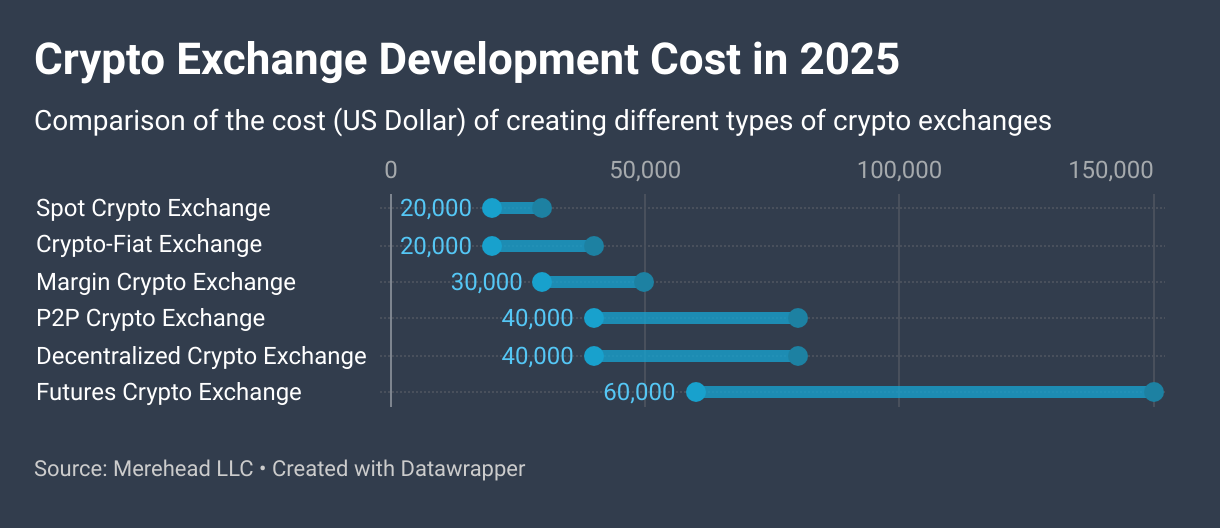
Budget depends on the exchange model and how much of it is custom. The starting prices above apply to builds on Merehead's existing exchange modules. A fully custom centralized exchange MVP with its own matching engine starts at $60,000, and a multi-product platform with spot, margin, futures, native mobile apps, and extended compliance workflows typically ranges from $150,000 to $250,000+. For a line-item breakdown, use our crypto exchange development cost guide and calculator.
Cost Tiers
Exchange on existing modules: from $20,000
Custom CEX MVP: from $60,000
Multi-product platform: $150,000 – $250,000+
Main cost drivers: the number of trading products, fiat support, supported networks, the liquidity model, KYC/KYT vendor fees, and third-party security audits. On one MVP, an external audit quote of about $25,000 led the client to launch a limited beta with transaction caps and an internal review first; the right choice depends on your risk profile and launch plan.

We work on Fixed Price or Time & Material terms. Estimates include infrastructure, liquidity provider fees, and third-party licenses such as KYC, KYT, and charting, so the budget reflects operating cost, not only development.

Share your target markets, trading products, and fiat requirements, and we will return a scoped estimate with timeline and cost drivers.
Get a Project Estimate  

Who We Build Crypto Exchanges For

crypto-fiat exchange operators
instant exchange and converter businesses
brokers adding margin, futures, or options
wallet and payment companies adding trading

  Reason

Why Choose Merehead as Your Crypto Exchange Development Company

Merehead has been building crypto exchanges since 2018 and has worked on 30+ exchange projects, from crypto-fiat spot platforms to exchanges that combine spot, margin, futures, and options. That work taught us that most launch risks sit outside the trading screen: node synchronization, custody flows, liquidity on day one, and the accounting behind every trade.
10+ years on the market
130++ completed projects
We plan for those risks from the start. Blockchain nodes are provisioned in the first week of a project, because a Bitcoin full node can take five to ten days to sync. Deposit and withdrawal flows are tested with real mainnet assets before launch, not only with testnet coins. And the exchange is designed so trading can continue on the internal order book if an external liquidity provider goes offline.
Review Your Architecture  
Exchange Experience Beyond the Trading UI
We have built exchanges with six trading modules in one system: spot, margin, futures, options, instant conversion, and a role-based admin panel. Each module has its own order logic, wallet accounting, and risk rules.
Architecture Planned for Extensions
Exchange roadmaps grow after launch. On one platform, VIP account tiers, per-user commissions, fiat staking, and overdrafts were added over six to twelve months. Because the architecture anticipated them, each module took weeks rather than a rebuild.
Compliance Wired into Money Flows
Every inbound deposit receives an AML risk score before the balance is credited. High-risk deposits are frozen and routed to a compliance review queue instead of reaching the user's balance.
Documentation Your Team Can Operate
Handover includes service diagrams, API collections, database schemas, test cases, and the calculation formulas for futures liquidation, funding rates, and P&L.

We deliver in milestones with acceptance criteria, and your team keeps access to the repository, infrastructure, and documentation from day one, so the platform never depends on a single engineer. Support after launch is available under SLA-based plans.

  FAQ

Crypto Exchange Development FAQ

Answers to the most frequently asked questions from our clients

Builds on Merehead's existing exchange modules start at $20,000 for a spot exchange. A fully custom centralized exchange MVP starts at $60,000, and multi-product platforms with margin, futures, mobile apps, and extended compliance typically cost $150,000 to $250,000+. Liquidity, KYC/KYT vendors, and security audits are budgeted separately.

Deploying and configuring our base exchange platform typically takes 2–4 months, plus 2–3 weeks to adapt the design to your brand. Custom modules add time: for example, about one month for an open trading API or 1.5–2 months for A-book futures. A Bitcoin node alone takes five to ten days to sync, so nodes are started in week one.

White label is faster when your model matches an existing product and differentiation comes from brand, markets, and operations. Custom development fits when you need your own matching logic, fiat accounting, or non-standard products. We compare both paths in our white label crypto exchange guide; many clients start on existing modules and extend them.

Yes. We connect external venues such as Binance, OKX, Kraken, or WhiteBit, including order book mirroring so a new exchange shows real depth from day one. We also build fallback between providers and keep the internal order book working if an external source is disabled. Commercial agreements with liquidity providers and market makers are made directly between you and them.

We threat-model custody and withdrawal flows, enforce role-based admin access with action logs and IP allowlisting, use 2FA for users and sensitive admin actions, and test deposits and withdrawals with real mainnet assets before launch. When your risk profile calls for an external audit, we prepare the code and documentation for it.

We implement KYC onboarding, KYT scoring of every deposit, quarantine for high-risk funds, limits, account restrictions, and audit trails. Which controls you need, and whether you need a license, depends on your jurisdictions and is decided with your legal advisors; we build the technical layer.
Talk to an expert
Discuss your exchange scope directly with Merehead's co-founder
Co-founder, Merehead
Business development

  Case study

Real Crypto Exchange Engineering Experience

Six Trading Modules in One Exchange
A client needed a full-scale centralized exchange rather than a spot-only launch. Each product needs its own order logic, wallet accounting, and liquidation rules, and the roadmap kept growing after launch. Decision: We delivered spot, margin, B-book futures, options priced with the Black-Scholes model, instant conversion, and a role-based admin panel on a microservices architecture designed for extensions. Result: The base platform deploys in 2–4 months; VIP tiers, per-user fees, overdrafts, and fiat staking were later added over six to twelve months without re-architecture.
Liquidity From Day One via Order Book Mirroring
A new exchange needed tradable BTC/USDT markets at launch. An empty order book drives traders away before organic liquidity forms. Decision: The exchange mirrors the OKX order book. When a user sells, the platform borrows the asset on OKX with up to 3x margin, executes there, credits the user, and repays from the hot wallet. Margin use, borrow limits, and collateral are monitored with Telegram and Slack alerts. Result: The order book shows real depth from the first trade; the module was scoped at 3–4 weeks.
Kubernetes Migration During a Production Launch
An exchange running on virtual machines was preparing for production traffic. The VM setup gave no way to deploy or scale services independently. Decision: We moved 17 microservices into Docker containers with Helm charts, HashiCorp Vault secrets integrated with GitLab CI, per-service autoscaling, and a Redpanda message bus. Stateless services such as the API gateway autoscale; matching and wallet services follow a separate policy because they hold state. Result: The migration was completed as part of the production launch.
Across 30+ exchange projects, the failures we see most often are not in the trading screen. They come from node credentials that expire, liquidity that depends on a single venue, and balances nobody can reconcile. We design for those points first and test deposits, trades, and withdrawals with real mainnet assets before any launch.

  Security

Security & Compliance for Exchange Platforms

Custody & Key Management
Operational funds sit in hot wallets and reserves in cold storage. Multiple hot wallets can be labeled by geography, entity type, or risk profile, and users can be moved between isolated contours without stopping the platform. Deposit addresses are archived, never deleted, to support recovery cases.
Withdrawal Controls & Access
Per-asset minimums and limits, manual approval queues, and per-user restrictions on deposits, withdrawals, and trading. 2FA for users; 2FA and IP allowlisting for sensitive admin actions. Long UIDs replace sequential IDs to prevent enumeration.
KYC, KYT & Case Handling
Separate onboarding flows for individuals and legal entities, KYT risk scores on every inbound deposit before crediting, quarantine accounts where users submit documents and a return address, and admin review with a full action log.
Why is this important?
Incident handling is built into the system, not added later. The duplicated ledger stops operations if balances diverge, low hot-wallet balances trigger alerts to a shared team channel, flagged deposit addresses are regenerated across all networks, and blocked funds can be moved to cold storage under admin control.

Merehead implements these technical controls. Licensing, regulatory interpretation, and compliance policy remain with your legal and compliance advisors.

  Liquidity

Liquidity Strategy

Liquidity is the first thing traders judge. Order book mirroring gives a new exchange real depth at launch, while internal matching builds organic volume over time. For a comparison of providers and commercial terms, see our overview of how to choose a crypto liquidity provider.
Review Your Architecture  
Liquidity Provider Integrations
Execution and market data connections to Binance, OKX, Kraken, and WhiteBit. Each trading pair can be mapped to a specific provider or routed to the best available rate, with WebSocket feeds so users always see a live price.
Fallback & Market Continuity
Primary and backup venues keep the business from depending on one exchange account. If an external provider is switched off, the pair stays tradable on the internal order book between platform users.
Fees, Rebalancing & Monitoring
Maker and taker fees per pair and per user, plus monitoring of margin utilization, borrow limits, and collateral on connected venues. Early-stage platforms often rebalance manually before automating, which keeps treasury risk visible.
Do you have a project idea?
Send
Yuri Musienko
Business Development Manager
Yuri Musienko specializes in the development and optimization of crypto exchanges, trading platforms, P2P solutions, crypto payment gateways, and asset tokenization systems. Since 2018, he has been consulting companies on strategic planning, entering international markets, and scaling technology businesses. More details