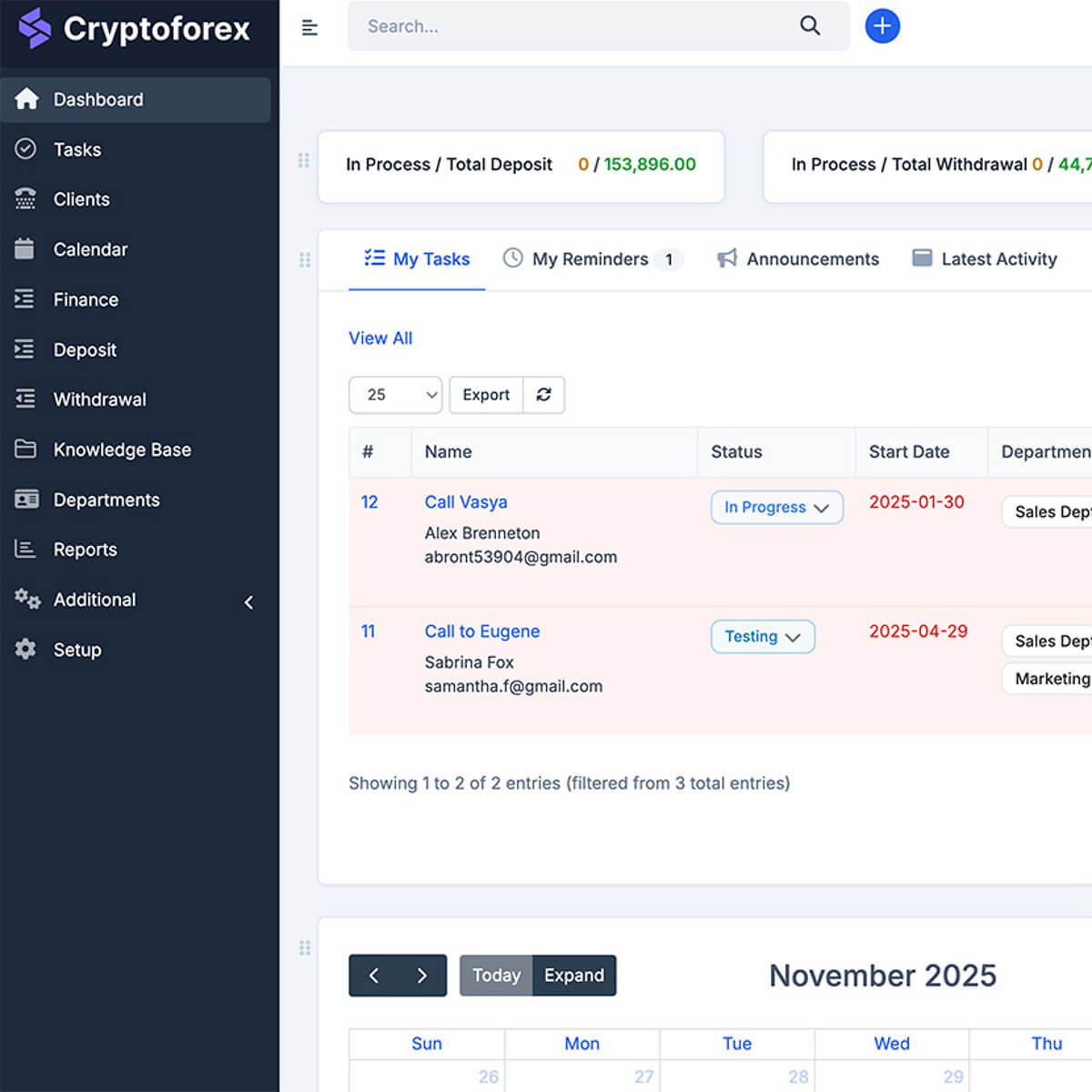
Prop trading software is the operational core of any proprietary trading firm: it defines trader capacity, risk exposure, payout logic, and the firm's ability to scale funded accounts. A production-grade platform serves 50,000–200,000 accounts per environment, processes real-time market data across multiple asset classes, and enforces automated risk rules without manual intervention. This guide covers the architecture, must-have features, development costs, and technical decisions that determine whether a prop platform succeeds or fails in production.
What Is Prop Trading Software and Who Needs It
Proprietary trading software is a system through which a firm allocates its own capital to traders, evaluates their performance against defined risk/reward criteria, and distributes profits according to a predetermined commission structure. Unlike a retail brokerage, a prop firm controls the evaluation rules, payout triggers, and risk parameters — which means the software must enforce all of these automatically, without edge cases that can be gamed.
The primary buyers are: prop firm founders building a funded trader program, existing brokers adding a proprietary trading layer, and fintech companies building white-label prop firm solutions for regional markets. The funded trader model — where traders pay a challenge fee, prove profitability within rules, and receive access to firm capital — has driven a surge in platform demand since 2022 and remains the dominant commercial model in the US and EU markets.
Prop firm challenge software is now a distinct product category. A platform needs a challenge module with configurable rules (max daily loss, max total drawdown, minimum trading days, profit targets), automated evaluation logic, and a seamless transition from challenge account to funded account — all without manual admin intervention. This is where most custom builds fail on their first iteration.
 Yuri MusienkoBusiness developer, Merehead
Core Architecture: CRM + Trading Engine + Risk Layer
A production prop trading platform is not a single system — it is three interconnected layers: a trading execution engine, a CRM with trader lifecycle management, and a risk management layer that operates in real time. The interaction between these three layers determines platform stability under load.
The trading engine handles order routing, position tracking, connection to liquidity providers, and P&L calculation. The CRM manages trader onboarding, KYC verification, account tiers, payout requests, and affiliate or IB structures. The risk layer runs in parallel, enforcing drawdown limits, blocking trades that violate account rules, and generating alerts when thresholds are approached.
Prop Firm Challenge Software: Evaluation Engine Architecture
The challenge module is the commercial entry point of any funded trader platform. Traders pay a one-time or recurring fee to access a simulated account with real market data and defined performance rules. Upon passing, they receive access to a live funded account with a profit share. The software must handle this lifecycle completely automatically.
Key parameters a challenge engine must configure per account type:
- Maximum daily loss limit (absolute $ or % of starting balance)
- Maximum total drawdown (static or trailing — a critical distinction that affects platform risk exposure)
- Profit target to pass the challenge phase
- Minimum number of active trading days
- Prohibited trading behaviors: holding positions over news events, overnight holds, grid trading, HFT patterns
- Leverage limits per instrument category
When a trader violates any rule, the account is automatically closed and the system records the breach type, time, and position that triggered it. This data feeds both the risk dashboard and, if configured, the analytics module for studying failure patterns across the trader cohort.
| Challenge Phase | Typical Profit Target | Max Daily Loss | Max Total Drawdown | Min Trading Days |
|---|---|---|---|---|
| Phase 1 (Evaluation) | 8–10% | 5% | 10% | 10 |
| Phase 2 (Verification) | 4–5% | 5% | 10% | 10 |
| Funded Account | No target (profit share) | 5% | 10% | No minimum |
Static drawdown calculates from the initial account balance. Trailing drawdown tracks from the peak equity reached — meaning a trader who reaches $110k on a $100k account has a trailing floor of $100k (assuming 10% trailing drawdown), not $90k. The business decision about which model to use directly affects firm risk exposure and must be implemented precisely in the evaluation engine.
Risk Management System: Real-Time Blocking and Monitoring
A risk management system in prop trading software operates differently from a standard trading platform. Rather than just logging risk events, it must actively prevent trades that would breach account rules — in real time, before execution, not after the fact.
The risk layer connects to the order flow and evaluates every incoming order against the current account state: current drawdown, daily P&L, open position exposure, and rule set for the specific account type. If an order would breach a limit, it is rejected at the platform level before being routed to the liquidity provider.
Beyond drawdown enforcement, the risk system handles position-level controls: stop loss and take profit execution with a precise price marker to eliminate slippage, maximum position size relative to account balance, and prohibited instrument lists per account tier. For platforms running multiple LP connections, hedging settings and scale are reflected on the monitor, and the multi-LP architecture provides order protection based on risk level.
Algorithmic Trading and Automated Bots in the Prop Ecosystem
Prop platforms increasingly integrate algorithmic trading modules — either as a feature for funded traders or as an internal toolset for platform operators. Building these correctly requires understanding the technical constraints that determine whether an algo module works in production or only in a demo environment.
For CEX↔DEX arbitrage modules (for example, routing between a centralized exchange and a cross-chain liquidity protocol), the architecture requires dynamic slippage calculation per trade. Tokens are categorized by liquidity tier — high, medium, low — and each tier carries a distinct slippage risk parameter. Without this, the displayed arbitrage price and the actual execution price diverge significantly on low-liquidity pairs, resulting in unprofitable trades that appear profitable in backtesting.
Tools typically embedded in the platform's algorithmic trading layer:
- Risk assessment: RiskMan, Tradovate, Actant RISK
- Data analysis and backtesting: QuantConnect, AlgoTrader, Amibroker
- Visualization and forecasting: MetaStock, Optuma, ThinkorSwim
- Trend and news monitoring: Bloomberg Terminal, Refinitiv Eikon, TradingView
Platform Infrastructure: Scalability, Liquidity Bridges, and Server Architecture
A prop trading platform running 50,000+ accounts cannot be built on a single-server architecture. Infrastructure decisions made at the beginning of the project determine whether the platform can scale without a full rewrite.
Liquidity bridges connect the platform to multiple vendor liquidity pools — LMAX, Currenex, CFH, Match-Trader — via LP connection with a market maker for order placement. Multi-LP connections provide three operational benefits:
- A-Book and B-Book processing costs are minimized through intelligent order routing
- Financial flows segmented by spread tiers are accelerated
- Stop loss and take profit execution is protected against slippage via precise price markers
Platforms are typically hosted in the US or Singapore for latency optimization, with cross-connection and DDoS protection as standard. The Kubernetes-based deployment approach — with individual microservices for wallet management, matching engine, notification service, and API gateway — allows stateless services to autoscale independently from stateful ones. Wallet services and order book services have state dependencies that make horizontal scaling non-trivial; this distinction must be defined before writing deployment configurations, otherwise significant rework is required post-launch.
CRM Features: Trader Lifecycle and Back Office
A prop trading CRM manages the complete trader lifecycle: registration and KYC, account tier assignment, challenge progression, funded account management, payout processing, and affiliate or IB relationship tracking. Each stage requires specific automation to avoid manual bottlenecks as the platform scales.
The KYC module must handle two verification paths: automated document verification via a provider like SumSub for international users, and local identity verification integrations for regional markets. Each provider has different webhook payloads and status transitions, requiring separate verification state machines in the backend rather than a unified flow. KYT (Know Your Transaction) verification — applied to every inbound deposit before balance is credited — is a separate compliance layer that most platforms add as an afterthought and then struggle to retrofit.
MAM and PAMM account modules, IB structures, and sub-IB trees create up to 50+ structure levels. Key back office capabilities the admin panel must include:
- Multi-wallet support with separate balances per account type (demo, challenge, funded, bonus)
- Automated payout calculation based on profit share tiers
- Withdrawal request queue with approval workflow and commission calculation
- UTM tag tracking for affiliate attribution
- SQL-based analytical reports (candlestick data, WebSocket and FIX protocol export)
- Sales module with task management, pipeline tracking, and performance dashboards
Trader Performance Grading and Payout Algorithm
The profit-sharing model is the commercial foundation of a prop firm. The algorithm that calculates trader rewards must account for account size, realized profitability percentage, and the firm's commission structure — with the underlying logic that larger accounts under management involve greater firm exposure and thus different commission tiers.
| Capital Under Management, $ | Profitability, % | Total Profit, $ | Firm Commission, % | Trader Income, $ |
|---|---|---|---|---|
| 1,000 | 72 | 720 | 50 | 360 |
| 5,000 | 34 | 1,700 | 75 | 425 |
| 10,000 | 49 | 4,900 | 70 | 1,470 |
| 20,000 | 68 | 13,600 | 55 | 6,120 |
| 50,000 | 52 | 26,000 | 60 | 10,400 |
| 100,000 | 29 | 29,000 | 80 | 5,800 |
The payout algorithm is not a static formula. A trader who demonstrates consistent profitability as their allocated capital increases earns a progressively higher commission percentage — up to 80–90% on some funded account tiers in competitive platforms. The system must evaluate profitability over rolling periods, apply tier upgrades automatically when thresholds are crossed, and generate payout reports exportable to Excel and CSV for accounting purposes.
KYC verification is the entry gate: the platform performs automated identity checks at registration, with the rating and commission percentage then managed by the system based on performance milestones and profit thresholds — denominated in stable reserve currencies or low-volatility crypto where applicable.
PWA and Multi-Platform Architecture
A prop trading platform requires consistent execution across desktop browsers, mobile browsers, and native applications. A Progressive Web Application (PWA) architecture written in JavaScript delivers trading functionality regardless of ISP speed variability and provides compatibility with both iOS and Android without maintaining separate codebases for non-native features.
The technical architecture combines WebSocket streaming for real-time quote delivery, interval candlestick data with export capabilities, and TradingView integration for advanced charting — including DOM panels with histograms, stop loss / take profit configuration, cluster evaluation on footprints, and volume profile histograms for support and resistance analysis. Heatmap trading and backtesting/replay functionality allow traders to validate strategies before deploying capital.
Backend services the platform must expose for multi-platform operation:
- Broker back office management via API for programmatic account administration
- Admin-configurable trading charts, feeds, and manager profile routing
- Client finance and asset management API for IB managers
- SQL server report generation with WebSocket and FIX protocol support
- Multi-channel trading across platforms with seamless payment gateways
Leaderboards, Certificates, and Competitive Features
Trader competitions and achievement systems serve a dual function: they increase engagement and provide the platform with behavioral data on trading patterns across a large cohort. A competition module requires configurable parameters (start date, eligible instruments, evaluation criteria), a real-time leaderboard, and automated certificate generation upon milestone completion.
The leaderboard enables copy trading from top performers — a feature that both increases capital deployment efficiency and serves as a retention mechanism for traders who haven't yet developed profitable strategies. The anti-fraud layer for competitions must detect and suppress grid trading in narrow timeframes and trades that mimic successful operations without genuine market exposure, using timeframe analysis and pattern-based filtering.
Certificates are generated automatically when traders cross defined milestones in 10–25 patterns. This automation eliminates manual certificate issuance as the trader base scales, while creating a visible progression system that motivates continued activity on the platform.
Yuri MusienkoBusiness developer, MereheadWhite-Label and Custom Development: Costs and Timelines
Prop trading software is available in three commercial models: white-label deployment of an existing platform, custom development from scratch, and a rental model with optional purchase. Each has distinct tradeoffs in cost, time-to-market, and long-term flexibility.
White-label deployment reuses a production-tested codebase with applied customization: design tokens (colors, logo, typography), payment gateway credentials, domain configuration, and third-party API keys (trading data, SMS, email). A deployment of this type can go from contract to live platform in under two weeks. The cost reduction versus custom development is 60–80%, and the risk on core trading mechanics is near zero because the underlying product has already been validated in production.
Custom development for a platform with core functionality starts at $40,000–60,000. High-frequency trading modules with linear, probabilistic, and stochastic algorithm embedding, combined with full proprietary architecture, range from $60,000–120,000 with a 3–6 month development timeline. This option is appropriate when competitive differentiation depends on unique algorithmic capabilities or when the business model requires owning the full technology stack.
| Model | Time to Market | Cost Range | Customization | Best For |
|---|---|---|---|---|
| White-label rental | 1–2 weeks | Monthly fee | Branding + config | Fast market entry, MVP validation |
| White-label purchase | 2–4 weeks | $20k–40k | Full source access | Cost-efficient owned platform |
| Custom (core features) | 2–4 months | $40k–60k | Full custom | Differentiated feature set |
| Custom (HFT + algo) | 3–6 months | $60k–120k | Full proprietary | Technology-first prop firms |
FAQ
A standard trading platform handles order execution and account management for retail clients. Prop trading software adds a layer of firm-specific logic on top: challenge evaluation rules, automated account grading, profit-sharing algorithms, funded account lifecycle management, and risk blocking that enforces firm rules in real time. The CRM in a prop platform manages trader progression, not just client data.
The challenge module maintains a rule set per account type (max daily loss, max total drawdown, profit target, minimum trading days) and evaluates every trade against current account state. When a rule is violated, the account is automatically closed and the breach is logged. When all targets are met, the system automatically transitions the account to funded status. This entire flow runs without manual admin intervention.
Static drawdown calculates from the initial account balance — a 10% limit on a $100k account means the account closes if equity drops below $90k, regardless of peak performance. Trailing drawdown tracks from the peak equity reached — if the account grew to $110k, the floor moves to $100k. Trailing drawdown is harder for traders to manage and reduces firm risk exposure; static drawdown is simpler and more trader-friendly. The choice is a business decision that must be implemented precisely in the evaluation engine.
Core functionality (CRM, challenge module, risk management, payment integration, trading interface) takes 2–4 months. Adding HFT algorithms, custom liquidity bridges, or advanced analytics extends the timeline to 4–6 months. White-label deployment of an existing platform takes 1–2 weeks. Infrastructure readiness — server provisioning, domain configuration, SSL — is a client deliverable that must be completed in parallel with development to avoid delaying go-live.
Standard integrations include MT4/MT5 account management API for position and balance synchronization, cTrader and xStation connectivity for platforms using those execution environments, and bridge connections to liquidity providers (LMAX, Currenex, CFH, Match-Trader). Trading systems are adapted to embed indicators for monitoring account profitability directly within the platform's risk dashboard.
Yes, for most founders it is the correct first choice. White-label deployment uses a production-tested codebase, costs 60–80% less than custom development, and can go live in 1–2 weeks. The core trading mechanics and risk engine have already been validated in production. Custom development makes sense when the business model depends on unique algorithmic features or when competitive differentiation requires owning the full technology stack.