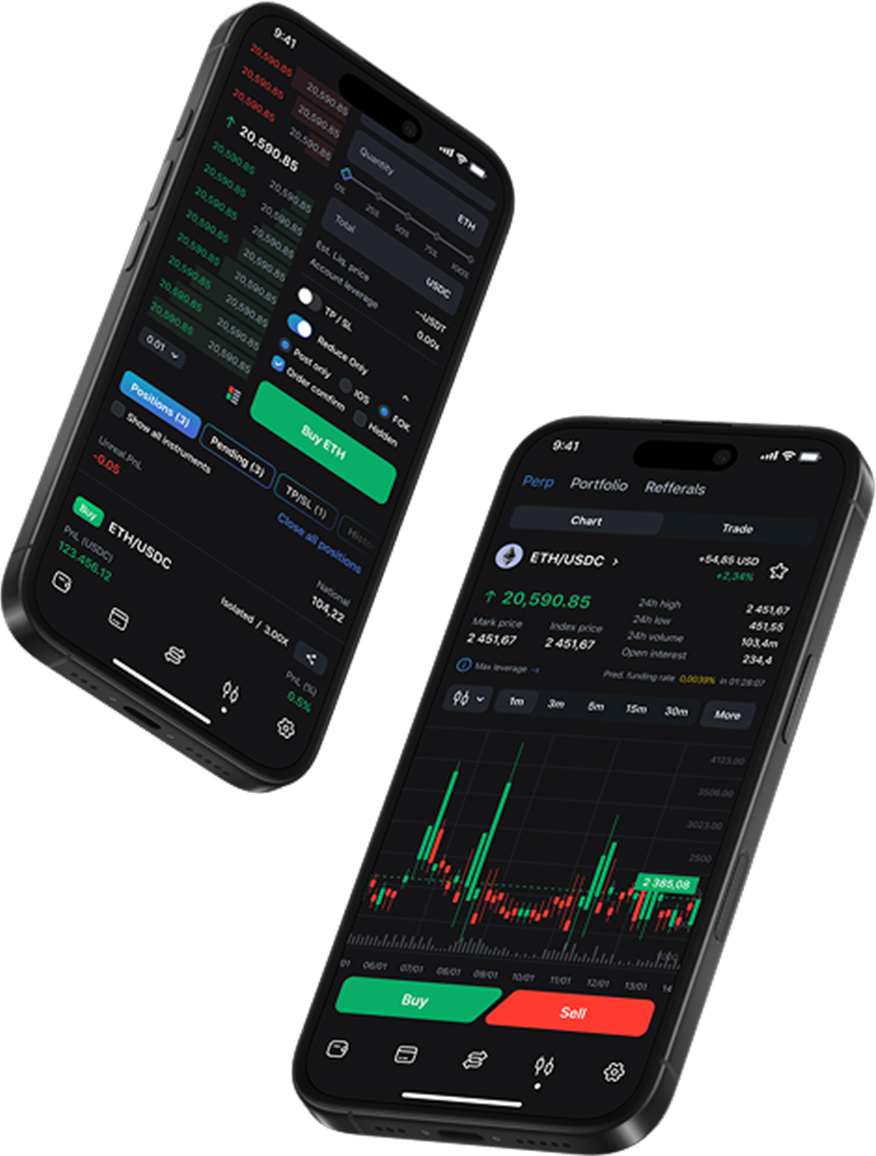
AMM-Based Trading ✨

Decentralized Exchange Development Company

Most DEX platforms don’t fail because of smart contracts. They fail because of liquidity design, UX friction, and wrong launch assumptions.

Review your DEX idea View Case Studies  
130+ projects
Experience
since 2015
Experience
blockchain expert
image

Reason

Why Choose Us as Your DEX Development Company

Every time we start developing a decentralized exchange, we see projects fail because of decisions that seem right at the start.

Most platforms don’t fail because of bad code or unattractive design. The main mistake is in decisions that may seem right, but lead to failure in the future.

Our role is not only to write code. We are a team that helps build a business. It’s to challenge assumptions, ask uncomfortable questions, and help you find the balance between ambition and rational product thinking.

Our experts will help you choose a liquidity provider, set up nodes with minimal costs and come up with the optimal internal trading logic to ensure high income and favorable conditions for users. We are a team that knows everything about trading platforms. How to work on them and how to earn on them.

Write to an expert
Real Experience in Crypto Exchange Development
Merehead has hands-on experience in developing decentralized crypto exchanges based on Solidity and Rust smart contracts. This allows us to design DEX solutions that take into account liquidity behavior, user incentives, and long-term sustainability from day one.
Focus on Production-Ready Protocols
The development team designs projects with a focus on scalability and security. Each DEX undergoes extensive testing before launching in a live environment with regular protocol updates.
Security-First Approach
Security is a key focus in DEX development. The team designs the architecture with best practices and integration of Ethereum or Solana-based smart contracts.
Scalable & Upgradeable Architecture
All projects will be designed to be easily scalable and upgradable. In some cases, microservices architecture and automated testing are used to build large DEX platforms.

Services

Decentralized Exchange Development Services

Our team offers a wide range of services for developing decentralized platforms

01

Custom DEX Development

We create customized, individual decentralized exchanges. The DEXs we develop are maximally adapted to your business model, target blockchain, and long-term protocol strategy.
02

AMM-Based Trading Protocols

Another area of our activity is the development of AMM-based trading protocols that allow for permissionless token exchanges with predictable pricing and stable liquidity.
03

Governance Mechanisms

The implementation of precise network management systems from our specialists allows token holders to transparently manage protocol updates and key parameters.
04

Multi-Chain & Cross-Chain DEX Solutions

The multi-chain and cross-chain DEX solutions our clients receive expand market reach while maintaining decentralized execution.
05

Wallet & Web3 Integration

We integrate DEX platforms with leading Web3 wallets to provide a seamless custody-free trading experience.
06

Smart Contract Development

Secure and efficient smart contracts developed by us ensure stable and efficient operation of swaps, pools, fees, and management logic.
07

Liquidity Pool & LP Reward Design

We design liquidity pools and reward mechanisms that incentivize long-term participation of liquidity providers.
merehead about

About

What Is a Decentralized Exchange (DEX)?

A Decentralized Exchange (DEX) is a blockchain-based trading platform that allows owners of digital assets to exchange, trade, and transact directly from their wallets, without the centralized management, custody, or control of a responsible company, as is the case with centralized exchanges. A DEX offers the freedom to manage your own assets, anonymity, and speed of exchange.

The decentralized exchange operates through smart contracts, which are the basis for security and all trading logic on the network.

What attracts users to DEX? Their key advantages are:

Smart contract execution

Non-custodial trading

Network transparency

Access without permission

Unlike centralized exchanges, DEX platforms do not rely on order books managed by a single entity. They use automated market maker (AMM) models and liquidity pools to ensure continuous trading without permissions, tight controls, and centralization of control in the hands of a single company.

Step-by-Step

How a Decentralized Exchange Works

On-chain trading powered by smart contracts and liquidity pools

Wallet Connection & User Authentication
Each user can connect their wallet to the DEX interface without having to create accounts and transfer responsibility to the management company.
Automated Market Maker (AMM) Pricing
Pricing in DEX is determined by AMM algorithms based on liquidity pool balances, not centralized order books, so the price of tokens is formed automatically.
On-Chain Trading Fee Distribution
Liquidity providers receive commissions from each transaction according to the distribution principle, which is clearly stated in the exchange rules.
Smart Contract–Based Trade Execution
All swaps and transactions on the exchange are executed automatically using smart contracts deployed on the blockchain, without manual management.
Liquidity Pools & Asset Reserves
Liquidity providers place their assets in pools in exchange for LP tokens for continuous trading and receiving commissions on each transaction.
Transparent Settlement & Finality
Blockchain technologies ensure transparency and irreversibility of each transaction, so each transaction can be audited.
image
image
image
image
image
image

Architecture

Decentralized Exchange Architecture We Build

Principles of scalability and full network execution, focus on security are the key principles of our development of decentralized exchange architecture. Thanks to a modular approach to development, we offer a convenient, easily scalable and centralized management-independent trading protocol. We customize each DEX to the owner's requirements.


Smart Contracts Layer
Swaps are executed and liquidity pools are managed at the smart contract level. The smart contracts we develop apply the protocol rules directly to the blockchain.
AMM & Liquidity Logic
Advanced analytics and liquidity logic in DEXs are the responsibility of automated market maker algorithms. They are the ones that shape token prices and liquidity based on pool balances and predefined curves.
Web3 Frontend
The Web3 technology that we are building into the interface allows users to transparently interact with the DEX directly from their wallets through a secure interface and personalize their own experience.
Indexing & Analytics. Leveled indexing and analytics in DEX is a continuous aggregation of data across the network and timely reporting on trading activity and liquidity. Get real-time data for flexible decisions.
Governance & Upgrade Modules. Protocol development through management modules and network updates ensures transparency and preservation of core exchange functionality when updating or scaling

Features

Core Features of a Decentralized Exchange Platform

The key principle of building a decentralized exchange platform is full on-chain execution. It is a platform where assets are fully controlled by users, and trading occurs without permission or centralized intermediary controllers, directly, transparently, and continuously.

Non-Custodial Project Architecture
Users retain full control over their assets. Only they decide whether to consent to the execution of transactions, and direct transactions are made from user wallets without transferring custody rights.
Automated Market Maker (AMM)
AMM algorithms are constant price analytics and their clear and transparent formation for continuous trading. Dynamic determination of token prices based on LP balances allows users to quickly respond to changes in prices.
Liquidity Pools
Liquidity pools provide the asset reserves needed for trading and allow users, as liquidity providers, to receive commissions on each swap.
Permissionless Token Swaps
Anyone can independently trade supported tokens on the DEX without registration, approvals, or centralized restrictions. Anonymity and unlimited transactions open up more possibilities.
On-Chain Transparency
All transactions, fees, and protocol rules are recorded in the blockchain and can be independently verified at any time using any criteria.

Cost

Cost of a Decentralized Exchange Development

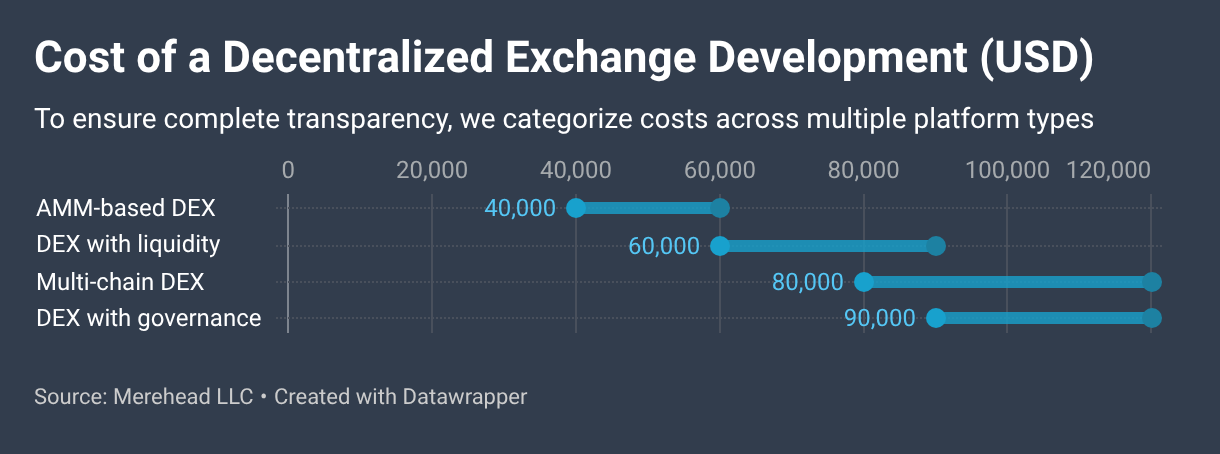
We offer an open and transparent cost calculation for developing decentralized exchanges. When estimating the cost of a project, our team relies on criteria such as the complexity of smart contracts, AMM logic, and liquidity mechanisms used for each individual DEX.

It is worth noting that the cost:

AMM-based DEX: $40,000 - $60,000
DEX with liquidity: $60,000 - $90,000
Multi-chain DEX: $80,000 - $120,000
DEX with governance: $90,000 - $120,000

We are guided by key factors to determine the value of DEX, including choosing the target blockchain, developing the AMM model design, liquidity pool structure, governance mechanisms, and multi-chain support, and building a value proposition on this.

Customization is a key principle of our development, and therefore the final cost is determined by the results of the selection of all settings and after technical analysis and architecture planning.

We will be happy to advise you if you are planning to launch a decentralized exchange, help you determine the optimal scope of development, and, accordingly, prepare a transparent cost estimate based on your goals and the task set for the team.
Contact Expert

FAQ

Have questions in mind?

Answers to the most frequently asked questions from our clients

The main difference lies in the levels of control over users’ assets. A Centralized Exchange (CEX) is run by a central company that stores and controls users’ funds and executes transactions through a centralized infrastructure. A Decentralized Exchange (DEX) allows trading directly from a user’s wallet and provides the ability to control their assets using smart contracts. Another difference with DEX is the ability to maintain anonymity without compromising security.

We approach each project individually, taking into account the complexity of the AMM, the choice of blockchain and security requirements, and this determines the development time. On average, the development of a decentralized exchange takes from 3 to 6 months..

The cost of creating a DEX is directly affected by the characteristics of the protocol, its management, and the number of chains that need to be supported. In our company, the development price usually ranges from $40,000 to $150,000.

Yes, that's what we do: we build our own decentralized exchanges based on AMM, take inspiration from leading protocols, and adapt the product to your specific business and liquidity model.

We help develop liquidity pool structures, incentive mechanisms and AMM logic, but we do not act as liquidity providers.
Talk to an expert
We are ready to answer all your questions
Top expert
10 years of experience

Security

Security in Decentralized Exchange Development

Secure Smart Contract Design
Secure smart contract design by our team ensures that swaps, pools, and fees are always as intended and follow a well-defined logic. Well-structured contracts reduce the attack surface and simplify future audits and updates.
Exploit Prevention & Testing
Comprehensive testing helps identify vulnerabilities such as re-login, price manipulation, and logic flaws before deployment. Preventing exploits at the protocol level protects both user funds and your DEX’s long-term reputation as a trusted trading platform.
Audit-Ready Architecture
The architecture, always ready for audit and adapted for transparent review, allows independent security agents to verify the protocol logic and all transactions made. The blockchain principle of recording every action works for increased security, and this significantly increases trust from users, liquidity providers and institutional partners.
Why this case is important
Security is perhaps the most important requirement in the development of decentralized exchanges, as smart contracts directly control user funds and protocol logic. The security of user data and assets can be at risk of irreversible loss even with minor vulnerabilities. That is why we pay the greatest attention to the design of DEX with security in mind and the use of new, effective and fail-safe tools to support it from the very beginning of architectural decisions.

Liquidity

Liquidity Strategy for DEX Platforms

Liquidity Pool Modeling
Before finalizing the architecture, we conduct liquidity pool simulation. Preliminary simulation helps to select effective asset pairs, their balance and usage on the DEX. This safety step helps to maintain stable trading conditions under different market scenarios.
LP Incentives & Rewards
Balancing LP rewards is another essential security step. Accurately balancing incentive mechanisms encourages liquidity providers to invest capital for long periods, increases loyalty, and prevents unfair commission distribution. In this way, we prevent sudden liquidity drops and improve the overall stability of the platform.
AMM Curve Optimization
AMM curves drive token prices. We perform a clear optimization of the AMM curve, which increases capital efficiency and reduces slippage for traders. Optimized curves are better adapted to volatile markets and various asset pairs.
Why this case is important
Liquidity is a key factor in the usability and adoption of decentralized exchanges as it directly impacts pricing, slippage and trading volume. A well-designed liquidity strategy ensures sustainable growth and works for the long-term strategies of our DEX company.

Management

Governance & Protocol Management

Governance Tokens
Governance tokens provide stakeholders with the opportunity to participate in protocol decision-making. We are developing the mechanics of granting governance tokens to implement effective long-term self-governance and self-regulation by users, liquidity providers, and the decentralized exchange (DEX) itself.
Voting & Proposals
Transparency and the ability to put a proposal to a general vote is the basis for implementing changes to the exchange protocol. From our side, it is a guarantee that future DEX updates will reflect collective decisions, not unilateral control.
On-Chain Parameter Control
Controlling network parameters allows you to adjust the protocol, including adjusting fees, rewards, and pool settings, through governance actions. This approach allows the DEX to adapt while maintaining transparency and decentralization, and provides its owner with enhanced capabilities to optimize the exchange for current needs and market trends.
Why this case is important
Despite the lack of centralized control, it is the thoughtful governance that determines how a decentralized exchange will evolve over time. Well-designed governance mechanisms align protocol development with the interests of the community and ecosystem. It is with this principle that our team implements the platform’s protocol governance mechanisms.
Do you have a project idea?
Send
Yuri Musienko
Business Development Manager
Yuri Musienko specializes in the development and optimization of crypto exchanges, binary options platforms, P2P solutions, crypto payment gateways, and asset tokenization systems. Since 2018, he has been consulting companies on strategic planning, entering international markets, and scaling technology businesses. More details