×
Services
Exchange & Trading Infrastructure
DeFi & Web3 Core
NFT Ecosystem & Multi-Chain
Tokenization & Fundraising
Crypto Banking & Fintech
AI Development
Create a centralized crypto exchange (spot, margin and futures trading)
Decentralized Exchange
Development of decentralized exchanges based on smart contracts
P2P Crypto Exchange
Build a P2P crypto exchange based on a flexible escrow system
Centralized Exchange
Build Secure, High-Performance Centralized Crypto Exchanges
DeFi Platform
Build DeFi projects from DEX and lending platforms to staking solutions
NFT Marketplace
Build NFT marketplaces from minting and listing to auctions and launchpads
Real Estate Tokenization
Real estate tokenization for private investors or automated property tokenization marketplaces
Build crypto banking platforms with wallets, compliance, fiat rails, and payment services
Crypto Payment Gateway
Create a crypto payment gateway with the installation of your nodes
AI Development
We build production-ready AI systems that automate workflows, improve decisions, and scale

Spot Trading ✨

Centralized Exchange Development Services

We build centralized exchanges designed for real trading volume, predictable performance, and operational control. Merehead delivers production-ready CEX platforms with order book trading, custody options, liquidity integrations, and compliance workflows.


Review your idea View Case Studies    
130+ projects
Experience
since 2015
Experience
blockchain expert
image

Reason

Why Choose Us as Your Centralized Exchange Development Company

Building a CEX is not a “website project” — it’s trading infrastructure with strict uptime, latency, custody, and risk constraints. We engineer exchanges for real operations: predictable matching under load, audit-ready logs, controlled withdrawal workflows, and an admin toolkit that your ops team can actually run day-to-day.

Merehead has been building blockchain and trading products since 2015 and ships production systems with clear ownership: architecture, security, integrations, and launch support. We don’t sell templates — we deliver a platform tuned to your markets, revenue model, and compliance scope, so you can scale without rebuilding core components later.

Write to an expert
Real Exchange Delivery Experience
We build trading platforms with real operational constraints and high-load requirements. This experience helps avoid design decisions that fail under volume.
Production-Ready Infrastructure Focus
We prioritize architecture, observability, and reliability so the platform can scale safely. This reduces downtime risk and improves user trust.
Security-First Engineering
Security controls are embedded into custody workflows, withdrawals, and access management. This reduces fraud exposure and strengthens compliance readiness.
Business-Driven Implementation
We align features with revenue model, liquidity strategy, and growth milestones. The result is a platform designed to compete, not just to launch.

Our blockchain development team has developed more than 30 crypto exchanges (spot, margin and futures trading). The average development time is from 3 to 4 months. Each project involves from 8 to 12 team members depending on the complexity of the project. One of our experiences is described in the case of developing a crypto exchange.

Services

Centralized Exchange Development Services

Our centralized exchange development services cover the full cycle-from architecture and matching engine logic to wallets, admin tools, and launch support. We tailor each build to your product model, target markets, and security requirements.

01

Custom CEX Development

We develop custom centralized exchanges with a feature set aligned to your business model and roadmap. You get full control over trading rules, fees, and platform operations.
02

Matching Engine & Order Book Trading

We build high-performance matching engines with order book logic and deterministic trade execution. The engine is designed for low latency, high throughput, and reliable settlement.
03

Liquidity Integration & Market Making Setup

We integrate liquidity providers and configure market data flows to support healthy spreads and depth. We also help structure incentive and fee mechanics to bootstrap liquidity.
04

Custody, Wallet Infrastructure & Key Management

We implement wallet infrastructure for deposits, withdrawals, and internal transfers with configurable custody models. Key management can be built with strong operational controls and security safeguards.
05

KYC/AML, Risk Controls & Compliance Workflows

We implement KYC onboarding, AML monitoring hooks, and risk-based controls aligned with your operating model. Compliance workflows include limits, alerts, manual review, and case management patterns.
06

Fiat On/Off-Ramps, Cards & Payment Integrations

We integrate fiat rails and payment providers to support buying and selling crypto with user-friendly flows. Integrations include transaction status tracking, reconciliation, and robust error handling.
07

Admin Panel, Monitoring & Reporting

We build admin dashboards for user management, listings, fees, permissions, and operational actions. Monitoring and reporting provide visibility into risk events, performance, and platform health.
merehead about

About

What Is a Centralized Exchange (CEX)?

A centralized exchange (CEX) is a trading platform where the operator runs the matching engine, manages user accounts, and enforces trading, custody, and risk policies. Orders are matched off-chain in an order book, while balances and positions are tracked in an internal ledger designed for speed and traceability.

Unlike on-chain trading, a CEX can offer low-latency execution, advanced order types, market data APIs, and operational controls (limits, approvals, monitoring) that help reduce fraud and improve incident response. This is why most high-volume venues rely on centralized matching and a robust ops layer.

A successful CEX is less about “listing coins” and more about market quality and trust: custody architecture, withdrawals safety, transparent fees, responsive support, and compliance workflows aligned to the jurisdictions you serve.

Our experience includes developing high-volume trading with load testing. In practice, one of the difficult components is the ability to integrate a new token, in which case the system must independently generate supply and demand and form a real-world graph with its data set.

11
years on the market
133
completed projects
40+
development team

Step-by-Step

How a Centralized Exchange Works

A CEX onboards users, manages balances, matches orders in an order book, and settles trades by updating internal ledgers. The platform also enforces security checks, compliance monitoring, and operational controls to protect users and reduce risk.

User Onboarding & Account Creation
Users register, verify identity when required, and gain access based on risk and jurisdiction rules. Account creation includes security setup, permissions, and configurable limits.
Deposits, Wallets & Custody
Users deposit crypto into managed wallet addresses and see balances reflected after confirmations. Custody and wallet operations are controlled through policy-based workflows and monitoring.
Order Placement & Matching
Traders place limit and market orders that enter the order book. The matching engine executes trades based on price-time priority and updates positions in real time.
Trade Settlement & Balance Updates
After a match, the internal ledger updates balances and records the executed trade with full traceability. Settlement logic ensures accurate fee calculation and consistent account states.
Withdrawals & Security Checks
Withdrawals trigger security controls such as limits, address checks, and optional manual approvals. The goal is to protect user funds while keeping the flow fast and predictable.
Monitoring, Compliance & Incident Response
The platform monitors abnormal activity, compliance flags, and operational incidents with clear escalation paths. This supports fast response, case handling, and audit-ready reporting.
A CEX connects four core systems: onboarding (KYC/risk gating), wallets/custody (deposits and withdrawals), the matching engine (price-time priority and execution rules), and the internal ledger (balances, fees, positions, audit trails). Around that core sits the ops layer — monitoring, alerts, manual review flows, and incident playbooks — which is what keeps trading stable when volume spikes or suspicious activity appears.
image
image
image
image
image
image

Architecture

Centralized Exchange Architecture We Build

We design modular exchange architecture so matching, custody, risk controls, and UI can scale independently. This approach improves reliability, reduces operational risk, and supports faster iteration.


Matching Engine Layer
The matching engine handles order book operations, trade execution, and deterministic matching rules. It is built for low latency and predictable performance under load.
Wallet & Custody Layer
This layer manages deposits, withdrawals, address orchestration, and custody policies. We implement controlled workflows to reduce risk while keeping operations efficient.
Risk & Compliance Layer
Risk services enforce limits, detect suspicious behavior, and support compliance actions. This layer includes alerting, manual review workflows, and escalation logic.
Liquidity & Market Data Layer. We integrate liquidity feeds and provide market data services for UI and APIs. The system supports real-time updates, depth snapshots, and reliable pricing data.
Trading UI & API Gateway. The UI and API gateway provide fast access to trading functions with clear permission controls. We optimize for conversion, stability, and a consistent trading experience.

Features

Core Features of a Centralized Exchange Platform

Core features define the trading experience, operational efficiency, and the platform’s ability to scale under real volume. We implement features that support liquidity growth, user retention, and risk control.

Spot Trading
Spot trading supports immediate asset swaps with order book execution and real-time balances. It’s the foundation for most exchange business models and liquidity strategies.
Margin and/or Futures
Margin and futures modules add leverage, funding logic, and risk controls for advanced trading. These features require strong liquidation mechanics and monitoring to manage exposure.
Advanced Order Types
We implement order types like stop-loss, take-profit, OCO, and trailing logic based on your trading scope. Advanced orders improve trader experience and platform competitiveness.
Market Data, Charts & APIs
We provide market data feeds, price updates, and trading APIs for pro traders and integrations. Charting and analytics support better decisions and higher engagement.
User Security
We implement 2FA, session controls, device management, and withdrawal protections. Strong user security reduces account takeover risk and improves trust.

Cost

Cost of Centralized Exchange Development

Centralized exchange development cost depends on the parts that must be engineered for reliability: matching performance targets, custody model, security controls for withdrawals, and the number of third-party integrations (KYC/AML, fiat rails, liquidity providers, analytics, charting). The more “production” you want on day one, the more time goes into hardening, monitoring, and operational tooling.

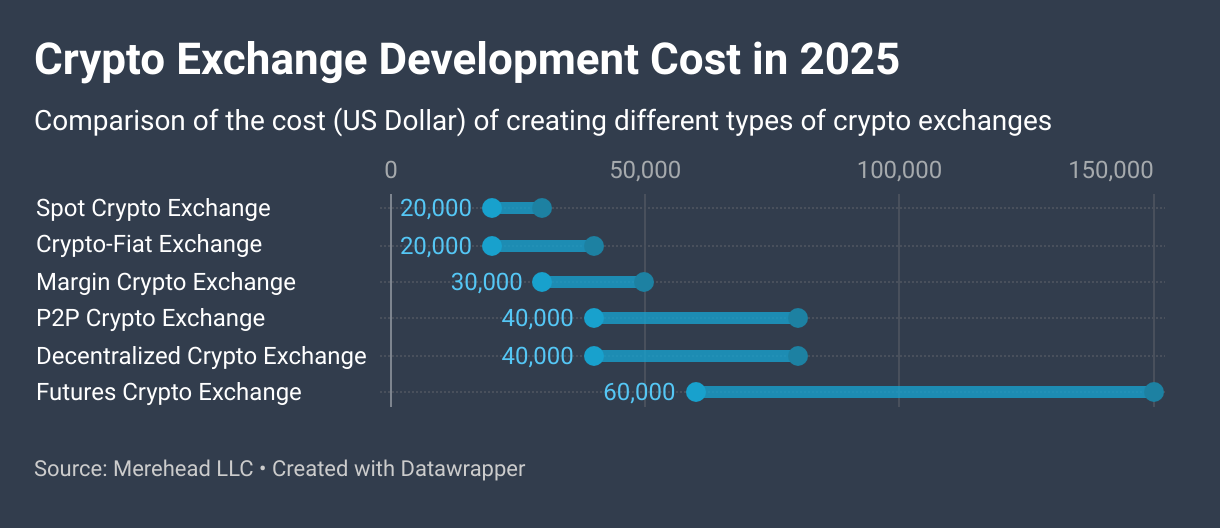
MVP Spot CEX (core trading + wallets + admin): $20,000 - $40,000
Mid-Scale CEX (more integrations + risk/monitoring): $40,000 - $60,000
Enterprise CEX (high-load + advanced compliance + redundancy): $60,000 - $150,000

Most budgets break when scope is defined by features instead of constraints. Two exchanges can both have “spot trading”, but the difference is throughput, latency, hot/cold wallet policies, reconciliation, and how quickly your ops team can detect and stop fraud. We estimate the build by complexity tiers so you can forecast time-to-launch without hidden engineering surprises.

A practical way to reduce costs is to first launch a secure spot MVP on external nodes. Then expand the capabilities and add margin trading and eventually futures. As a rule, the MVP preparation takes up to 3 months, taking into account the already developed code base. The Enterprise platform is developed from 6 to 9 months.

While these points highlight key cost drivers, every centralized exchange is unique. Speak with our blockchain architects to refine your technical requirements and get an accurate roadmap for your development.
Contact Expert

Who Should Launch a Centralized Crypto Exchange?

Fintech startups launching regulated CEX
Brokerages expanding into crypto trading
Payment platforms with exchange features
Institutions offering compliant trading venues

FAQ

Have questions in mind?

Answers to the most frequently asked questions from our clients

Cost depends on custody model, performance targets, and integrations such as payments, KYC, and liquidity providers. We estimate by complexity (MVP, mid-scale, enterprise) to keep budgeting predictable.

An MVP CEX typically takes 10–16 weeks depending on features and integrations. More complex builds take longer due to performance hardening, compliance scope, and operational tooling.

A CEX uses a centralized matching engine and operator-controlled workflows for custody, compliance, and operations. A DEX executes trading on-chain through smart contracts with non-custodial settlement.

Yes, we can build spot trading as a foundation and add margin or futures modules as your roadmap requires. Advanced trading requires stronger risk controls, liquidation logic, and monitoring.

We help design liquidity strategy and integrate liquidity providers based on your target markets. We also advise on fee tiers and incentives to support sustainable liquidity growth.
Talk to an expert
We are ready to answer all your questions
Top expert
10 years of experience

Security

Security & Compliance for CEX Development

Custody Security
We design custody models that match your risk posture, including secure key management options. HSM or MPC-style approaches can be used to protect signing operations and reduce attack surface.
Withdrawal Controls & Anti-Fraud
We implement withdrawal limits, velocity checks, address rules, and optional manual approvals. Anti-fraud controls reduce account takeovers and suspicious payout behavior.
AML Monitoring & Case Management
We integrate monitoring hooks and workflow patterns for alerts, reviews, and case handling. This supports compliance operations and reduces exposure to illicit activity.
Why is this important?
Security and compliance are not optional features, but core product requirements that determine whether CEX can perform under pressure. We design deposit and withdrawal as controlled workflows (policy rules, approvals, limits, monitoring) and implement audit-ready logging, role-based access, and incident response tools. Our team tests each API to prevent local DDoS attacks. A separate important security element is the semi-automatic management of withdrawals under internal control and audits.

Liquidity

Liquidity Strategy for Centralized Exchange

Liquidity Provider Integrations
We integrate LPs and configure routing logic to maintain depth and market quality. Integrations include monitoring and fallback handling to avoid liquidity gaps.
Market Making & Spread Strategy
We help define spread targets, inventory logic, and fee structures that support stable markets. The goal is predictable execution quality for traders and sustainable economics for the platform.
Volume, Incentives & Fee Design
We design fee tiers, maker/taker logic, and incentives aligned to your growth stage. These mechanics help attract liquidity providers and retain active traders.
Why is this important?
Liquidity is a go-to-market strategy, not just an integration. We help you choose the right initial path (LP connection, market maker setup, or hybrid), define market quality targets (spread, depth, uptime), and design rewards and incentives for makers/takers who don’t fake volume, but create sustainable order book activity. Our experience shows that it’s worth launching the most liquid trading pairs first: BTC/USDT, ETH/USDT, SOL/USDT, XRP/USDT, BNB/USDT, LTC/USDT.For example, after launching one of our projects, 90% of all transactions were made in BTC/USDT and ETH/USDT.

Integrations

Integrations We Support

Payment Providers & On/Off-Ramps
We integrate payment services for fiat deposits, withdrawals, and instant purchase flows. Each integration includes monitoring, retries, and reconciliation support.
KYC/AML Vendors
We connect identity verification and screening providers to support onboarding and compliance workflows. Integrations are designed to minimize friction while maintaining control.
TradingView/Charts & Market Data Feeds
We integrate charting tools and market data feeds for professional trading experiences. This improves retention and supports advanced trader workflows.
Why is this important?
Integration determines how fast you can launch and how stable your exchange will be in real life. We integrate KYC/AML providers, fiat on/off-ramps, key custody/management options, liquidity providers and trading analytics with production-level processing: status tracking, retries, reconciliation and clear admin control on failures. Our experience includes integrating SumSub, onData, Crystal for KYC/AML/KYT; TradingView for charts, TraderMade for datasets; Visa/Mastercard for payments; Binance, Kraken for liquidity.
Do you have a project idea?
Send
Yuri Musienko
Business Development Manager
Yuri Musienko specializes in the development and optimization of crypto exchanges, binary options platforms, P2P solutions, crypto payment gateways, and asset tokenization systems. Since 2018, he has been consulting companies on strategic planning, entering international markets, and scaling technology businesses. More details