×
Services
Exchange & Trading Infrastructure
DeFi & Web3 Core
NFT Ecosystem & Multi-Chain
Tokenization & Fundraising
Crypto Banking & Fintech
AI Development
Exchange & Trading Infrastructure
Create a centralized crypto exchange (spot, margin and futures trading)
Decentralized Exchange
Development of decentralized exchanges based on smart contracts
Stock Trading App
Build Secure, Compliant Stock Trading Apps for Real-World Brokerage Operations
P2P Crypto Exchange
Build a P2P crypto exchange based on a flexible escrow system
Centralized Exchange
Build Secure, High-Performance Centralized Crypto Exchanges
DeFi & Web3 Core
DeFi Platform
Build DeFi projects from DEX and lending platforms to staking solutions
NFT Ecosystem & Multi-Chain
NFT Marketplace
Build NFT marketplaces from minting and listing to auctions and launchpads
Tokenization & Fundraising
Real Estate Tokenization
Real estate tokenization for private investors or automated property tokenization marketplaces
Crypto Banking & Fintech
Build crypto banking platforms with wallets, compliance, fiat rails, and payment services
Build Secure Crypto Wallet Apps with a Production-Ready Custody Model
Crypto Payment Gateway
Create a crypto payment gateway with the installation of your nodes
AI Development
AI Development
We build production-ready AI systems that automate workflows, improve decisions, and scale

  Non-Custodial Wallet

Crypto Wallet App Development Company

We build crypto wallet apps that combine strong key security, smooth UX, and reliable blockchain connectivity. Merehead delivers production-ready wallets with the right custody model, multi-chain support, and security controls designed for real-world usage.

130+ projects
Experience
since 2015
Experience
blockchain expert
image

  Services

Crypto Wallet App Development Services

Our crypto wallet app development services cover product design, wallet core, security architecture, and integrations needed for launch and scaling. We build wallets that are stable under real traffic, easy to operate, and aligned with US-grade security expectations.

01

Custom Crypto Wallet App Development

We develop wallet apps for iOS, Android, and web with consistent UX and fast performance. The product is built for secure signing flows, clear transaction states, and reliable onboarding.
02

Non-Custodial Wallet Development

We build non-custodial wallets where users control their keys and sign transactions locally. This model reduces custody risk and supports a true self-custody experience.
03

Custodial Wallet & Backend Infrastructure

We develop custodial wallets with backend services for account management, risk controls, and operational tooling. This approach is suitable when you need recovery support, enterprise policies.
04

MPC / HSM Key Management Integration

We integrate MPC or HSM-based key management to strengthen custody security and operational control. This approach reduces single-point compromise risk while supporting enterprise-grade signing policies.
05

Multi-Chain & Token Support

We add multi-chain support based on your target assets, network fees, and ecosystem priorities. Token support includes reliable balance discovery, decimals handling, and contract verification workflows.
06

DeFi, DEX & Staking Integrations

We integrate swaps, DeFi access, and staking flows when the product requires it. Integrations are designed with clear risk prompts, slippage handling, and stable transaction state management.
07

Wallet Admin Panel & Operations Tools

We build admin tools for support, monitoring, risk events, and configuration management. Operational tooling helps teams handle incidents, resolve user issues, and maintain service quality.

  About

What Is a Crypto Wallet App?

A crypto wallet app is a sophisticated digital interface designed to manage cryptographic keys and interact with various blockchain protocols. Unlike traditional banking apps that store currency, a crypto wallet stores the private and public keys required to sign transactions and broadcast them to the distributed ledger. It serves as a personal gateway to the decentralized economy, enabling users to manage digital assets and interact with various decentralized finance (DeFi) solutions.
Modern wallet solutions have evolved into multi-functional platforms that support multiple blockchains (Layer 1 and Layer 2) and diverse asset classes, including tokens, stablecoins, and NFTs. For a business, a crypto wallet is not just a storage tool but a critical touchpoint for user engagement, requiring high-performance synchronization with nodes to provide real-time balance updates and history tracking.
At the core of an enterprise-grade wallet is the seed phrase and key derivation logic (BIP-32/39/44 standards). Whether it is a mobile, desktop, or browser-based solution, the software must ensure that the cryptographic signature process is both seamless for the user and impenetrable to external threats, bridging the gap between complex blockchain mechanics and intuitive financial management.
1/3

  Step-by-Step

How a Crypto Wallet App Works

A wallet app generates or provisions keys, manages addresses, signs transactions, and broadcasts them to the blockchain through node connectivity. It also tracks confirmations, displays balances, and provides security and recovery workflows to keep users protected.

Wallet Creation & Key Setup
Users create a wallet or import an existing one using a secure key setup flow. We implement UX that reduces mistakes and supports safe onboarding from day one.
Confirmation Tracking & Notifications
The wallet tracks confirmations and updates balances and history in near real time. Notifications keep users informed about received funds, completed transfers, and security events.
Transaction Signing & Broadcasting
Transactions are signed locally (non-custodial) or via custody infrastructure (custodial/MPC) depending on your model. Sign transactions for swapping assets directly on a decentralized exchange (DEX).
Send/Receive & Fee Estimation
Users can send and receive assets with clear fee estimation and network selection. Fee handling supports predictable confirmations and reduces failed transactions.
Address Management & Asset Discovery
The wallet manages addresses and discovers assets across supported networks and tokens. We implement reliable balance indexing and token detection for accurate portfolio views.
Recovery, Support & Security Events
Recovery flows depend on custody model and can include seed phrases, recovery kits, or controlled procedures. Security events and support workflows are designed to reduce loss and speed up resolution.
A crypto wallet app functions through the secure generation and storage of private keys, which are used to generate a digital signature for every transaction. When a user initiates a transfer, the app constructs a transaction object, signs it with the private key within a Secure Enclave or via MPC (Multi-Party Computation), and then broadcasts it to the blockchain network via a node provider (like Infura or Alchemy). To ensure the highest level of security and performance during this cycle, we follow a rigorous technical roadmap, which we have detailed in our comprehensive guide on how to create a crypto wallet app. The app constantly monitors the blockchain's state using WebSockets or polling to reflect confirmed transactions and updated balances in the user interface.

  Features

Core Features of a Stock Trading App

Intro
Core features determine usability, trust, and retention for trading users in the US market. We focus on the features that impact conversion, trading confidence, and operational stability.
Security (2FA, Device Controls, Sessions)
We implement 2FA, session controls, device management, and suspicious-login detection patterns. Security UX is designed to protect accounts without breaking conversion.
Real-Time Quotes & Charts
We implement real-time pricing, candlestick charts, and basic technical indicators based on your market data provider. Fast updates and stable rendering are essential for active traders.
Watchlists, Alerts & News Feeds
Users can build watchlists, set price alerts, and follow market events in a single workspace. Alerts improve engagement and help users react to market changes responsibly.
Order Types (Market, Limit, Stop)
We support key order types with clear confirmations and validation rules. This reduces user errors and improves the quality of the trading experience.
Portfolio Tracking & Performance Analytics
Users can track positions, allocation, returns, and performance over time with understandable metrics. Analytics are designed for clarity, not just visuals.

  Architecture

Crypto Wallet Architecture We Build

We build wallet architecture that separates key management, blockchain connectivity, and application logic to improve security and maintainability. This modular design supports scaling, faster updates, and safer operations.


01
Mobile App Layer (iOS/Android)
The mobile layer is optimized for fast interactions, safe confirmations, and stable rendering. UX is designed to reduce mistakes in high-stakes actions like sending funds.
02
Key Management Layer (MPC/HSM/Keystore)
We implement key storage and signing based on your custody model and security posture. This includes device secure enclaves, MPC signing services, or HSM-backed custody.
03
Blockchain Connectivity (Nodes/RPC, Indexers)
We connect to node providers and indexing services for balances, history, and real-time updates. Connectivity includes caching and fallback strategies to reduce downtime.
04
Backend Services (If Custodial/Hybrid)
Backend services manage accounts, policies, notifications, and operational workflows when needed. This layer supports admin actions, risk controls, and compliance processes.
Security Layer (Auth, Encryption, Rate Limits). We implement authentication, encryption, and rate limiting where applicable to reduce abuse. Security controls include device checks and suspicious activity detection patterns.

  Cost

Cost of Crypto Wallet App Development
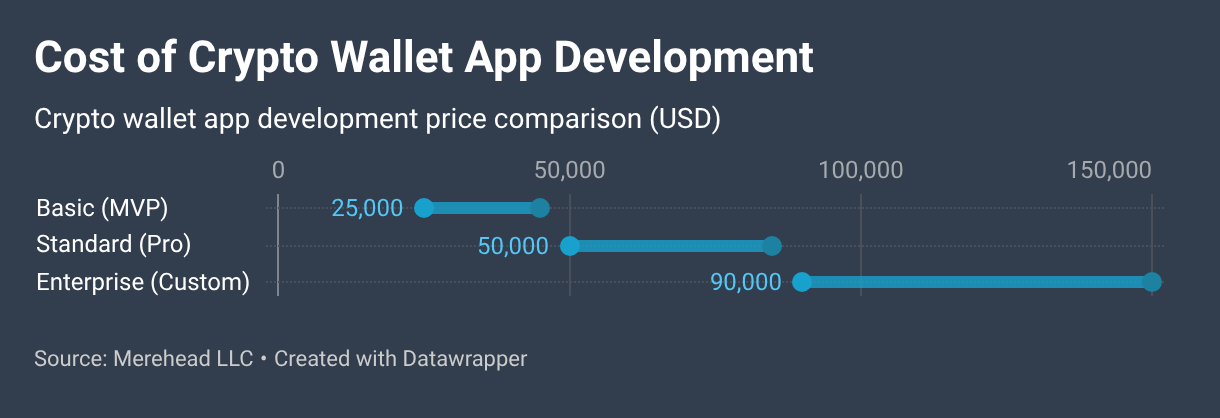
The development cost for a custom crypto wallet typically ranges from $45,000 for a white-label or MVP solution to $150,000+ for a feature-rich enterprise platform. In the US market, price volatility is driven by the choice of custody model, the number of integrated blockchains, and the complexity of the security infrastructure. For a deeper financial analysis, we recommend reviewing our latest breakdown of how much it costs to develop a crypto wallet app, which accounts for current labor rates and evolving security standards.
Cost Estimates
Basic (MVP): $25,000 - $45,000
Standard (Pro): $50,000 - $85,000
Enterprise (Custom): $90,000 - $150,000
Developing a secure backend and a cross-platform mobile app (Flutter/React Native) for a basic wallet takes approximately 3 to 5 months. However, adding advanced features such as in-app swaps via DEX aggregators, fiat-to-crypto on-ramps, and multi-signature support for corporate accounts can increase both the timeline and the budget.

At Merehead, we emphasize a cost-efficiency strategy by utilizing pre-tested security modules and proprietary middleware. This approach allows us to reduce development hours by up to 30%, focusing your budget on high-impact areas like smart contract audits and penetration testing, ensuring a robust launch within a predictable financial framework.

Ready to launch a secure digital asset gateway? Contact our blockchain architects today for a comprehensive cost breakdown and a technical roadmap tailored to your project’s specific security and compliance needs.
Contact Expert  

Who Should Launch Crypto Wallet App

Fintech Apps Adding Crypto Wallet Features
Web3 Startups Launching Wallet Products
Exchanges and Brokerages Needing Wallet Apps
Enterprises Building Secure Custody Solutions

  Reason

Why Choose Merehead as Your Crypto Wallet App Development Company

Merehead brings 10 years of technical excellence in FinTech and blockchain engineering to the table. We don't just build apps; we architect secure financial environments. Our team has a proven track record of delivering wallets that handle $10M+ in transaction volume, focusing on low-latency synchronization and institutional-grade key management.
0+ years on the market
0+ completed projects
We distinguish ourselves through a 'Security-First' engineering culture. Every wallet we develop undergoes rigorous internal testing and is designed to pass external audits by top-tier security firms. Our expertise spans across Bitcoin, Ethereum, Solana, and EVM-compatible chains, ensuring your product is ready for a multi-chain future from day one..

Beyond the code, we provide strategic consulting on market positioning and regulatory readiness. Partnering with Merehead means gaining access to a team that understands the nuances of gas optimization, MEMP-pool monitoring, and MEV protection, ensuring your users enjoy a superior, cost-effective, and safe trading experience.
Write to an expert  
Security-First Engineering
We treat key management, signing UX, and recovery flows as the core of the product. Security controls are embedded in architecture and operational workflows.
Real Web3 Delivery Experience
We build Web3 platforms that handle real transactions, real users, and real operational constraints. This experience helps avoid common wallet pitfalls and edge-case failures.
Production-Ready Architecture & Ops
We design modular architecture, monitoring, and operational tooling from day one. This improves reliability and reduces downtime risk after launch.
Transparent Milestones and Ownership
We deliver in milestones with demos, shared backlog visibility, and clear acceptance criteria. You get predictable progress and documented ownership across the build.

Our team has successfully deployed over 15 crypto wallets with integration of our own blockchain nodes. Our main specialization is the development of custodial applications with integration of deposit, withdrawal and swap functions. Our crypto experts have over 10 years of experience in the crypto trading industry.

  FAQ

Have questions in mind?

Answers to the most frequently asked questions from our clients

Non-custodial wallets keep keys with the user and sign transactions locally, while custodial wallets manage keys on the platform side. Custody choice affects security responsibilities, compliance scope, and user experience.

An MVP wallet typically takes 8–14 weeks depending on chains and core features. More complex custodial or multi-chain builds take longer due to security hardening and integrations.

Cost depends on custody model, chain count, and integrations such as swaps and on/off-ramps. We estimate by complexity (MVP, multi-chain, custodial/MPC) to keep budgets predictable.

Yes, we can build wallets with similar core flows and UX patterns tailored to your product strategy. We also customize security controls, supported assets, and integrations based on your requirements.

Yes, we build multi-chain wallets and integrate swap providers when required. We implement slippage protection and robust transaction state handling for reliability.

We implement secure key management, safe signing UX, threat modeling, and security testing across critical flows. Monitoring and operational tooling help detect issues and respond quickly post-launch.
Talk to an expert
We are ready to answer all your questions
Top expert
10 years of experience

  Security

Security, Privacy & Compliance

Secure Key Storage & Recovery Design
We design secure key storage and recovery flows aligned with your custody model. Recovery UX focuses on preventing user mistakes without compromising security.
Authentication, Biometrics & Session Controls
We implement biometrics, session controls, and secure re-auth flows for sensitive actions. This reduces the risk of unauthorized transfers and account abuse.
Transaction Risk Checks & Anti-Fraud
We implement risk checks such as address screening patterns, velocity limits, and suspicious behavior triggers where applicable. Anti-fraud controls help reduce scams and unauthorized withdrawals.
Security is the cornerstone of any digital asset solution. We implement a multi-layered security stack, including AES-256 encryption, two-factor authentication (2FA), and biometric protection (FaceID/TouchID), following the standards used in a professional crypto banking ecosystem to ensure asset safety. To ensure US market compliance, our wallets are designed to support KYC/AML integrations (e.g., Sumsub, Onfido) and adhere to the FATF Travel Rule. We also prioritize privacy by implementing zero-knowledge proofs where applicable and ensuring that all sensitive data is handled within hardware-isolated environments.

  Integrations

Integrations We Support

WalletConnect / dApp Browser
We integrate WalletConnect and dApp connection flows for smooth Web3 access. UX includes clear permissions and safe signing confirmations.
Node Providers & Indexing Services
We connect RPC providers and indexers for balance discovery, history, and transaction tracking. Integrations include failover and monitoring for reliability.
On/Off-Ramp & Payment Providers
We integrate on/off-ramps to support fiat purchase and cash-out flows. Status handling, reconciliation, and support tooling are included for operational stability.
Why is this important?
We empower your wallet with a rich ecosystem of third-party integrations to enhance utility and liquidity. Our team has extensive experience connecting wallets to liquidity providers (like MoonPay, Banxa, or Simplex) for fiat on-ramps and DEX aggregators (1inch, Uniswap) for in-app swaps.

We also provide a seamless connection with popular NFT marketplaces via WalletConnect, ensuring users can safely manage and trade their digital collections. Additionally, we support integrations with Price Oracles (Chainlink) and Portfolio Analytics tools, providing your users with a comprehensive financial dashboard.

  Experience

Custody Models We Implement

Choosing the right custody model is vital for your business strategy and user trust. We implement Non-Custodial (Self-Custody) models for users who want full control over their funds, utilizing mnemonic phrases or iCloud/Google Drive encrypted backups.

For institutional clients, we offer Custodial solutions with multi-signature (Multi-Sig) logic and MPC (Multi-Party Computation), which eliminates a single point of failure by splitting the private key into several 'shards' distributed across secure servers. MPC-based custody models often used in institutional-grade exchanges provide the perfect balance between high-speed transaction signing and top-tier asset protection.
Write to an expert  
Non-Custodial (User-Owned Keys)
Users fully control keys and sign transactions on-device. This model maximizes self-custody but requires strong recovery UX and user education.
Custodial (Platform-Managed Keys)
The platform manages keys and executes transactions under policy controls. This model supports recovery and centralized operations but requires stronger security and compliance posture.
Hybrid Custody (Flexible Control)
Hybrid custody combines self-custody UX with platform controls for selected operations. This model works well when you want flexibility across user segments and risk levels.
Do you have a project idea?
Send
Yuri Musienko
Business Development Manager
Yuri Musienko specializes in the development and optimization of crypto exchanges, binary options platforms, P2P solutions, crypto payment gateways, and asset tokenization systems. Since 2018, he has been consulting companies on strategic planning, entering international markets, and scaling technology businesses. More details